
Table of Contents
European Solar Panel Prices See 20% Increase
Solar panel prices in Europe have risen for the first time in months, with reports indicating an increase of over 20%. According to Bart Wansink, CEO of Search4Solar, a European platform for buying and selling solar products, prices could continue to rise in the coming weeks.
Search4Solar received price updates from 10 unnamed manufacturers this week, showing a noticeable increase. Prices for tunnel oxide passivated contact (TOPCon) modules used in residential and commercial projects have risen to around €0.10 ($0.10) per watt, up from €0.07/W in October. All-black solar panels are now priced at €0.12/W.
Wansink noted that PERC solar panels, including 400W models, are still priced around €0.077/W to €0.08/W. While these prices remain lower than newer technologies like TOPCon or HJT panels, PERC panels are becoming less available. Manufacturers are shifting production toward more efficient technologies, which means PERC panels will soon be harder to find, likely leading to higher prices for alternative panels once current stock runs out.
Search4Solar also expects further price hikes after the Chinese New Year. The company explained that manufacturers are no longer willing to produce at a loss, which is pushing prices up. Some suppliers are still offering panels at €0.08/W, but these prices are set to rise by 15% starting February 1.
In a recent interview, OPIS analysts pointed out that the increase in prices started about three weeks ago, driven by reduced polysilicon production from major manufacturers. While panel prices may not rise significantly before the Chinese New Year, oversupply remains a concern.
France Exempts Collective Self-Consumption from Excise Tax Up to 1 MW
Good news for the clients of the 700 active collective self-consumption projects in France. With the adoption of the 2025 finance law, these projects are now exempt from excise duties on electricity.
According to Article 21 of the law, collective self-consumption projects of up to 1 MWc, both residential and commercial, are no longer subject to excise tax. This exemption, which will be retroactively applied from January 1, 2025, is valid until January 1, 2027. It follows a long-standing request from the sector and was introduced as part of an amendment by the Senate, backed by the Syndicat des énergies renouvelables (SER).
For consumers in energy communities, this means the excise tax on each unit of self-consumed electricity has been removed, saving up to €33.7 per MWh. The measure is also beneficial for renewable energy producers, as it makes collective self-consumption projects more attractive and financially viable.
Patrice Gérardin, CEO of SerenySun, a company leading several self-consumption projects in France, expressed his satisfaction with the exemption: “As producers, it allows us to retain long-term customers at a time when regulated electricity prices are falling, while strengthening our business models, particularly with banks. This change enables us to carry out projects that wouldn’t normally be feasible due to lack of profitability.”
Enogrid, a consultancy focused on collective self-consumption, sees the fiscal change as a valuable lever for promoting multi-actor projects in the sector and an exceptional opportunity for the development of small-scale hydropower projects under 1 MW.
Inverted Perovskite Solar Cell with Stabilized C60 Reaches 25.6% Efficiency
An international research team has developed an inverted perovskite solar cell that achieves a record-breaking 25.6% efficiency. This breakthrough is thanks to a stabilized C60 electron transport layer (ETL), enhanced with an n-type polymeric additive.
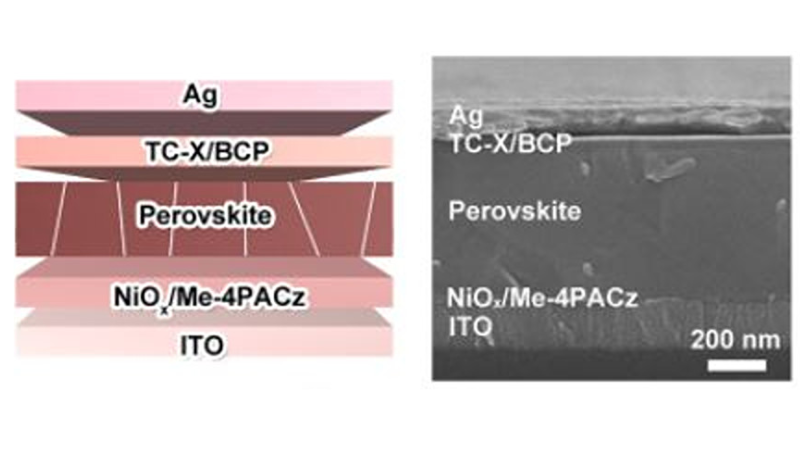
Inverted perovskite cells use a “p-i-n” structure, where the hole-selective contact (p) is at the bottom, and the electron transport layer (n) is on top. This is the opposite of the traditional “n-i-p” design. The cell is illuminated through the hole-transport layer in the p-i-n configuration.
C60 is known for its high performance in perovskite solar cells but has issues with aggregation, which makes it difficult to process. To solve this, the team used an additive called TPDI-BTI to stabilize the C60, allowing it to be processed using a simpler and cheaper solution-based method.
By adjusting the TPDI-BTI additive, the researchers improved the C60 ETL’s film formation, stability, and electron transport, leading to better solar cell performance and long-term reliability.
The optimized solar cell, built with materials like indium tin oxide (ITO) and nickel(II) oxide (NiOx), achieved a 25.6% efficiency, the highest for inverted perovskite cells with solution-processed C60 ETLs. The cell also showed excellent stability, lasting 1,800 hours under continuous light and 700 hours at high temperatures.
The research, published in Joule, involved scientists from China, Switzerland, Saudi Arabia, and Italy. The team concluded that C60-polymer mixed ETLs could be key to making perovskite solar cells more affordable, efficient, and stable.
Global LCOE of Grid-Scale Solar to Drop 2% in 2025
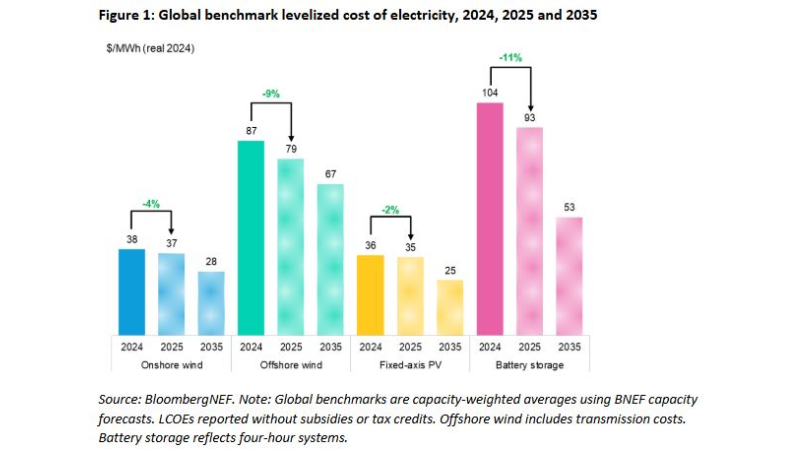
BloombergNEF reports that the levelized cost of energy (LCOE) for grid-scale solar and battery storage is expected to decrease globally in 2025. Fixed-axis solar will drop to $0.035/kWh, while LCOE for battery storage will fall by 11%.
LCOE is a way to compare the cost of different energy technologies, calculating the total cost of building and running a power plant over its lifetime, divided by the energy it produces.
For utility-scale solar, BloombergNEF predicts a 2% decrease in LCOE, from $36 per MWh in 2024 to $35 per MWh in 2025. By 2035, the LCOE could drop to $25 per MWh, a 31% reduction.
Battery storage LCOE is expected to fall by 11%, from $104 per MWh in 2024 to $93 per MWh in 2025, with further reductions expected by 2035.
The cost of fixed-axis solar farms dropped 21% globally in 2024. Despite overcapacity in the solar supply chain, the trend is likely to continue.
New solar plants are now competitive with new U.S. gas plants, making solar more attractive, especially with potential changes in the U.S. natural gas market.
While trade barriers may slow cost declines, BloombergNEF predicts LCOE will fall by 22% to 49% by 2035. According to Matthias Kimmel, head of energy economics at BloombergNEF, the push for cheaper green energy technology is unstoppable.
EU Takes Legal Action Against Eight Member States Over Renewable Energy Permitting Laws
The European Commission has stepped up legal proceedings against eight EU member states for failing to implement new rules aimed at speeding up renewable energy project approvals.
This action relates to Directive (EU) 2023/2413, which simplifies the permitting process and recognizes renewable energy projects, storage, and related infrastructure as of major public interest. Member states were required to adopt these rules by July 1, 2024. In September 2024, the Commission sent formal notices to 26 countries for non-compliance.
Now, the Commission has issued reasoned opinions to Cyprus, Italy, Slovakia, Spain, and Sweden for not submitting their transposition measures, and to Bulgaria, France, and the Netherlands for providing insufficient or unclear details on how their measures meet the directive’s requirements.
In a separate action, the Commission is pursuing legal action against Hungary and Poland for not fully transposing the EU’s internal electricity market rules, as outlined in Directive (EU) 2019/944, with a deadline of December 31, 2020.
Additionally, Belgium, Estonia, Latvia, and Romania have received reasoned opinions for failing to properly implement the 2018 Renewable Energy Directive.
Member states have two months to respond and make the necessary changes. If they do not, the Commission may refer the cases to the Court of Justice of the European Union.
Since 2008, Maysun Solar has been dedicated to producing high-quality photovoltaic modules. Our range of solar panels, including IBC, HJT and TOPCon panels, and balcony solar stations, are manufactured using advanced technology and offer excellent performance and guaranteed quality. Maysun Solar has successfully established offices and warehouses in many countries and built long-term partnerships with top installers! For the latest quotes on solar panels or any photovoltaic-related inquiries, please contact us. We are committed to serving you, and our products provide reliable assurance.
Reference:
Bellini, E. (2025, January 29). European PV module purchasing platform reports 20% increase in panel prices. Pv Magazine International. https://www.pv-magazine.com/2025/01/29/european-solar-module-purchase-platform-reports-20-increase-in-panel-prices/
Puthod, F. (2025, February 11). L’autoconsommation collective exonérée d’accise jusqu’à 1 MW. Pv Magazine France. https://www.pv-magazine.fr/2025/02/11/lautoconsommation-collective-exoneree-daccise-jusqua-1-mw/
Bellini, E. (2025, February 11). Inverted perovskite solar cell based on stabilized C60 achieves 25.6% efficiency. Pv Magazine International. https://www.pv-magazine.com/2025/02/11/inverted-perovskite-solar-cell-based-on-stabilized-c60-achieves-25-6-efficiency/
Kennedy, R. (2025, February 7). LCOE of grid-scale solar expected to drop 2% globally in 2025. Pv Magazine International. https://www.pv-magazine.com/2025/02/07/lcoe-of-grid-scale-solar-expected-to-drop-2-globally-in-2025/
Jowett, P. (2025, February 13). EU escalates infringement procedures over energy permit laws. Pv Magazine International. https://www.pv-magazine.com/2025/02/13/eu-escalates-infringement-procedures-over-energy-permit-laws/

When does HJT bifacial gain pay off on European rooftops, and when is IBC the better option?
When do HJT bifacial solar panels generate stronger returns on European rooftop projects, and when should IBC solar panels take priority?

Which homes are suitable for garden solar?
Which homes are suitable for garden solar? Assess space, shading, orientation and electricity-use goals to quickly judge whether garden solar is a suitable option.

Are Differences Between Solar Panels More Noticeable in High-Temperature Conditions?
High temperatures reduce solar panel efficiency, but the gap in summer power generation is not determined by temperature alone. This article compares the high-temperature performance of HJT, TOPCon and IBC, and explains how businesses should choose.

Why Have N-Type TOPCon Solar Panels Become the Market Mainstream?
N-type TOPCon solar panels have become one of the mainstream photovoltaic technologies thanks to their strong balance of efficiency, cost and mass-production maturity. This article briefly explains their structural features, practical advantages and typical application scenarios.

April News from the European Solar Industry
The European solar market is showing clear signs of recovery: system value is being reaffirmed, German auction prices are stabilising, Italy’s rules are becoming clearer, and revenue certainty in France is improving.

When Are More Expensive N-Type Solar Panels Worth Choosing?
Whether N-type solar panels are worth the extra cost depends on whether project duration, temperature load and roof conditions can turn that added cost into real returns.