Solar power is widely regarded as a low-carbon energy source. However, generating electricity from solar energy and manufacturing a low-carbon solar module are not quite the same thing.
Before a photovoltaic module leaves the factory, it passes through multiple manufacturing stages, including silicon processing, wafer production, cell manufacturing, glass and encapsulation production, and final module assembly. Differences in regional energy mixes, manufacturing processes and raw-material supply chains can therefore lead to significant variations in the manufacturing carbon footprint of solar modules.
In the past, this type of information appeared mainly in corporate sustainability reports.
Today, it is increasingly becoming part of actual PV product assessment and project procurement.
Why is Europe paying more attention to the manufacturing carbon footprint of solar modules?
As Europe continues to expand solar capacity, increasing attention is also being paid to how photovoltaic products themselves are manufactured.
The European Commission’s Joint Research Centre notes that although solar PV is a low-carbon technology, module manufacturing can still be energy-intensive. Electricity used in silicon production, silicon content, aluminium frames and glass are among the main contributors to the carbon footprint of crystalline-silicon PV modules.
As a result, the environmental assessment of solar products is gradually expanding beyond clean electricity generation during operation to include the manufacturing stage itself.
In 2025, the JRC published harmonised rules for calculating the carbon footprint of photovoltaic modules, with the aim of supporting the potential development of future Ecodesign requirements. The methodology is based on the EU Environmental Footprint method and the Product Environmental Footprint Category Rules (PEFCR) for photovoltaic products.
Europe currently has no single carbon-footprint threshold that applies to every commercial and industrial PV project. However, the direction of policy development is becoming increasingly clear:
The environmental performance of solar modules is gradually becoming a measurable product attribute.
What is the difference between Carbon Footprint and LCA?
In European solar projects, requirements for Carbon Footprint, LCA and EPD documentation are increasingly common, but these documents are not interchangeable.
Carbon Footprint focuses primarily on greenhouse gas emissions, usually expressed in CO₂ equivalent.
LCA (Life Cycle Assessment) has a broader scope. In addition to climate-change impacts, it can assess other environmental impacts across different stages of a product’s life cycle.
EPD (Environmental Product Declaration) generally presents life-cycle environmental data in a standardised format according to an established methodology.
Therefore, if a project specification explicitly requires an LCA, providing only a carbon-footprint value may not be sufficient. Likewise, when a project requires a carbon assessment based on a specific national methodology, a standard EPD may not necessarily be accepted as a substitute.
For an EPC, the first question when reviewing environmental documentation should not be:
“Does the supplier have an environmental certificate?”
It should be:
“Does this document meet the actual requirements of this project?”
France has already brought carbon footprint into real project requirements
France provides a useful example of how carbon-footprint data can move from sustainability reporting into actual PV project requirements.
In certain French photovoltaic support schemes and PPE2 tenders, the ECS — Évaluation Carbone Simplifiée, or Simplified Carbon Assessment — is used to assess the carbon footprint of solar modules.
CERTISOLIS states that ECS assessments are used for tenders organised by the French Energy Regulatory Commission (CRE) and within the relevant French regulatory framework.
This type of assessment is not simply a “low-carbon” label applied at brand level. It is linked to the actual module and its manufacturing supply chain.
This creates a direct connection between environmental performance, module procurement and project documentation.
If the product changes, the corresponding environmental data may also need to be verified again.
For other European markets, France’s PPE2 framework is not a single set of rules that can simply be applied across Europe. However, it provides a clear example of how carbon footprint can evolve from an ESG concept into a procurement metric that can be verified through project documentation.
For EPCs, the risk often comes from a mismatch between the product and its documentation
In conventional module procurement, many of the core technical requirements can be confirmed once the IEC certificates and datasheet match the selected product model.
Environmental documentation can be more complex.
A module’s carbon footprint may depend on raw-material sourcing, manufacturing sites, electricity mix and the specific bill of materials. Environmental data therefore often needs to correspond closely to the actual product being supplied.
Problems can arise when a project reaches the later stages of procurement and the EPC discovers that:
the selected module model is not covered by the relevant documentation;
the project requires an LCA, but the supplier has provided a different national carbon assessment;
or the actual manufacturing route no longer matches the environmental documentation originally reviewed.
In such cases, the project team may need to recheck the product or even revise the procurement plan.
For commercial and industrial PV projects of several hundred kilowatts or several megawatts, a change of module can also affect array layout, string design, system cost and delivery schedules.
For this reason, Carbon Footprint, LCA and EPD documentation is best reviewed during final module selection rather than treated as paperwork to be completed immediately before delivery.
For EPCs working on commercial and industrial installations, Maysun Solar’s Corporate Solar solutions provide additional information on module selection and project applications.
The real value of a low-carbon module lies in verifiability
Corporate customers are paying increasing attention to Scope 3 emissions, supply-chain decarbonisation and ESG targets.
In this context, simply describing a product as a “low-carbon module” provides limited value.
What matters more is whether the project team can determine:
which assessment methodology was used;
which product the data applies to;
which manufacturing stages are included in the calculation;
what the actual result is;
and whether the data can be supported by appropriate documentation.
This is likely to become increasingly relevant in European C&I solar procurement.
Solar modules must still meet the fundamental requirements of efficiency, reliability and long-term energy performance. But alongside these traditional criteria, transparent manufacturing carbon-footprint data is becoming another product attribute that project owners can compare and verify.
For more information on N-type TOPCon technology and its use in commercial and industrial applications, see Maysun Solar’s TOPCon module overview.
Start with project requirements and verify environmental data early
For EPCs and project developers, carbon-footprint documentation is best included in the technical review during module selection, alongside datasheets, IEC certificates, warranties and other project documentation, rather than being added only during procurement or delivery.
Confirming the module model, power range and corresponding environmental data at an early stage can reduce the risk of having to change products, revise the BOM or provide additional documentation later in the project.
This becomes particularly important for large commercial and industrial installations, where a change in module model may also affect array layout, string design, system configuration and overall project cost.
Some Maysun Solar N-TOPCon glass-glass modules have been assessed according to the French PPE2_V2 ECS methodology, covering product ranges from 485–510 W and 600–625 W.
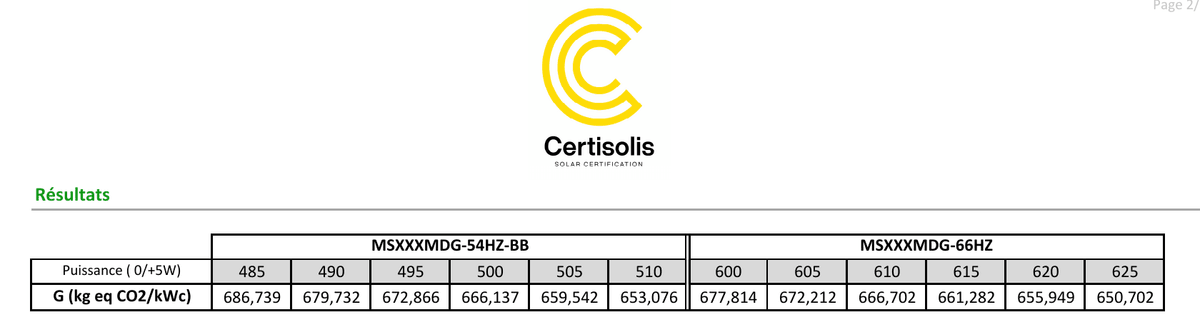
As European companies place greater emphasis on supply-chain decarbonisation, life-cycle environmental performance and green procurement, environmental data is gradually becoming another consideration alongside conventional technical parameters when selecting PV modules.
For EPCs, bringing these requirements into the design and procurement process at an early stage can help make project execution smoother and reduce the need for adjustments later on.
Sources and References
Carbon Footprint – Photovoltaic Panels | European Commission, Knowledge4Policy
https://knowledge4policy.ec.europa.eu/projects-activities/carbon-footprint-photovoltaic-panels_en
Harmonised Rules for the Calculation of the Carbon Footprint of Photovoltaic Modules in the Context of the EU Ecodesign Directive | European Commission Joint Research Centre
https://publications.jrc.ec.europa.eu/repository/handle/JRC141275
CERTISOLIS Carbon Footprint – Simplified Carbon Assessment (ECS)
https://www.certisolis.com/certisolis/bilan-carbone/