

TOPCon or HJT? Key Considerations for Solar Panel Selection in PV Projects

TOPCon or HJT? Key Considerations for Solar Panel Selection in PV Projects

The solar industry is accelerating its transition to N-type cell technology. For EPCs and project buyers, TOPCon remains the dominant choice in most projects due to its more mature industry scale and supply system, while HJT is more attractive in specific scenarios, such as high-temperature environments, limited space, or high bifacial gains.

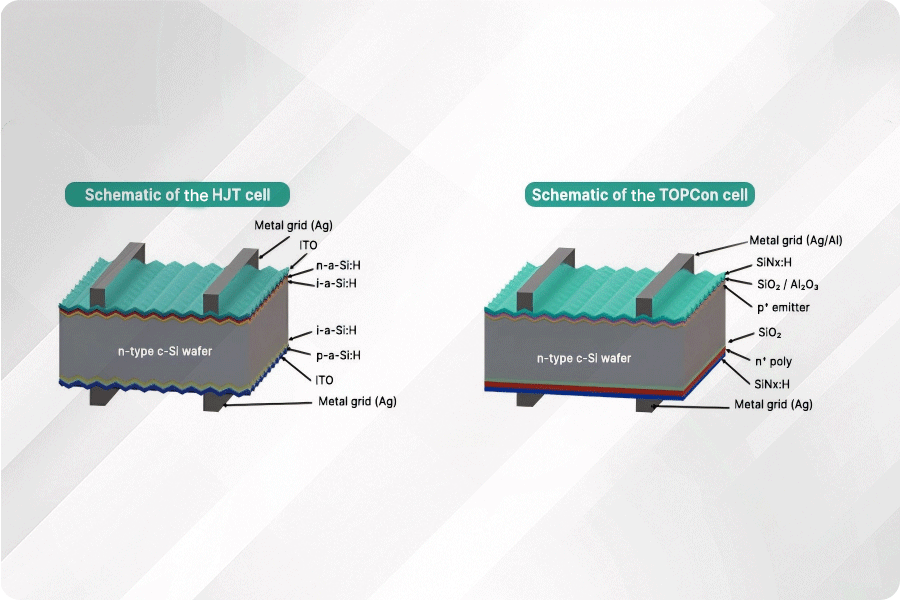
For further details on the structural differences between these two technologies, please refer to the article N-Type Solar Cell Technology: The Differences Between TOPCon and HJT.

Table of Contents

Why the Choice Between TOPCon and HJT is Starting to Influence Project Decisions

N-type cells are becoming the new mainstream technology in the solar industry, with TOPCon and HJT being the two most representative technological paths. According to industry forecasts from InfoLink and TaiyangNews, by 2025, N-type cells are expected to account for over 70% of global new battery production capacity. Among these, TOPCon will still be the dominant technology for new capacity, while HJT production capacity continues to expand.

Core Differences Between TOPCon and HJT: Efficiency is Not the Only Factor

Under current mass production conditions, the efficiency gap between TOPCon and HJT is typically less than 1%, with the technical differences being more evident in temperature performance and industry maturity.

Key Performance Comparison Between TOPCon and HJT Solar Panels

Indicator TOPCon HJT
Mass Production Efficiency 21.5–23.3 % 21.7–23.4 %
Temperature Coefficient −0.29 to −0.32 %/°C Approx. −0.243 %/°C
Temperature Performance Good Better
Industry Maturity High Moderate
Cost Structure Relatively Stable Higher
Typical Applications Ground-mounted plants, Commercial & Industrial rooftops High-temperature environments, Space-constrained projects

Note: The data in the table is based on publicly available industry information and mass production product parameters from leading manufacturers. Specific performance may vary depending on different manufacturers and module types.

In actual projects, the choice of technology mainly depends on three factors:

  • Component supply capacity

  • Operating environment

  • Power generation per unit area

In most standardized projects, supply stability and cost structure are typically prioritized. TOPCon usually becomes the default choice; when projects are more focused on temperature performance or power generation per unit area, HJT solar panels are more likely to enter the technical evaluation.

When is TOPCon the More Practical Choice?

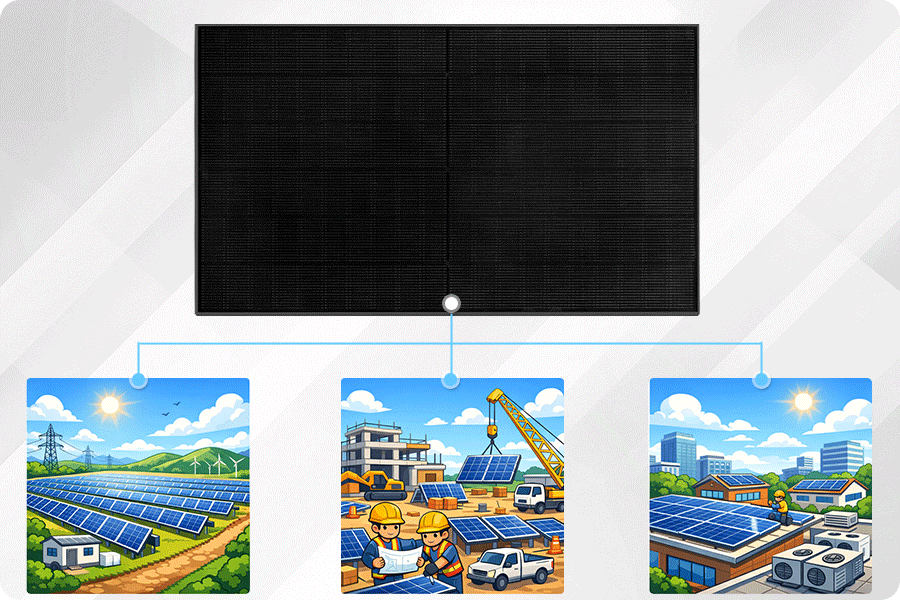
In most current solar projects, TOPCon is typically the default technology choice. This is primarily due to the advantages in supply capacity driven by industry scale, market application, and manufacturing pathways.

Large-Scale Ground-Mounted Solar Projects

Ground-mounted solar projects are highly sensitive to component supply capacity. Research by IEA and Fraunhofer ISE shows that solar panels typically account for 30-40% of the total investment in a solar plant, making them the most significant equipment cost in the system.

When project scales reach tens of megawatts or even hundreds of megawatts, the volume of panel procurement becomes massive, and supply capacity becomes a key constraint.

InfoLink and TaiyangNews predict that by 2025:

  • TOPCon capacity will be around 800–900GW;

  • HJT capacity will be around 70–100GW.

In ground-mounted solar projects, the technology with larger supply capacity tends to be more likely to receive priority adoption.

Standardized EPC Projects

According to InfoLink, in 2024, TOPCon’s market share of global new solar panels will exceed 60%. A large number of installations have helped drive the standardization of system design, construction processes, and supply chains.

A larger market application scale has allowed TOPCon to form a more mature installation and supply system in EPC projects.

Commercial & Industrial Rooftop Projects

Rooftop projects are generally smaller in scale, but the return on investment requirements are clearer, and component supply capacity and manufacturing maturity remain important considerations.

TOPCon can be produced by upgrading the PERC production line. According to statistics from TaiyangNews and CPIA, about 70–80% of TOPCon capacity comes from PERC line upgrades, which also helps maintain higher availability in the market.

When Does HJT Have the Advantage?

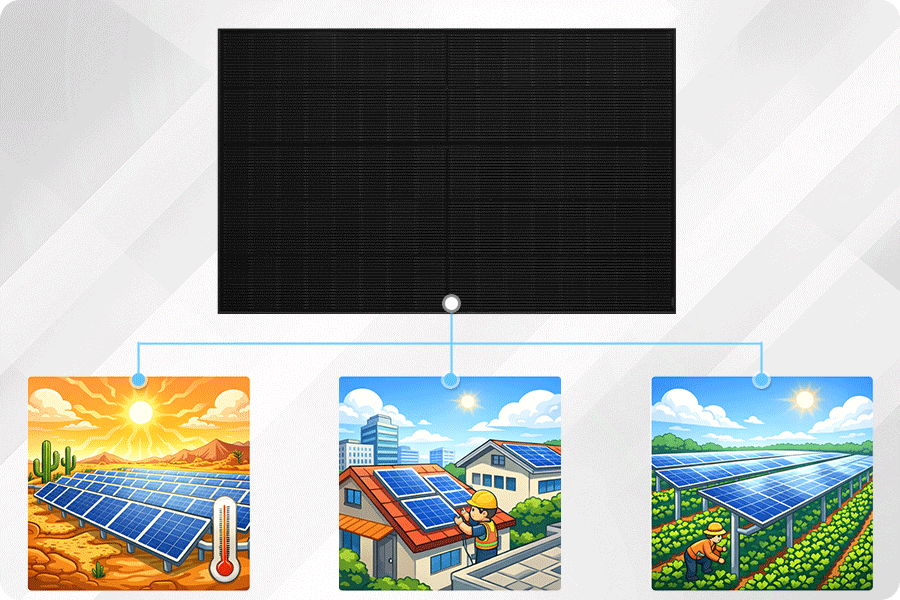
Under certain project conditions, HJT solar panels still have advantages, particularly in terms of temperature performance, power generation per unit area, and bifacial power generation potential.

High-Temperature Operating Environments

The temperature coefficient of HJT panels is typically around −0.243 %/°C, slightly lower than TOPCon.

In high-temperature regions or rooftop projects with poor ventilation, the operating temperature of the panels tends to be higher over time. Research from Fraunhofer ISE shows that for every 10°C increase in panel temperature, the power generation efficiency drops by about 3%.

In high-temperature environments, HJT panels are generally more attractive.

Space-Constrained Rooftop Projects

When rooftop space is limited, the power generation per unit area impacts the system’s installed capacity and project returns.

Some HJT panels have mass production efficiencies approaching or exceeding 23%. In space-constrained environments, even small efficiency differences can affect system capacity.

In space-limited rooftop projects, HJT panels are often considered in the technology evaluation.

Projects with High Bifacial Power Generation Potential

Some solar projects rely on bifacial power generation, such as those with highly reflective ground surfaces, snowy environments, or agri-voltaic systems.

HJT panels can typically achieve a bifaciality rate of 90–95%. In environments with good reflective conditions, the back-side power contribution can be around 10–30%.

In projects with high bifacial power generation potential, HJT panels often have the advantage.

How to Choose Between TOPCon and HJT

In the current solar market, TOPCon remains the most mature and largest N-type technology route, and it is the default choice for most standardized projects.

However, when project conditions focus more on the following factors, HJT panels may be more attractive:

  • High-temperature operating environments

  • Space-constrained rooftop projects

  • High bifacial power generation potential

There is no absolute superiority between TOPCon and HJT; the choice depends more on project conditions and system design objectives.

TOPCon VS HJT Frequently Asked Questions

1. Which is more suitable for European projects, TOPCon or HJT solar panels?

In the current European solar market, most standardized projects still prioritize TOPCon solar panels. TOPCon has a larger industry scale and a more mature supply system, making it easier to secure stable supply for ground-mounted plants and commercial & industrial rooftop projects.

2. What are the main differences between TOPCon and HJT solar panels?

Both TOPCon and HJT are N-type solar panel technologies. The efficiency difference between them is usually less than 1%, with the main differences being in temperature coefficient, industry maturity, and cost structure.

3. In which situations do HJT solar panels have the advantage?

HJT solar panels are generally more advantageous in high-temperature environments, space-constrained rooftop projects, or projects with high bifacial power generation potential. Their lower temperature coefficient and higher bifaciality can provide more stable power generation performance.

4. What factors should be considered when choosing between TOPCon and HJT for a solar project?

The technology choice typically depends on component supply capacity, operating environment, and power generation per unit area. Different projects will prioritize cost, temperature performance, or efficiency, which will influence the selection of the solar panel technology.

As a solar panel manufacturerMaysun Solar has been providing a stable supply of panels for the European wholesale and distribution market, covering mainstream N-type battery technologies such as IBC technologyTOPCon technology, and HJT technology. We assist EPCs and project buyers in achieving higher power output per unit area and system efficiency, ensuring compatibility with project conditions.

Recommend reading

March European Solar Industry News

March European Solar Industry News

This article outlines recent developments in the European solar market, including the EU cross-border solar auction scheme, structural shifts in Germany, updated GSE regulation in Italy, and the recent recovery in solar panel prices.

Read More »

Comments

No comments yet. Why don’t you start the discussion?

Leave a Reply

Your email address will not be published. Required fields are marked *