

At the start of 2026, the European solar market experienced changes. Solar panel prices rebounded, electricity price volatility widened, and the procurement pace moved forward, leading to adjustments in project and procurement decisions.
Table of Contents
Solar Panel Prices Return to €0.1/Wp Range
In early 2026, European solar panel prices showed signs of recovery. According to the pv.index report, as of February, prices for mainstream high-efficiency panels such as TOPCon, all-black, and back-contact models surpassed €0.1/Wp, with single-sided TOPCon at approximately €0.109/Wp, the first time since spring 2025. From January to February, prices for mainstream technologies increased by around 7%–10%, following a consistent upward trend.
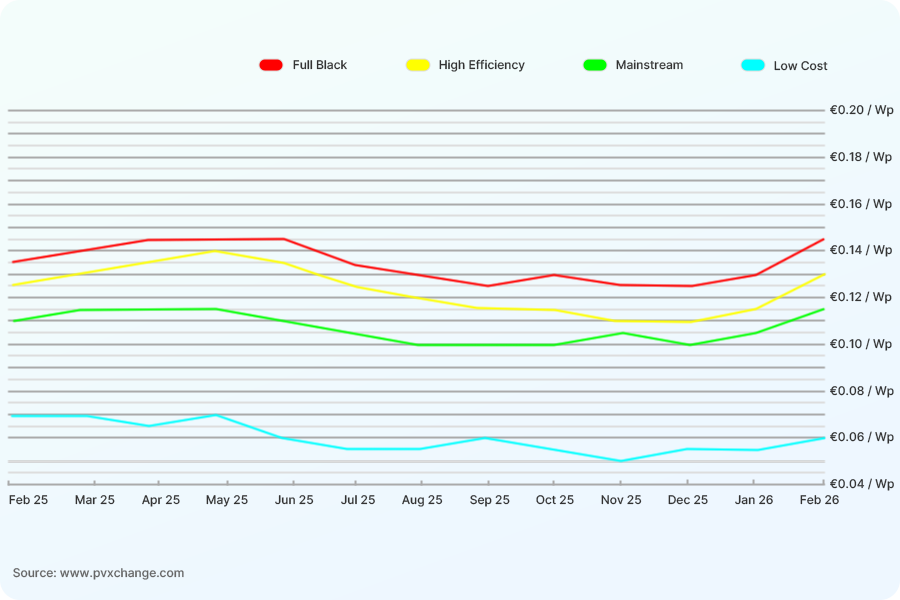
A similar trend is seen in the spot market. Data from pvXchange shows high-efficiency panels at €0.130/Wp, all-black panels at €0.145/Wp, and mainstream products at €0.115/Wp, all rising compared to the previous month. Price changes are concentrated in the mid-to-high-efficiency product range, with the market still focusing on performance and stability.
Overall, current price levels have shown a clear recovery from the mid-2025 lows, and procurement activity is picking up, with prices gradually stabilizing within a more consistent range.
Source: www.pvxchange.com
Electricity Price Volatility Expands
Unlike the return of solar panel prices to a relatively stable range, the European electricity market in early 2026 displayed more pronounced volatility.
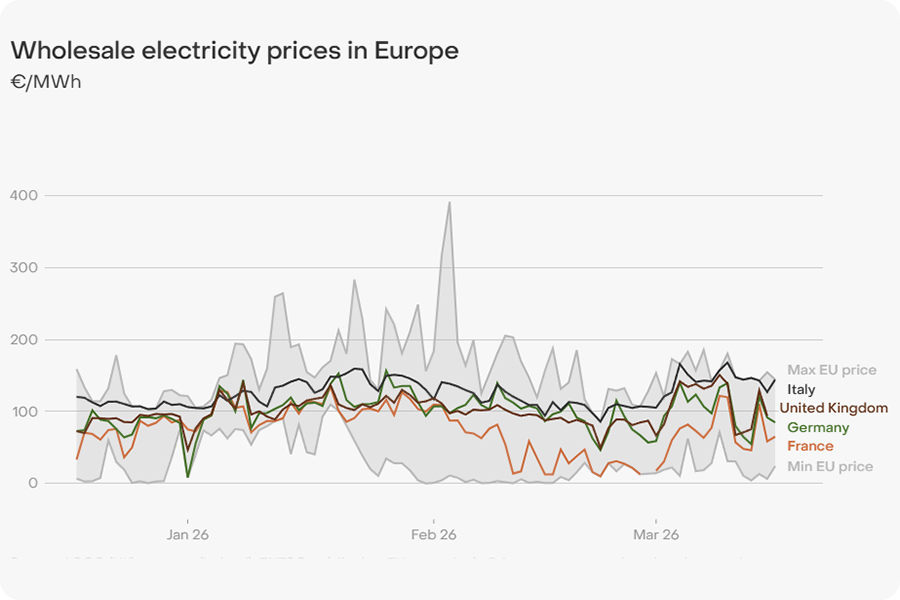
According to wholesale electricity price data from Ember, major markets such as Germany, France, Italy, and the UK have seen frequent fluctuations in recent months. Daily price differences were significant, with some periods maintaining prices above €100–€150/MWh, while during higher renewable energy output periods, prices dropped considerably, with some markets operating near lower price ranges. The price changes did not follow a single direction but rather reflected a widening range.
An increased share of renewable energy has made electricity prices more sensitive to weather conditions, while natural gas prices and geopolitical factors still influence marginal electricity pricing. The mismatch between energy storage and grid regulation capabilities with output rhythms has amplified the price differences between different periods.
Beyond the electricity price levels, the volatility itself is also having a more direct impact on energy usage and procurement decisions.
Source: Adapted from Ember (based on ENTSO-E, LCCC, SEMOpx data)
In addition to price and electricity market factors, policy-driven actions continue to reinforce the demand for distributed solar power. In Germany, for example, several federal states have introduced rooftop solar installation requirements for new or renovated buildings, with clearer enforcement in commercial and public buildings.
Although a nationwide mandatory framework has not yet been established, the policy coverage is gradually expanding, providing a relatively stable demand base for rooftop solar and supporting medium-to-long-term procurement expectations.
Solar Panel Supply Pace Tightens
According to data from sun.store, the European Solar Procurement Managers’ Index (PV PMI) for February 2026 was 69, maintaining a high level in the expansion range for two consecutive months.
This index, based on platform user surveys, primarily reflects procurement expectations and market sentiment. As spring project launches approach, some buyers have started to arrange purchases in advance.
It’s important to note that the index more reflects short-term sentiment and rhythm changes, rather than actual growth in end-user demand. Against the backdrop of electricity price fluctuations, supply chain uncertainties, and policy expectation shifts, the procurement pace has moved forward in phases, contributing to the index’s sustained high levels.
Changes at the trading level are more direct. During the inquiry process, besides price, delivery time and order confirmation conditions have been more frequently discussed. The gap between spot and forward orders has widened, with some procurement decisions accelerating noticeably.
While the market has not experienced a widespread shortage, the difficulty in matching supply and demand has increased due to concentrated demand and product structure differences. During some time windows, the certainty of obtaining specific panel specifications is not as high as before.
Overall, the market is shifting from “on-demand procurement” to “early locking,” with availability gradually becoming a key factor in procurement decisions.
Maysun Solar supplies the European market with solar panels based on key technologies including IBC technology, TOPCon technology, and HJT technology, suitable for a wide range of system applications. We support partners in selecting optimal module power and configurations in line with evolving European price trends, policies and project requirements.
Recommend reading

How Important Is the Temperature Coefficient When Choosing a Solar Panel?
How important is temperature coefficient when choosing a solar panel? This article answers that question directly and explains which projects should include it in early screening and which do not need to treat it as a top priority.

When does HJT bifacial gain pay off on European rooftops, and when is IBC the better option?
When do HJT bifacial solar panels generate stronger returns on European rooftop projects, and when should IBC solar panels take priority?

Which homes are suitable for garden solar?
Which homes are suitable for garden solar? Assess space, shading, orientation and electricity-use goals to quickly judge whether garden solar is a suitable option.

Are Differences Between Solar Panels More Noticeable in High-Temperature Conditions?
High temperatures reduce solar panel efficiency, but the gap in summer power generation is not determined by temperature alone. This article compares the high-temperature performance of HJT, TOPCon and IBC, and explains how businesses should choose.

Why Have N-Type TOPCon Solar Panels Become the Market Mainstream?
N-type TOPCon solar panels have become one of the mainstream photovoltaic technologies thanks to their strong balance of efficiency, cost and mass-production maturity. This article briefly explains their structural features, practical advantages and typical application scenarios.

April News from the European Solar Industry
The European solar market is showing clear signs of recovery: system value is being reaffirmed, German auction prices are stabilising, Italy’s rules are becoming clearer, and revenue certainty in France is improving.