Across Europe, summer heatwaves are no longer just a climate or comfort issue. They are becoming an energy-use issue. During hot summer days, air conditioning, ventilation, refrigeration, office equipment and industrial cooling loads can rise exactly when rooftop solar modules are exposed to higher operating temperatures.
In late June 2026, the World Meteorological Organization reported that a widespread and intense European heatwave had broken numerous temperature records and affected human health, ecosystems, agriculture, infrastructure and labour productivity. World Weather Attribution also described the same period as a heatwave reaching 5–12°C above seasonal averages across parts of Europe.
For PV self-consumption projects, this changes the way solar modules should be evaluated. The key question is no longer only how much electricity a system can generate over a year. It is also how much useful power the system can deliver when buildings actually need electricity most.
This is where HJT solar modules become particularly relevant. With a lower temperature coefficient, high power density, good low-light response and low long-term degradation, HJT technology can be better suited to European residential, commercial and industrial projects where summer daytime loads are increasing, roof space is limited and self-consumption is becoming more important.
Table of Contents
1. Why European heatwaves are changing PV self-consumption
In traditional PV projects, many users first compare module wattage, total system capacity and cost per watt. But as summer heatwaves become more frequent and intense across Europe, self-consumption projects need to focus on a more practical question: can the PV system provide stable, directly usable electricity during hot daytime load periods?
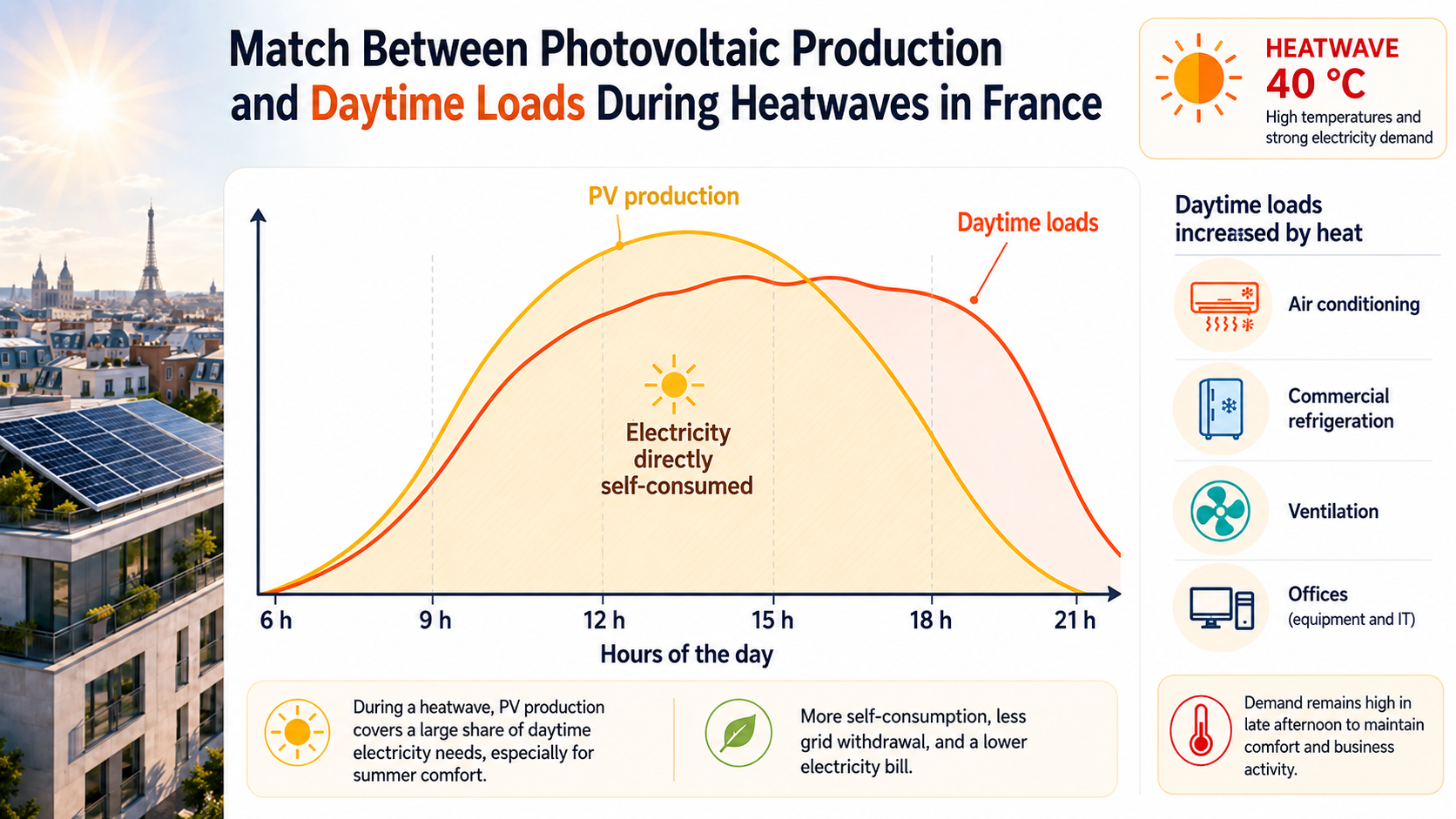
During heatwaves, the electricity profile of homes and commercial buildings can change. In residential projects, air conditioning, heat pumps in cooling mode, home office equipment, domestic hot water systems and EV charging may increase daytime electricity use. In commercial and industrial projects, offices, hotels, supermarkets, cold-chain facilities, food processing sites, warehouses and light industrial buildings often have loads that are already concentrated during daylight hours.
This makes the match between the solar production curve and the building load curve more important. The value of a PV system is not only “how much electricity it produces annually”, but “how much of that electricity can be used on site when the building actually needs it”.
Across Europe, the value of PV is increasingly linked to local consumption rather than simple export. Feed-in tariffs, net billing and surplus compensation rules differ by country, but the general direction is clear: the more electricity a building can consume directly, the more important system design, load matching and module performance become.
European electricity prices also keep self-consumption relevant. Eurostat reported that average household electricity prices in the EU were €28.96 per 100 kWh in the second half of 2025, while average non-household prices for medium-sized consumers were €18.37 per 100 kWh. These values vary by country and tariff, but they show why directly replacing grid electricity remains important for many residential and commercial users.
2. Why high temperatures reduce solar module output
The power rating shown on a solar module datasheet is usually measured under Standard Test Conditions, or STC. These conditions are based on 1000 W/m² irradiance, a cell temperature of 25°C and an AM1.5 spectrum. In real rooftop conditions, however, modules rarely operate at a cell temperature of 25°C for long periods.
Under strong summer sunlight, module temperature can rise well above ambient temperature. This is especially true on dark roofs, poorly ventilated rooftops, low-clearance mounting systems or installations where heat cannot dissipate easily.
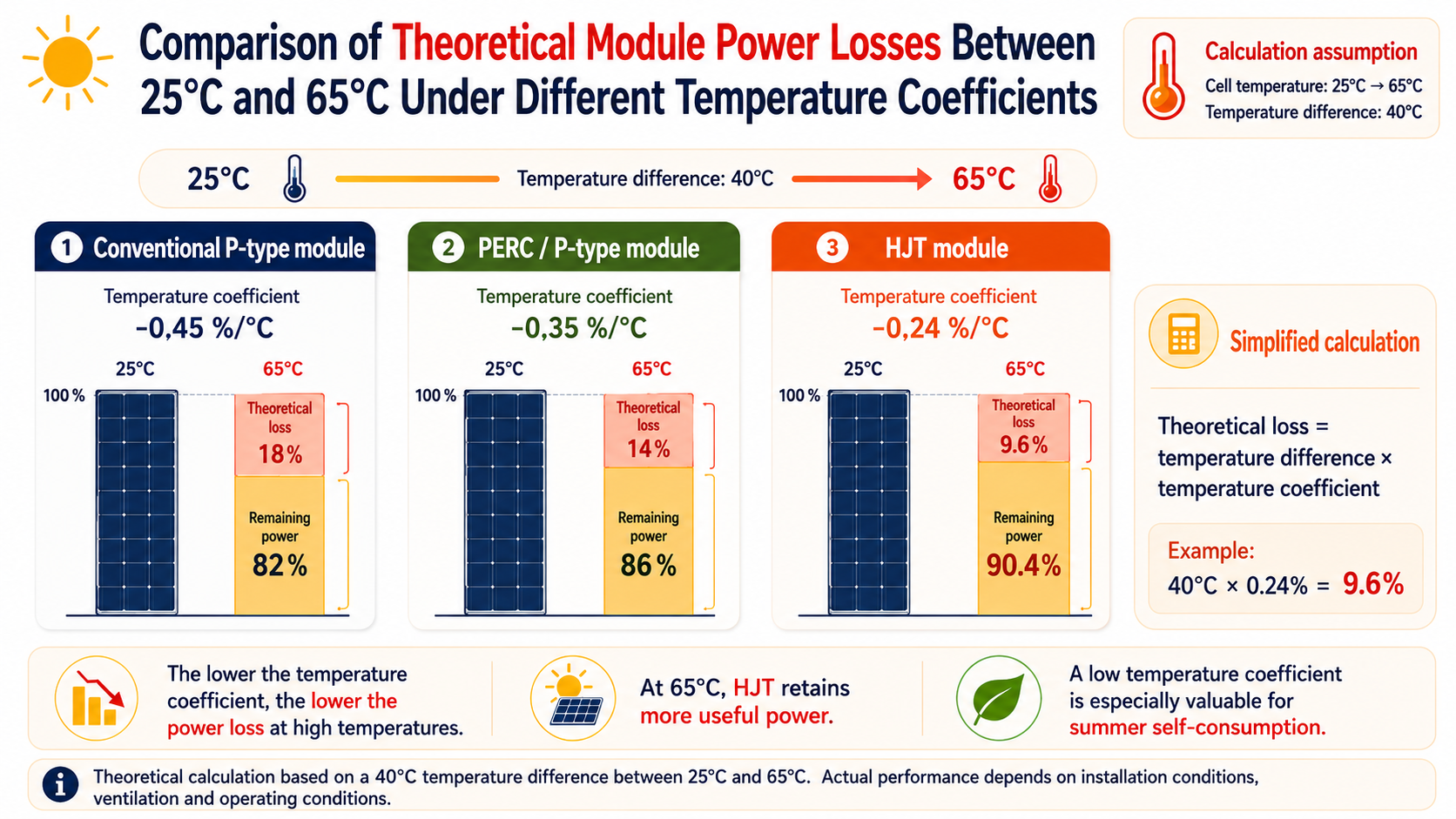
When module temperature increases, output power decreases. The key parameter used to estimate this effect is the power temperature coefficient. The lower the temperature coefficient, the smaller the theoretical power loss at high operating temperatures.
For example, if cell temperature rises from 25°C to 65°C, the temperature difference is 40°C. If a conventional P-type or PERC module is calculated with a temperature coefficient of -0.35%/°C to -0.45%/°C, the theoretical power loss is about 14% to 18%. If an HJT module has a temperature coefficient of -0.24%/°C, the theoretical loss under the same temperature difference is about 9.6%.
This means that, in hot European summer rooftop conditions, HJT modules may retain more useful output. For projects with air conditioning, refrigeration, office loads or industrial daytime consumption, this difference can become practically relevant.
However, the temperature coefficient does not determine system performance by itself. Actual output also depends on roof ventilation, mounting structure, tilt angle, shading, inverter configuration, local irradiance, load profile and storage design. IEA PVPS notes that PV module energy yield assessment requires measurement approaches that consider outdoor operating conditions rather than relying only on STC parameters.
3. Why useful daytime power matters more than nominal power
The core of a PV self-consumption system is not simply annual generation. It is the ability to use more electricity directly on site.
During hot summers, many loads occur in the daytime, including:
- residential air conditioning and heat pumps in cooling mode;
- ventilation and cooling in office and service buildings;
- refrigeration in supermarkets, restaurants and cold-chain facilities;
- hotel, retail and commercial electricity demand;
- equipment operation in industrial buildings;
- daytime EV charging and battery charging.
These loads naturally overlap with PV generation hours. The problem is that midday and afternoon are also the periods when module temperatures can be highest and thermal power losses can become more visible. If a module loses too much power under high temperature, the real system output may be lower than expected exactly when the user needs electricity most.
This is why European self-consumption projects should not compare modules only by STC-rated power. They should also compare useful power under real summer operating conditions.
ENTSO-E’s Summer Outlook 2026 describes a generally favourable adequacy situation for most of the European power system, while still highlighting the growing importance of flexibility solutions such as interconnection, storage, demand-side response and operational coordination. For building-level PV projects, this reinforces the role of self-consumption and load matching as part of a more flexible energy system.
4. Why HJT solar modules are better suited to hot summer conditions
HJT solar modules are not only relevant because of high power ratings. Their value comes from a combination of characteristics: lower high-temperature losses, high power density, good low-light response, bifacial potential and long-term output stability.
4.1 Lower temperature coefficient helps reduce heatwave power losses
HJT technology usually has a lower power temperature coefficient than many conventional P-type module technologies. For European summer projects, this is a key point.
When buildings activate air conditioning, ventilation, refrigeration or production equipment during heatwaves, the PV system needs to provide more usable electricity during the day. At the same time, rooftop module temperature rises. If high-temperature losses are large, the real contribution of the system during load peaks can be reduced.
A lower temperature coefficient helps HJT modules maintain more stable output under hot rooftop conditions. For residential, commercial and industrial self-consumption projects, this means that more PV electricity may be available for direct use during high-demand daytime periods.
4.2 Higher power density is useful when roof space is limited
Many rooftops in Europe have limited usable space. Roof windows, chimneys, skylights, parapets, HVAC units, maintenance corridors, fire-safety access zones and partial shading can all reduce the area available for PV installation.
When usable roof area is limited, module efficiency and power density directly affect how much system capacity can be installed. HJT modules usually offer high conversion efficiency and high power density, helping projects increase installed capacity within constrained roof areas.
This is especially relevant for residential rooftops, hotels, offices, retail buildings and small to medium-sized commercial rooftops. These projects often want to increase self-consumption but do not always have large, unobstructed roof areas.
Fraunhofer ISE’s Photovoltaics Report notes that commercial silicon module efficiency has improved significantly over the past decade, and that n-type TOPCon and heterojunction technologies are replacing p-type PERC technology in the high-efficiency module segment.
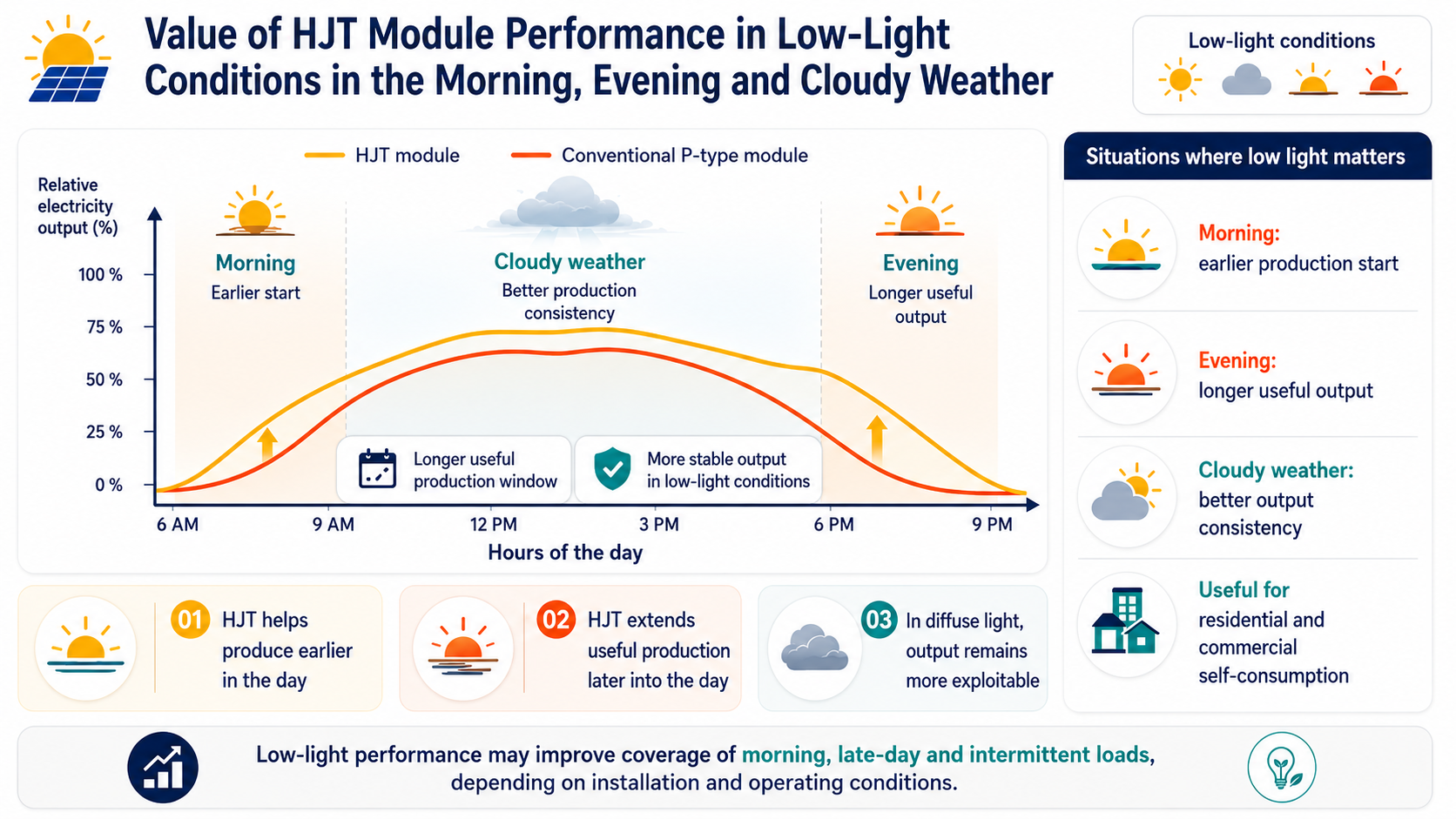
4.3 Better low-light response can extend useful generation hours
European solar conditions vary widely. Southern Europe often has stronger summer irradiance, while Northern, Western and Central Europe may face more cloudy days, low sun angles, morning/evening diffuse light and variable weather.
HJT modules are often valued for their low-light response. This can help the system maintain better output in the morning, evening or under changing cloud conditions. For self-consumption projects, this can extend the useful generation window across the day.
For residential users, this may help cover morning and evening household loads. For commercial users, it may support office, refrigeration or equipment loads during longer parts of the operating day.
4.4 Double-glass bifacial structure can add potential in suitable scenarios
HJT modules often have high bifacial potential. When designed as double-glass bifacial modules, they can use light reflected from the roof or ground if the rear side receives sufficient irradiance.
However, bifacial gain should not be presented as a fixed guaranteed percentage. Light-coloured flat roofs, elevated mounting systems, carports, open structures and high-reflectance surfaces are more favourable for rear-side irradiation. If modules are installed close to a dark roof, or if the rear side is heavily blocked by the mounting structure, bifacial gain will be limited.
IEA PVPS Task 13 reports that bifacial PV performance depends strongly on system design, ground reflectance, mounting height, shading and measurement assumptions. This is why bifacial HJT modules should be evaluated according to the actual project environment rather than a fixed gain claim.
5. HJT vs P-type modules: what should European self-consumption projects compare?
For European self-consumption projects, comparing HJT modules with conventional P-type or PERC modules should not be limited to purchase price per watt. It is more useful to compare the parameters that influence useful energy, high-temperature output and long-term stability.
Comparison criterion | Conventional P-type / PERC modules | HJT modules | Relevance for European self-consumption projects |
High-temperature losses | Temperature coefficient is usually higher, depending on datasheet | Temperature coefficient is usually lower, for example -0.24%/°C | Helps retain more useful output during heatwaves |
Example at 65°C | Theoretical loss of about 14%–18% compared with 25°C | Theoretical loss of about 9.6% compared with 25°C | More stable output during daytime load peaks |
Power per unit area | Depends on model, often lower than high-efficiency n-type modules | Generally high efficiency and high power density | Useful when roof space is limited |
Low-light performance | Depends on technology and module design | Often good response under low-light conditions | Helps cover morning, evening and cloudy-day loads |
Bifacial potential | Often monofacial or with limited rear-side gain | High bifacial potential; double-glass structure suits rear-side irradiation | Suitable for light-coloured roofs, carports and elevated mounting |
Long-term degradation | LID and LeTID should be considered depending on technology | Usually lower long-term degradation | Supports more stable output over 25–30 years |
5.1 Temperature coefficient: the key parameter during heatwaves
The power temperature coefficient directly affects module power loss at high operating temperature. During European heatwaves, rooftop module temperature can be far above the 25°C used under STC. If the temperature coefficient is high, real output reduction becomes more visible.
The lower temperature coefficient of HJT modules makes them more suitable for hot rooftop environments. For projects with air conditioning, refrigeration or daytime industrial loads, this parameter can be more meaningful than simply comparing nominal power.
5.2 Power density: how much useful capacity can fit on a limited roof?
Many European residential and commercial rooftops have limited usable area due to shading, technical equipment, roof access paths and safety distances. In this context, high power-density modules can increase installable capacity per square metre.
For residential and small to medium-sized rooftops, 500W-class high-efficiency HJT modules can be evaluated. For large commercial rooftops, logistics warehouses, carports and industrial buildings, 700W-class double-glass HJT modules may be considered depending on project size, load capacity and system design.
5.3 Bifacial potential: real value depends on installation conditions
HJT double-glass bifacial modules can offer high bifacial potential, but real energy gain depends on rear-side irradiance. Light-coloured roofs, elevated mounting systems, carports and open structures are more favourable for bifacial performance.
If modules are mounted close to a dark roof and little light reaches the rear side, the bifacial gain may be limited. In those cases, HJT can still be chosen, but the evaluation should focus more on front-side efficiency, temperature coefficient and long-term degradation.
5.4 Long-term degradation: stability over 25–30 years
PV system value is not determined in one year. It is built over 20, 25 or 30 years of operation. Conventional P-type PERC modules are mature, but project designers still need to consider degradation mechanisms such as LID and LeTID.
HJT modules typically use n-type wafers and a heterojunction structure. Low degradation is one of their common advantages. For European residential, commercial and industrial users who want stable long-term generation, a lower degradation path can improve predictability over the project lifetime.
6. Simplified heat-loss example: a 10 kWp rooftop system in Southern Europe
To better understand the impact of temperature coefficient on self-consumption, we can use a simplified calculation.
Assume a home or small commercial rooftop in Southern Europe, such as Spain, Italy, Greece, Portugal or southern France, has a 10 kWp PV system. During a hot summer day, the outdoor temperature reaches 40°C. Due to roof heat absorption and module self-heating, the cell temperature may reach about 65°C. Compared with the 25°C used under STC, the temperature difference is 40°C.
The high-temperature power loss can be estimated as:
High-temperature power loss = temperature difference × system rated power × absolute value of power temperature coefficient
Where:
temperature difference means the increase in cell temperature compared with 25°C;
system rated power means the rated PV system power under STC;
absolute value of power temperature coefficient means the power loss ratio for each additional degree Celsius.
In this simplified example, assume a conventional P-type module has a power temperature coefficient of -0.40%/°C, while an HJT module has a coefficient of -0.24%/°C.
Item | Conventional P-type module | HJT module |
System rated power | 10 kWp | 10 kWp |
Assumed cell temperature | 65°C | 65°C |
Difference from 25°C STC | 40°C | 40°C |
Power temperature coefficient | -0.40%/°C | -0.24%/°C |
Instantaneous high-temperature power loss | 1.60 kW | 0.96 kW |
Useful power after thermal loss | 8.40 kW | 9.04 kW |
Instantaneous HJT advantage over P-type | — | About 0.64 kW |
The calculation is:
High-temperature power loss for the conventional P-type system:
40°C × 10 kW × 0.40% = 1.60 kW
So, under this assumption, the useful output of the conventional P-type system during the hot operating period is about:
10 kW – 1.60 kW = 8.40 kW
High-temperature power loss for the HJT system:
40°C × 10 kW × 0.24% = 0.96 kW
So, under the same condition, the useful output of the HJT system is about:
10 kW – 0.96 kW = 9.04 kW
The instantaneous power difference between the two systems is:
9.04 kW – 8.40 kW = 0.64 kW
If the system operates for 5 hours under strong irradiance and high temperature, the HJT system may retain about:
0.64 kW × 5 hours = 3.2 kWh
In other words, on a typical heatwave day, the same 10 kWp rooftop system using HJT modules may provide about 3.2 kWh more useful electricity than a conventional P-type system.
If this electricity is consumed directly on site and the avoided electricity cost is assumed at €0.20–€0.30/kWh, the daily value of the retained energy would be approximately:
3.2 kWh × €0.20/kWh = €0.64
to
3.2 kWh × €0.30/kWh = €0.96
This is only a simplified estimate. Real results depend on roof tilt, ventilation, shading, inverter configuration, local irradiance, self-consumption rate and electricity price. But it shows one important point: during heatwaves, the temperature coefficient is not an abstract technical parameter. It directly affects how much electricity a PV system can provide during high-load periods.
For a 10 kWp residential or small commercial system, the difference may be a few kilowatt-hours per hot day. For a 100 kWp, 300 kWp or larger commercial rooftop, the cumulative difference during hot periods scales proportionally. This is why the temperature coefficient deserves close attention in European commercial and industrial self-consumption projects.
7. Which European projects should consider HJT modules first?
HJT modules are not the only choice for every project. However, they are particularly worth considering in several European application scenarios.
7.1 Homes with air conditioning, heat pumps or high daytime consumption
For European residential users, daytime self-consumption becomes more important when homes use air conditioning in summer, heat pumps in cooling mode, home office equipment, EV charging or battery storage.
If roof space is limited and the homeowner wants to increase both installed capacity and useful summer generation, high-efficiency HJT modules can be a relevant option.
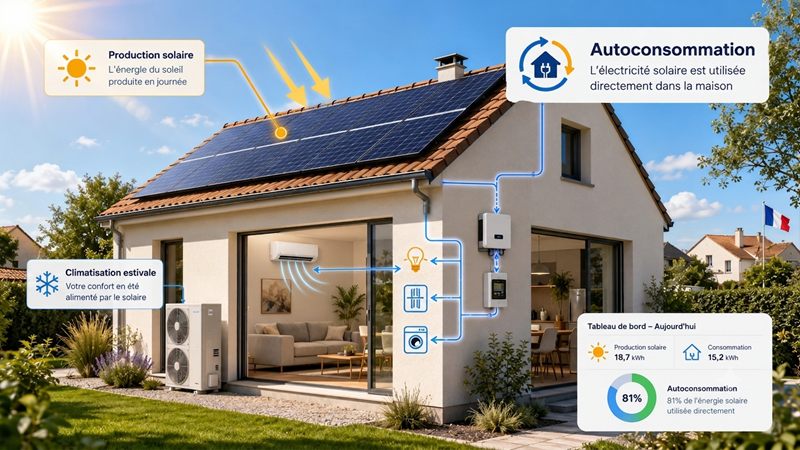
7.2 Offices, hotels, retail and service buildings
Offices, hotels, retail buildings and service facilities often use cooling, lighting, ventilation, lifts, IT equipment and refrigeration during the day. These loads naturally overlap with PV production hours.
During heatwaves, cooling and ventilation demand can increase further. The better high-temperature stability of HJT modules can help improve the real contribution of self-consumed solar electricity during daytime operation.
Img alt: Match between commercial building daytime loads and HJT solar generation
7.3 Cold-chain, supermarkets, restaurants and food processing
Cold-chain warehouses, supermarkets, restaurants and food processing sites often have strict refrigeration needs. In summer, their electricity demand can increase and remain concentrated during the day.
For these projects, the value of PV is not only annual electricity cost reduction. It is also whether the system can provide stable on-site power during refrigeration load peaks. The lower temperature coefficient and more stable hot-weather output of HJT modules make them relevant for these high self-consumption scenarios.
7.4 Industrial buildings and logistics warehouses
Large industrial buildings, logistics warehouses and production facilities usually have large roof areas and significant daytime electricity loads. For these projects, high-power double-glass HJT modules can be evaluated according to roof load capacity, mounting method and system design.
If the project includes production equipment, ventilation systems, cooling systems or warehouse management equipment, HJT’s high-temperature stability and power density can more easily translate into self-consumption value.
Img alt: Commercial and industrial rooftops in Europe using HJT double-glass modules to increase self-consumption
7.5 Northern and Central European projects with low-light conditions
In Northern and Central Europe, morning and evening generation, cloudy weather and low sun angles are often more relevant than peak midday irradiance alone. For users who want to extend the useful production window, HJT’s low-light response can support a more stable generation profile across the day.
This can be useful for homes with morning and evening loads, offices with extended operating hours, and commercial buildings where demand is not limited to peak sunshine hours.
8. What should be checked before choosing HJT modules?
Before choosing HJT modules, project owners and installers should check whether the project can actually benefit from high-efficiency modules. The technical advantages of HJT are more likely to become real project value when roof conditions, load profile, system configuration and budget are aligned.
8.1 Roof area, orientation, shading and ventilation
Roof area determines installable capacity. Orientation and tilt influence the production curve. Shading affects local output, while ventilation influences module temperature.
For residential projects, roof windows, chimneys, trees, roof shape and usable installation area should be reviewed. For commercial and industrial projects, parapets, HVAC equipment, fire access routes, maintenance zones, roof load capacity and mounting systems need to be checked.
Even with high-efficiency HJT modules, performance can still be limited if the installation suffers from heavy shading or poor ventilation.
8.2 Whether bifacial modules can receive enough rear-side light
The rear-side gain of HJT double-glass bifacial modules depends on rear-side irradiance.
Light-coloured flat roofs, elevated racking, carports, open structures and installations with sufficient height above the surface are more likely to use reflected light. If modules are installed close to a dark roof and almost no light reaches the back side, bifacial gain may be limited.
These projects can still use HJT modules, but the decision should focus more on temperature coefficient, front-side efficiency and long-term degradation.
8.3 Self-consumption rate, load profile and storage
HJT modules are especially relevant for projects with a high self-consumption rate. But high self-consumption should be evaluated through the real load curve, not simply by system size.
Does the user consume electricity during the day? Are there summer loads from cooling, refrigeration or equipment? Is battery storage included? Is the inverter properly sized? These factors all affect the final value of the system.
If the user has low daytime consumption and no storage, much of the PV electricity may need to be exported, and the economics of high-efficiency modules should be recalculated. On the other hand, if daytime loads are stable and on-site consumption is strong, HJT’s high-temperature performance and power density are more likely to show their value.
9. Conclusion: in hot summers, useful power matters more than rated power
European heatwaves are changing the way PV self-consumption projects should be evaluated. For homes, commercial buildings and industrial sites, summer daytime is both a period of strong PV generation and a period when cooling, refrigeration, ventilation, office and production loads may increase.
Module selection should therefore not be based only on rated power or price per watt. What really affects self-consumption value is whether the module can maintain stable output in hot rooftop conditions and provide more electricity at the time users need it.
HJT solar modules combine a low temperature coefficient, high power density, good low-light response, bifacial potential and low long-term degradation. This makes them a relevant option for European self-consumption projects, especially when roof space is limited, summer loads are high and on-site electricity use is strong.
The final choice should still depend on roof structure, ventilation, shading, load profile, storage design and budget. In Europe’s hotter summers, PV module selection is shifting from “which module has the highest rated power?” to “which module can provide more useful power under real high-temperature operating conditions?”
Discover HJT modules for European self-consumption projects
As a solar module manufacturer, Maysun Solar supplies European customers with IBC, TOPCon and HJT solar modules for residential rooftops, complex roof structures, and commercial and industrial projects. For European self-consumption customers, HJT modules can be considered when the project requires stable output under high temperatures, high power density and low long-term degradation.
FAQ
1. What are HJT solar modules?
HJT solar modules use heterojunction technology, which combines crystalline silicon wafers with thin amorphous silicon layers. This cell structure can support a lower temperature coefficient, good low-light response, high module efficiency and low long-term degradation.
2. Why are HJT modules relevant for PV self-consumption in Europe?
PV self-consumption projects in Europe increasingly focus on using electricity directly on site rather than simply exporting surplus energy. HJT modules can help in hot conditions, low-light periods and limited roof-space scenarios, making more solar electricity available during useful daytime hours.
3. Do HJT modules perform better than conventional P-type modules during heatwaves?
Under high-temperature conditions, HJT modules generally have a lower power temperature coefficient, which means lower theoretical power loss. For projects with air conditioning, refrigeration or significant daytime loads, HJT modules can help maintain more stable output.
4. Which European projects are best suited for HJT modules?
HJT modules are suitable for residential, commercial and industrial projects with limited roof space, strong daytime consumption, cooling or refrigeration loads, high self-consumption targets, or a focus on long-term output stability.
5. Are HJT modules always more economical than conventional modules?
Not automatically. Economics depend on roof area, orientation, shading, self-consumption rate, load curve, storage configuration, system cost and local electricity tariffs. HJT modules are most relevant when useful high-temperature output, power density and long-term stability are more important than the lowest upfront price per watt.
Références
1. World Meteorological Organization — Records fall as extreme heat grips Europe
https://wmo.int/media/news/records-fall-extreme-heat-grips-europe
2. World Weather Attribution — Fossil fuel emissions have rapidly worsened European heatwaves in just a few decades
https://www.worldweatherattribution.org/fossil-fuel-emissions-have-rapidly-worsened-european-heatwaves-in-just-a-few-decades/
3. ENTSO-E — ENTSO-E releases 2026 Summer Outlook Report
https://www.entsoe.eu/news/2026/05/29/entso-e-releases-2026-summer-outlook-report/
4. European Commission — Commission welcomes ENTSO-E report confirming EU electricity preparedness for summer 2026
https://energy.ec.europa.eu/news/commission-welcomes-entso-e-report-confirming-eu-electricity-preparedness-summer-2026-05-29_en
5. Eurostat — EU household electricity prices stable in 2025
https://ec.europa.eu/eurostat/web/products-eurostat-news/w/ddn-20260505-1
6. Eurostat — Non-household electricity prices in 2nd half of 2025: -3.5%
https://ec.europa.eu/eurostat/web/products-eurostat-news/w/ddn-20260508-2
7. Fraunhofer ISE — Photovoltaics Report
https://www.ise.fraunhofer.de/en/publications/studies/photovoltaics-report.html
8. IEA PVPS Task 13 — Photovoltaic Module Energy Yield Measurements: Existing Approaches and Best Practice
https://iea-pvps.org/key-topics/photovoltaic-module-energy-yield-measurements-existing-approaches-and-best-practice/
9. IEA PVPS Task 13 — Bifacial Photovoltaic Modules and Systems
https://iea-pvps.org/key-topics/bifacial-photovoltaic-modules-and-systems/
Recent Posts
- European Heatwaves and PV Self-Consumption: Why HJT Solar Modules Perform Better in Hot Summers
- Partial Shading on Solar Panels: Why a Small Shadow Can Cause Major Power Losses
- From Half-Cell to Multi-Cut: Why PV Modules Are Paying More Attention to More Segmented Circuit Design?
- Does Summer Heat Reduce Solar Panel Efficiency? What Really Happens to PV Output
- Low-Carbon PV Procurement in France: Why ECS, PEP Ecopassport and Solar Carports Matter