Changes in solar panel prices in recent years:
After a difficult 2022, the Ukraine-Russia war and its energy crisis have caused the cost of solar equipment and installation labor to increase. This is fantastic news for the cost of solar equipment and labor for installation.
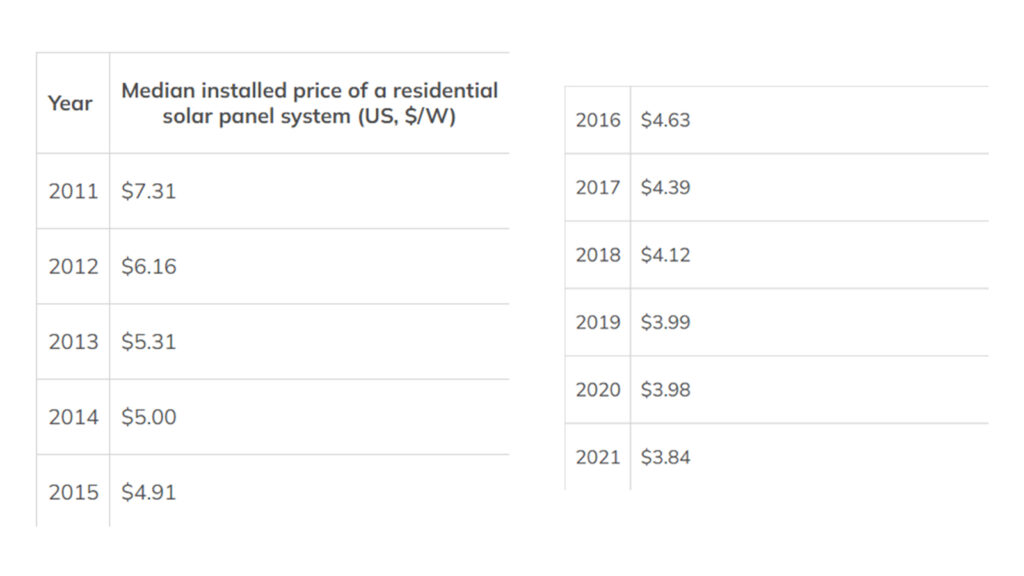
Sharp price drops for solar panels are typical. The installed cost of home solar panel systems has decreased 39 percent over the previous ten years, from $6.20 per watt in 2012 to $3.80 per watt in 2021, according to Berkeley Lab’s Tracking the Sun report for 2022. The decreasing cost of solar panel modules has been the primary driver of this trend. solar panel module prices have decreased by 92% since 1998.
According to Berkeley Lab’s 2022 edition of the Tracking the Sun report, the installed price of residential solar panel systems has fallen 39 percent over the past decade, from $6.20 per watt in 2012 to $3.80 per watt in 2021. This trend has been driven by declining solar panel module prices over time. Since 1998, the cost of solar panel modules has fallen by a whopping 92%.
Solar panel module prices have declined by 47%, from $1.03/watt in 2012 to $0.55/watt in 2021.And after that the prices is continuing to drop.
Factors affecting the price of solar panels:
1. Exchange rate:
the exchange rate on the price of solar modules have two main channels: material imports and oil imports. First, by importing solar module materials, the manufacturing cost of solar modules is affected by the exchange rate.
The raw material for solar modules is polysilicon. Polysilicon is first processed into ingots and then cut into wafers. These wafers are integrated into the solar cell, which serves as the basic energy conversion unit. Finally, the solar cells are assembled into solar modules.This’s why silicon is important in the manufacturing of PV panels.
The Nemet Institution (2005) used a model with polysilicon as the independent variable and solar module prices as the dependent variable. The results show that silicon costs explain about 12% of the “learning-by-doing” effect. Similarly, an empirical analysis by the Pillai Institution (2014) shows that for every 1% decrease in silicon prices, solar module prices decrease by 0.9%. Thus, both material prices and the strength of the currencies of the countries that influence the cost of material imports have an impact on solar module prices.
2. Oil prices:
We need to realize that renewable energy is being developed as a substitute for oil.
Global oil prices have suddenly increased since 2002. The desire for alternate energy sources grows as oil prices do. As a result, the “primary effect” or “substitution effect,” which is the effect of oil prices, cannot be overlooked in analyses of the pricing of renewable energy sources. PV cost is also indirectly impacted by oil. Energy, such as oil, is seen as a production input alongside labor and capital.
Increased energy prices might hasten the development of technology. Usually, more R&D drives down the cost of renewable technologies. Thus, increased oil prices lead to higher R&D spending, which lowers the cost of solar panels.
An empirical analysis of the influence of oil prices on the advancement of renewable energy technology is provided by Cheon and Urpelainen (2012). The analysis demonstrates that rising oil prices are associated with an increase in public spending on renewable energy R&D and patents.A study by Wong, Chia, and Chang (2013), who examined the elasticity of energy R&D in relation to fluctuations in oil prices, came to similar conclusions. The findings demonstrate a positive correlation between oil prices and R&D in renewable energy. Therefore, increased oil prices could hasten technological development and result in reduced solar panel costs.
3.Cost:
(1) Installation Costs
Berkeley Lab’s Tracking the Sun report (2022) shows that the installed cost of solar panel systems has dropped by 39% over the past decade. in 2012, the median installed price of a residential solar panel system (in the U.S.) was $6.2/watt. in 2021, the median is $3.8/watt. Over the past decade, the installed price of residential solar panel systems has declined by 39%, from $6.2/watt in 2012 to $3.8/watt in 2021.
(2) Soft Costs :Labor costs and other operating costs.
The balance between system and soft costs is about 80% of the total system cost. The solar panel module cost is about 15% and the inverter cost is 5%.
Will the cost to install solar panels keep decreasing?
To date, the decline in the installed price cost of solar panels has been due to the significant decline in the price of solar panel modules over time.
While solar panel module prices may continue to fall in accordance with Swanson’s Law, they have fallen to nearly $0.50/watt and represent only 15% of the installed cost of solar panels.
As we move forward, any further significant reduction in cost will need to come from one of the other price components.
Inverter prices, balance of system costs, and soft costs, however, have not decreased significantly over time relative to development history. As a result, it is assumed that a time will soon come when the price of installing solar panels will start to level off. The market for solar panels is expanding quickly, and customers have several options. In this instance, choosing a reputable, reasonably priced company is crucial when buying solar panel panels.
Since 2008, Maysun Solar has specialized in producing high quality photovoltaic modules. Our wide range of all-black, black frame, silver and glass-to-glass solar panels utilize half-cut, MBB, IBC and Shingled technologies. These solar panels offer superior performance and stylish designs that blend seamlessly into any building. Maysun Solar has successfully set up offices and warehouses in many countries and has established long-term relationships with excellent installers! For the latest module quotes or any PV related inquiries, please contact us. We will be happy to serve you.

Low-Carbon PV Procurement in France: Why ECS, PEP Ecopassport and Solar Carports Matter
Table of Contents France is becoming one of Europe’s most documentation-driven solar markets. For EPC companies, developers and commercial project owners, module selection is no longer based only on price-per-watt, efficiency or linear power warranties. Carbon documentation, supply-chain traceability and project-specific compliance files

PV Module Installation Beyond Rooftops: Multi-Scenario Applications for Bifacial N-Type Modules in Europe
PV module installation is not limited to rooftops. For residential users, small commercial users and distributed PV projects in Europe, spaces such as balconies, gardens, fences, carports, terraces, façades and pergolas can also provide additional installation areas when conditions allow. As solar use

Europe’s Grid Cap Era: Why High-Efficiency Solar Panels Matter More in 2026
Introduction In 2026, the economics of distributed solar in Europe are changing. Grid congestion, export limits, negative electricity prices and zero-export requirements mean that a solar project can no longer be judged only by how much electricity it generates. The more important question

How Do Solar Panel Delivery Delays Affect Installer Costs?
Solar panel delivery delays can affect installation schedules, project acceptance and payment collection.

The Forgotten “Invisible Assets”: Why Repowering Is the Strategic Key for European Solar in 2026
As grid congestion delays new solar projects across Europe, existing PV assets are becoming a strategic source of growth. This article explains why PV repowering can help EPCs and C&I asset owners unlock hidden value from already-connected solar plants, improve LCOE, and extend long-term asset performance with high-efficiency TOPCon, IBC and HJT modules.

Solar Panel Procurement in Europe: Why Stable Supply Matters More Than a One-Off Low Price
When European installers, distributors and corporate buyers choose solar panels, a one-off low price should not be the only factor. Stable supply, model continuity, technical documents and replenishment capacity often matter more for long-term cooperation and project delivery.