
A datasheet, an IEC certificate and a 25- or 30-year warranty can make a solar module look fully validated on paper. For a reliable purchasing decision, however, those documents are only the starting point. The electrical ratings, mechanical design, certificates, connectors, warranty terms and the modules that actually arrive on site all need to describe the same product configuration.
That matters for homeowners, installers and professional buyers alike. Instead of asking only whether a supplier ‘has the certificates’, ask which exact model and bill of materials (BOM) were assessed, whether the documentation covers the production site and product variant being ordered, and whether the module is compatible with the intended inverter and mounting system.
This guide uses international IEC requirements as the technical baseline. Local electrical, structural, fire, grid-connection and building rules still apply in each country, so product certification should never be treated as a substitute for system design or site-specific engineering.
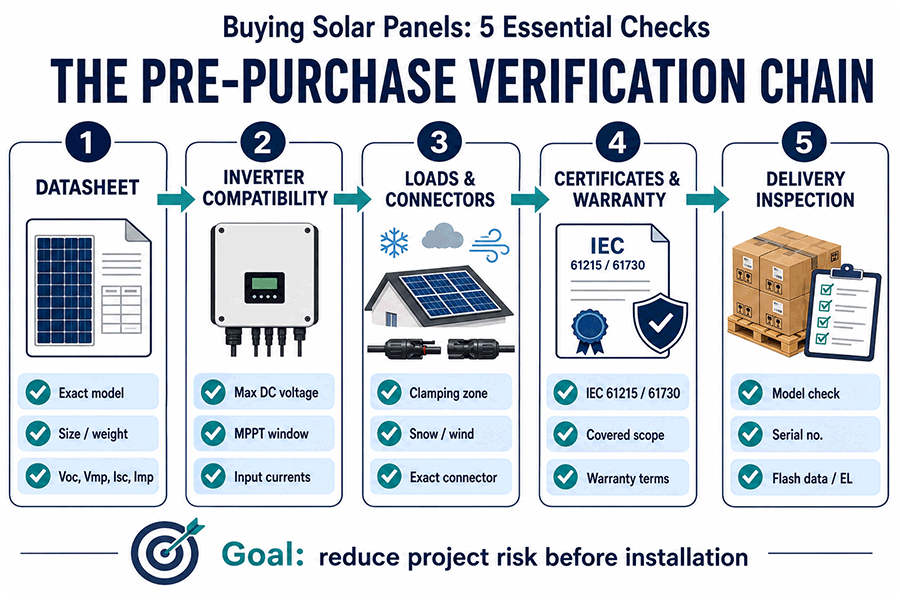
Table of Contents
1. Solar module datasheets: the parameters that actually matter
The datasheet is the technical foundation of a purchase, not just a marketing sheet. Before ordering, check the exact model code, dimensions, weight, Pmax, Voc, Vmp, Isc, Imp, temperature coefficients, maximum system voltage, connector type and mechanical mounting conditions.
Comparing a 450 W module with a 460 W module is not enough. A higher current can change how many strings an MPPT can accept; a slightly larger module can change roof or tracker layout; and a different connector can affect the DC wiring plan and field replacement strategy.
STC versus operating conditions
STC is useful because it standardizes nameplate comparisons, but a PV array does not operate at STC all year. Irradiance, module temperature and angle of incidence vary continuously. If the manufacturer provides NMOT/NOCT data, low-light curves or validated PAN/IAM files, they can provide additional context for energy modelling and system design.
| Check | STC | Closer-to-operation data | Why it matters |
|---|---|---|---|
| Irradiance | 1,000 W/m² | Often around 800 W/m² for NMOT-type conditions | Nameplate power is not annual energy yield |
| Temperature | 25 °C module/cell condition | Higher operating temperature | Temperature coefficients affect real output |
| Main use | Compare Pmax, Voc, Isc, Vmp, Imp | Understand behaviour away from STC | Separates similar modules more meaningfully |
| Extra data | Standard electrical ratings | NMOT/NOCT, curves, PAN/IAM where available | Supports modelling and compatibility checks |
2. Inverter compatibility and cold-weather string voltage
Module-to-inverter compatibility is not a watts-only question. Voc, Vmp, Isc and Imp must be checked against the inverter’s absolute maximum DC voltage, MPPT operating window, maximum input current per MPPT and permitted short-circuit current.
IEC 62548-1:2023 provides design requirements for PV arrays, including DC wiring, protection, switching and earthing provisions. It is a useful international reference, but national electrical codes and the manufacturer’s installation instructions still govern the final design.
Simplified example: Voc rise in cold weather
Open-circuit voltage rises as module temperature falls. A preliminary check can use: Voc,cold = Voc,STC × [1 + |βVoc| × (25 °C − Tmin)].
· Voc at STC: 42.0 V
· Voc temperature coefficient: −0.25%/°C
· Assumed minimum module temperature: −15 °C
The cold-weather Voc is about 46.2 V per module. A 21-module string is therefore about 970.2 V, while 22 modules reach about 1,016.4 V. If the inverter has a 1,000 V absolute DC limit, the 22-module string is already outside that limit in this simplified example.
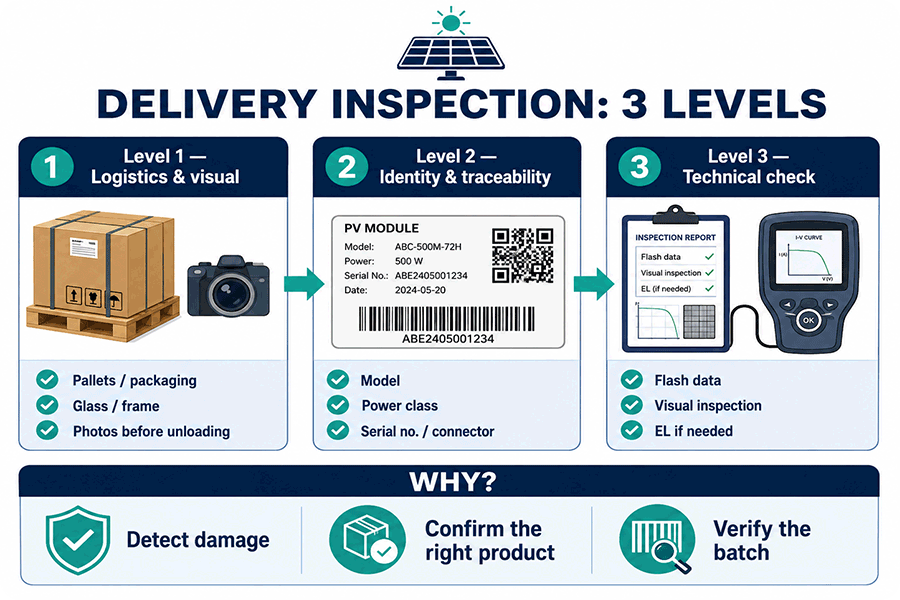
Maximum DC voltage and the upper MPPT limit are different constraints, and the DC/AC ratio does not replace either check. Final string sizing should use exact manufacturer data and a minimum temperature appropriate to the project location.
3. Mechanical loads and connectors: what 5400 Pa and ‘MC4 compatible’ really mean
A mechanical load value only has meaning together with the test and mounting configuration. A datasheet value such as 5400 Pa does not prove that a module is suitable for every roof, carport, ground-mount structure or tracker.
1. Module: what load was validated, and under which clamping zones, rail positions or mounting methods?
2. Mounting system: can the rails, clamps, fasteners, ballast or tracker hardware carry the required site loads?
3. Structure/site: what wind, snow, dead-load and local structural actions must the building or support structure resist?
For projects designed under Eurocodes, wind and snow actions are determined using the relevant national annexes; other countries use their own structural codes. The procurement point is universal: module test load is not the same thing as allowable roof load.
Connector wording deserves the same scrutiny. ‘MC4 compatible’ is not the same as an Original MC4 connector. IEC 62852 covers safety requirements and tests for PV DC connectors, while IEC 62548-1 sets array design requirements. Stäubli advises against cross-mating connectors from different manufacturers and notes that mechanical plug-in compatibility does not mean the mixed pair retains a valid product certification.
Ask for the exact connector manufacturer and model, then check the module and inverter instructions before approving the DC interface.
4. IEC certification versus extended reliability testing
IEC 61215 and IEC 61730 are fundamental procurement checks, but they are not a complete project due-diligence program. IEC 61215 addresses design qualification of terrestrial PV modules and explicitly does not turn qualification results into a quantitative lifetime prediction. IEC 61730 addresses module safety qualification.
A serious certificate review should confirm certificate number and status, manufacturer, model or product family, relevant construction variants, and—where the certification documentation provides it—the production site and BOM scope. A PDF logo by itself is not enough.
| Risk area | Baseline qualification | Additional procurement verification |
|---|---|---|
| Thermal cycling | IEC 61215 thermal-cycle sequence | Extended thermal cycling / more cycles |
| Damp heat | Damp-heat qualification sequence | Longer duration or batch-based testing |
| Mechanical stress | Applicable static/cyclic load sequence | Combined load + TC/HF sequences; test with project mounting hardware |
| Microcracks | Performance checks around qualification tests | EL imaging before/after stress |
| PID / LeTID | Applicable qualification framework | Longer or project-specific sequences |
| Manufacturing consistency | Type/design qualification | Pre-shipment or batch testing on actual production lots |
Independent labs such as Kiwa PVEL use batch testing to assess manufacturing consistency for modules destined for a specific project. Possible scopes include flash testing, EL imaging, visual inspection, wet-leakage testing, mechanical loading, thermal cycling and performance characterization. This is usually disproportionate for a small residential order, but it can be valuable for large C&I or utility-scale procurement.
5. Warranty, BOM and traceability: make sure every document describes the same module
A 25- or 30-year warranty is a contract, not a quality score. Check the legal entity providing the warranty, covered models, start date, product-warranty period, power-degradation curve, exclusions, claim documentation, and whether transport, labour or replacement costs are included.
Also separate the product warranty from installer workmanship warranties, statutory consumer rights and project insurance. Those layers may interact, but they are not interchangeable. For B2B projects, the contract should make clear which party carries each obligation if a module defect, installation defect or logistics damage occurs.
Why BOM matters
A model name alone may not identify every material combination inside the module. Glass, encapsulant, cell, backsheet, frame, junction box and connector can all vary. Kiwa PVEL notes that modules with the same model type and datasheet can be manufactured with different BOMs, provided those components are listed within the manufacturer’s certification documentation. Professional buyers therefore need to connect the certificate, approved BOM and actual production lot.[5]
Nameplate power should also be treated as a declared specification rather than an independent measurement of every delivered module. Fraunhofer ISE reviewed more than 70,000 module power measurements and, after filtering the dataset, reported average manufacturer-versus-lab differences of about −1.3% for 2023 and −1.2% for 2024 in the analysed subset. Those figures should not be generalized to every manufacturer or module, but they show why independent measurement can matter when the financial exposure is large.
Procurement distinction
• Datasheet = manufacturer’s declared product specification.
• Flash report / independent test = measured information for a module or production lot.
• Certificate = qualification scope that must be matched to the ordered configuration.
6. Delivery inspection: a three-level acceptance process
Procurement verification should end with the actual delivery, not with the purchase order. The received modules must be checked against the model, documents and configuration approved during procurement.
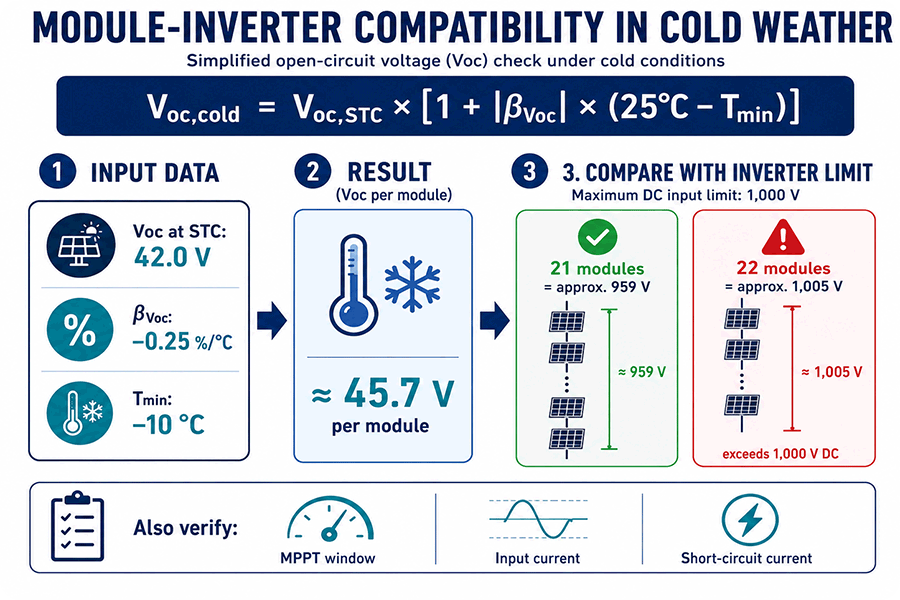
| Level | Purpose | Typical checks |
|---|---|---|
| 1 — Logistics / visual | Identify transport or packaging damage | Pallets, packaging, glass breakage, frame damage, impact marks, photos before unloading |
| 2 — Identity / traceability | Confirm the product actually delivered | Model code, power bin, label, serial number/barcode, connector type, quantity |
| 3 — Technical sampling | Verify lot conformity where justified | Flash data, visual inspection, EL sampling; wet leakage or lab tests depending on project risk |
EL testing is not necessary for every residential shipment. On larger projects, however, sampling can help identify microcracks or hidden defects that visual inspection alone cannot reliably detect. If the connector, frame, glass construction or model code differs from what was approved, document the change and resolve it before modules move deeper into the logistics chain or are installed.
Conclusion
The best procurement choice is not automatically the module with the highest wattage or longest headline warranty. The real objective is consistency between the declared product, the system design, certification scope, warranty terms and the goods delivered to site.
IEC certification does not replace string design; a 5400 Pa test value does not replace structural engineering; ‘MC4 compatible’ does not replace exact connector identification; and a 30-year warranty is only as useful as the entity, terms and claims process behind it.
A practical procurement chain is: datasheet → system design → certification and BOM → warranty → delivered product. When those five layers align, technical documentation becomes a meaningful risk-control tool rather than a stack of PDFs.
FAQ
Which solar panel certifications should I check before buying?
IEC 61215 and IEC 61730 are key references for design qualification and module safety. Check the manufacturer, model/family, covered configuration and document status—not just the certificate logo. Local installation and grid codes still apply.
How do I know whether a solar panel is compatible with an inverter?
Compare Voc, Vmp, Isc and Imp with the inverter’s maximum DC voltage, MPPT window and input-current limits. Recalculate string Voc at the site’s minimum module temperature.
Does a 5400 Pa rating mean a module is suitable for every roof?
No. The rating applies under defined test and mounting conditions. Clamping zones, mounting hardware, wind/snow actions and structural capacity must all be checked separately.
Is ‘MC4 compatible’ the same as Original MC4?
No. Ask for the exact connector manufacturer and model. Cross-mating connectors from different brands can create technical, certification and liability risks.
What should be checked when solar panels arrive?
Inspect packaging and visible damage first, then verify quantities, model codes, power bins, labels, serial numbers and connectors. Large projects may add flash-report review, EL sampling or other technical tests.
References and sources
1. IECEE — IEC 61215-1:2021, terrestrial PV module design qualification: https://www.iecee.org/certification/iec-standards/iec-61215-12021
2. IEC — IEC 61730-1:2023, PV module safety qualification: https://webstore.iec.ch/en/publication/59803
3. IEC — IEC 62548-1:2023, PV array design requirements: https://webstore.iec.ch/en/publication/64171
4. Stäubli — why cross-mating PV connectors is a safety risk: https://www.staubli.com/global/en/electrical-connectors/industries/renewable-energy/cross-connection.html
5. Kiwa PVEL — Batch Testing: https://www.kiwa.com/en/services/testing/batch-testing/
6. Fraunhofer ISE — Solar module output often overstated (2025): https://www.ise.fraunhofer.de/en/press-media/press-releases/2025/solar-module-output-often-overstated.html
Resent Post
- Carbon Footprint and LCA in European C&I Solar: Why EPCs Should Check Before Module Procurement
- HEMS and Dynamic Electricity Pricing: From Solar Generation to Smart Energy Management
- Maysun Solar’s First 3.5 MW Solar EPC Project in Italy Enters Its Final Stage
- August European Solar Industry News
- Industrial Roofs with Limited Load Capacity: Lightweight or High-Efficiency Solar Panels?