Table of Contents
Introduction
In today’s world, we are in a crucial period of transition from traditional energy sources to clean energy. Solar energy, as one of the most promising clean energy sources, has garnered global attention and investment. However, with the continuous advancement and diversification of solar technology, selecting the most suitable solar panels has become increasingly important. Today, we focus on a highly anticipated solar technology: TOPCon solar panel. With its outstanding performance and cost-effectiveness, TOPCon solar panel is becoming the wise choice for those pursuing cost-effectiveness. In this article, we delve into the advantages of TOPCon solar panel, providing you with concrete reasons why they are the cost-effective choice.
What is TOPCon Solar Cell?
The TOPCon cell belongs to the category of n-type solar cells. An n-type cell is fabricated using a semiconductor material doped with phosphorus, imparting a negative charge to the material. Compared to p-type cells, this variant offers numerous benefits such as enhanced efficiency and superior performance under low-light conditions.
How is the TOPCon Solar Cell structured?
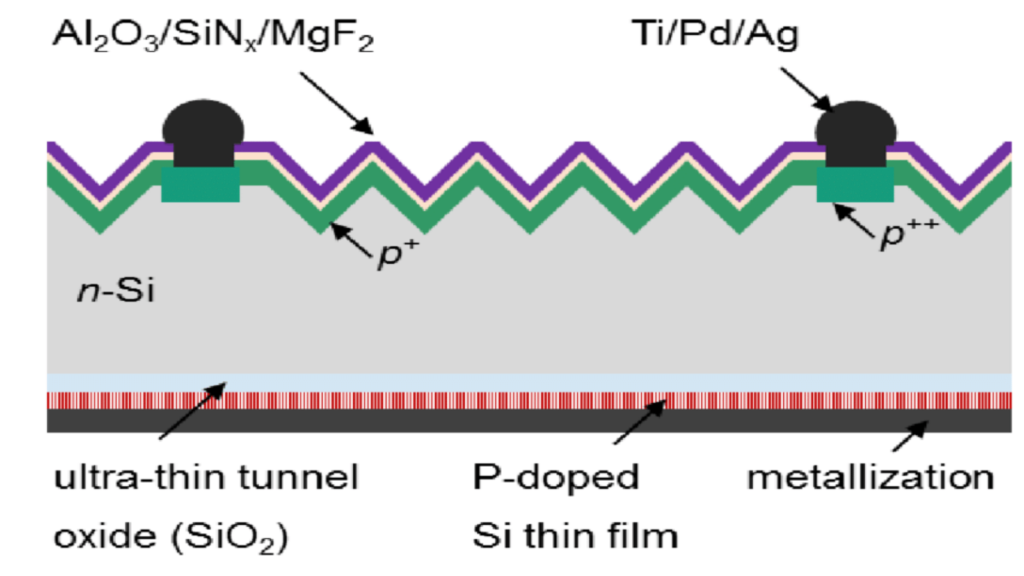
The typical components of TOPCon Solar Cell includes:
Anti-reflective coating: Applied on the front side of photovoltaic modules to minimize light losses due to reflection and maximize energy output.
Front contacts: A thin layer of conductive material directly atop the anti-reflective coating, such as silver or aluminum. This layer serves as the positive electrode contact, allowing current to flow out of the module.
N-doped layer: Positioned beneath the front contact, composed of silicon and phosphorus.
P-doped layer: Composed of silicon and boron, sunlight can extract individual electrons from these silicon layers, generating electricity.
Oxide layer: This layer is the hallmark of TOPCon cell, blocking the channels for charge carriers. However, due to tunneling effect, current can overcome the barrier.
Back contacts: Another conductive contact on the backside of multicrystalline silicon, used to collect current and export it from the module. This back contact serves as the negative electrode.
The advantages of TOPCon solar Panel
1.High Efficiency and Performance Stability
TOPCon solar panel utilizes advanced bifacial technology, combining the advantages of N-type cell silicon, resulting in higher photovoltaic conversion efficiency and excellent performance stability. Traditional single-sided solar panels can only absorb sunlight from one side, while TOPCon panel with bifacial technology can also receive scattered and reflected light from the environment on the backside, increasing the efficiency of light utilization. Therefore, under the same illumination conditions, TOPCon panels can generate more electricity. Under foreign object shading conditions, TOPCon panel incurs low damage and hotspot risks. The bifacial double-glass structure provides better protection for internal cell components, reducing pollution and damage from external environmental factors such as dust and rain, thereby extending the lifespan of the panels, ensuring stable power output over long-term use.
2.High Bifacial Rate
Due to the adoption of a bifacial cell structure and heterojunction design, TOPCon solar cell achieves a bifacial rate of up to 85%. By introducing efficient cell structures on both sides of the solar cell, the efficiency of light absorption and charge transfer is maximized, thereby increasing the energy output of the entire photovoltaic system. This feature makes TOPCon panel highly applicable in practical applications, especially suitable for scenarios where maximum energy output is required in limited space, such as rooftop solar systems.
3.Strong Environmental Adaptability
TOPCon cells exhibit a low temperature coefficient, ensuring stable power generation even in high-temperature climates. This resilience reduces the adverse effects of heat on system performance. With sunlight absorption capability on both its front and back, TOPCon solar panels maintain high output even in low-light conditions, enhancing overall system performance. Their environmental adaptability enables versatile deployment across wide scenarios.
4.Low Light-Induced Degradation (LID) Characteristics
Thanks to the high phosphorus content and minimal boron presence in TOPCon N-type cells, their unique characteristics mitigate the impact of boron-oxygen pairs, virtually eradicating Light-Induced Degradation (LID) phenomenon under illumination. Consequently, TOPCon solar panels sustain stable performance throughout extended usage, unaffected by degradation due to illumination. This low LID trait renders TOPCon panels a dependable and enduring solar solution, especially fitting for applications demanding consistent long-term performance.
Real data analysis: TOPCon Solar Panel vs PERC Solar Panel
TOPCon solar panel has a higher efficiency than PREC solar panel:
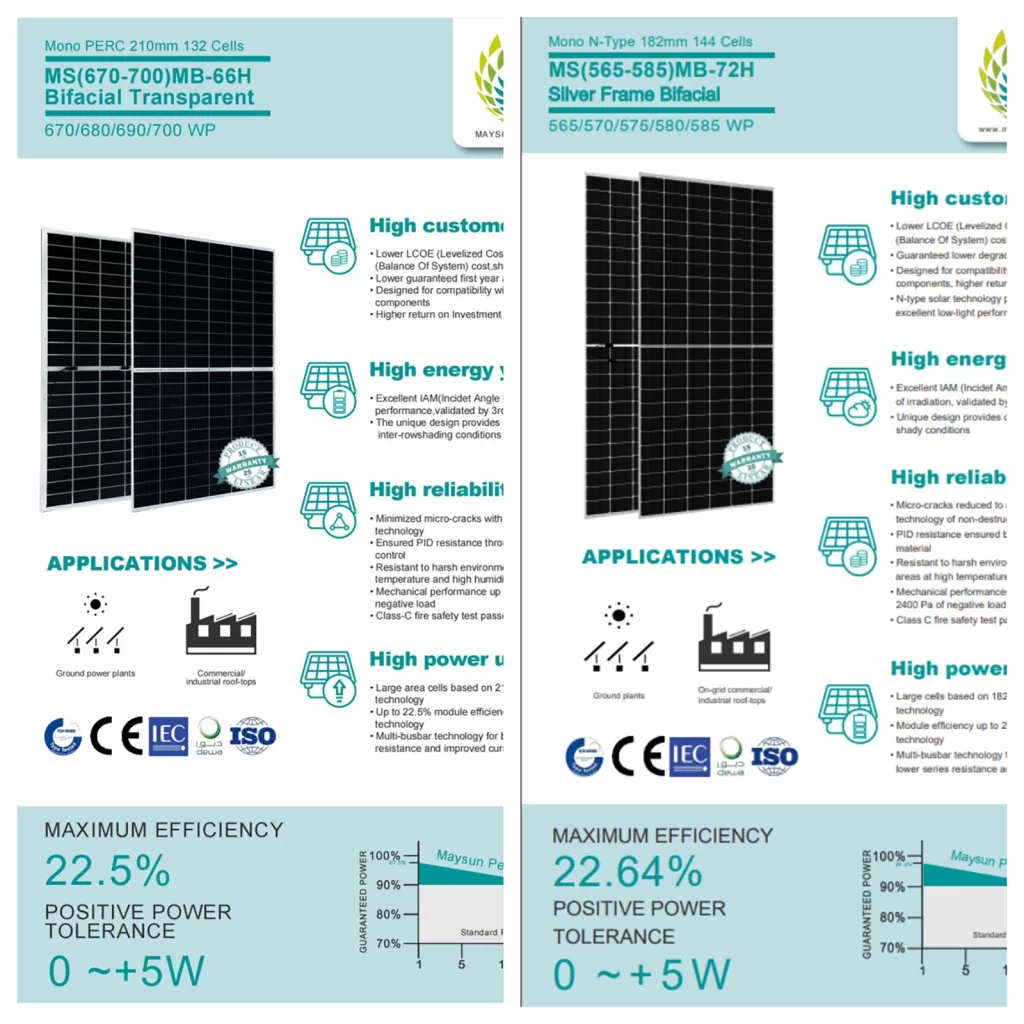
TOPCon solar cells generally have a higher conversion efficiency than PREC cells. For example, the maximum efficiency of MaySun Solar’s PREC panels ranges between 21.0% – 22.5%, and the maximum efficiency of TOPCon panels ranges between 22.28% – 22.64%, which is generally higher than that of PREC panels.
TOPCon solar panel works more stable than PREC solar panel:
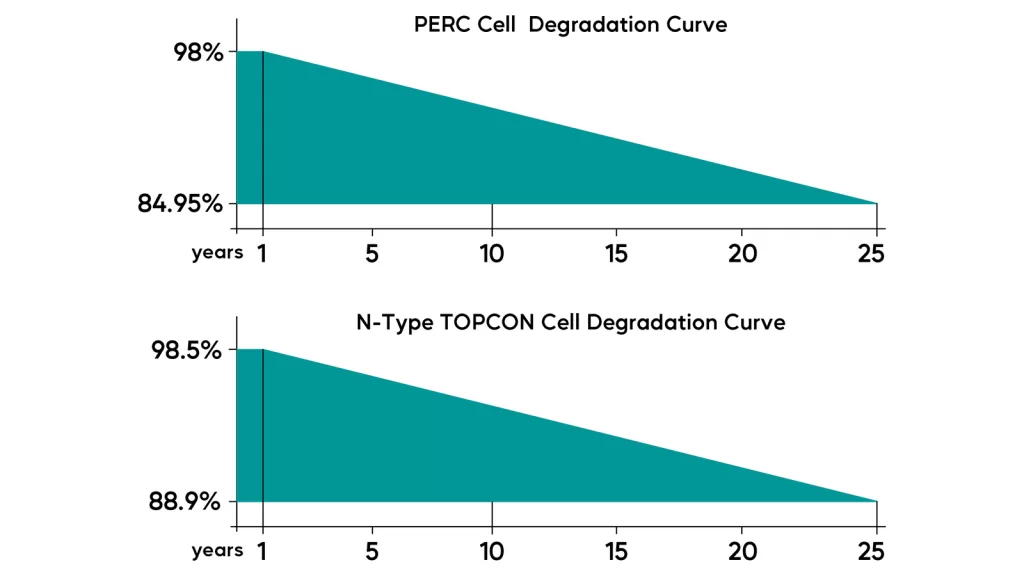
PERC solar cell have a power decay rate of 2% in the first year, and after 25 years, the power generation capacity is 84.95% of the original capacity. In contrast, TOPCon solar cell, due to the use of N-type cell, have a power decay rate of only 1.5% in the first year, and after 25 years, the power generation capacity can still be maintained at 88.9% of the original capacity, which makes the performance extremely stable.
Modules utilizing N-type cells are more capable of generating electricity under low light conditions such as morning, evening and cloudy days. TOPCon cell is about 0.5-1.0% higher than PERC cell in terms of power generation per watt due to the excellent low-light performance.
TOPCon solar panel has a higher Bifacial rate than PERC solar panel:
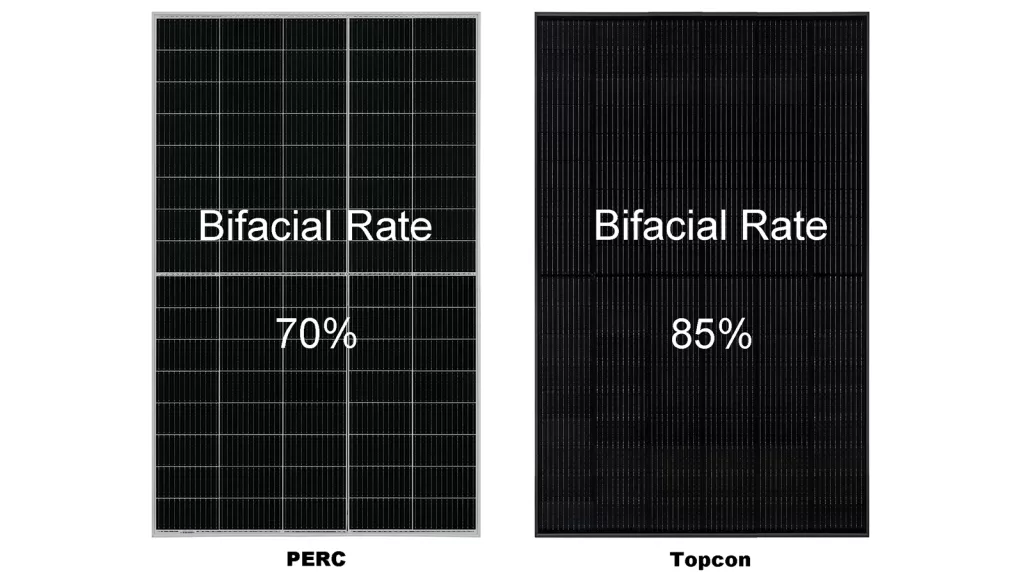
PERC solar cell’s bifacial rate is 70%, while TOPCon cell’s bifacial rate reaches 85%, marking a significant improvement over PERC solar cell. As mentioned above, a high bifacial rate can maximize the conversion rate of light energy and improve the energy output of the entire PV system.
TOPCon solar panel’s overall performance is better than PERC solar panel’s:
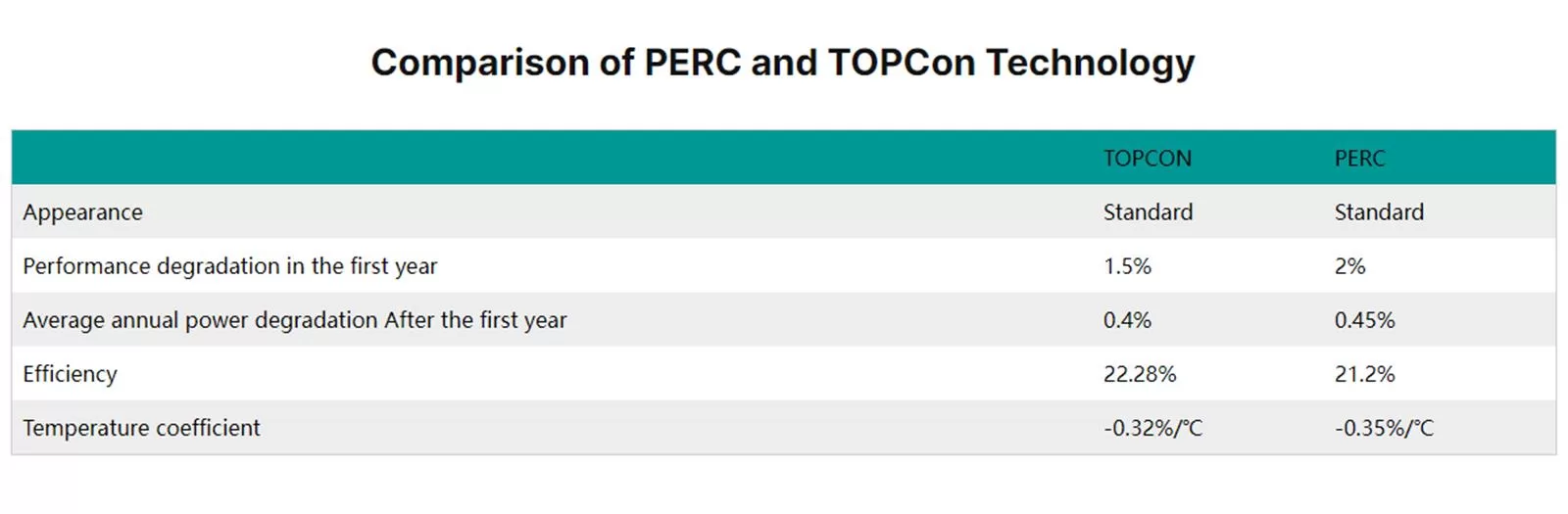
The data in the figure shows that Maysun Solar’s TOPCon panel outperform PERC panel under the same conditions. Specifically as follows:
From the data, one year later, PERC solar panel’s performance declines by 2%, with an average power decrease of 0.45% after the first year. In contrast, TOPCon solar panel’s performance only decreases by 1.5%, with an average power decrease of 0.4% after the first year. TOPCon panel has a temperature coefficient of -0.32%/°C, while PERC has a temperature coefficient of -0.35%/°C. This indicates that for the same conditions, every one-degree Celsius increase in temperature results in a 0.35% power loss for PERC solar panel, while TOPCon solar panel only experiences a 0.32% power loss. The above data illustrates that compared to PERC solar panel, TOPCon solar panel exhibits more stable and efficient performance over time and changing environmental conditions.
Efficiency: 21.9%-22.6%
Dimensions (L × W × H): 2279 x 1134 x 30 mm
Weight: 29 kg
Packaging: 37 pcs/pallet, 740 pcs/40'HQ
Warranty: 15-year product guarantee and 25-year power guarantee
Efficiency: 21.7%-22.4%
Dimensions (L × W × H): 2279 x 1134 x 30 mm
Weight: 32 kg
Packaging: 36 pcs/pallet, 720 pcs/ 40'HQ
Warranty: 30-year product and power warranty
Efficiency: 21.5%-22.3%
Dimensions (L × W × H): 1722 x 1134 x 30mm
Weight: 24 kg
Packaging: 36 pcs/pallet, 936 pcs/40'HQ
Warranty: 30-year product and power warranty
Conclusion
In today’s solar energy market, we face an important decision: how to balance efficiency, stability, and cost to meet the demand for clean energy. In this regard, TOPCon solar panel provides an answer. Its high efficiency, stability, low cost, and environmental adaptability make it a highly anticipated technology in the solar panel market. It is a rising star in the field of solar panels, with tremendous development prospects. By choosing TOPCon solar panel, we can not only achieve higher energy output and long-term return on investment but also make a positive contribution to environmental protection and sustainable development. Therefore, TOPCon solar panel is undoubtedly a wise choice for those pursuing cost-effectiveness, deserving widespread application and promotion. Maysun Solar’s TOPCon products possess all these advantages. If you are interested, please feel free to contact us!
Reference:
kelly pickerel(2022) ‘what is topcon solar panel technology?’, 1 april. https://www.solarpowerworldonline.com/2022/04/what-is-topcon-solar-panel-technology/.
admin(2023) ‘topcon solar cells vs mono perc solar cells: a comparative analysis’ 14 october.
https://www.novergysolar.com/topcon-vs-perc-vs-hjt-solar-cells/.
anna vöpel(2023) ‘topcon-solarzellen: aufbau, funktion, nachteile, preis’, 11 july
https://gruenes.haus/topcon-solarzellen/.
You may also like:

European Heatwaves and PV Self-Consumption: Why HJT Solar Modules Perform Better in Hot Summers
Across Europe, summer heatwaves are no longer just a climate or comfort issue. They are becoming an energy-use issue. During hot summer days, air conditioning, ventilation, refrigeration, office equipment and industrial cooling loads can rise exactly when rooftop solar modules are exposed to

Partial Shading on Solar Panels: Why a Small Shadow Can Cause Major Power Losses
Introduction: Shading Is Not Just a Surface Area Problem In a photovoltaic system, a small shadow can be amplified by the electrical structure of the module. In a typical module with three electrical sections, a shaded area covering only a small part of

From Half-Cell to Multi-Cut: Why PV Modules Are Paying More Attention to More Segmented Circuit Design?
Table of Contents In recent years, half-cell modules have become a mainstream design in the photovoltaic market. Compared with traditional full-cell modules, half-cell technology reduces the operating current of each cell unit, lowers internal resistive losses, and improves thermal management and partial shading

Does Summer Heat Reduce Solar Panel Efficiency? What Really Happens to PV Output
Table of Contents Many PV users notice an unusual phenomenon in summer: although sunlight is strongest at noon, the power curve shown in the monitoring app does not reach the expected peak. In contrast, on a sunny spring day, or just after a

Low-Carbon PV Procurement in France: Why ECS, PEP Ecopassport and Solar Carports Matter
Table of Contents France is becoming one of Europe’s most documentation-driven solar markets. For EPC companies, developers and commercial project owners, module selection is no longer based only on price-per-watt, efficiency or linear power warranties. Carbon documentation, supply-chain traceability and project-specific compliance files

PV Module Installation Beyond Rooftops: Multi-Scenario Applications for Bifacial N-Type Modules in Europe
PV module installation is not limited to rooftops. For residential users, small commercial users and distributed PV projects in Europe, spaces such as balconies, gardens, fences, carports, terraces, façades and pergolas can also provide additional installation areas when conditions allow. As solar use