
Table of Contents
Key Factors Affecting Low-Light Performance
In daily photovoltaic system operations, power generation does not occur solely during peak sunlight hours. Conditions such as early mornings, evenings, overcast skies, and winter months—characterized by low irradiance—account for a significant portion of annual operating time. This is particularly true in northern Italy, mountainous regions, and areas with short daylight hours in winter, where these conditions significantly shape the generation curve. Therefore, a module’s actual output under low-light conditions directly determines the system’s overall performance and investment return.
There are three main factors that influence a solar module’s performance in low-light conditions.
The first is the structure of the solar cells.
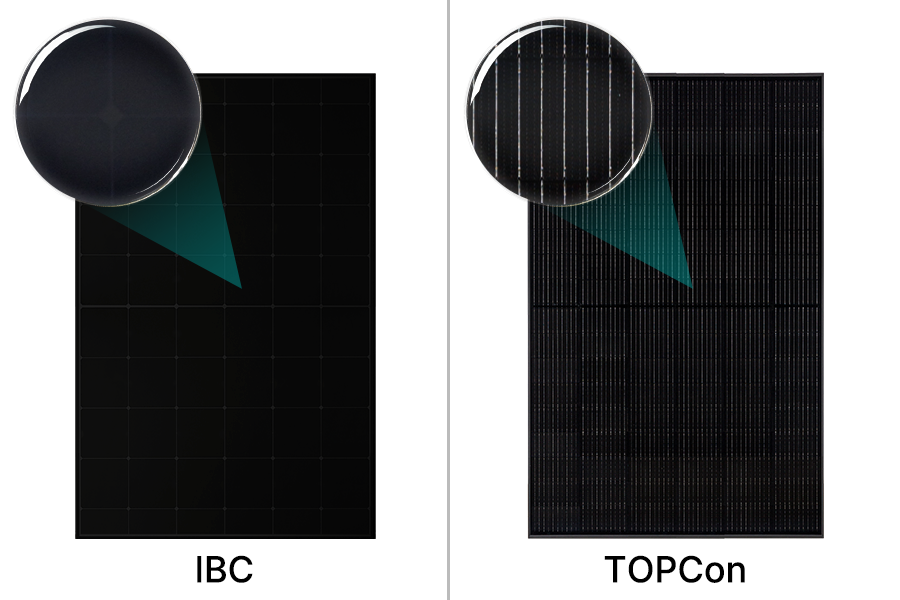
Traditional modules have metal grid lines on the front side that partially block incoming light, reducing light absorption efficiency. In contrast, IBC (Interdigitated Back Contact) modules relocate all electrodes to the rear side, minimizing front-side shading and enhancing light capture in low-irradiance environments.
The second factor is the module’s spectral response and sensitivity to low light levels.
At irradiance levels between 200 and 600 W/m², different technologies show clear performance differences. Modules with superior low-light performance can not only initiate power generation at lower irradiance levels but also maintain a more stable output, effectively extending the daily generation period.
The third critical factor is environmental adaptability.
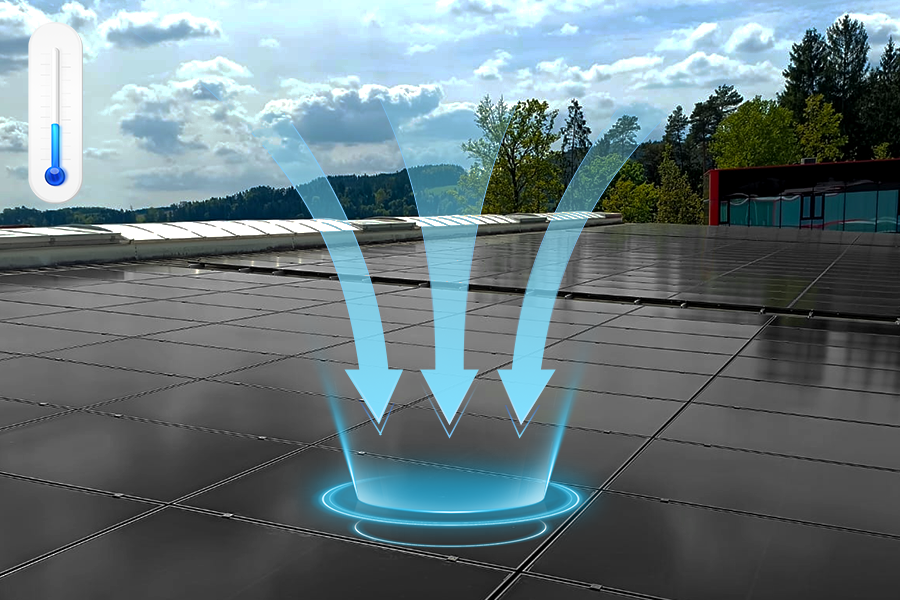
Low-light conditions often coincide with lower temperatures and a higher proportion of diffuse light. In these cases, a module’s temperature coefficient and encapsulation structure become especially important. A lower temperature coefficient indicates better power retention in colder conditions. For example, IBC modules have a temperature coefficient of -0.29%/°C, which is better than most conventional products. Modules with strong diffuse light absorption can also perform more consistently in cloudy or shaded environments.
Low-light performance is not an isolated technical metric but a reflection of the synergy between structural design, spectral response, and environmental adaptability. It is also a key indicator of whether a photovoltaic module can deliver stable energy production throughout diverse year-round climate conditions.
How Do IBC Modules Achieve High Efficiency in Low-Light Conditions?
In low-light environments, a solar module’s ability to generate electricity efficiently depends on how effectively it captures limited light and how quickly it responds electrically. IBC modules have a clear structural advantage in this regard. Their front-side design is free of metal obstructions, which increases the available area for incoming light. This is particularly beneficial during periods of low irradiance, steep incident angles, or high diffuse light levels, as it improves photon absorption efficiency.
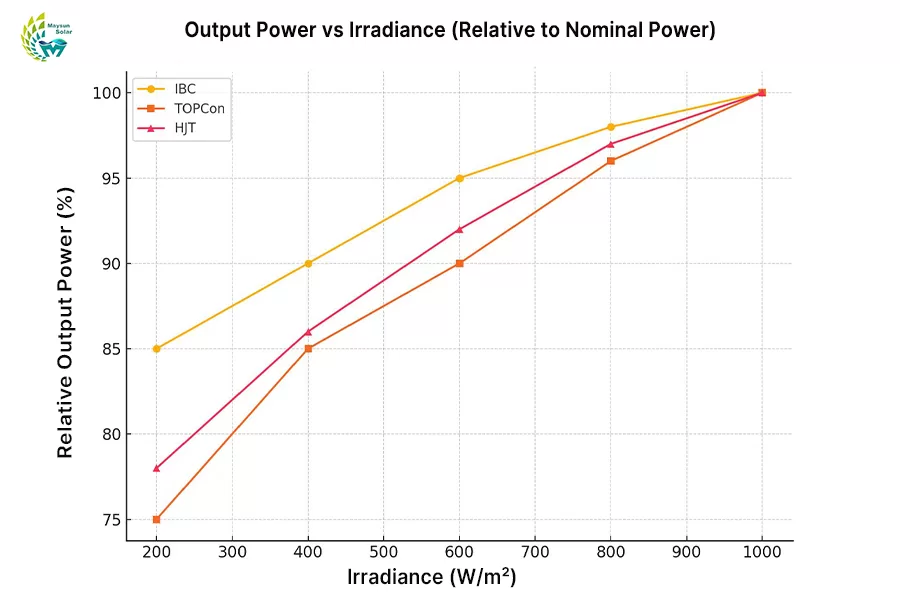
Beyond structural openness, IBC modules also demonstrate superior spectral response. They can initiate current generation more rapidly at low irradiance levels, effectively lowering the “power generation threshold.” Under typical 200 W/m² conditions, these modules can still maintain over 85% of their output power, whereas conventional modules show a noticeable drop in response under the same conditions. This performance edge allows IBC modules to extend effective generation times during early mornings, evenings, and overcast weather, ultimately raising the system’s overall daily production curve.
Temperature is another key variable affecting low-light generation. Low irradiance often coincides with colder temperatures. IBC modules excel in such conditions thanks to their better temperature coefficient, rated at -0.29%/°C. This means less power loss as temperatures drop, enabling more consistent output—especially valuable during winter and the cold hours around sunrise and sunset.
Additionally, IBC modules typically use high-reflectivity backsheet materials combined with high-transmittance glass, enhancing their ability to capture diffuse light in cloudy or shaded conditions. Even under indirect light, they can effectively convert irradiance into output power, reducing generation fluctuations caused by environmental instability. This level of performance stability is especially important for complex rooftops, non-ideal angles, or commercial installations with frequent structural shading.
In summary, the strong performance of IBC modules under low-light conditions results from the systematic integration of optimized structure, material synergy, and responsive design—not merely from a single efficiency figure.
Output Differences Under Low Irradiance
In low-light conditions, the performance differences among various solar technologies are often more revealing than under standard test conditions. While IBC, TOPCon, and PERC modules may exhibit similar efficiencies under standard irradiance, their behavior within the 200–600 W/m² range shows clear distinctions in response speed, output stability, and spectral adaptability.
PERC modules, with front-side gridline shading and a narrower spectral absorption range, typically require irradiance above 300 W/m² to reach stable output. As a result, their generation efficiency drops significantly during mornings, evenings, and cloudy weather.
HJT modules, thanks to enhanced passivation structures, demonstrate stronger low-light responsiveness than conventional technologies. However, under extremely low irradiance or cold conditions, they can still experience delayed activation and slight power fluctuations during the initial generation phase.
TOPCon modules have improved front-side passivation and carrier lifetimes, delivering better low-light performance than PERC. Nonetheless, some products still show delayed response and minor power instability under very low irradiance or low-temperature conditions.
Thanks to their unobstructed front design, superior spectral response, and optimized current paths, IBC modules perform exceptionally well in low-light environments. Multiple field tests show that under low irradiance, IBC modules deliver earlier startup, higher output, and a smoother power curve during marginal light periods. They are especially effective in rooftop scenarios with frequent shading or during early morning and late evening hours, significantly extending effective generation time.
It is worth noting that in large-scale ground-mounted systems where bifacial gains are substantial, TOPCon’s high bifaciality remains an advantage. However, when focusing on the “front-side response under low irradiance” in distributed applications, IBC modules offer more stable and predictable output due to their structural optimizations.
| Performance Dimension | IBC | TOPCon | HJT |
|---|---|---|---|
| Front-side shading | No shading | Shaded | Shaded |
| Low irradiance response | Slightly below 200W/m² | 250–300W/m² | Slightly above 200W/m² |
| Conversion efficiency under low light | Around 85% | Around 75–80% | Around 80–85% |
| Temperature coefficient | -0.29%/°C | -0.32%/°C | -0.243%/°C |
| Scattered light utilization | High | Average | Good |
Note: This table is based on publicly available specifications and field test data, reflecting typical performance differences under low-light conditions.
Ideal Low-Light Application Scenarios for IBC Modules
While the superior low-light performance of IBC modules is evident in technical specifications, their real value lies in application adaptability. In projects where low-light periods dominate or environmental conditions are complex, the structural advantages of IBC modules translate into tangible energy gains. Compared with mainstream technologies like TOPCon and PERC, IBC modules exhibit stronger responsiveness and greater stability under low irradiance.
Compared to TOPCon modules, IBC’s front-side obstruction-free design allows for earlier activation and more consistent output in dim conditions. Although HJT modules perform well in cold climates, IBC modules offer a broader spectral response, ensuring longer effective generation time in variable environments. Typical application scenarios include:
Distributed rooftops with frequent shading: Urban commercial buildings with narrow spacing between structures or tree-covered surroundings.
Regions with short winter daylight hours and high generation share during sunrise/sunset: Such as northern Italy or the Alpine region.
Projects with high aesthetic or structural demands: Including BIPV facades and solar carports.
Industrial users with pronounced early-morning or evening loads: Such as high-consumption enterprises operating early or late shifts.
According to field data from completed installations, in regions where winter daylight averages less than three hours per day, IBC modules can generate 3%–5% more annual energy than same-capacity PERC modules. While this gap may seem minor on a daily basis, it accumulates over time into significantly higher system returns—especially in projects with high electricity prices or well-defined power sale mechanisms, where it contributes to more stable cash flow.
Conclusion
As solar module technologies become increasingly homogenized, the true measure of a system’s performance is no longer limited to peak efficiency ratings under lab conditions, but rather its ability to adapt to real-world environmental variations. Among these, low-light performance stands out as a key indicator of practical effectiveness.
With an open-front design, broad spectral response, and excellent temperature adaptability, IBC modules offer a sustained power generation advantage under non-ideal lighting conditions. For distributed rooftops, installations with pronounced early-morning or evening loads, or projects with stringent aesthetic requirements, IBC modules are not an added expense but a reliable path to stable long-term returns.
The true value of high-performance modules lies not in peak output on sunny days, but in their ability to deliver stable power generation even in low-light and shaded conditions—maximizing every usable ray of light.
Since 2008, Maysun Solar has been both an investor and manufacturer in the photovoltaic industry, providing zero-investment commercial and industrial rooftop solar solutions. With 17 years in the European market and 1.1 GW of installed capacity, we offer fully financed solar projects, allowing businesses to monetize rooftops and reduce energy costs with no upfront investment. Our advanced IBC module, HJT module and TOPCon module panels, and balcony solar stations, ensure high efficiency, durability, and long-term reliability. Maysun Solar handles all approvals, installation, and maintenance, ensuring a seamless, risk-free transition to solar energy while delivering stable returns.
Reference
IEA PVPS – International Energy Agency Photovoltaic Power Systems Programme
Task 13: Performance and Reliability of Photovoltaic Systems https://iea-pvps.org/research-tasks/performance-and-reliability/
DNV Energy Systems – PV Module Reliability Scorecard 2023 https://www.dnv.com
TÜV Rheinland – Comparative Testing of Solar Modules Under Low Light Conditions https://www.tuv.com/world/en/comparative-testing-of-solar-modules-under-low-light-conditions.html
NREL – National Renewable Energy Laboratory
Spectral Response and Temperature Coefficient Studies for Silicon Solar Technologies https://www.nrel.gov
Fraunhofer ISE – Photovoltaics Report 2024 https://www.ise.fraunhofer.de
Recommend Reading

Low-Carbon PV Procurement in France: Why ECS, PEP Ecopassport and Solar Carports Matter
Table of Contents France is becoming one of Europe’s most documentation-driven solar markets. For EPC companies, developers and commercial project owners, module selection is no longer based only on price-per-watt, efficiency or linear power warranties. Carbon documentation, supply-chain traceability and project-specific compliance files

PV Module Installation Beyond Rooftops: Multi-Scenario Applications for Bifacial N-Type Modules in Europe
PV module installation is not limited to rooftops. For residential users, small commercial users and distributed PV projects in Europe, spaces such as balconies, gardens, fences, carports, terraces, façades and pergolas can also provide additional installation areas when conditions allow. As solar use

Europe’s Grid Cap Era: Why High-Efficiency Solar Panels Matter More in 2026
Introduction In 2026, the economics of distributed solar in Europe are changing. Grid congestion, export limits, negative electricity prices and zero-export requirements mean that a solar project can no longer be judged only by how much electricity it generates. The more important question

How Do Solar Panel Delivery Delays Affect Installer Costs?
Solar panel delivery delays can affect installation schedules, project acceptance and payment collection.

The Forgotten “Invisible Assets”: Why Repowering Is the Strategic Key for European Solar in 2026
As grid congestion delays new solar projects across Europe, existing PV assets are becoming a strategic source of growth. This article explains why PV repowering can help EPCs and C&I asset owners unlock hidden value from already-connected solar plants, improve LCOE, and extend long-term asset performance with high-efficiency TOPCon, IBC and HJT modules.

Solar Panel Procurement in Europe: Why Stable Supply Matters More Than a One-Off Low Price
When European installers, distributors and corporate buyers choose solar panels, a one-off low price should not be the only factor. Stable supply, model continuity, technical documents and replenishment capacity often matter more for long-term cooperation and project delivery.


Really appreciated the focus on low-light performance—it’s an often-overlooked aspect that can significantly impact overall system efficiency, especially in regions with long winters or frequent cloud cover. Curious if you’ve seen any data comparing IBC performance in diffuse light versus direct sunlight over longer periods, like an entire seasonal cycle?