Introduction
A low-maintenance rooftop solar system is not created after installation. It is designed before installation.
Over a 20–30 year operating life, rising O&M costs are rarely caused by dirty glass alone. They are more often caused by design decisions made at the beginning: overloaded roof layouts, missing access paths, low-tilt soiling, unmanaged shading, mismatched DC connectors, poor cable routing, or monitoring that only shows total system output.
The NREL, Sandia and SunSpec Alliance O&M best practice report notes that standardized O&M planning can help reduce maintenance costs and make them more predictable. PNNL also highlights the value of system performance tracking for detecting issues and supporting long-term operation.
This article does not focus on how often solar panels should be cleaned. Instead, it covers six design areas that directly affect long-term maintenance: module selection, roof layout, drainage, shading, electrical details and monitoring.
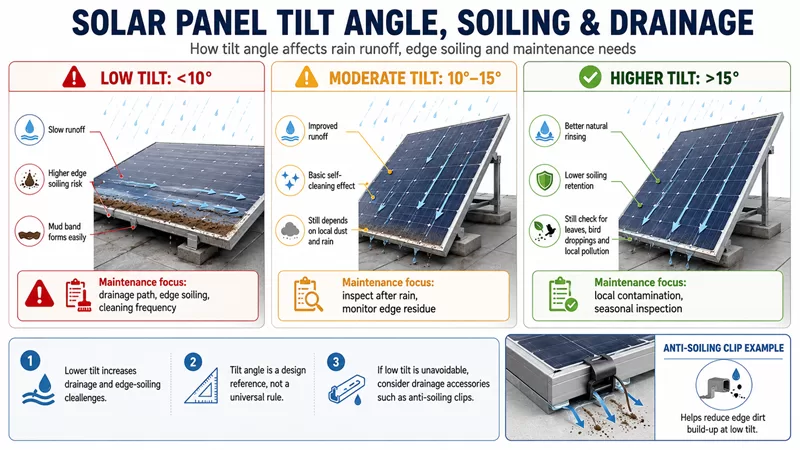
3. Drainage and Soiling: Low-Tilt Roofs Need Edge-Soiling Control
Soiling is not a small issue. IEA PVPS states that dust, pollutants and biological residue on PV module surfaces are an important cause of system underperformance, with average global energy losses estimated at around 4%–7%. Actual losses vary by climate, rainfall, pollution sources and installation conditions.
Tilt angle | Maintenance risk | Design action |
Nearly flat / below 10° | Slow runoff; dirt bands can form along the lower edge | Prioritize drainage path, edge soiling and cleaning strategy |
10°–15° | Some self-cleaning effect, but soiling may remain in polluted areas | Use production data to decide whether drainage accessories are needed |
Above 15° | Usually better for natural rain washing | Still check for bird droppings, leaves, industrial dust and local pollution |
These angles are design references, not universal rules. The real question is whether rainwater can carry contamination away from the lower edge, or whether dirt will become a long-term shading band.
Scenario | Low-maintenance solution |
Low-tilt flat roof | Avoid perfectly horizontal installation where possible; create a drainage angle with the mounting structure |
Persistent edge soiling | Evaluate anti-soiling clips or low-soiling frame designs |
Industrial area / roadside roof | Use production curves to decide cleaning needs instead of fixed cleaning intervals |
Trees or frequent bird activity nearby | Avoid leaf and bird-dropping zones; increase inspection frequency if needed |
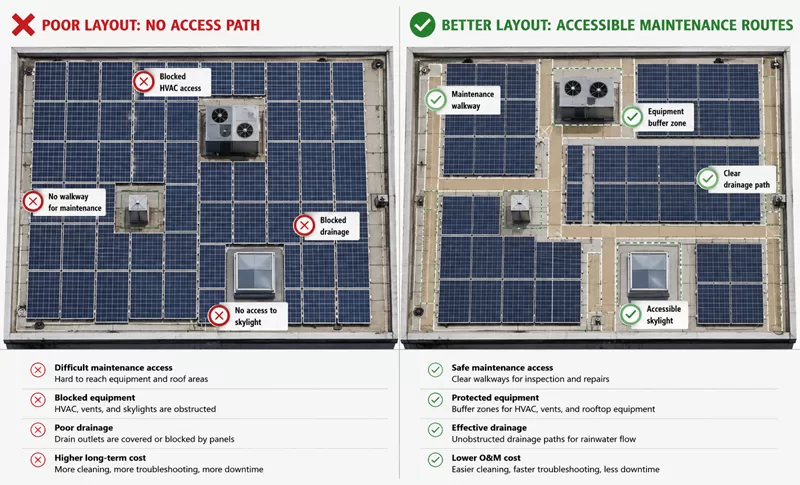
Near gutters and drains | Ensure mounting structures do not block roof drainage or maintenance access |
Key takeaway:
Low maintenance does not mean no cleaning. It means reducing cleaning caused by poor drainage design.
4. Shading Zoning: Make Shading Controllable and Easy to Diagnose
The biggest problem with shading is not only energy loss. It is troubleshooting cost.
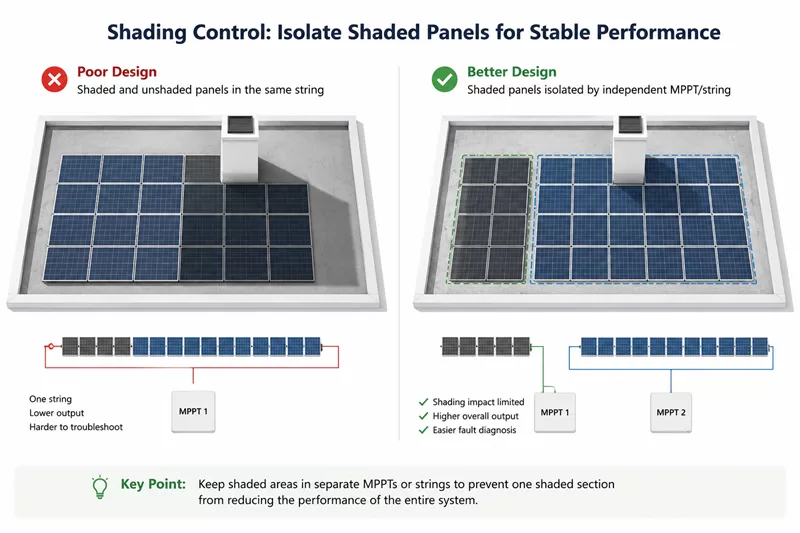
Chimneys, parapets, lightning rods, vents, trees and nearby buildings can all create long shadows in the morning, evening or winter. If shaded and unshaded modules are mixed into the same string or MPPT, later performance issues become difficult to diagnose. The cause could be shading, soiling, module damage, connector resistance or inverter behavior.
Roof condition | Low-maintenance solution |
Multi-slope residential roof | Consider microinverters or optimizers to reduce the impact of one shaded module on others |
Chimney, skylight or tree shading | Group shaded modules separately instead of mixing them with unshaded modules |
Commercial parapet shading | Connect shaded edge zones to independent MPPTs or separate strings |
Unavoidable equipment shading | Make the shaded area predictable, isolated and traceable |
Seasonal tree shading | Review the annual sun path, not only summer noon conditions |
Avoid these mistakes
Mistake | Risk |
Mixing shaded and unshaded modules in one string | A small shadow can reduce a larger area of output |
Checking shading only at summer noon | Winter low-sun-angle shading is missed |
Not marking shaded zones on drawings | O&M teams cannot interpret future anomalies |
Relying on “adjustments later” | Rooftop retrofits are expensive |
Key takeaway:
Low-maintenance design does not require a roof with no shading at all. It requires unavoidable shading to be isolated within a controlled and traceable zone.
5. Electrical and Mounting Details: Many Faults Hide Behind the Module
Many long-term rooftop PV issues do not start from broken module glass. They start from cables, connectors, mounting structures, waterproofing or grounding.
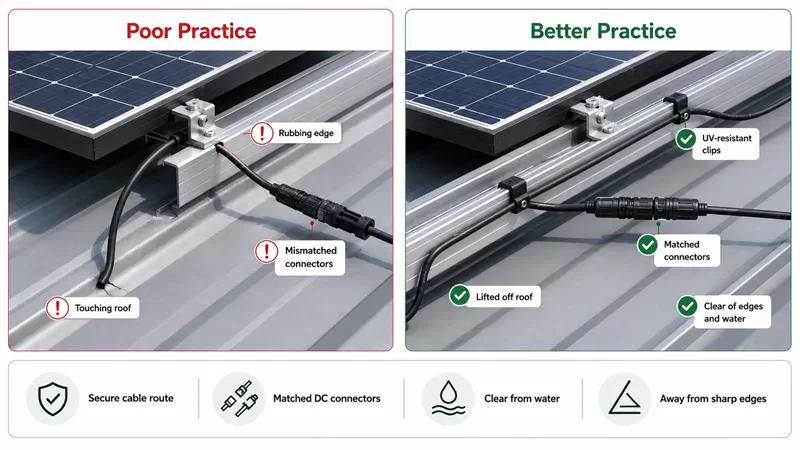
5.1 Cable Management
Red line | Risk controlled |
DC cables should not touch metal roofs, sharp edges or standing-water zones | Reduce insulation wear, aging and ground faults |
Cables should not hang loosely or swing in the wind | Avoid long-term friction damage |
Use weather-resistant clips or ties | Make future inspection and replacement easier |
Organize DC cable routes by roof zone on commercial rooftops | Shorten fault diagnosis time |
5.2 DC Connectors
Connector mismatch is an underestimated safety risk in rooftop PV systems. Northern Territory WorkSafe notes that AS/NZS 5033:2021 requires DC connectors in solar PV installations to be paired only with connectors from the same manufacturer to satisfy compliance and safety requirements.
European projects may not directly follow the Australian standard, but the principle is widely relevant: connector compatibility is not only about whether two plugs can physically connect. It is also about matched certification, contact design and long-term electrical behavior.
Connector management | Low-maintenance value |
Use the same brand, model and certified pairing where possible | Reduce contact resistance and overheating risk |
Avoid random field replacement with different connectors | Reduce hidden electrical faults |
Record connector specifications | Support spare parts and warranty management |
Use approved crimping tools and procedures | Avoid loose contact and rising contact resistance |
5.3 Mounting and Corrosion Protection
Environment | Mounting selection recommendation |
Standard residential roof | Select according to local structure, wind load and corrosion requirements |
Commercial metal roof | Check compatibility between clamps, rails and roof sheet material |
Coastal / humid / salt-mist environment | Evaluate stainless steel, aluminum or high-corrosion-resistant coated materials |
Industrial pollution area | Check corrosion class, fastener material and maintenance interval |
Roof penetration mounting | Define waterproofing method and warranty responsibility before installation |
Key takeaway:
The front side of a module determines power generation. The backside connections and mounting details determine how easy the system is to maintain.
6. Monitoring: Do Not Rely Only on Total Energy Output
A system that only shows total energy output is not suitable for low-maintenance operation.
When total output drops, the cause could be weather, soiling, shading, string imbalance, connector heating, inverter alarms, curtailment or module degradation. Without enough data granularity, the O&M team has to troubleshoot on the roof.
PNNL states that tracking PV system performance helps identify potential issues and maximize savings. IEC 62446-1 also defines documentation, commissioning tests, inspection and verification requirements for grid-connected PV systems, which can serve as a useful framework for system handover and future inspection.
Project type | Recommended monitoring depth |
Small residential rooftop | Inverter platform monitoring |
Multi-slope or shaded residential roof | Optional module-level or optimizer-level monitoring |
Medium commercial rooftop | At least MPPT-level or string-level data |
Large C&I rooftop | Zone monitoring, string comparison, alarm rules and remote diagnosis |
High-O&M-cost rooftop | Evaluate remote I-V curve diagnosis and thermal imaging inspection |
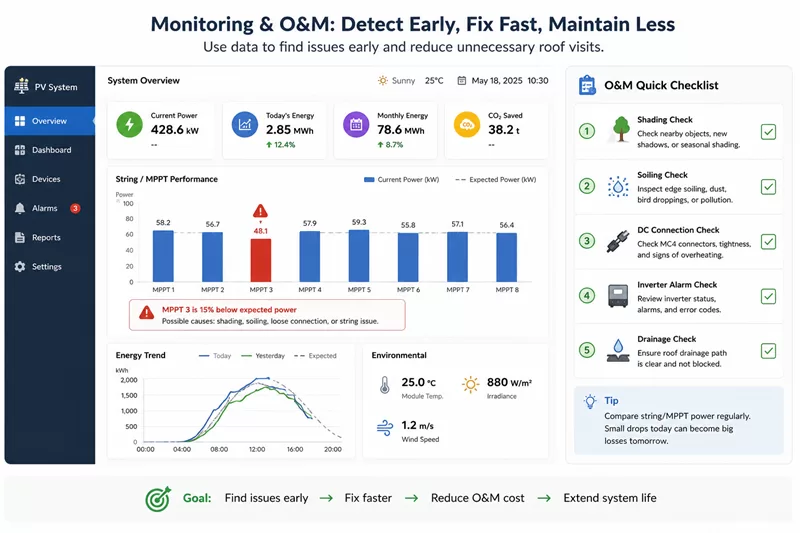
Alarm logic
Data anomaly | Check first |
One similar string stays lower over time | Shading, soiling, connector, string wiring |
Output does not recover after rain | Edge dirt band, bird droppings, local pollution |
Sudden output drop | Inverter alarm, wiring, fuse, DC-side fault |
Seasonal recurring drop | Tree shading, parapet shadow, sun path |
Abnormally low output during hot periods | Ventilation, inverter location, connector heating, module temperature coefficient |
AFCI, remote I-V curve diagnosis and module-level monitoring are not mandatory for every rooftop project. But for high-value commercial rooftops, fire-sensitive sites or projects with high labor costs, they can reduce unnecessary roof visits and speed up fault location.
Key takeaway:
Low maintenance does not mean nobody checks the system. It means the system tells you where to check first.