Summer brings stronger sunlight and longer daylight hours, so it is normally one of the most productive seasons for a solar system. However, some system owners notice that solar panel output does not continue to rise during the hottest part of the day. In some cases, output may even fall despite intense sunlight.
This is not a contradiction.
Solar panels need sunlight to generate electricity, but silicon solar cells do not perform well at excessively high operating temperatures. Stronger sunlight increases the amount of solar energy reaching the panel, but not all absorbed energy is converted into electricity. A considerable proportion becomes heat, raising the temperature of the solar cells.
Summer performance is therefore influenced by two closely connected factors:
- Temperature coefficient determines how much power a solar panel loses for every 1°C increase in temperature.
- Ventilation space influences how hot the solar panel becomes under real rooftop conditions.
The first reflects the panel’s inherent resistance to heat, while the second reflects the thermal conditions created by the installation. Both must be considered to properly assess rooftop solar performance during hot weather.
Table of Contents
1. Why Do Solar Panels Become So Hot in Summer?
The rated power shown on a solar panel datasheet is measured under Standard Test Conditions, commonly known as STC.
These conditions include:
- Solar irradiance of 1,000 W/m²
- Solar cell temperature of 25°C
- Air mass spectrum of AM 1.5
The important point is that 25°C refers to the solar cell temperature during laboratory testing. It is not the outdoor air temperature, nor does it represent the normal operating temperature of a solar panel installed on a roof.
Fraunhofer ISE explains that real operating conditions often differ significantly from STC, which means that a solar panel will not necessarily operate at its rated efficiency in the field.
On a clear summer day with strong sunlight and low wind speed, solar panels continuously absorb solar radiation. When heat cannot escape easily from the back of the panels, their operating temperature can rise far above the surrounding air temperature.
Several factors can make this effect more severe:
- Dark roof surfaces
- Metal roofing
- Limited distance between the panels and the roof
- Poor airflow behind the array
- Long, uninterrupted panel rows
- Low wind speed
The U.S. Department of Energy explains that solar cells generally perform better at lower temperatures. As temperature rises, electrical current may increase slightly, but voltage normally decreases more noticeably. The overall result is a reduction in maximum power output.
In simple terms:
Stronger sunlight increases the available solar energy, but excessively high panel temperatures reduce conversion efficiency.
This is why hot summer weather does not mean that solar panels generate more electricity simply because they become hotter.
2. What Is the Temperature Coefficient of a Solar Panel?
A solar panel datasheet normally includes several temperature-related parameters:
- Temperature coefficient of maximum power, or Pmax
- Temperature coefficient of open-circuit voltage, or Voc
- Temperature coefficient of short-circuit current, or Isc
For most system owners and solar panel buyers, the most relevant value is the:
Temperature Coefficient of Pmax
This parameter is usually expressed as a percentage per degree Celsius, written as %/°C. For most crystalline-silicon solar panels, the Pmax temperature coefficient is a negative number.
For example:
Pmax temperature coefficient: −0.35%/°C
This means that, under otherwise identical conditions, the maximum power of the solar panel theoretically decreases by approximately 0.35% for every 1°C increase in solar cell temperature above 25°C.
The simplified calculation is:
Theoretical power change ≈ Pmax temperature coefficient × (solar cell temperature − 25°C)
The closer the value is to zero, the less sensitive the solar panel is to high temperatures.
For example:
- −0.24%/°C is better than −0.35%/°C
- −0.26%/°C is better than −0.30%/°C
In this context, “better” only means that the panel loses less power as its temperature rises. Temperature coefficient alone does not determine the overall quality of a solar panel.
Other factors must also be considered, including:
- Solar panel efficiency
- Power degradation
- Low-light performance
- Mechanical load resistance
- Panel dimensions
- Product warranty
- Compatibility with the inverter and mounting system
3. How Do PERC, TOPCon and HJT Solar Panels Perform in Hot Weather?
Temperature coefficients are not completely fixed for each solar cell technology. Products based on the same technology may still have different values depending on the manufacturer, cell design and product generation.
The following figures should therefore be treated as representative examples, rather than universal values for every solar panel.
| Solar cell technology | Representative Pmax temperature coefficient | Theoretical power change at 75°C | Sensitivity to heat |
|---|---|---|---|
| P-type PERC solar panel | Approximately −0.35%/°C | −17.5% | Relatively high |
| N-type TOPCon solar panel | Approximately −0.30% to −0.26%/°C | Approximately −15% to −13% | Relatively low |
| HJT solar panel | Approximately −0.24%/°C | −12% | Low |
A representative P-type monocrystalline solar panel datasheet specifies a Pmax temperature coefficient of −0.35%/°C.
Many N-type TOPCon solar panels offer values of around −0.30%/°C, while some newer products have improved to approximately −0.26%/°C.
As an example, the Maysun Solar HJT 500–520W bifacial full-black solar panel has a stated Pmax temperature coefficient of −0.24%/°C. Under the same temperature increase, its theoretical power reduction is therefore lower than that of the P-type example with a coefficient of −0.35%/°C.
However, solar cell technology continues to develop. It would be inaccurate to state that every TOPCon solar panel performs worse than every HJT solar panel, or that every HJT panel automatically performs better than every PERC product.
The correct approach is to check the actual value in the product datasheet.
When evaluating hot-weather performance, the actual Pmax temperature coefficient is more important than the technology label alone.
4. How Much Power Can High Temperatures Reduce?
Consider a hot summer day when the actual solar cell temperature reaches 70°C.
Compared with the STC reference temperature of 25°C, the temperature difference is:
70°C − 25°C = 45°C
Example 1: P-Type Solar Panel
Assume a Pmax temperature coefficient of −0.35%/°C:
45 × −0.35% = −15.75%
Under this simplified calculation, the maximum power is theoretically around 15.75% lower than the panel’s rated STC power.
Example 2: TOPCon Solar Panel
Assume a Pmax temperature coefficient of −0.30%/°C:
45 × −0.30% = −13.5%
The theoretical power reduction is approximately 13.5%.
Example 3: HJT Solar Panel
Assume a Pmax temperature coefficient of −0.24%/°C:
45 × −0.24% = −10.8%
The theoretical power reduction is approximately 10.8%.
The comparison can be summarised as follows:
| Solar panel example | Theoretical power change at 70°C |
| Panel with −0.35%/°C | −15.75% |
| Panel with −0.30%/°C | −13.50% |
| Panel with −0.24%/°C | −10.80% |
Under these assumed conditions, the difference between a panel rated at −0.24%/°C and one rated at −0.35%/°C is approximately 4.95 percentage points.
For a 10 kWp solar system, the theoretical instantaneous difference attributable to temperature coefficient would be:
10 kWp × 4.95% = approximately 0.495 kW
This does not mean that every real solar system will show a fixed difference of 495 W.
Actual output is also affected by:
- Solar irradiance
- Wind speed
- Inverter efficiency
- Panel mismatch
- Shading
- Dirt and dust
- Cable losses
- System orientation
- Roof pitch
Nevertheless, the calculation demonstrates an important principle:
When solar panels operate at high temperatures for long periods, even relatively small differences in temperature coefficient can affect real energy production.
5. Why Does Ventilation Beneath Solar Panels Matter?
If temperature coefficient represents the panel’s inherent resistance to heat, rear ventilation represents the installation’s ability to remove heat.
Solar panels mainly release heat through:
- Convection with the surrounding air
- Thermal radiation to the environment
- Heat conduction through the mounting structure and roof
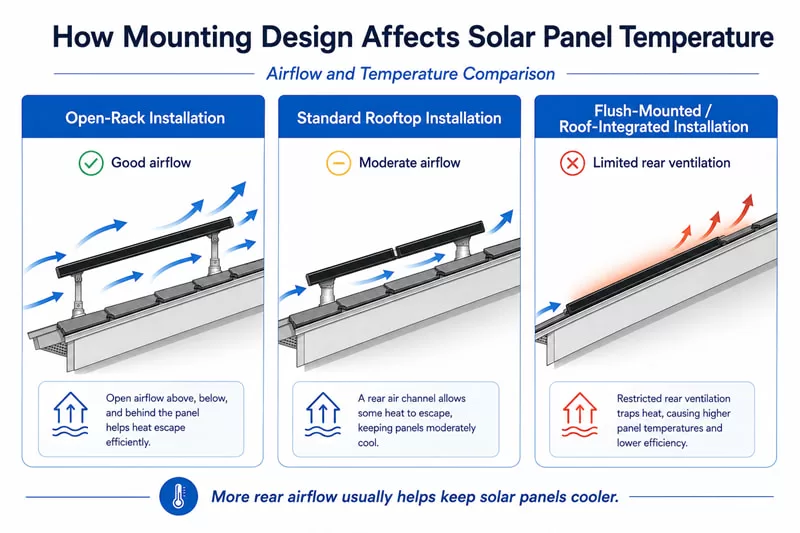
In an open-mounted system, air can normally move around both the front and the back of the solar panels. Heat is therefore removed more effectively.
In flush-mounted, roof-integrated or partially enclosed systems, hot air behind the panels may be unable to escape easily. This can result in higher operating temperatures.
PVsyst also distinguishes between different thermal conditions, including:
- Free-standing solar panel installations
- Semi-ventilated rooftop installations
- Insulated or poorly ventilated rear surfaces
These different configurations are assigned different thermal loss parameters, demonstrating that mounting design directly affects expected solar panel temperature.
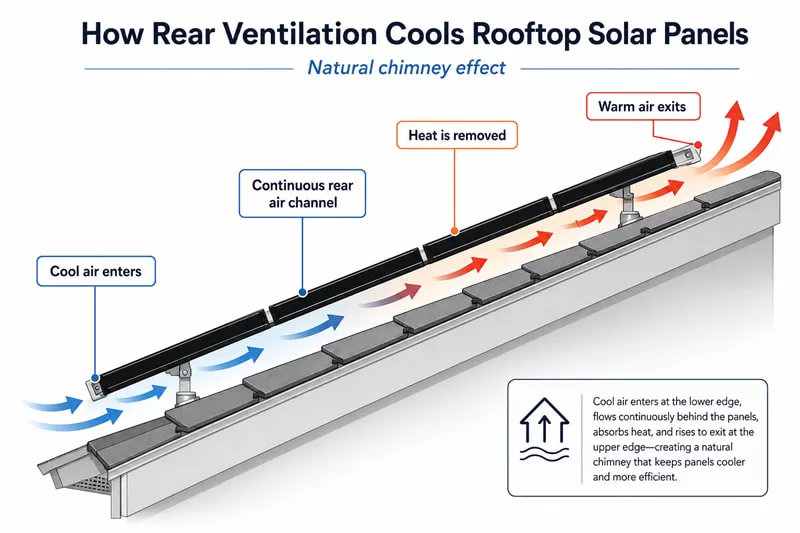
How Does the Chimney Effect Work?
On a sloped roof, a continuous air channel behind the solar panels can create natural airflow:
- Cooler air enters from the lower edge of the array.
- The air absorbs heat from the back of the solar panels.
- The heated air becomes less dense and rises.
- Warm air leaves through the upper part of the array.
- Cooler air continues to enter from below.
This process is commonly described as the chimney effect.
It does not require fans or additional electricity. However, it only works effectively when the airflow path remains open.
The installation should therefore provide:
- A clear air inlet at the lower edge
- A continuous airflow path behind the panels
- A suitable outlet at the upper edge
If the array is completely enclosed for aesthetic reasons, or if rails, cables and roof structures block the airflow channel, ventilation may remain limited even when there is some physical distance between the panels and the roof.
6. How Much Space Should Be Left Between the Roof and Solar Panels?
There is no single universal spacing requirement that applies to every roof.
A computational fluid dynamics study on building-integrated photovoltaics found that, under its specific roof pitch and multi-panel arrangement, an air gap of approximately 0.12 to 0.15 metres helped reduce overheating and excessive temperatures near the top of the array.
However, this result should not be interpreted as meaning:
Every rooftop solar system must have a gap of 12 to 15 centimetres.
The required spacing depends on many factors:
- Roof pitch
- Length of the solar panel array
- Portrait or landscape panel orientation
- Roof material and colour
- Local wind conditions
- Prevailing wind direction
- Rail and mounting structure
- Availability of lower and upper ventilation openings
- Fire safety requirements
- Structural and wind-load calculations
Fraunhofer research into roof-integrated solar systems also shows that panel position, wind direction and the chimney effect can create different temperatures across an array.
Under certain wind conditions, temperature differences of approximately 2°C to 4°C were measured between panels at different positions in the array. The temperature distribution may also change when wind approaches from the rear side of the roof.
Instead of focusing only on a fixed number of centimetres, installers should consider three more important questions.
Is the Air Channel Continuous?
A few isolated gaps are not enough. Air needs a continuous path from the lower part of the array to the upper part.
Are the Air Inlet and Outlet Open?
Spacing alone does not guarantee good ventilation. Air must be able to enter and leave the channel.
Does the Installation Follow Structural and Safety Requirements?
The spacing must be compatible with:
- The solar panel installation manual
- The mounting system instructions
- Wind-load calculations
- Roof structure
- Fire protection requirements
- Local building regulations
The final mounting design should therefore be determined by a qualified installer or system designer.
7. How Much Power Loss Can Ventilation Recover?
There is no fixed temperature reduction that can be guaranteed through ventilation.
The result depends on:
- Ambient temperature
- Solar irradiance
- Wind speed
- Roof surface
- Mounting height
- Array length
- Roof pitch
- Air inlet and outlet design
It is therefore not accurate to claim that ventilation will always reduce solar panel temperature by 15°C or 20°C.
A simplified example can still illustrate the value of lower operating temperatures.
Assume that improved mounting and ventilation reduce the solar cell temperature by 8°C.
Solar Panel with −0.35%/°C
The theoretical reduction in temperature-related power loss would be:
8 × 0.35% = 2.8%
Solar Panel with −0.30%/°C
The theoretical reduction would be:
8 × 0.30% = 2.4%
Solar Panel with −0.24%/°C
The theoretical reduction would be:
8 × 0.24% = 1.92%
This does not mean that a solar panel with a lower temperature coefficient needs less ventilation.
The two measures address different parts of the same problem:
- A low temperature coefficient reduces the power lost for every 1°C increase.
- Good ventilation reduces the actual temperature increase experienced by the solar panel.
Using both approaches together is the most effective way to reduce summer heat losses.
8. Which Projects Should Pay Particular Attention to Temperature Coefficient and Ventilation?
Regions with Hot Summers and Strong Solar Irradiance
High ambient temperatures, strong sunlight and long periods of hot weather can keep solar panels at elevated operating temperatures for many hours.
Dark Metal Roofs
Dark roofs absorb more solar radiation. Metal roof surfaces can also heat up quickly, creating a demanding thermal environment behind the solar panels.
Flush-Mounted and Building-Integrated Solar Systems
Building-integrated photovoltaic systems and flush-mounted installations often have less rear airflow than open-rack systems.
Commercial and Industrial Systems with High Daytime Loads
Air-conditioning systems, production equipment, cold storage facilities, servers and commercial buildings often consume large amounts of electricity during the day.
If solar panel output decreases during the hottest hours, less solar electricity may be available for direct self-consumption.
Projects with Limited Roof Space
When usable roof area is limited, the design should consider not only rated power per square metre, but also how much output the selected solar panels can maintain under real summer conditions.
For these applications, selecting N-type solar panels with a relatively low Pmax temperature coefficient and providing suitable rear ventilation can be more meaningful than focusing on rated wattage alone.
For projects requiring high power density, a full-black appearance and improved hot-weather performance, the HJT 500–520W bifacial full-black solar panel can be used as one product example.
Its datasheet specifies a Pmax temperature coefficient of −0.24%/°C. However, the actual system benefit must still be evaluated according to project location, roof design and mounting conditions.
9. Can High Temperatures Affect Solar Panel Lifespan?
The most immediate effect of high solar panel temperature is a reduction in power output.
Over the long term, sustained heat and repeated heating and cooling cycles can also increase thermal stress on:
- Encapsulation materials
- Solar cell interconnections
- Solder joints
- Junction boxes
- Cables and connectors
- Backsheet or rear glass structures
The U.S. Department of Energy notes that excessive temperature can affect not only solar cell efficiency but also the service life of solar cells and other panel materials.
Fraunhofer ISE uses repeated thermal cycling between −40°C and +85°C as part of solar panel reliability testing. This demonstrates that temperature variation is an important factor in assessing long-term durability.
However, high ambient temperature should not be treated as the direct cause of every hot spot.
Hot spots are more commonly associated with:
- Partial shading
- Dirt or bird droppings
- Solar cell defects
- Electrical mismatch
- Poor connections
- Damaged bypass diodes
High surrounding temperatures can increase thermal stress and may worsen localised heating, but they are not the only cause of hot spots.
10. What Should System Owners and Installers Pay Attention To?
1. Do Not Compare Rated Wattage Alone
Two solar panels with the same rated power may have different temperature coefficients. Their actual output on a hot roof may therefore differ.
2. Check the Pmax Temperature Coefficient
Do not rely only on technology labels such as PERC, TOPCon or HJT. Always compare the values stated in the actual product datasheet.
3. Distinguish Air Temperature from Solar Panel Temperature
An outdoor temperature of 35°C does not mean that the solar cells are operating at 35°C. Under strong sunlight, the panel temperature may be significantly higher.
4. Maintain a Continuous Rear Air Channel
Ventilation is not simply about leaving a small gap. Air should be able to move from the bottom of the array to the top.
5. Avoid Completely Sealing the Array
Decorative covers, side panels and roof structures may restrict airflow. Appearance should be balanced with ventilation, fire safety and maintenance requirements.
6. Follow Solar Panel and Mounting Instructions
The mounting height should not be increased arbitrarily. Clamping zones, anchoring points and rail spacing must comply with the installation instructions and structural calculations.
7. Pay Special Attention to Long Arrays
As air moves upward behind a long array, it gradually absorbs heat. Long panel rows should therefore be designed to minimise obstructions within the ventilation path.
11. Frequently Asked Questions
Why Does Solar Panel Power Decrease at High Temperatures?
As solar cell temperature rises, current normally increases slightly, but voltage falls more noticeably. The overall maximum power output therefore decreases.
Is 25°C the Ideal Outdoor Temperature for Solar Panels?
No. The 25°C value used in STC refers to solar cell temperature during laboratory testing. It is not the outdoor temperature and should not be treated as a universal ideal operating condition.
Is a Lower Temperature Coefficient Better?
When other factors are equal, a Pmax temperature coefficient with a smaller absolute value results in lower theoretical power losses at high temperatures.
However, panel efficiency, dimensions, degradation, mechanical strength and system compatibility must also be considered.
Do HJT Solar Panels Always Perform Better Than TOPCon Solar Panels in Hot Weather?
Not necessarily.
Many HJT products have very low temperature coefficients, but newer TOPCon products have also improved significantly. The correct comparison should be based on the values stated in each product datasheet.
Must There Be a 15 cm Gap Between Solar Panels and the Roof?
No universal rule applies to every roof.
Some research has identified approximately 12–15 cm as beneficial under specific roof and array conditions. The final spacing should be determined according to roof pitch, array length, wind load, fire safety and the mounting system.
How Much Can Ventilation Increase Energy Yield?
There is no fixed answer.
The result depends on how much ventilation reduces the actual solar cell temperature and on the Pmax temperature coefficient of the selected solar panels.
Professional simulation or operating data is required for an accurate project-specific estimate.
Do Full-Black Solar Panels Become Hotter?
Solar panel temperature depends on several factors, including:
- Solar cell technology
- Glass and encapsulation
- Rear structure
- Roof colour
- Mounting method
- Wind speed
- Ventilation
Colour alone is not enough to determine operating temperature. For full-black solar panels, the temperature coefficient and installation conditions should be assessed together.
Conclusion: Hot-Weather Performance Depends on Both Solar Panel Technology and Installation Design
The summer performance of a solar system cannot be explained by sunlight intensity or rated panel power alone.
The temperature coefficient determines how sensitive a solar panel is to heat. Ventilation design influences how hot the panel becomes under real rooftop conditions.
A lower Pmax temperature coefficient reduces the amount of power lost for every 1°C increase in solar cell temperature.
A continuous and appropriately designed rear ventilation channel helps remove heat and limit the actual operating temperature.
For projects in hot regions, on dark roofs, with high daytime electricity consumption, limited roof area or restricted ventilation, both factors should be considered from the design stage.
The key principle is:
The temperature coefficient determines how much power is lost for every 1°C increase, while ventilation determines how many degrees the solar panel actually heats up.
Combining suitable solar panel technology with appropriate rooftop design helps the system maintain more stable output during periods of strong summer irradiance.
References
Fraunhofer ISE – Recent Facts about Photovoltaics in Germany
https://www.ise.fraunhofer.de/content/dam/ise/en/documents/publications/studies/recent-facts-about-photovoltaics-in-germany.pdf
U.S. Department of Energy – Solar Photovoltaic Performance and Efficiency Basics
https://www.energy.gov/cmei/systems/solar-photovoltaic-performance-and-efficiency-basics
PVsyst – Array Thermal Losses
https://www.pvsyst.com/help-pvsyst7/thermal_loss.htm
G. Gan – Effect of Air Gap on the Performance of Building-Integrated Photovoltaics
https://www.sciencedirect.com/science/article/abs/pii/S0360544209001042
Fraunhofer – PV Roof-Integrated Systems vs. Best- and Worst-Case Installation Conditions
https://publica.fraunhofer.de/entities/publication/c73bea0f-6dfd-4b9f-84de-e2cff8cfab8c
JinkoSolar P-Type Solar Panel Datasheet
https://www.jinkosolar.com/uploads/JKM525-545M-72HL4-TV-F1-EN.pdf
JinkoSolar N-Type Solar Panel Datasheet
https://www.jinkosolar.com/uploads/61a0507f/JKM590-610N-78HL4-BDV-F1-EN.pdf
Maysun Solar HJT 500–520W Bifacial Full-Black Solar Panel Datasheet
https://www.maysunsolar.com/wp-content/uploads/2025/09/Maysun-Solar-210mm-Bifacial-HJT-108-Cells-500W-520W-Full-Black-1960mm-%C3%97-1134mm-%C3%97-30mm-2.pdf
Recent Posts
- Why Do Solar Panels Lose Power in Hot Weather? How Temperature Coefficient and Roof Ventilation Affect Summer Energy Yield
- How to Design a Low-Maintenance Rooftop Solar System
- European Heatwaves and PV Self-Consumption: Why HJT Solar Modules Perform Better in Hot Summers
- Partial Shading on Solar Panels: Why a Small Shadow Can Cause Major Power Losses
- From Half-Cell to Multi-Cut: Why PV Modules Are Paying More Attention to More Segmented Circuit Design?