Table of Contents
In recent years, half-cell modules have become a mainstream design in the photovoltaic market. Compared with traditional full-cell modules, half-cell technology reduces the operating current of each cell unit, lowers internal resistive losses, and improves thermal management and partial shading response to a certain extent.
However, as N-type cells, larger wafers, and high-power modules continue to develop, PV module competition is no longer focused only on nominal power under standard test conditions. Internal current paths, thermal losses, shading response, and long-term operating stability are becoming increasingly important factors affecting real-world energy yield.
Against this background, designs such as third-cut, quarter-cut, and other more segmented cell structures are attracting more attention.
“Multi-cut” does not simply mean cutting cells into smaller pieces. Its real purpose is to reorganize the internal current paths of a module through more segmented cell units and more flexible circuit design, helping the module maintain more stable output under high temperatures, partial shading, and complex rooftop conditions.
1. What is a multi-cut PV module?
A multi-cut PV module refers to a module in which full solar cells are cut into smaller cell units and then connected through series, parallel, or hybrid interconnection designs.
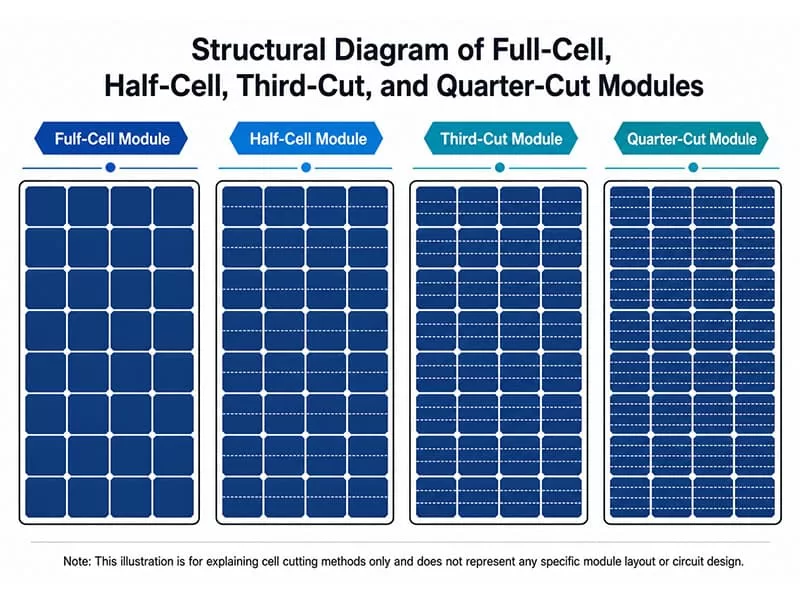
Common multi-cut formats include:
- Half-cell modules: full cells are cut into two pieces and have become a mature mainstream design;
- Third-cut modules: full cells are cut into three pieces to further reduce the operating current of each cell unit;
- Quarter-cut and higher-segmentation modules: cells are further divided for more complex circuit segmentation;
- Shingled modules: a special high-density segmentation and interconnection method.
From the outside, multi-cut technology may look like a change in cell cutting method. But from the operating principle of the module, it changes the internal current distribution, interconnection path, and shading response.
In traditional full-cell modules, each cell carries a relatively high operating current. As cell sizes increase and module power rises, current management becomes more important. Multi-cut design has emerged in this context: by splitting larger generating units into smaller cell units, it reduces unit current and creates more room for flexible circuit design.
2. Why do high-power modules need more refined current management?
Multi-cut technology is gaining attention because high-power modules require more precise management of internal current, thermal losses, and interconnection paths.
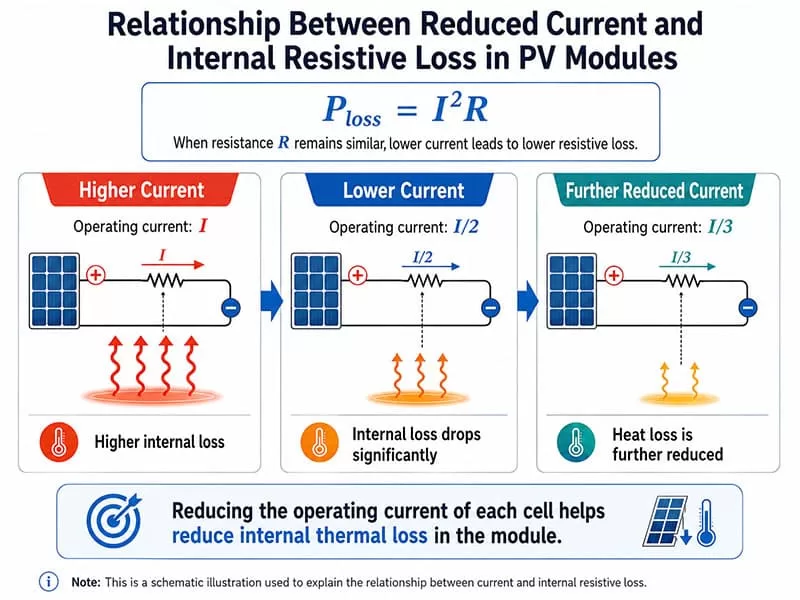
Inside a PV module, ribbons, interconnection areas, and conductive paths all generate a certain amount of resistive loss. This loss is related to the square of the current and can be understood through the following formula:
P_loss = I²R
Here, I represents current and R represents resistance.
This means that, under similar conditions, the higher the operating current, the more obvious the internal resistive loss and local heating pressure become. By cutting a full cell into smaller cell units, the operating current of each unit can be reduced, which helps lower part of the internal losses.
In an ideal case:
- the current of a half-cell unit is approximately 1/2 of that of a full cell;
- the current of a third-cut cell unit is approximately 1/3 of that of a full cell;
- the current of a quarter-cut cell unit is approximately 1/4 of that of a full cell.
From the formula, lowering current can reduce resistive loss at a squared rate. But in a real PV module, the final performance is not determined by mathematical splitting alone. Cutting quality, edge passivation, ribbon design, series-parallel structure, bypass diode segmentation, and encapsulation reliability all affect actual module output.
Therefore, multi-cut technology is not simply a cell-cutting technique. It is a circuit design approach built around lower current, lower losses, and long-term reliability.
3. Why does partial shading affect the output of the whole module?
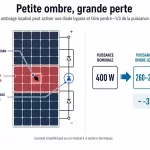
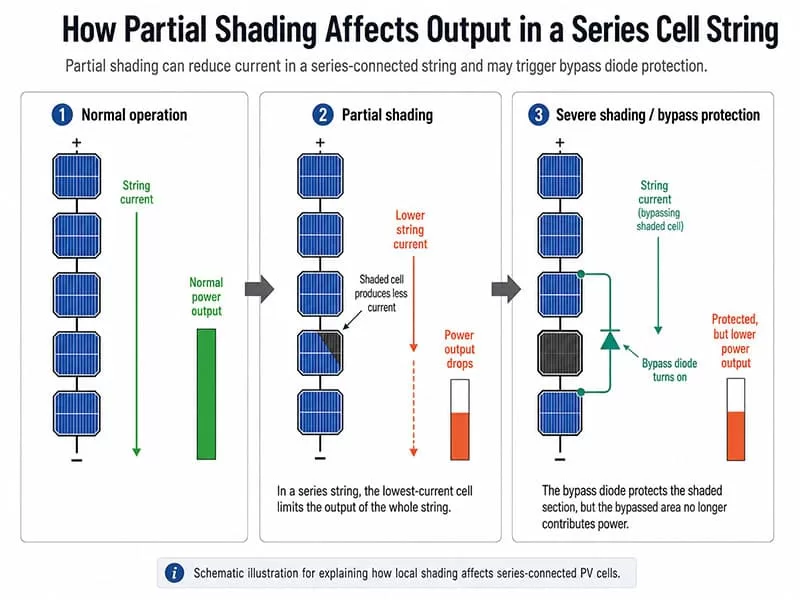
Partial shading affects module output because the current in a series circuit is often limited by the cell unit with the lowest current.
The cells inside a PV module do not operate completely independently. They are connected in series or in series-parallel configurations to form cell strings. When one cell or one area is shaded, its generating capability drops, and its output current decreases as well.
In a series circuit, the current of the entire cell string is often determined by the cell with the lowest current. In other words, a local shadow may not only affect the shaded area itself, but also reduce the output of the entire string.
Under severe shading, the shaded cell may become reverse-biased, changing from a power-generating unit into a power-consuming load. This can cause local heating, commonly known as the hot-spot effect.
To reduce hot-spot risk, modules are usually equipped with bypass diodes. When one cell string is severely shaded, the bypass diode allows current to bypass the affected area, helping protect the cells. However, the bypassed section can no longer contribute power, so module output will still decrease.
Therefore, shading performance does not depend only on the cells themselves. It is also strongly affected by internal circuit design, bypass diode segmentation, and cell string layout.
4. How does a multi-cut circuit improve shading response?
Multi-cut design can reduce the secondary impact of local shading by using more segmented cell units and circuit areas.
In traditional module structures, cells and cell strings are divided into relatively large sections. A local shadow may therefore affect a larger part of the circuit output. Multi-cut design divides larger cell units into smaller generating units and uses more refined series-parallel structures, making it easier to limit local current mismatch to a smaller area.
With a well-designed circuit, multi-cut modules can help:
- reduce the operating current of each cell unit;
- lower part of the resistive losses along interconnection paths;
- reduce local heating pressure;
- limit the secondary loss caused by local shading;
- allow unshaded areas to continue generating power as much as possible.
This is one reason multi-cut design is receiving attention in complex rooftop applications.
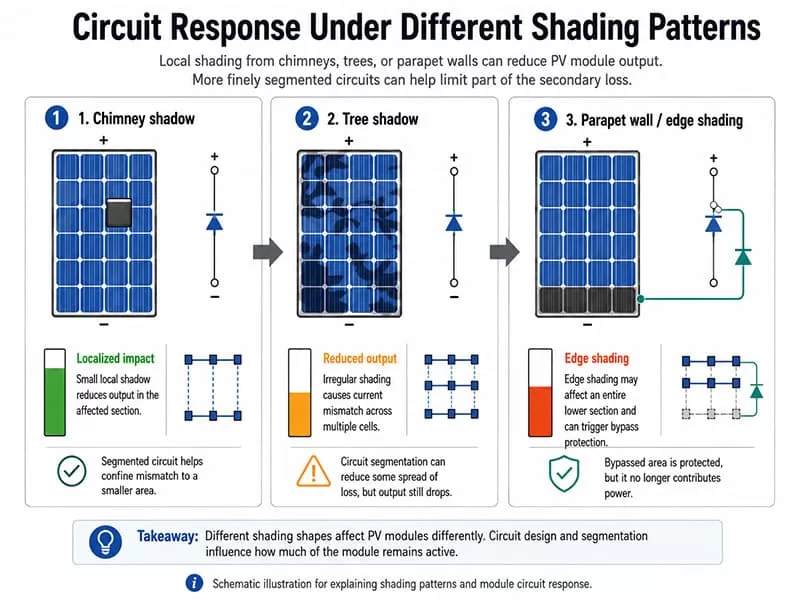
In real projects, shading is often irregular. Chimneys, tree shadows, parapet walls, ventilation equipment, skylights, and nearby buildings can create shadows of different shapes and directions. Some shadows are localized, some are horizontal, and some move as the sun angle changes.
Therefore, multi-cut technology can improve shading response only when the internal circuit design matches the actual shading scenario. It cannot eliminate shading, nor can it guarantee better performance under every shading condition. But it provides a more flexible design basis for reducing the spread of local mismatch losses.
5. What are the differences between different cell segmentation designs?
Different segmentation designs do not have a simple ranking of better or worse. They represent different trade-offs in current management, encapsulation process, and application suitability.
The following table compares common module structures from the perspective of their main design changes, functions, and points to note:
| Design type | Core change | Main function | Points to note |
|---|---|---|---|
| Full-cell module | Cells are not cut | Simple structure, widely used in earlier module designs | Higher current per cell; local shading may affect a larger area |
| Half-cell module | Cells are cut into 2 pieces | Reduces unit current and part of the resistive loss | Mature technology, but limited room for differentiation |
| Third-cut module | Cells are cut into 3 pieces | Further reduces unit current and improves thermal loss and local response | Requires more careful circuit design and manufacturing consistency |
| Quarter-cut and higher segmentation | Cell units are further divided | Finer circuit segmentation and more design flexibility | More complex interconnection, encapsulation, and reliability verification |
| Shingled module | Special high-density segmentation and interconnection | Improves packing density and may offer specific advantages in some shading scenarios | A different technology route and should not be compared too simplistically |
From this perspective, multi-cut is not a single technology, but a group of module structure solutions built around current, loss, shading, and reliability.
Even if different manufacturers use similar segmentation methods, their actual circuit designs may differ. Whether a module has better local shading response depends not only on how many pieces each cell is cut into, but also on how the cell strings are arranged, how parallel paths are designed, how bypass diodes are segmented, and how stable the encapsulation process is.
6. Is more segmentation always better?
More segmentation does not automatically mean better performance. The key lies in whether the circuit design is reasonable and whether reliability and cost remain controllable.
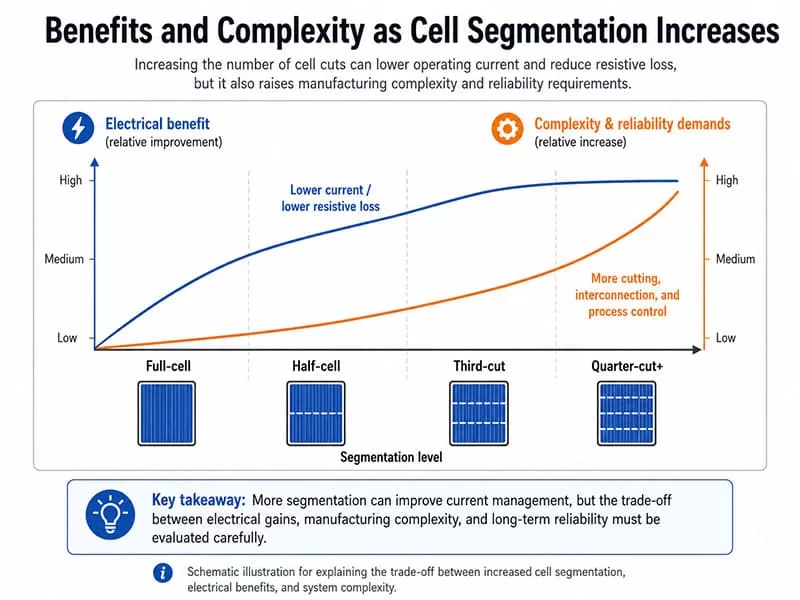
As cells are divided into smaller units, the operating current of each unit decreases, which theoretically helps reduce resistive loss and local heating. At the same time, however, the number of cutting edges, interconnection paths, soldering points, and encapsulation structures also increases, placing higher demands on manufacturing consistency and long-term reliability.
If the cutting edges are not properly processed, risks such as edge recombination, microcracks, or long-term degradation may increase. If the interconnection structure becomes too complex, production consistency and long-term reliability verification may also become more challenging.
In addition, different shadow shapes can lead to different results. Localized shading, horizontal shading, vertical shading, and edge shading under low sun angles all affect module circuit areas in different ways. A segmentation design that performs well under one shading pattern may not show the same advantage in every scenario.
Therefore, the key question is not “how many cuts can a cell have,” but whether the module can achieve a reasonable balance among lower current, lower loss, reliability, cost, and application scenario.
7. What should be considered when selecting multi-cut modules?
When choosing multi-cut modules, it is not enough to look only at the number of cell cuts. Circuit design, shading conditions, installation method, and long-term reliability should also be considered.
First, the internal circuit design of the module should be evaluated. Even if two modules both use half-cell, third-cut, or other multi-cut designs, their cell string layout, parallel paths, and bypass protection zones may differ. These details often determine shading performance.
Second, the project scenario should be considered. If the roof has no shading, a uniform orientation, and good installation conditions, the differences between segmentation structures may not be very obvious. But if the project has chimneys, tree shadows, parapet walls, equipment shadows, or high-temperature operating conditions, the low-current and local-response capabilities of multi-cut design become more relevant.
Third, module reliability matters. More segmentation means more cutting edges and interconnection areas. Therefore, cutting quality, edge passivation, encapsulation process, soldering consistency, and long-term weather resistance are all important.
Finally, system design also needs to be considered. Module orientation, string design, inverter matching, shading duration, and O&M conditions all affect the final power generation result. Multi-cut modules can help improve some operating issues, but they cannot replace proper system design.
For commercial and industrial rooftops, complex residential roofs, BIPV projects, or applications with partial shading risks, the real focus should not be only on peak power under standard test conditions, but on long-term energy stability in real operating environments.
8. Conclusion: the value of multi-cut design lies in real-world power generation stability
From half-cell to multi-cut, PV module development is shifting from a pure focus on nominal power toward more stable power generation under real operating conditions.
The core value of multi-cut technology is not to prove how finely a cell can be divided. Instead, it uses lower current, more segmented circuits, and more reasonable interconnection design to reduce internal losses, improve thermal management, and enhance output stability under partial shading.
As high-power modules become more common, internal current paths and circuit segmentation will increasingly affect long-term system performance. For complex rooftops, high-temperature environments, and applications with partial shading risks, stable energy generation is often more important than nominal power alone.
Therefore, when discussing multi-cut modules, the most important question is not how many times a cell can be cut, but whether the circuit design can help the module generate electricity more stably and reliably in real-world conditions.
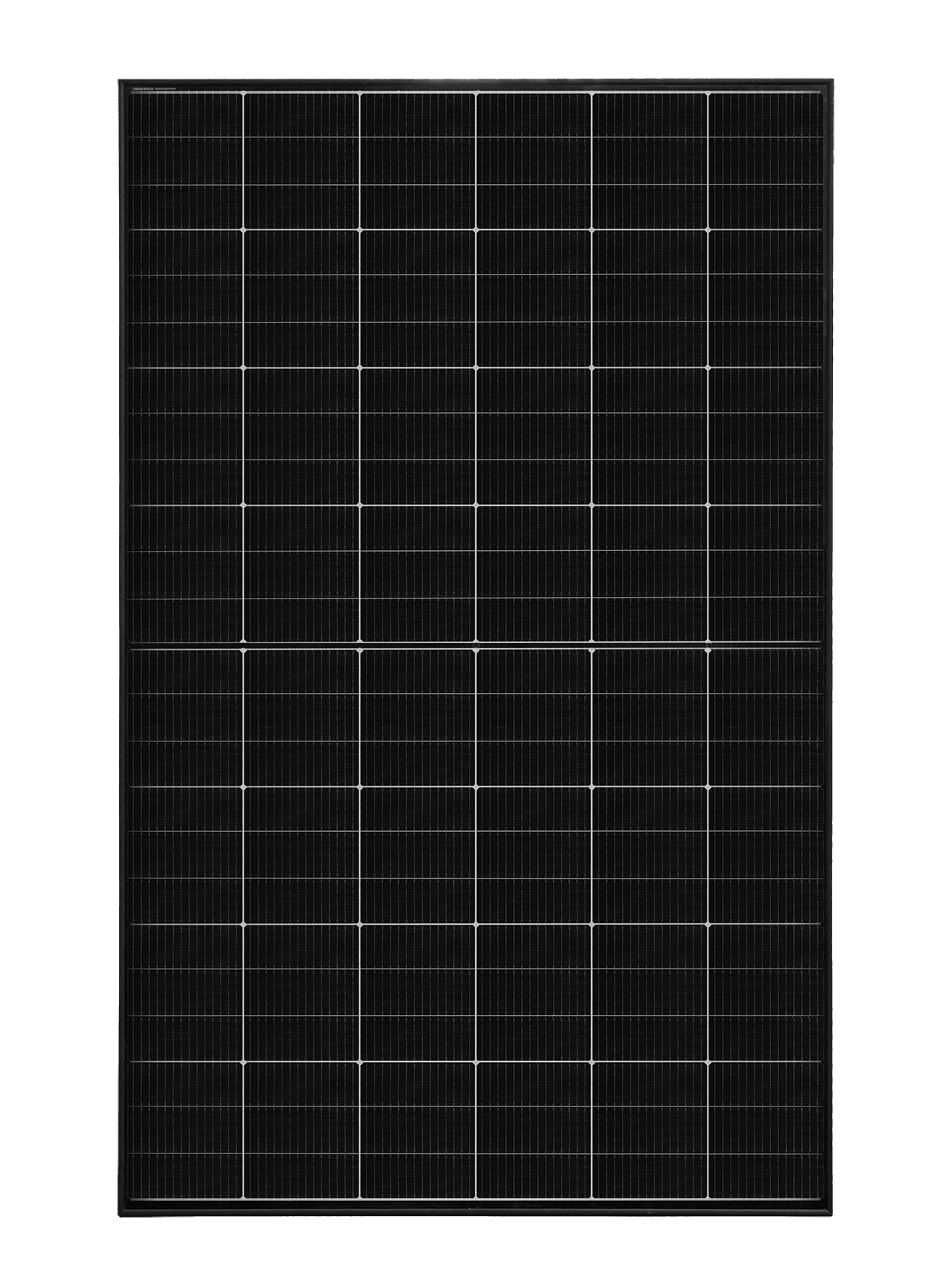
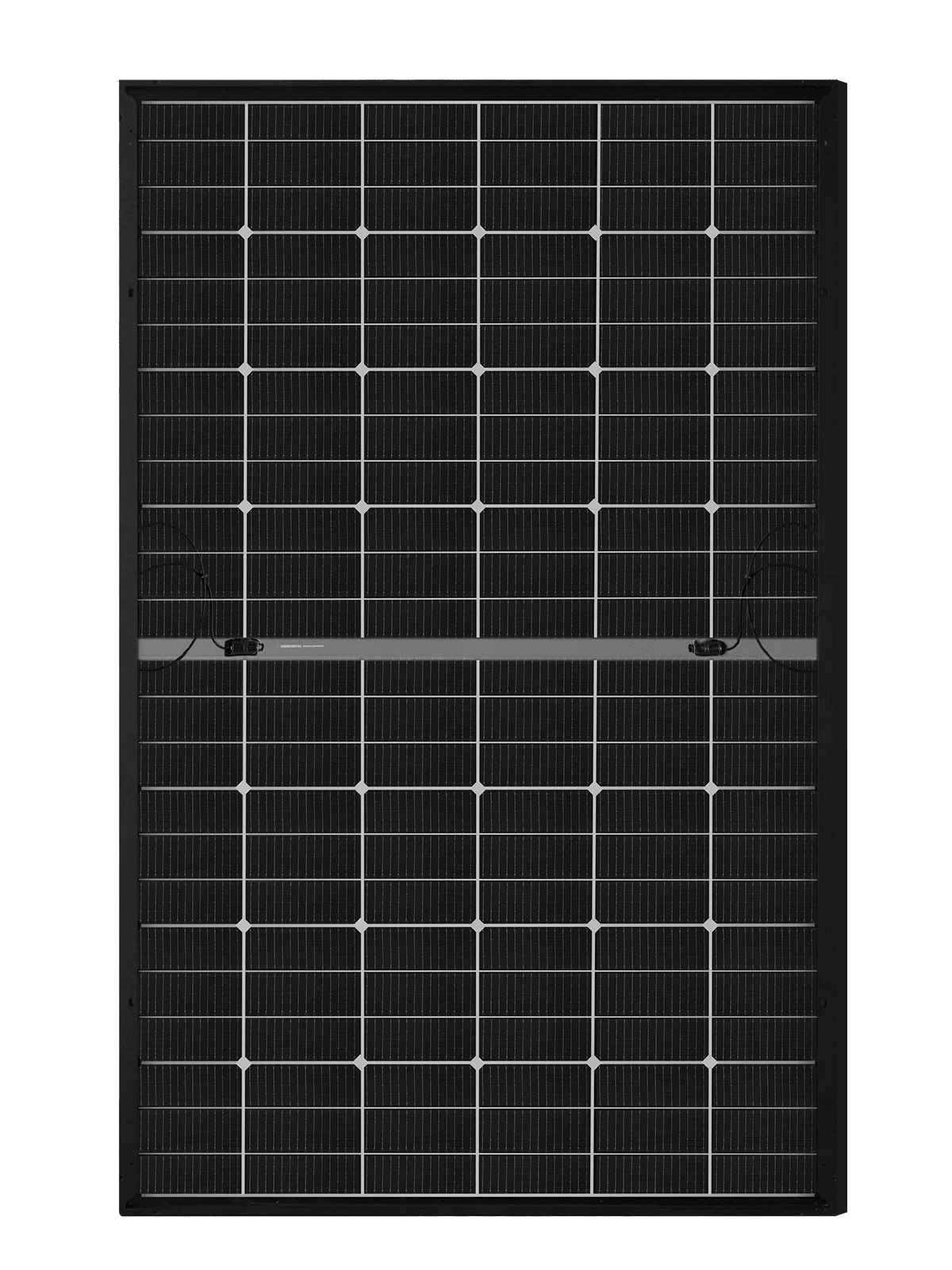
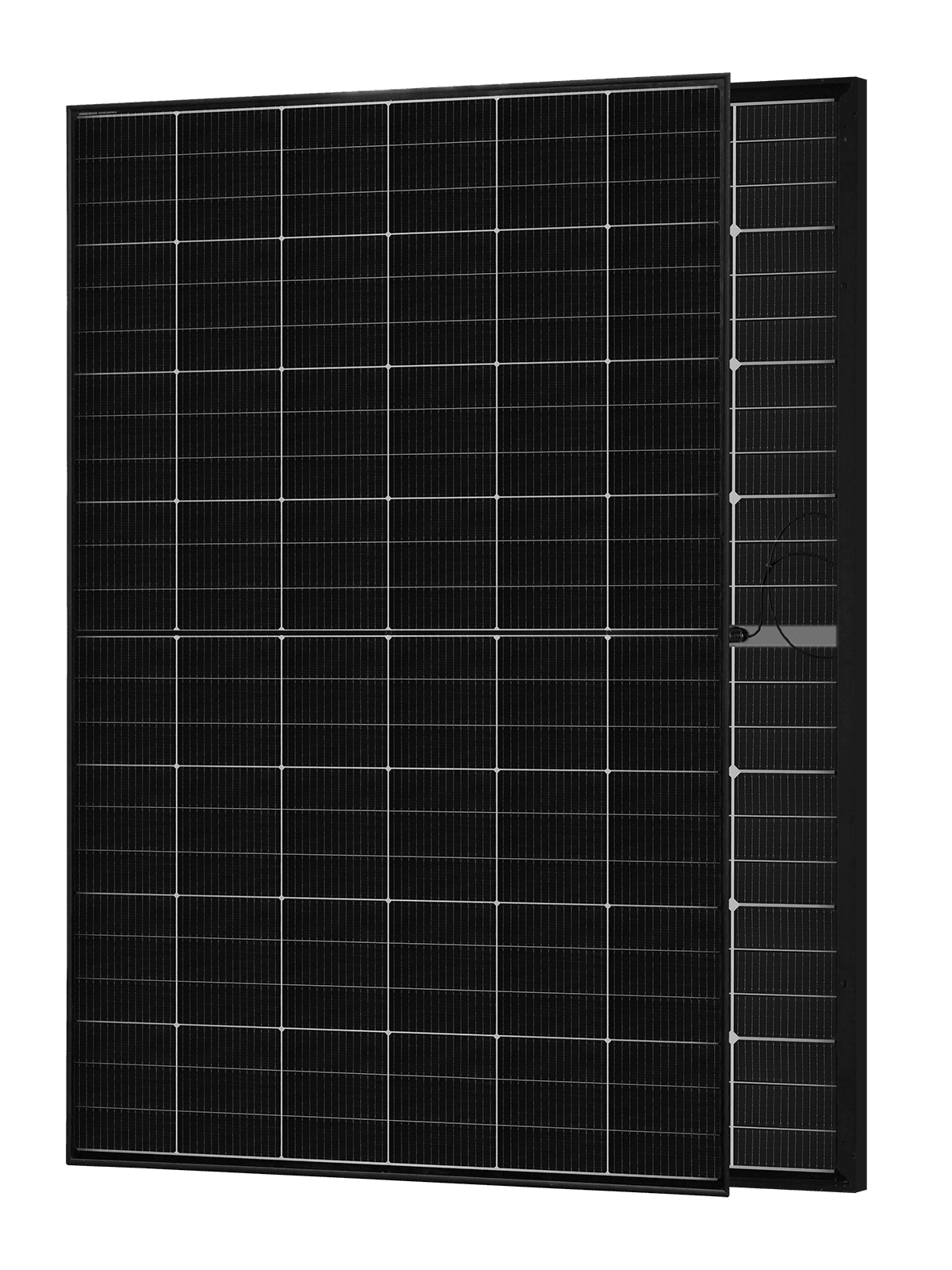
Twisun Pro 430W–460W 1/3-Cut N-TOPCon Bifacial Solar Module (Transparent)
|
|
Power output: 430W / 435W / 440W / 445W / 450W / 455W / 460W |
|
|
Efficiency: 21.50%–23.02% |
|
|
Mechanical load rating: Front 5400 Pa / Rear 4000 Pa |
|
|
Dimensions (L × W × H): 1762 × 1134 × 30 mm |
|
|
Packing: 36 pcs/pallet, 936 pcs/40HQ |
|
|
Warranty: 30-year product and performance warranty |
Reference
Fraunhofer ISE, Techno-Economic Analysis of Half Cell Modules – The Impact of Half Cells on Module Power and Costs.
https://www.ise.fraunhofer.de/content/dam/ise/de/documents/publications/conference-paper/36-eupvsec-2019/Mittag_4AV120.pdf
Fraunhofer CSP / IMWS, Reduced Shading Effect on Half-Cell Modules – Measurement and Simulation.
https://publica.fraunhofer.de/entities/publication/19a6c151-450a-4100-955c-c6ec63f84360
Fraunhofer, A Comprehensive Study of Module Layouts for Silicon Solar Cells Under Partial Shading.
https://publica.fraunhofer.de/bitstreams/3b85b226-12c0-45e5-8ce2-693c666bed55/download
NREL, Partially Shaded Operation of a Grid-Tied PV System.
https://docs.nrel.gov/docs/fy09osti/46001.pdf
EPJ Photovoltaics, Challenges and Advantages of Cut Solar Cells for Shingling and Half-Cell Modules.
https://www.epj-pv.org/articles/epjpv/full_html/2024/01/pv230065/pv230065.html
VDMA / ITRPV, International Technology Roadmap for Photovoltaics 2025.
https://www.vdma.eu/de/international-technology-roadmap-photovoltaic
Scientific Reports, Performance Analysis of Partially Shaded High-Efficiency Mono PERC / Mono Crystalline PV Module under Indoor and Environmental Conditions.
https://www.nature.com/articles/s41598-024-72502-z
Recent Posts
- From Half-Cell to Multi-Cut: Why PV Modules Are Paying More Attention to More Segmented Circuit Design?
- Does Summer Heat Reduce Solar Panel Efficiency? What Really Happens to PV Output
- Low-Carbon PV Procurement in France: Why ECS, PEP Ecopassport and Solar Carports Matter
- PV Module Installation Beyond Rooftops: Multi-Scenario Applications for Bifacial N-Type Modules in Europe
- Europe’s Grid Cap Era: Why High-Efficiency Solar Panels Matter More in 2026