For years, home solar systems have focused on one main question:
How much electricity can my rooftop solar system generate?
But as home batteries, smart meters, electric vehicles and flexible electricity tariffs become more common, residential energy management is entering a new phase.
The more important questions are becoming:
When should energy be generated, stored and used — and when should a household reduce its reliance on the grid?
This is where a Home Energy Management System (HEMS) comes in.
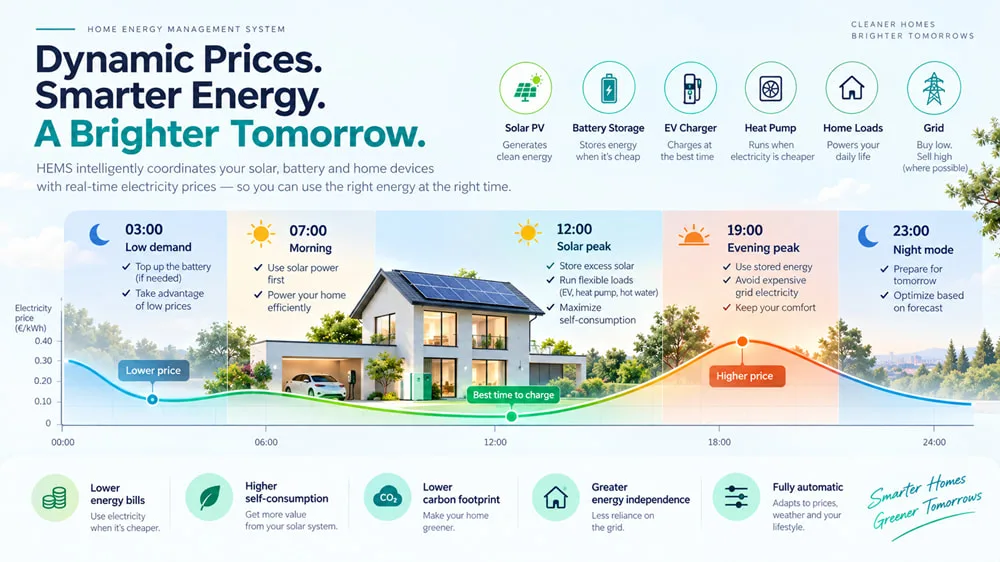
By connecting solar PV, battery storage, EV chargers, heat pumps and smart meters, a HEMS can coordinate household energy use according to electricity prices, solar forecasts, household demand and battery status.
When combined with dynamic electricity pricing, a home energy system no longer simply uses electricity whenever it is produced. Instead, it can actively shift energy use to more suitable times.
What Is a Home Energy Management System?
A Home Energy Management System (HEMS) acts as the intelligent control centre of a home’s energy ecosystem.
Depending on system compatibility, it can connect and coordinate equipment such as:
- Solar inverters
- Home battery storage
- Smart meters
- EV chargers
- Heat pumps
- Hot-water systems
- Other flexible household loads
A conventional solar installation primarily focuses on electricity generation.
A HEMS adds another layer:
deciding when different devices should operate.
For example, when solar generation is high around midday, a HEMS may prioritise battery charging while also scheduling an EV charger, heat pump or hot-water system.
Later in the day, when electricity prices are higher and solar output has fallen, the system can reduce grid imports and make greater use of stored solar energy.
Dynamic Electricity Pricing vs. Time-of-Use Tariffs
Dynamic electricity pricing and Time-of-Use tariffs are sometimes used interchangeably, but they are not exactly the same.
Time-of-Use Tariffs
Time-of-Use, or ToU, tariffs typically divide the day into predetermined pricing periods.
For example:
- Night: lower price
- Daytime: standard price
- Evening peak: higher price
Because these periods are generally known in advance, households can schedule activities such as EV charging, appliance use or battery charging accordingly.
Dynamic Electricity Pricing
Dynamic electricity pricing is more flexible.
Under EU electricity-market rules, a dynamic electricity price contract reflects price changes in electricity spot markets, including day-ahead and intraday markets, at intervals linked to market settlement periods. [1]
Depending on the tariff and market, prices may therefore change hourly or even every half hour.
When renewable generation is abundant and electricity demand is relatively low, wholesale electricity prices may fall significantly.
During periods of higher demand or tighter supply, prices may rise.
The main opportunity is therefore not simply to use less electricity.
It is to:
shift flexible electricity consumption to more favourable periods.
What Is Time-Based Energy Arbitrage?
When a household combines:
HEMS + battery storage + a variable or dynamic electricity tariff
it may be able to use a strategy often described as energy arbitrage or time-based energy arbitrage.
The basic principle is simple:
store energy when electricity is cheaper and use stored energy when electricity is more expensive.
For example, when prices are low, a HEMS can prioritise charging the battery from solar generation.
If solar production is insufficient, electricity is inexpensive and higher prices are expected later, a compatible system may also decide to charge part of the battery from the grid.
During higher-price periods, the home can then reduce grid imports and use stored energy instead.
The real value of smart energy management, however, goes beyond simply “buy low, use high”.
A HEMS can take several factors into account:
electricity prices + weather + solar forecast + household demand + battery status
to determine an appropriate energy strategy.
A Day with HEMS: How Can a Smart Home Manage Energy Automatically?
Imagine a household equipped with:
- Rooftop solar PV
- Home battery storage
- HEMS
- Smart meter
- Electric vehicle
- Heat pump
Its energy use could be managed differently throughout the day.
12:00 — High Solar Generation
Around midday, solar generation is often at or near its highest level.
At the same time, household demand may be relatively limited, creating surplus solar electricity.
A HEMS can prioritise this energy according to a predefined strategy:
Solar PV → Household consumption → Battery → Flexible loads
For example, the system may:
- Charge the home battery
- Run the heat pump or heat domestic hot water
- Charge an electric vehicle
- Activate other flexible loads
If the household is also on a dynamic tariff and electricity prices are favourable, the HEMS can combine price data with weather and generation forecasts to decide whether additional grid charging is worthwhile.
19:00 — Evening Peak Period
Evening is often one of the busiest periods for residential electricity consumption.
Cooking, lighting, entertainment systems, heat pumps and other appliances may all operate while solar generation has already fallen significantly.
A HEMS can respond by:
- Reducing grid imports during expensive periods
- Prioritising stored battery energy
- Postponing non-essential loads
- Maintaining a minimum battery reserve based on user preferences
Solar energy stored earlier in the day can therefore supply household loads during the evening.
Where local regulations, electricity contracts and system configurations permit, some systems may also support electricity export or participation in other flexibility services.
03:00 — Low Demand and Planning for Tomorrow
Household electricity demand is usually lower overnight.
Some electricity tariffs may also offer lower prices during these periods.
A HEMS can use weather and consumption forecasts to plan for the following day.
If strong solar generation is expected, the system may leave available battery capacity for the next day’s solar production.
If cloudy weather and lower PV generation are expected, while overnight electricity prices are favourable, the system may choose to charge part of the battery from the grid.
A genuinely intelligent HEMS therefore does more than simply:
charge when prices are low and discharge when prices are high.
It can continuously evaluate:
- Current electricity prices
- Expected future prices
- Weather forecasts
- Solar generation forecasts
- Battery State of Charge (SOC)
- Household energy demand
- User comfort and charging requirements
and adjust its strategy accordingly.
How Does a HEMS Make Energy Decisions?
A HEMS can be understood as an energy optimisation system using several types of information.
Inputs
Electricity Prices
Current and expected electricity prices
Solar Forecast
Expected photovoltaic generation
Weather Forecast
Weather conditions that may affect generation and demand
Household Demand
Expected electricity consumption
Battery SOC
Current battery State of Charge
User Preferences
For example, a minimum EV charge level by a specified time
Optimisation
The HEMS analyses these inputs and determines an appropriate energy-use strategy.
Equipment Control
Depending on device compatibility, the system can coordinate:
Solar PV → Battery → EV Charger → Heat Pump → Household Loads → Grid
The key value of HEMS is therefore the ability to bring previously separate household energy devices into one coordinated energy ecosystem.
How Is Flexible Energy Management Already Used in Europe?
France: HEMS, EDF Tempo and Solar Self-Consumption
France provides an interesting example through the EDF Tempo tariff.
Tempo is not a conventional real-time dynamic tariff. Instead, electricity prices vary according to the colour assigned to each day and whether consumption occurs during peak or off-peak hours.
EDF currently divides the year into 300 Blue Days, 43 White Days and 22 Red Days. Red Days are concentrated during the winter period, when households are encouraged to reduce or shift consumption during peak hours. A communicating Linky meter is required for the Tempo option. [3]
For a household with solar and battery storage, an energy management system could use this information to plan consumption in advance.
During more expensive periods, it may help to:
Prepare battery capacity in advance
Increase solar self-consumption
Shift flexible loads
Reduce grid imports during peak periods
For households with both solar PV and battery storage, tariffs such as Tempo make the question of when electricity is used increasingly important.
United Kingdom: Half-Hourly Dynamic Electricity Pricing
The UK provides a more direct example of dynamic electricity pricing.
Agile Octopus, for example, offers electricity prices that change every half hour based on wholesale electricity prices. A compatible smart meter capable of providing half-hourly readings is required. [4]
According to Octopus Energy, this type of tariff can be particularly relevant for households with:
Electric vehicles
Heat pumps
Home batteries
Other energy-intensive flexible appliances
A HEMS can monitor lower-price periods and schedule equipment such as battery storage, EV chargers, heat pumps and hot-water systems accordingly.
When prices rise, it can reduce grid consumption where possible.
The major advantage over manually checking electricity prices is simple:
the optimisation process can be automated.
How Much Can a HEMS Save?
There is no universal percentage.
The financial benefit of a HEMS depends on several factors, including:
Local tariff structure
Difference between low and high electricity prices
Availability of dynamic or Time-of-Use tariffs
Solar PV system size
Battery storage capacity
Household load profile
EV ownership
Heat-pump use
Battery charge and discharge efficiency
Battery degradation and cycling costs
In general, the more flexible energy demand a household has, the more opportunities a HEMS may have to optimise consumption.
A solar-only household may primarily use HEMS to improve immediate self-consumption.
Adding an EV creates another flexible load that can be shifted toward periods of higher solar generation or lower electricity prices.
Adding battery storage makes it possible to shift energy consumption between different periods of the day.
Which Homes Can Benefit Most from HEMS?
Solar PV Only
A HEMS can help increase solar self-consumption and optimise certain controllable household loads.
Solar PV + Electric Vehicle
EV charging can be scheduled around solar generation and electricity prices.
Solar PV + Heat Pump
Heat pumps are significant electrical loads with some potential flexibility.
A HEMS can schedule suitable operation during periods of higher solar generation or more favourable electricity prices while respecting household comfort requirements.
Solar PV + Home Battery
Excess solar electricity generated during the day can be stored for use later, including during higher-price periods.
Solar PV + Battery + EV + Heat Pump + Dynamic Tariff
This combination generally provides the greatest number of controllable energy resources.
A HEMS can coordinate generation, storage and several major household loads while reducing the need for manual intervention.
What Should You Consider Before Using HEMS with Dynamic Pricing?
A HEMS is not simply a piece of software that will work with every energy system automatically.
Several factors should be checked before deployment.
Device Compatibility
Check whether the inverter, battery, EV charger and heat pump support third-party control, APIs, Modbus or other compatible communication protocols.
Smart Meter Requirements
Some dynamic electricity tariffs require smart meters capable of providing more granular consumption data. EU electricity-market rules also connect access to dynamic electricity contracts with appropriate smart-meter functionality. [1][2]
Battery Cycling
More frequent charging and discharging can increase the number of battery cycles.
A good optimisation strategy should therefore consider not only electricity prices but also battery efficiency, operating limits and long-term battery life.
Grid Charging
Rules governing charging a home battery from the electricity grid can vary according to the country, electricity contract and equipment configuration.
Electricity Export
Whether electricity stored in a battery can be exported to the grid also depends on local regulation, export tariffs, electricity contracts and technical configuration.
The Real Value of HEMS: From Solar Installation to Home Energy System
The future value of residential solar is not determined by panel wattage alone.
As home batteries, electric vehicles, heat pumps, smart meters and flexible electricity tariffs become more common, another question becomes increasingly important:
Can all these devices work together intelligently?
A traditional solar system answers:
How can I generate electricity?
A HEMS adds a second question:
How can I use that electricity at the right time?
By coordinating solar PV, battery storage, EV charging, heat pumps and electricity prices, a HEMS can give households greater control over their energy use and help reduce reliance on expensive grid electricity.
For households using dynamic or flexible electricity tariffs, intelligent energy scheduling can become an increasingly important part of the overall solar and storage system.
Frequently Asked Questions
Can HEMS Work with an Existing Solar System?
It depends on whether the existing inverter, battery and related devices support compatible communication interfaces.
Many modern systems can communicate through APIs, Modbus or manufacturer platforms.
Compatibility should always be confirmed for the specific equipment before installation.
Is HEMS Useful Without a Home Battery?
Yes.
Without a battery, a HEMS can still manage flexible loads such as:
- EV charging
- Heat-pump operation
- Hot-water heating
- Compatible smart appliances
The system can shift some of these loads toward periods of stronger solar generation or lower electricity prices.
Battery storage, however, adds the ability to shift energy itself between different periods.
Can a HEMS Charge a Home Battery from the Grid?
Some systems can, provided this is supported by the battery and inverter configuration and permitted under the relevant electricity contract and local rules.
Whether grid charging makes economic sense depends on factors such as:
- Electricity price differences
- Battery efficiency
- Battery cycling costs
- Expected solar generation the following day
Will HEMS Affect Home Comfort?
It does not have to.
Users can define minimum requirements and priorities.
For example:
“The EV must reach 80% charge by 7:00 a.m.”
The HEMS can then search for suitable charging periods while respecting that requirement.
Can HEMS Control Both an EV Charger and a Heat Pump?
Yes, if the relevant devices and HEMS support compatible control and communication protocols.
This is one of the main advantages of home energy management: bringing solar, storage and major household loads into a coordinated system.
Is Dynamic Electricity Pricing Always Cheaper Than a Fixed Tariff?
No.
Dynamic electricity pricing tends to be more useful for households that can shift a meaningful share of their electricity consumption.
If most electricity use occurs during expensive periods and the household has no battery or flexible loads, a dynamic tariff may not necessarily result in lower energy costs.
The household’s actual consumption profile should therefore be considered before choosing an electricity tariff.
References
[1] European Union — Directive (EU) 2019/944 on common rules for the internal market for electricity
https://eur-lex.europa.eu/eli/dir/2019/944/2024-07-16/eng
[2] European Commission — Smart grids and meters
https://energy.ec.europa.eu/topics/markets-and-consumers/smart-grids-and-meters_en
[3] EDF Particulier — Tempo electricity tariff (official information)
https://particulier.edf.fr/fr/accueil/gestion-contrat/options/tempo/details.html
[4] Octopus Energy — What is Agile Octopus, and how do I join?
https://octopus.energy/help-and-faqs/articles/what-is-agile-octopus-and-how-do-i-join/