When installing solar panels, one common recommendation is to face them south to maximize electricity generation.
But not every building has a south-facing roof.
Some homes have east- and west-facing roof slopes, while others have usable roof space facing north. Even a south-facing roof may experience shading from nearby trees or buildings.
So, is a south-facing roof always the best choice for solar panels? And is installing solar panels on an east-west or north-facing roof still worthwhile?
The answer depends on more than annual electricity production.
Solar panel orientation also affects when electricity is generated, how much energy can be consumed directly, and the overall economics of a photovoltaic (PV) system.
This guide compares south-facing, east-west and north-facing solar panels, explains how installation tilt affects energy output, and shows how to estimate the optimal solar panel angle using the European Commission’s PVGIS tool.
Quick Answer: What Is the Best Orientation for Solar Panels?
In France and much of the Northern Hemisphere, south-facing solar panels generally provide favorable conditions for maximizing annual electricity production.
However, the best installation direction depends on the building and its electricity consumption.
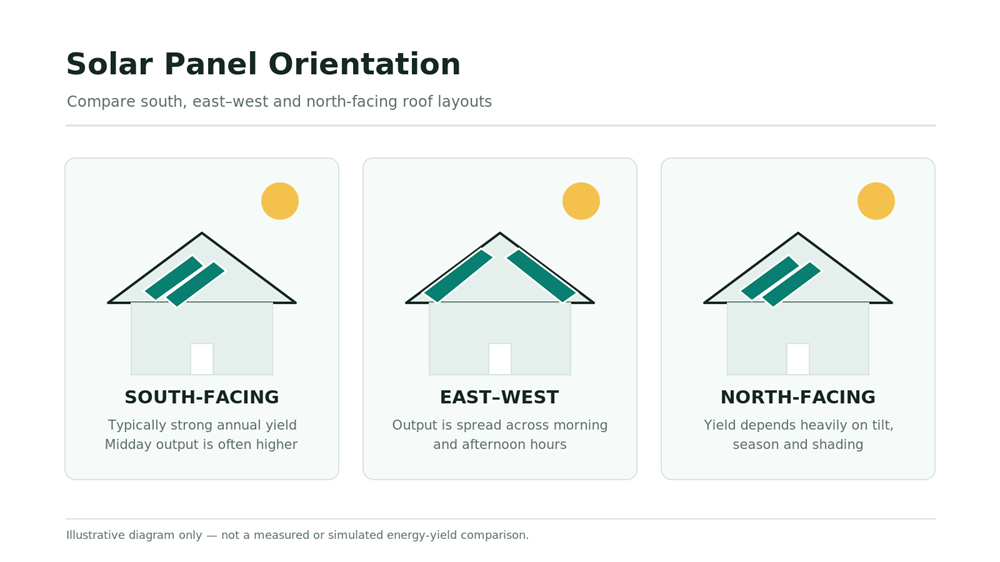
South-facing panels: Generally suitable for maximizing annual solar energy yield.
East-west solar panels: Distribute electricity generation more widely across the morning and afternoon, potentially improving self-consumption.
North-facing panels: Usually generate less electricity on steeply pitched roofs, but low-tilt installations may still be worth evaluating.
Solar panel tilt: Influences how much solar radiation reaches the panels and should be assessed together with orientation.
Best overall solution: Depends on available roof area, shading, electricity demand, system costs and local solar resources.
For a more accurate assessment, homeowners and installers can use the European Commission’s free PVGIS solar energy calculator to compare different installation configurations.
The angle that produces the most electricity is not necessarily the one that delivers the best financial return.
Table of Contents
South, East-West or North: Which Solar Panel Orientation Is Best?
How Much Does Solar Panel Orientation Affect Energy Production?
Why Can East-West Solar Panels Improve Self-Consumption?
Are North-Facing Solar Panels Worth Installing?
How to Calculate Your Roof’s Solar Panel Tilt Angle
How to Find the Optimal Solar Panel Angle with PVGIS
How to Choose the Right Solar Panel Layout and Technology
Frequently Asked Questions
1. South, East-West or North: Which Solar Panel Orientation Is Best?
The amount of solar energy received by a photovoltaic module depends on several factors, including its orientation, tilt angle, local solar irradiation and surrounding shading.
For most fixed rooftop solar installations in France, a south-facing orientation is generally a useful reference for maximizing annual energy production.
However, east-west systems can offer advantages when electricity consumption is spread across the daytime.
Comparison of Solar Panel Orientations
| Orientation | Annual Energy Potential | Daily Generation Pattern | Suitable Applications |
|---|---|---|---|
| South-facing | Generally high | Stronger generation around midday | Projects prioritizing annual electricity yield |
| East-west | Usually lower per installed kWp than an optimized south-facing system | More generation in the morning and afternoon | Dual-slope roofs and daytime self-consumption |
| North-facing | Generally lower, particularly on steep roofs | Strongly affected by tilt and season | Low-tilt roofs requiring project-specific assessment |
Note: These are general characteristics of fixed PV installations in France. Actual results depend on geographic location, roof pitch, shading and system design.
Why Do South-Facing Solar Panels Usually Produce More Electricity?
In the Northern Hemisphere, south-facing fixed solar panels generally receive favorable solar irradiation over the course of a year.
When the roof is properly inclined and free from significant shading, this orientation often provides high annual energy yield per installed kilowatt-peak (kWp).
Under clear skies, south-facing arrays typically produce a more pronounced peak around the middle of the day.
However, there is an important consideration:
The time when solar panels generate the most electricity may not be the time when a building consumes the most electricity.
For example, a household where most occupants are away during the day may have relatively low electricity demand around noon.
A portion of the electricity generated during this period may therefore be exported to the grid rather than used directly.
This is why solar panel orientation should be evaluated alongside electricity consumption patterns.
2. How Much Does Solar Panel Orientation Affect Energy Production?
One of the most common questions is:
How much electricity will an east-west solar installation produce compared with a south-facing system?
There is no universal percentage that applies to every rooftop.
The difference depends on geographic location, roof inclination, system configuration and shading conditions.
However, research from the French Agency for Ecological Transition (ADEME) provides a useful reference.
ADEME 2025 Study: Balancing Annual Yield and Self-Consumption
In its January 2025 report, Autoconsommation individuelle d’origine photovoltaïque, ADEME examined the potential benefits of distributing photovoltaic modules across south, east and west orientations.
The report indicates that, under the conditions considered, a multi-orientation configuration can offer the following characteristics compared with a fully south-facing installation:
| Indicator | South-East-West Configuration Compared with South |
|---|---|
| Expected electricity production | Approximately 10% lower |
| Generation profile | More widely distributed throughout the day |
| Self-consumption rate | Approximately 6% higher in the referenced comparison |
Source: ADEME, January 2025, page 8.
Importantly, these results refer to a combination of south-, east- and west-facing panels, not an exclusively east-west installation.
They should not be treated as universal performance figures for every roof.
Nevertheless, the research highlights an important principle:
A small reduction in annual electricity production does not necessarily mean a proportional reduction in the practical value of solar energy.
How to Compare Orientations Under the Same Conditions
Consider a hypothetical 6 kWp rooftop solar installation in Lyon, France.
To compare different orientations fairly, the same system capacity, location, module technology and other relevant assumptions should be maintained.
| Parameter | South-Facing | East-West | North-Facing |
|---|---|---|---|
| Location | Lyon | Lyon | Lyon |
| Installed Capacity | 6 kWp | 3 kWp East + 3 kWp West | 6 kWp |
| Tilt Angle | 30° | 30° | 30° |
| Azimuth (PVGIS 5 convention) | 0° | -90° / +90° | ±180° |
| Illustrative System Losses | 14% | 14% | 14% |
These values are simulation inputs, not measured electricity generation results. The 30° tilt is used for comparison, not presented as Lyon’s universal optimal angle.
For an east-west installation, the eastern and western arrays can be simulated separately and their results combined, or modeled using an appropriate multi-section function.
Three indicators are especially useful:
Annual Energy Production (kWh/year)
The estimated amount of electricity generated by the complete system over one year.
Specific Energy Yield (kWh/kWp/year)
The annual electricity production relative to installed peak capacity, allowing comparisons between system configurations.
Monthly Energy Production (kWh/month)
The distribution of electricity generation throughout the year, including seasonal differences.
PVGIS uses historical meteorological datasets to estimate long-term PV performance. These outputs are modeled values rather than measurements from a particular household.
3. Why Can East-West Solar Panels Improve Self-Consumption?
Imagine two households with different electricity consumption patterns.
Household A: Higher Electricity Demand Around Midday
Someone is usually at home during the day. Appliances such as washing machines, water heaters and other electrical equipment often operate around noon.
A south-facing solar installation may align well with this household’s electricity demand.
Household B: Higher Electricity Demand in the Morning and Afternoon
Electricity consumption is more noticeable in the morning and later in the afternoon, while midday consumption is relatively low.
If the roof has suitable eastern and western slopes, an east-west installation may provide a generation profile that better matches some of these needs.
The key difference is not only how much electricity the system produces annually, but also when that electricity becomes available.
What Is the Solar Self-Consumption Rate?
The self-consumption rate (SCR) measures the percentage of solar electricity generated that is consumed on-site.
Self-Consumption Rate = Solar Electricity Consumed On-Site ÷ Total Solar Electricity Generated × 100%
For example, suppose a residential PV system generates 5,000 kWh per year, of which 2,000 kWh are consumed directly by the household.
The self-consumption rate is:
SCR = 2,000 ÷ 5,000 × 100% = 40%
This is an illustrative calculation, not an average figure for European households.
Self-Consumption Rate vs Self-Sufficiency Rate
Another important indicator is the self-sufficiency rate (SSR), also referred to as the solar self-supply ratio.
It measures the share of a building’s total electricity consumption covered by its own solar generation.
Self-Sufficiency Rate = Solar Electricity Consumed On-Site ÷ Total Building Electricity Consumption × 100%
If the same household consumes 8,000 kWh annually:
SSR = 2,000 ÷ 8,000 × 100% = 25%
These indicators answer two different questions:
SCR: How much of the solar electricity generated is used directly?
SSR: How much of the building’s total electricity demand is covered by its solar system?
A higher SCR does not automatically mean a higher SSR or better financial returns.
Does an East-West Solar System Always Save More Money?
Not necessarily.
The economic value of a solar installation depends on several factors, including the electricity purchase price, compensation for exported electricity and the cost of the PV system.
A simplified annual operating benefit calculation is:
Annual Operating Benefit = Self-Consumed Electricity × Avoided Grid Electricity Price + Exported Electricity × Applicable Export Tariff − Annual Operating Costs
This is not a complete return-on-investment calculation. Initial investment, maintenance, replacement costs, degradation and other financial assumptions must also be considered.
For grid-connected PV projects in France, surplus electricity arrangements depend on the applicable contract and regulatory conditions.
Relevant information is available from:
Enedis:
https://www.enedis.fr/je-vends-le-surplus-de-ma-production-consommee
EDF OA:
https://www.edf-oa.fr/le-contrat-s21
Electricity export rates and support arrangements are subject to regulatory changes and project eligibility requirements.
For projects in other European countries, local electricity tariffs and grid regulations must be evaluated separately.
The best-performing PV system is not necessarily the system with the highest annual energy production. It is the one that delivers the greatest value under the project’s actual operating conditions.
4. Are North-Facing Solar Panels Worth Installing?
North-facing rooftops are generally less favorable for solar energy generation in France and much of the Northern Hemisphere.
This is particularly true for steeply inclined roofs, where panels may receive significantly less direct solar irradiation over the year.
However, this does not mean that north-facing solar panels cannot generate electricity.
Why Can North-Facing Panels Still Generate Electricity?
Solar radiation reaching a photovoltaic module consists of several components.
Direct Normal Irradiance (DNI)
Solar radiation arriving directly from the direction of the sun.
Diffuse Horizontal Irradiance (DHI)
Solar radiation scattered by the atmosphere and clouds, measured on a horizontal surface.
Ground-Reflected Radiation
Solar radiation reflected from nearby surfaces and the surrounding environment.
The actual irradiation received by an inclined PV module depends on the combination of these components, the module’s orientation and tilt, and the position of the sun.
Therefore, even when a north-facing panel receives relatively little direct sunlight, it may still generate electricity from diffuse and reflected radiation.
North-Facing Roof at 10° vs 45° Tilt
Consider two north-facing roofs.
Roof A: 10° Tilt
The panels are relatively close to horizontal, which can reduce some of the disadvantages associated with their north-facing orientation.
Roof B: 45° Tilt
The panels are inclined more steeply toward the north, generally resulting in less favorable annual solar irradiation conditions.
These configurations should not be expected to deliver the same energy yield.
For a low-tilt north-facing roof, the potential electricity production may still justify further evaluation if the available area is large and shading is limited.
However, a north-facing system should never be approved based on a generic claim such as “it will produce 70% of a south-facing system.”
Any performance comparison must specify the location, tilt angle, system design and simulation assumptions.
5. How to Calculate Your Roof’s Solar Panel Tilt Angle
Before choosing the optimal solar panel installation angle, it is important to distinguish between two questions:
What is the actual inclination of the existing roof?
What installation angle would maximize the expected annual energy production?
These are not the same calculation.
Calculate the Existing Roof Pitch
If the roof dimensions are known, the inclination can be calculated using basic trigonometry.
Tilt Angle β = arctan(h / d)
Where:
h = vertical height difference
d = corresponding horizontal distance
β = roof tilt angle measured from the horizontal
For example, if a roof rises by 0.60 meters over a horizontal distance of 1 meter:
β = arctan(0.60 / 1) ≈ 31°
The existing roof pitch is therefore approximately 31 degrees.
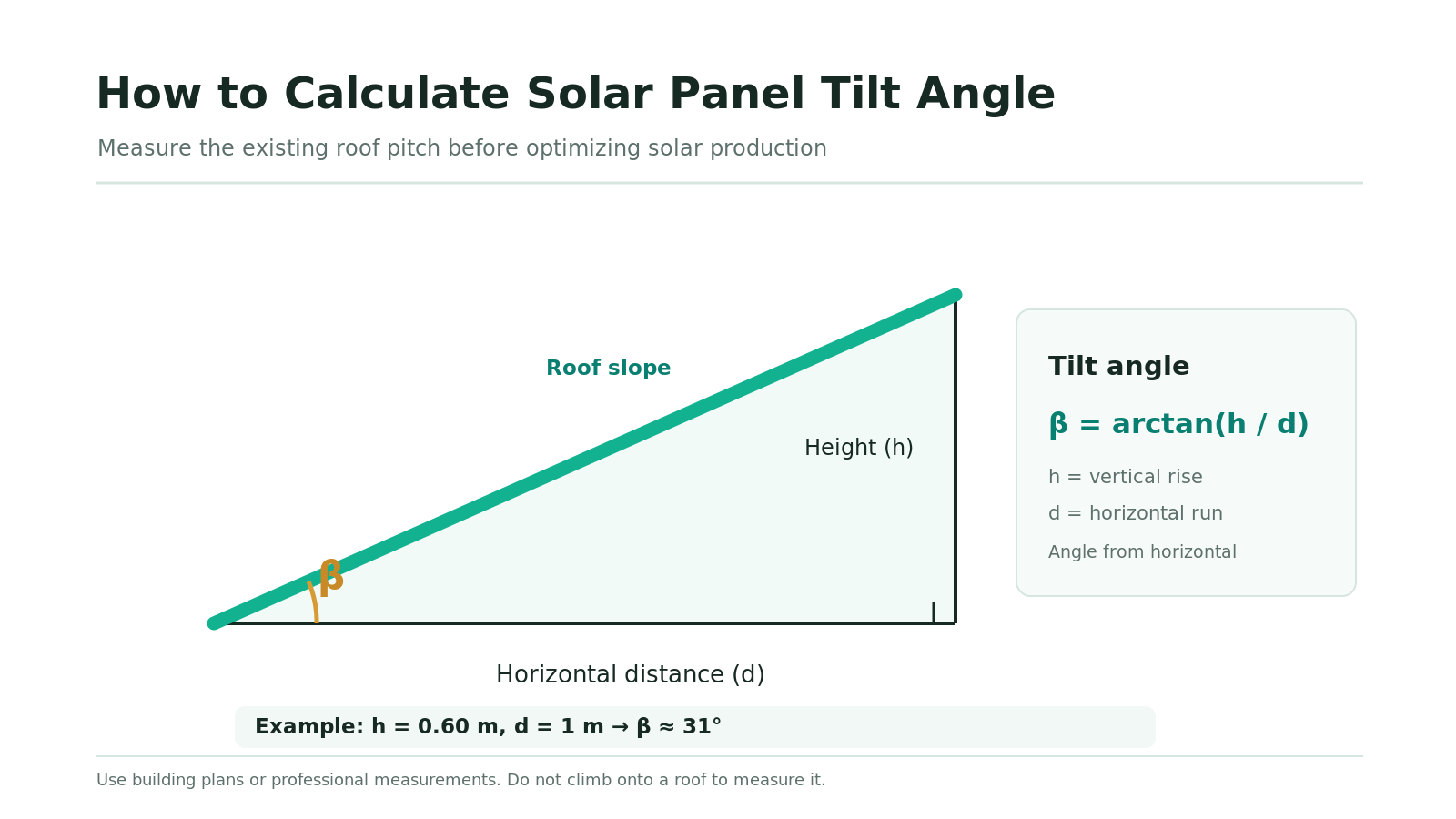
This formula calculates the existing inclination. It does not determine the optimal angle for solar electricity generation.
For safety, measurements should be obtained from architectural drawings or by qualified professionals rather than by accessing the roof without appropriate protection.
Can Latitude Be Used to Estimate Solar Panel Tilt?
A common rule of thumb is to use the installation site’s latitude as an initial reference for fixed solar panel inclination.
However, this is only a rough starting point.
The optimal annual tilt angle also depends on local meteorological conditions, diffuse radiation, orientation and system design.
For example, an installation in Lyon should not automatically use a tilt angle equal to Lyon’s latitude.
A more reliable approach is to compare multiple installation angles using location-specific solar irradiation data.
For additional technical background, see Maysun Solar’s article:
Why Do Solar Panels Need to Be Placed at an Angle?
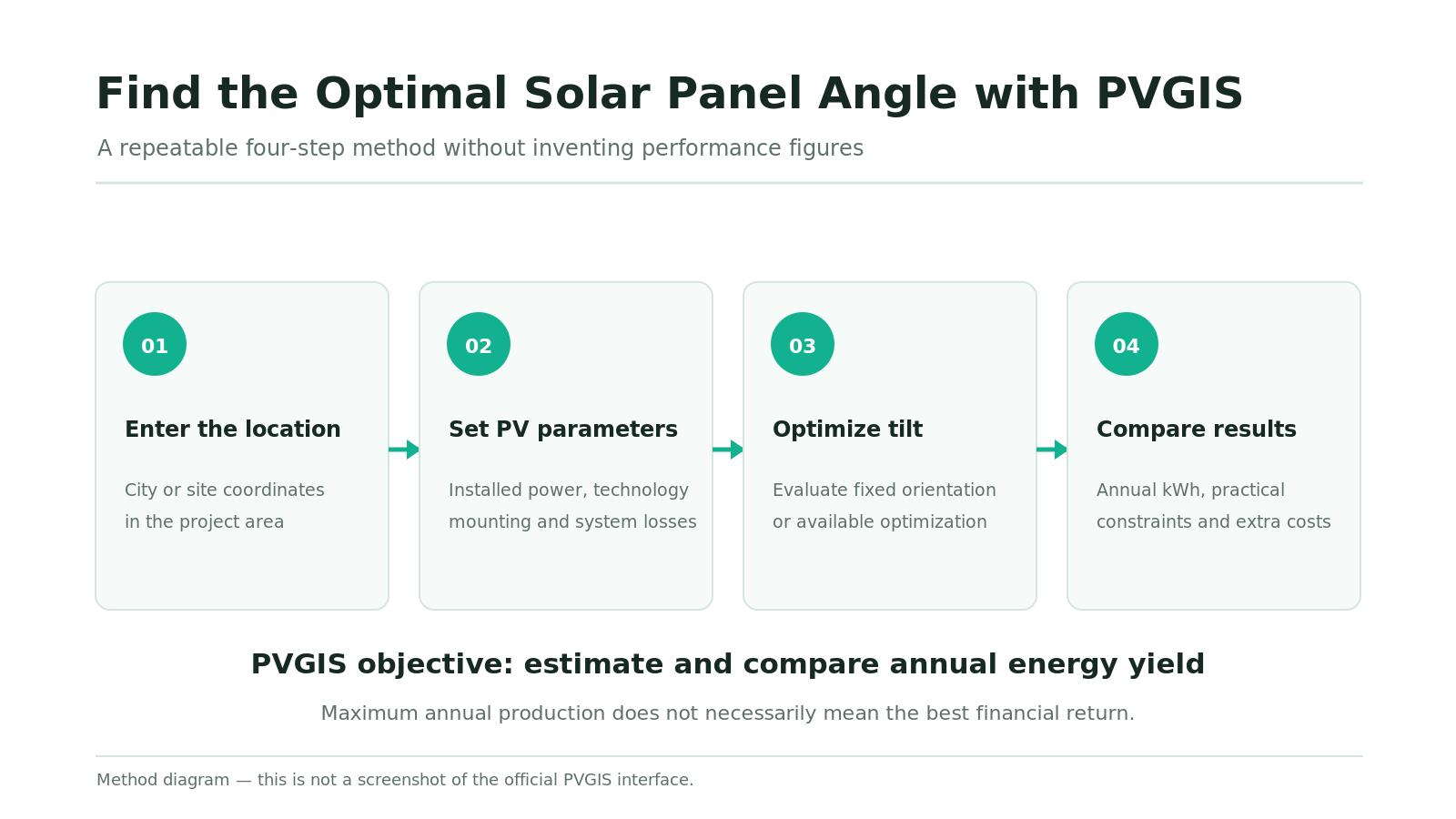
6. How to Find the Optimal Solar Panel Angle with PVGIS
The European Commission’s Photovoltaic Geographical Information System (PVGIS) provides free solar radiation and PV performance estimates for different locations and installation configurations.
PVGIS is useful for comparing the potential annual electricity generation of solar panels installed at different orientations and tilt angles.
Official tool:
https://photovoltaic-geographic-information-system.ec.europa.eu/en
Step 1: Enter the Installation Location
Select the city or geographic coordinates where the photovoltaic system will be installed.
For example:
Paris, France
Lyon, France
Marseille, France
For actual projects, precise installation coordinates are preferable to general city-level estimates.
Step 2: Define the PV System Parameters
Enter the system parameters required by the selected PVGIS calculation function.
These may include:
Installed PV capacity (kWp)
Solar module technology
Mounting configuration
System losses
Tilt angle
Orientation or azimuth
When comparing different orientations, keep all other relevant variables consistent.
Step 3: Compare Different Tilt Angles
If the roof orientation is fixed, calculate the estimated production at the existing roof angle and at alternative inclinations.
Where supported by the selected PVGIS version or calculation function, use its tilt optimization feature to identify the angle that maximizes estimated annual electricity production.
If both orientation and tilt are flexible, evaluate a range of combined configurations.
Step 4: Compare Annual Energy Production
Review the estimated annual electricity production in kWh.
For example, a roof with an existing tilt of 25° can be compared with a proposed alternative angle.
The difference in annual generation should then be evaluated against the additional cost of mounting structures and installation work.
PVGIS 6 provides an updated interface and supports advanced PV system modeling. Some control names and functions differ from earlier versions, so users should follow the documentation corresponding to the version they are using.
Official documentation:
PVGIS 6 User Guide:
PVGIS 5 User Manual:
Is the Angle with the Highest Energy Yield Always the Best?
No.
An optimized angle may increase annual electricity production, but the additional energy may not justify the installation cost.
For instance, if the existing roof pitch is already close to the modeled optimum, adding elevated mounting structures may provide only a limited increase in annual production.
A practical decision should also consider wind loading, structural limitations, roof waterproofing, maintenance access and long-term costs.
The technically optimal angle and the economically optimal installation solution are not necessarily identical.
7. How to Choose the Right Solar Panel Layout and Technology
Once roof orientation and tilt have been assessed, the next step is to select a module configuration that fits the available space and project objectives.
Scenario A: Unshaded South-Facing Residential Roof
A south-facing roof with favorable inclination and limited shading is often well suited to maximizing annual PV production.
For roofs with limited usable space, module efficiency and power density become important considerations.
High-efficiency N-TOPCon modules can help project designers achieve greater installed capacity within a constrained rooftop area, provided the module dimensions and electrical specifications are compatible with the system.
Explore Maysun Solar’s:
Residential Photovoltaic Solutions
Scenario B: East-West Dual-Slope Roof
For buildings with eastern and western roof slopes, using both surfaces may increase the total available installation area and distribute electricity generation across a wider part of the day.
Important design considerations include:
Available capacity on each roof slope
Local shading conditions
Morning and afternoon electricity consumption
PV string configuration
Inverter and maximum power point tracking (MPPT) compatibility
Separate MPPT inputs are often useful when eastern and western arrays experience different operating conditions.
However, a dual-MPPT configuration is not universally mandatory. The final electrical design should follow the inverter manufacturer’s specifications and the actual array configuration.
Scenario C: Commercial and Industrial Flat Roof
On large commercial rooftops, the optimal layout depends on more than the specific yield of each installed kilowatt-peak.
For example, east-west low-tilt mounting structures may allow a more compact arrangement in certain flat-roof applications.
This can potentially increase total installed capacity within the available roof area.
However, the design must also account for:
Row-to-row shading
Structural load capacity
Wind loading
Drainage
Maintenance access
Inverter sizing
Building electricity demand
For commercial projects, comparing the total annual output of the complete rooftop system is often more meaningful than comparing only the annual yield per installed kWp.
Explore Maysun Solar’s Commercial and Industrial Solar Solutions.
For layout planning, see:
Rooftop Solar Panel Size and Layout Guide
Should You Choose Bifacial Solar Panels for East-West Installations?
Bifacial modules can generate electricity from both the front and rear surfaces.
However, their additional energy yield depends on how much usable irradiation reaches the rear side of the module.
Factors such as ground reflectivity, mounting height, row spacing and structural design all influence the potential bifacial gain.
Therefore, an east-west installation does not automatically guarantee better performance from bifacial modules.
Maysun Solar offers N-TOPCon, HJT and bifacial glass-glass module solutions for different rooftop and commercial applications.
For suitable installation environments, bifacial technology can be considered as part of a broader system design assessment.
Explore:
Bifacial Solar Panel Solutions
For project-specific module selection or technical consultation, contact Maysun Solar.
8. Frequently Asked Questions
What Is the Best Direction for Solar Panels?
In the Northern Hemisphere, south-facing solar panels generally offer favorable conditions for maximizing annual electricity production. However, east-west configurations can also be suitable depending on roof design and electricity consumption patterns.
Are East-West Solar Panels Less Efficient Than South-Facing Panels?
An east-west installation will generally produce a different annual energy yield than an optimized south-facing system of equal installed capacity.
The actual difference depends on location, roof tilt, shading and system design.
It should be calculated using consistent simulation parameters rather than applying a universal loss percentage.
Can Solar Panels Face North?
Yes. North-facing panels can still generate electricity using diffuse and reflected solar radiation.
However, their annual energy yield is generally lower on steeply inclined roofs in the Northern Hemisphere.
Low-tilt north-facing installations require project-specific evaluation.
What Is the Best Tilt Angle for Solar Panels?
There is no single optimal tilt angle for every location.
The best angle depends on geographic latitude, local solar irradiation, panel orientation and project objectives.
PVGIS can help estimate annual energy production at different tilt angles.
Is a 30-Degree Solar Panel Tilt Always Optimal?
No. A 30° tilt may be used as a reference in comparative studies, but it is not universally optimal.
Existing roof conditions and local simulation results should guide the final decision.
Should I Change My Roof’s 25° Tilt to 35°?
Not necessarily.
First compare the estimated annual electricity production at both angles. Then consider whether the additional output justifies the cost and structural requirements of modifying the installation.
Do East-West Solar Systems Require Separate MPPT Inputs?
Separate MPPT inputs are commonly considered for arrays with different orientations, but the final configuration depends on inverter specifications, string design and operating conditions.
Does Higher Annual Solar Production Always Mean Better Financial Returns?
No.
Financial performance also depends on self-consumption, electricity prices, export compensation, installation costs and long-term operating expenses.
Conclusion: The Best Solar Panel Orientation Depends on the Project
South-facing solar panels are generally a strong choice for maximizing annual energy production in France and other Northern Hemisphere locations.
However, east-west solar installations can distribute generation more widely across the day and may better match certain electricity consumption patterns.
North-facing rooftops are less favorable in many cases, but their technical and economic suitability should be assessed according to actual tilt, shading and local solar resources.
Before selecting an installation layout, consider four steps:
Identify the roof’s actual orientation.
Measure its existing inclination.
Compare alternative configurations using PVGIS.
Evaluate annual generation together with electricity demand, installation costs and structural requirements.
For residential and commercial projects alike, the most effective solution is not necessarily the one with the theoretically highest solar irradiation.
The best solar panel orientation is the one that makes efficient use of the available roof, matches the building’s electricity needs and delivers sustainable long-term value.
Related Articles from Maysun Solar
1. Why Do Solar Panels Need to Be Placed at an Angle?
Explains solar panel inclination, installation considerations and methods for estimating suitable tilt angles.
2. Rooftop Solar Panel Size and Layout Guide
Covers available roof area, module dimensions, row spacing and practical rooftop layout design.
3. Why “The Best Solar Panel” Is a False Premise
Discusses how module technology selection should depend on actual project conditions, performance objectives and long-term returns.
Sources and References
1. ADEME (January 2025) — Individual Photovoltaic Self-Consumption
Original report: Autoconsommation individuelle d’origine photovoltaïque
https://www.ademe.fr/wp-content/uploads/2025/01/avis-ademe-autoconsommation-photovoltaique_-janvier-2025.pdf
Reference: Page 8, discussion of south-east-west PV configurations, estimated annual generation and self-consumption rates.
2. European Commission, Joint Research Centre — PVGIS 6
https://photovoltaic-geographic-information-system.ec.europa.eu/en
PVGIS 6 User Guide:
https://joint-research-centre.ec.europa.eu/photovoltaic-geographical-information-system-pvgis/using-pvgis-6/pvgis-6-user-guide_en
3. European Commission, Joint Research Centre — PVGIS 5 User Manual
https://joint-research-centre.ec.europa.eu/photovoltaic-geographical-information-system-pvgis/using-pvgis-5/pvgis-5-user-manual_en
Reference: Solar panel slope, azimuth conventions and tilt optimization.
4. Enedis — Selling Surplus Electricity from Self-Consumption
https://www.enedis.fr/je-vends-le-surplus-de-ma-production-consommee
Reference: Grid connection and surplus electricity arrangements in France.
5. EDF OA — S21 Purchase Agreement
https://www.edf-oa.fr/le-contrat-s21
Reference: French photovoltaic electricity purchase agreements and applicable conditions.