Yes. During long-term operation, solar panels typically experience a certain degree of efficiency decline. In most cases, this change is gradual and predictable. What matters more is whether the degradation rate remains stable and whether it could affect long-term power generation and overall energy yield.
Table of Contents
If you would like to learn more about first-year degradation, linear degradation, and the long-term performance differences between technologies, you can continue reading the Solar Panel Degradation Guide.
Why Do Solar Panels Lose Efficiency?
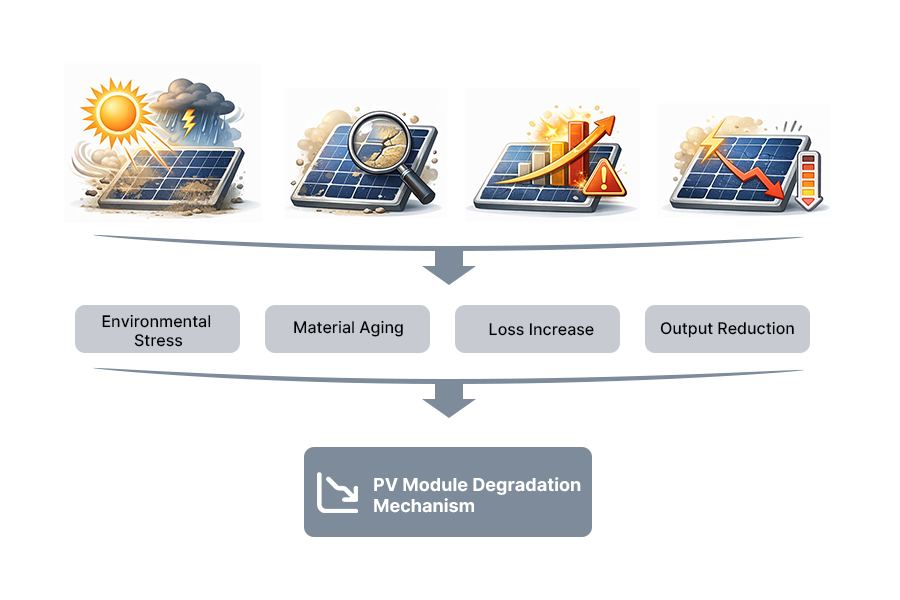
Solar panels lose efficiency over time mainly because part of the incoming sunlight is no longer converted into electricity as efficiently as before, and some of the generated electricity is increasingly lost during internal transmission. This is not caused by the sudden failure of a single component. Instead, it results from gradual changes in solar cells, encapsulation materials and interconnection structures during long-term outdoor operation.
In practice, several mechanisms commonly contribute to solar panel efficiency loss:
Reduced activity of solar cells
Long-term exposure to sunlight and heat can increase carrier recombination within the cells. As fewer charge carriers are collected and exported, power generation gradually declines. In some technologies, this effect is more noticeable in the early stage and then stabilises.Increasing resistive losses
During power generation, current passes through busbars, ribbons and connection points. Over time, solder fatigue, ageing interconnections or deteriorating contact conditions can increase internal resistance, leading to greater transmission losses.Declining transparency and protection of encapsulation materials
Materials such as glass, EVA and backsheet are exposed to UV radiation, heat and moisture for long periods. Ageing, yellowing or reduced protective performance can lower the amount of effective light reaching the cells or weaken protection against environmental stress, reducing output.Accumulation of microcracks and local mismatch
Transport, installation, wind and snow loads, and repeated thermal cycling can gradually create small structural damage in cells or connections. Although not immediately visible, these defects may restrict current flow or increase local heating over time, reducing the overall output of the solar panel.
What Factors Affect the Rate of Efficiency Loss?
Although all solar panels experience some efficiency decline over time, the degradation rate can vary significantly between projects. This difference is usually influenced by technology type, encapsulation structure, installation environment, and system conditions.
From a time perspective:
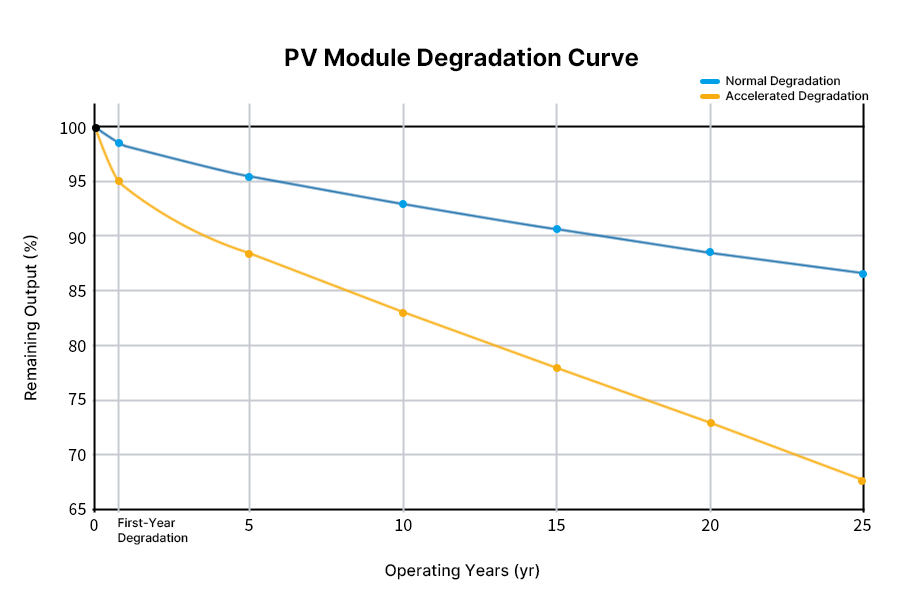
The first year of operation is often the key stage for observing early performance changes.
During mid- to long-term operation, if the solar panel remains stable, efficiency loss typically slows and becomes a gradual cumulative process.
Over 5–10 years or longer, differences in materials, structure and long-term stability between solar panels tend to become more apparent.
From a climate and environmental perspective:
High-temperature rooftop environments can intensify thermal stress and accelerate material ageing.
High humidity, coastal and salt-mist environments place greater demands on the long-term reliability of encapsulation and electrical connections.
Strong UV exposure continuously challenges the weather resistance of materials.
Regions with large day–night temperature differences and frequent thermal cycling are more prone to solder fatigue and microcrack accumulation.
Solar panel degradation is therefore not determined solely by operating time, but by the combined effects of time and environmental conditions.
Long-term performance comparison of different solar panel technologies:
| Technology | Encapsulation Structure | First-year Degradation (%) | Annual Degradation (%/year) | Temperature Coefficient (%/°C) |
|---|---|---|---|---|
| IBC | Glass-backsheet | ~1.5 | ~0.4 | ~-0.29 |
| TOPCon | Bifacial Glass-Glass | ~1.5 | ~0.4 | ~-0.29 – -0.32 |
| HJT | Bifacial Glass-Glass | ~1.0 | ~0.35 | ~-0.243 |
Note: Values shown are typical reference ranges. Please refer to the relevant product datasheet for exact specifications.
Which Degradation Indicators Deserve the Most Attention
When assessing the long-term performance of solar panels, it is not enough to simply look at whether a 25-year warranty is offered. What matters more are the specific degradation indicators behind it. In practice, the key metrics affecting long-term power generation are first-year degradation, annual degradation rate and long-term power retention.
First-year degradation reflects the change in solar panel performance during the initial operating period. This metric is important because some panels experience a more noticeable performance drop shortly after installation before entering a slower linear degradation phase. If the first-year loss is relatively high, long-term energy yield may still be affected even when the subsequent annual degradation remains within a normal range.
The annual degradation rate represents the decline in performance once the solar panel has entered a stable operating stage. For projects with long operating cycles, this indicator is often more meaningful than small differences in initial power rating. What determines the actual output after 10, 15 or even 25 years is usually not a few extra watts at the start, but whether the annual degradation remains stable and within a reasonable range.
Long-term power retention refers to the guaranteed output level of a solar panel after 25 years or more. Compared with simply highlighting the warranty period, this metric better reflects the real shape of the long-term performance curve. Warranty years indicate the time span, while power retention is closer to the actual long-term energy value.
In addition to these indicators, it is also important to distinguish between normal degradation and abnormal changes.
Generally acceptable situations:
Some performance change in the first year, followed by a slower and stable degradation trend
A relatively low annual degradation rate with a stable long-term curve
Variations in power generation that correspond to temperature, irradiation, dust or seasonal factors
Situations requiring closer attention:
Noticeably faster power loss within the first few years of operation
Increasing performance differences between solar panels under similar conditions in the same project
Sudden drops in energy production rather than gradual changes
Performance decline accompanied by issues such as hotspots, PID effects, encapsulation defects or local overheating
When evaluating the long-term performance of solar panels, the most relevant questions are how much performance is lost in the first year, how much declines each year afterwards, and how much output remains over the long term. Only by considering these indicators together can the long-term stability of a solar panel be assessed more accurately.
Frequently Asked Questions
Common questions about solar panel efficiency degradation and long-term performance
Do solar panels lose efficiency every year?
Usually yes, but the decline is typically gradual and accumulates over time. For most photovoltaic projects, a certain level of efficiency loss is normal. What matters is whether the degradation rate remains stable and within the typical industry range.
What is the difference between first-year degradation and later degradation?
First-year degradation refers to the more noticeable performance change that may occur shortly after installation. Later degradation describes the slower, linear decline that continues once the solar panel enters stable operation. Both indicators are important: the first affects the system’s starting performance, while the latter influences long-term energy yield.
Can high temperatures accelerate solar panel degradation?
In many cases, yes. Long-term heat can increase thermal stress within the solar panel and accelerate ageing of materials and electrical connections. As a result, performance changes may become more pronounced, especially for systems installed on hot rooftops with limited ventilation.
Does a difference in first-year energy production mean faster degradation?
Not necessarily. Early differences in energy production may be influenced by weather conditions, irradiation levels, installation angle, ventilation, or maintenance practices. To identify abnormal degradation, longer-term performance data should be analysed alongside first-year and annual degradation indicators.
As a solar panel manufacturer, Maysun Solar supplies the European wholesale and distribution market with modules based on IBC technology, TOPCon technology, and HJT technology. Beyond initial power and size, we focus on first-year degradation, long-term stability and high-temperature performance to support more predictable long-term output for rooftop and commercial & industrial projects.
Recommend reading

Do Solar Panels Lose Efficiency Over Time?
Solar panels lose efficiency over time. Key indicators include first-year degradation, annual degradation rate, temperature coefficient, and long-term power retention.
March European Solar Industry News
This article outlines recent developments in the European solar market, including the EU cross-border solar auction scheme, structural shifts in Germany, updated GSE regulation in Italy, and the recent recovery in solar panel prices.

430–460W or 600W+? How Should You Choose Solar Panel Power for Rooftop Projects?
Compares 430–460W solar panels and 600W solar panels in C&I rooftop projects, showing that solar panel selection should prioritise roof compatibility and system stability.
Changes in the European Solar Policy and Market in 2026
Europe’s 2026 solar policy and grid changes are reshaping solar panel selection, shifting project returns towards market-driven mechanisms and highlighting the roles of TOPCon, HJT and IBC solar panels.
Why European EPCs Are Reassessing Large-Format Solar Panels
European EPCs are re-evaluating large-format solar panels. Panel size directly affects installation risk, system compatibility, and solar project ROI stability.
Do Vertical Bifacial Modules Really Deliver Additional Yield?
Vertical bifacial PV systems are gaining increasing attention across Europe. This article explores under what conditions a vertical layout can create additional value, how bifacial gain is influenced by site conditions, and which project types are best suited to this design.