Why European EPCs Are Reassessing Large-Format Solar Panels

Why European EPCs Are Reassessing Large-Format Solar Panels

As panel sizes continue to increase, European EPCs are reassessing how solar panel size influences project risk and return stability. In complex rooftop projects, size is no longer just a technical parameter — it is increasingly becoming a key decision factor.

Table of Contents

Why European EPCs Are Reassessing Solar Panel Size Decisions

The European solar market continues to maintain a high installation level.

According to SolarPower Europe, the EU added approximately 65.5 GW of new solar capacity in 2024, with 2025 expected to remain at a similar level, bringing total installed capacity close to 400 GW.

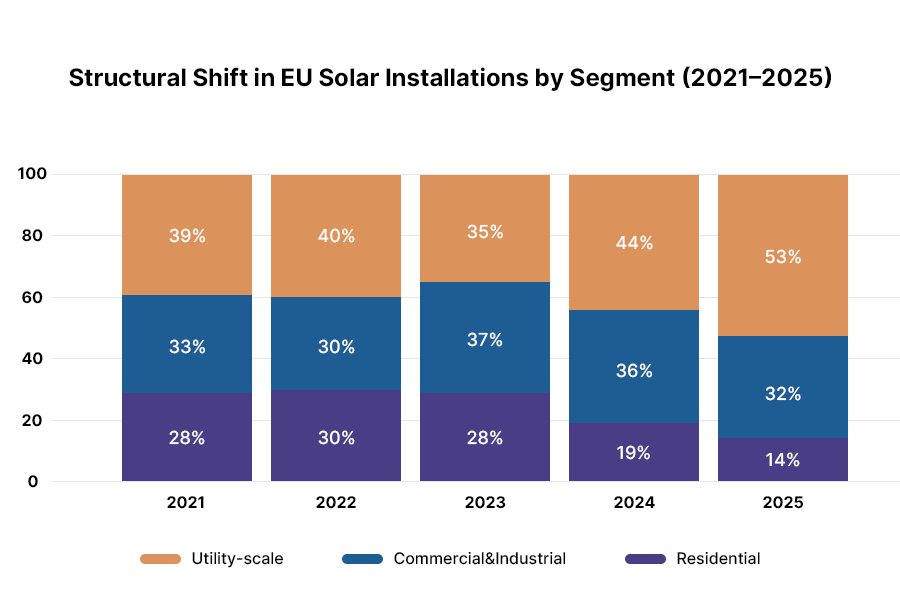
After two consecutive years of strong growth, the European solar market is gradually shifting from a phase of rapid expansion to one of structural optimisation. As a result, solar panel selection and system compatibility are becoming increasingly important.

Chart showing the changing share of residential, commercial & industrial, and utility-scale solar installations in the EU from 2021 to 2025.

Figure: Structural changes in EU solar installations across residential, commercial & industrial, and utility-scale sectors from 2021 to 2025. Source: SolarPower Europe.

At the same time, both panel output and physical size have expanded rapidly in recent years. According to Fraunhofer ISE, mainstream panel power ratings have already entered the 700 W range. For EPCs, solar panel size now influences rooftop compatibility, installation complexity, and long-term maintenance risk. Technical changes that can be absorbed in standardised ground-mounted projects often translate into real decision pressure in complex rooftop environments.

As a result, more European EPCs are reassessing whether larger panels should still be prioritised under different project conditions.

Solar panel sizing is shifting from a technical parameter to a project-level decision.

Large Solar Panels Are Not Always the Optimal Choice

In real projects, large solar panels are often seen as a direct path to efficiency and cost optimisation. However, this assumption tends to overlook constraints related to rooftop layout, structural conditions, and long-term operations. As panel size continues to increase, these factors begin to directly affect system performance, installation risk, and project returns.

2.1 Higher Panel Output Does Not Equal Higher System Efficiency

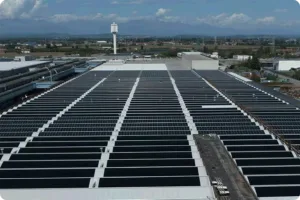
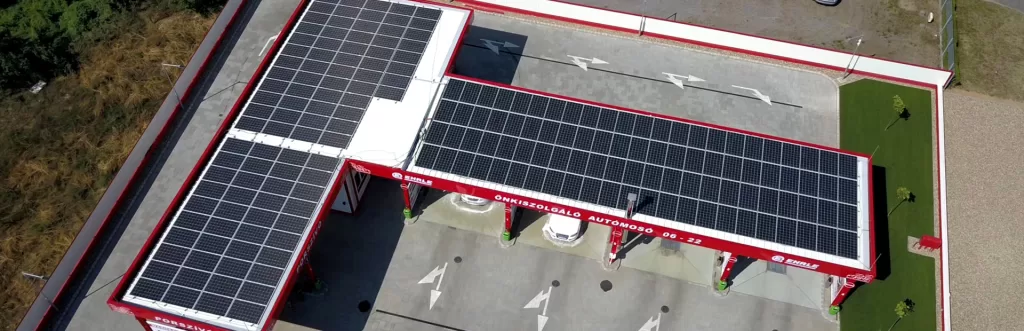
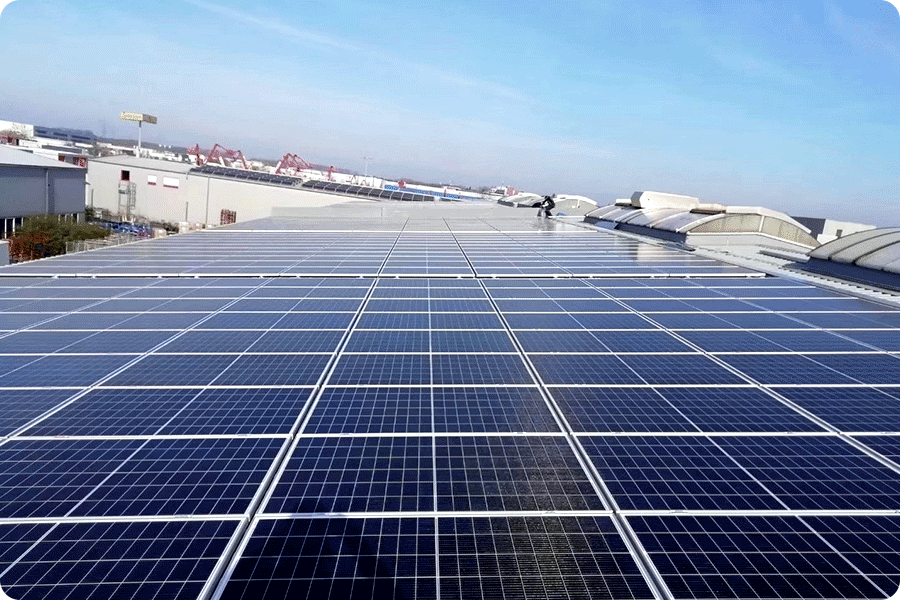
In residential and commercial rooftop projects, higher output per panel does not necessarily translate into higher system generation. Skylights, equipment zones, and irregular roof boundaries can significantly influence layout design. Larger panels may reduce rooftop utilisation, offsetting the advantage of higher individual output.

Complex rooftops often involve multiple orientations, partial shading, and string configuration constraints — factors that frequently have a greater impact on system efficiency than the rated output of a single panel.

2.2 Larger Panel Size Alters Structural and Installation Risk

Increasing panel size directly changes roof load dynamics and installation conditions. Larger wind exposure areas and more concentrated fixing-point stress can amplify structural uncertainties, particularly on lightweight or ageing roofs.

Handling and installing large panels also reduces operational tolerance. They require higher installation precision and experienced teams, and are more prone to cumulative installation errors in complex environments.

2.3 Installation and O&M Costs Are Often Underestimated

The installation efficiency and long-term O&M costs of large panels are often underestimated. On complex rooftops, extended installation time and increased labour coordination may weaken their cost advantage.

If damage occurs or replacement is required, intervention complexity is typically higher than with standard-sized panels. These hidden costs can directly influence actual project returns over the lifecycle.

When Solar Panel Size Can Reduce Project ROI

In real projects, solar panel size rarely determines system performance on its own. However, under certain conditions, it can influence the distribution of project risk and the stability of returns.

What panel size often changes is not efficiency itself, but the project’s risk structure.

3.1 Which Projects Are More Sensitive to Panel Size

The impact of solar panel size varies across projects, becoming more pronounced in structurally constrained environments or where operational requirements are high.

These differences typically emerge in structural limitations, on-site handling constraints, and long-term operational needs.

  • In buildings with structural limitations, larger panels may increase uncertainty in structural assessment and approval.

  • In O&M-sensitive assets, changes in panel operability can gradually translate into additional maintenance complexity.

  • In long-term ownership or PPA-based projects, size-related uncertainties are more likely to enter risk assessment and revenue assumptions.

These factors do not imply that size itself is problematic, but rather that its influence becomes more visible under specific project conditions.

3.2 How Panel Size Affects the ROI Structure

Solar panel size can influence project ROI through multiple pathways, particularly affecting its stability.

In complex environments, these impacts often emerge gradually within key assumptions and risk considerations.

  • Changes in panel size may affect design margins, installation planning, and on-site maintenance approaches, eventually influencing long-term cost assumptions or uncertainty factors.

  • In long-term contracts or asset-holding models, maintenance complexity and replacement difficulty are more likely to be incorporated into financing and risk assessments, shaping return projections.

  • Downtime coordination, intervention frequency, and operational flexibility may also vary with panel size, influencing ROI stability over time.

Industry experience suggests that size does not affect a single financial metric, but rather how returns are distributed under different operating scenarios — especially in complex rooftop projects. This is one of the key reasons why many EPCs have recently revisited solar panel sizing strategies.

3.3 Size Decisions Depend on Project Conditions

Based on European project experience, there is no universally superior panel size. Its impact largely depends on project-specific constraints.

When roof structures approach load limits, installation space is restricted, or buildings require continuous operation, panel size becomes a critical design consideration.

In complex rooftop or long-term operational projects, size influences not only layout and installation planning but also maintenance rhythms and risk assessments. As projects move into the operational phase, these differences tend to surface in O&M and project management practices.

Solar panel size is best understood as part of the project’s risk and condition framework. For many European EPCs, size decisions are typically based on project constraints rather than purely on efficiency or output metrics.

Common Risk Scenarios of Solar Panel Size Across Different Projects

Project Condition Typical Situation Size Preference
Roof close to load limits Repeated structural assessments Caution with large panels
Dense rooftop equipment or fragmented layout Layout complexity Prefer flexible panel sizes
Restricted lifting or access routes Installation difficulty Avoid oversized panels
Frequent O&M or no shutdown allowed Complex replacement intervention Prioritise operability
Long-term ownership or PPA projects High return stability requirements Stability preferred

Understanding the Decision Dimensions of Solar Panel Size

Under different project conditions, solar panel size should be assessed within a broader decision framework.

From structural constraints to operational requirements and asset objectives, these factors collectively shape how size trade-offs are evaluated.

Rooftop conditions, installation complexity, and O&M costs are closely linked to solar panel size.

In many projects, discussions around panel size begin with the physical realities of the roof and structure. Building geometry, continuity of usable area, and load limits all influence layout potential. In European commercial and industrial projects, skylights, equipment zones, and structural segmentation typically reduce usable space by around 10–30% compared to total roof area. When structures approach design limits, size differences often become central to discussions around design margin and risk allocation.

On-site conditions tend to reveal size-related differences early. Restricted working space, complex lifting routes, or limited maintenance access can quickly affect installation planning depending on panel dimensions. In complex rooftop environments, installation efficiency may vary by around 5–15%. For assets requiring long-term operational stability, panel accessibility and replacement practicality also become relevant O&M considerations.

From an asset perspective, panel size is often linked to risk appetite. Long-term ownership models typically prioritise operational predictability, while delivery- or capacity-driven projects may focus elsewhere. In some European commercial rooftop projects, O&M-related expenditure accounts for roughly 10–20% of lifecycle costs — meaning differences in maintenance convenience linked to panel size can become amplified.

Different combinations of constraints rarely lead to a uniform sizing decision. Project limitations and strategic objectives tend to define the focus of size evaluation, explaining why similar projects may adopt different sizing strategies.

How to Assess Whether Solar Panel Size Is Suitable in a Project

Assessment Focus Key Considerations Typical Judgement
Roof conditions Load limits, layout continuity Use caution with large panels when constraints are tight
Installation planning Lifting routes, working space Avoid oversized panels when restricted
O&M requirements Intervention frequency, shutdown limitations Prioritise operability when demands are high

Solar Panel Size Decisions in European Projects

In practice, solar panel size rarely serves as a standalone starting point for decision-making. More often, it reflects a combined outcome shaped by rooftop conditions, installation planning, and project objectives.

On roofs with continuous layout potential and clearly defined structural boundaries, larger panels can often deliver advantages in capacity and installation efficiency. In buildings with complex equipment distribution or space constraints, flexibility in panel size tends to be more valuable.

As projects move into the operational phase, size-related considerations increasingly emerge in day-to-day management. Maintenance accessibility, replacement planning, and operational continuity all influence sizing decisions.

Market practice shows that more European projects are no longer simply pursuing larger panels, but instead balancing size based on specific conditions.

  • There is no universally optimal solar panel size.

  • Size selection typically reflects project constraints rather than technical preference.

  • In complex rooftops, size impacts installation and O&M first.

  • Larger panels are better suited to stable conditions with clear boundaries.

  • Different project objectives naturally lead to different sizing choices.

  • Panel size is more a project management consideration than a single engineering parameter.

  • The higher the long-term operational requirement, the more cautious size decisions tend to become.

These observations help explain the practical logic behind solar panel sizing decisions in today’s European projects.

As a solar panel manufacturer, Maysun Solar provides stable panel supply to the European wholesale and distribution market, covering mainstream technologies such as IBC technologyTOPCon technologyand HJT technology. Our portfolio is suited to complex rooftops and clearly defined commercial and industrial projects, with a focus on achieving higher output per unit area and improved system synergy under the right project conditions.

Reference

SolarPower Europe. (2025). EU Solar Market Outlook 2025–2030. https://www.solarpowereurope.org/insights/outlooks/eu-solar-market-outlook-2025-2030/detail

Fraunhofer ISE. (2025). Photovoltaics Report. https://www.ise.fraunhofer.de/content/dam/ise/de/documents/publications/studies/Photovoltaics-Report.pdf

IEA PVPS. (2024). Trends in Photovoltaic Applications 2024. https://iea-pvps.org/trends_reports/trends-in-pv-applications-2024/

European Commission Joint Research Centre (JRC). (2024). Snapshot of Photovoltaics. https://publications.jrc.ec.europa.eu/repository/handle/JRC136341

Recommend reading

April News from the European Solar Industry

April News from the European Solar Industry

The European solar market is showing clear signs of recovery: system value is being reaffirmed, German auction prices are stabilising, Italy’s rules are becoming clearer, and revenue certainty in France is improving.

Read More »