Do Vertical Bifacial Modules Really Deliver Additional Yield?

Do Vertical Bifacial Modules Really Deliver Additional Yield?

As Europe’s electricity markets fluctuate and land-use models continue to evolve, more projects are reassessing PV system layout strategies. Compared with conventional tilted arrays, vertically installed bifacial modules are gradually moving into real-world deployment, particularly in agrivoltaics, solar fencing, and projects in higher-latitude regions.

In practical operation, system performance is shaped not only by the modules themselves, but also by ground reflectivity, seasonal variation, and array configuration. As a result, similar system designs may deliver markedly different outcomes across projects. This has made the question of whether vertical bifacial systems can generate additional value an ongoing focus of discussion within the European engineering community.

Table of Contents

Why Are Vertical Bifacial Systems Gaining Attention in Europe?

In recent years, a growing number of projects across Europe have begun re-evaluating alternative PV array layouts. Vertical bifacial systems are no longer confined to experimental use, but are increasingly appearing in agrivoltaic projects, boundary installations, and higher-latitude regions. Some developers are integrating them into fencing structures to simultaneously address land-use and power generation needs.

This shift is also linked to evolving electricity market dynamics. As price volatility increases, the timing of generation is becoming more important than total annual output alone. Unlike conventional arrays that concentrate production around midday, vertically installed bifacial panels often maintain a degree of output during morning and evening hours — a characteristic that is attracting growing interest.

Operational experience from Northern and Central Europe further indicates that under low winter sun angles, vertical modules can maintain relatively stable irradiation conditions. Combined with the reduced risk of prolonged snow coverage on module surfaces, winter performance has become a key point of interest for some projects.

The growing interest in vertical bifacial systems is often driven by several practical considerations:

  • Enabling power generation alongside agricultural activity or on constrained land
  • Enhancing early-morning and late-afternoon production in alignment with electricity price profiles
  • Seeking more stable winter output in higher-latitude regions
  • Exploring alternative layouts to optimise overall system performance

These discussions do not suggest that vertical systems will replace conventional designs, but under certain conditions, they are increasingly viewed as a layout option worth evaluating.

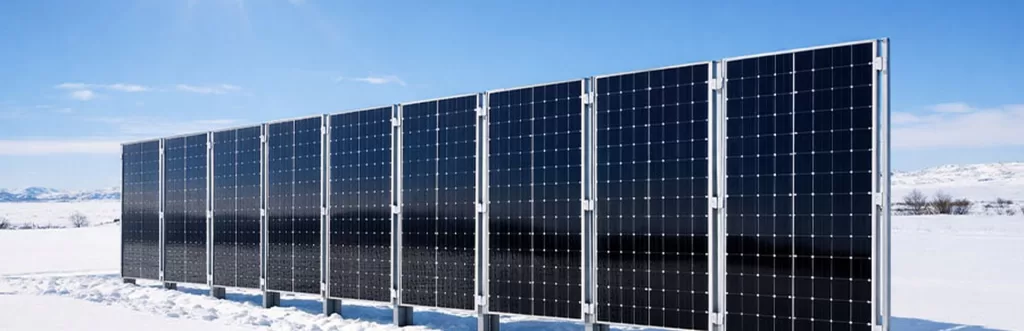
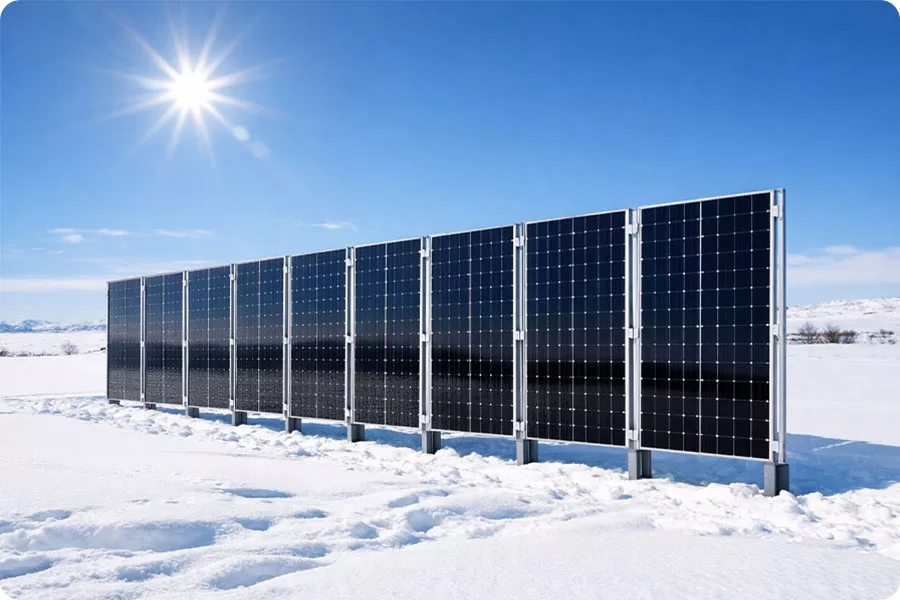
Vertical bifacial PV modules operating in a high-latitude snowy environment, where snow enhances ground reflectivity and boosts rear-side irradiation and bifacial yield.

Key Mechanisms Behind the Additional Yield of Vertical Installation

The potential value of vertical bifacial systems typically stems from the combined effect of multiple factors. Unlike conventional arrays that rely primarily on front-side irradiation, vertical installation alters how modules capture light, resulting in distinct operational characteristics.

The additional yield mainly arises from the following mechanisms:

  • Changes in generation profile
    When modules are installed vertically in an east–west orientation, low-angle sunlight in the early morning and late afternoon can directly reach the module surfaces. This allows the system to maintain output during periods when traditional arrays typically produce less energy. A more evenly distributed generation curve often holds greater value in markets with high electricity price volatility.
  • Expanded utilisation of bifacial irradiance
    Vertical installation places both sides of the bifacial solar panels within a wider field of view, enabling diffuse light from the ground and surrounding environment to continuously reach the rear surface. Under favourable reflective site conditions, this rear-side irradiance can become a meaningful source of additional energy and a key contributor to bifacial gain.
  • Impact of operating conditions on long-term performance
    As vertically installed modules are less prone to water accumulation and dust build-up, rainfall tends to provide more effective natural cleaning. In certain environments, this can help reduce performance losses caused by soiling. While the short-term impact may be limited, it may translate into more stable long-term energy yield.

Overall, the value of vertical bifacial systems lies not in boosting instantaneous peak output, but in enabling differentiated system behaviour under specific conditions through the interaction of multiple mechanisms.

How Environmental and Design Factors Influence Bifacial Gain

In real-world projects, bifacial gain is rarely a fixed value. Instead, it varies depending on environmental conditions and system design. Among these factors, ground reflectivity is often considered one of the most direct — yet frequently underestimated — influences.

Multiple European studies and project experiences suggest that under typical ground reflectivity conditions, bifacial PV systems may achieve an annual energy gain of around 10%. In high-reflectivity or snow-covered environments, this gain can increase to approximately 20% or even higher.

3.1 How Ground Conditions Can Amplify Bifacial Gain

In practice, ground reflectivity directly affects the level of irradiance reaching the rear side of bifacial solar panels, thereby influencing overall system yield. Research indicates that improved ground reflectivity can significantly enhance rear-side contribution.

Winter scenario: Natural reflectivity from snow

In Northern Europe, Alpine regions, and parts of Central Europe, winter snow cover can substantially increase ground reflectivity. This enhances rear-side irradiation for bifacial modules, potentially leading to higher-than-expected total system output. Some studies indicate that bifacial gain may reach around 20% during snow-covered periods.

In addition, vertical installation reduces the likelihood of prolonged snow accumulation on module surfaces, helping maintain effective generation — a key contributor to winter performance advantages.

Non-winter scenario: Artificial improvement of reflectivity

In snow-free environments, some projects enhance bifacial gain by optimising ground materials, such as:

  • Using white gravel or light-coloured stones
  • Applying light-coloured concrete or reflective coatings
  • Maintaining clean ground surfaces to minimise light absorption
  • Selecting soil treatments with higher reflectivity

A test conducted in Milan, Italy, showed that installing high-reflectivity materials beneath the modules could improve system energy yield by around 20%, highlighting the direct impact of ground conditions on rear-side irradiance. However, such ground optimisation is typically a system-level design measure and should be evaluated alongside maintenance costs and project context.

3.2 Array Layout and Shading Conditions

Beyond ground conditions, factors such as project latitude, solar path, and row spacing also influence system performance. Where rear-side space is constrained or shading increases, actual energy yield may vary even when module performance remains identical.

In rooftop projects, such limitations are common due to equipment zones, parapets, or access pathways. As a result, bifacial gain is often lower than in open-field installations — an important consideration when assessing system potential.

Overall, the performance of bifacial PV systems depends more on the alignment between site conditions and design strategy than on module specifications alone. This is why environmental factors must be evaluated alongside system design during the project assessment phase.

Which Scenarios Are Best Suited to Vertical Bifacial Systems?

Vertical bifacial PV systems are not a universal solution, but tend to deliver greater value under specific environmental conditions and project objectives. Based on European project experience, this layout becomes particularly attractive where sites can provide stable diffuse light, or where generation profile distribution is prioritised over peak output.

4.1 Under Which Project Conditions Do They Offer the Most Advantage?

The following scenarios are often worth closer evaluation:

  • High-latitude regions or areas with significant winter snowfall
    Snow can substantially enhance ground reflectivity, while vertical installation helps minimise snow accumulation on modules, supporting more stable winter energy yield.
  • Agrivoltaic or land-constrained projects
    Vertical layouts reduce interference with ground-level activity, making them more compatible with agricultural or multi-use land applications.
  • Solar fencing and linear infrastructure projects
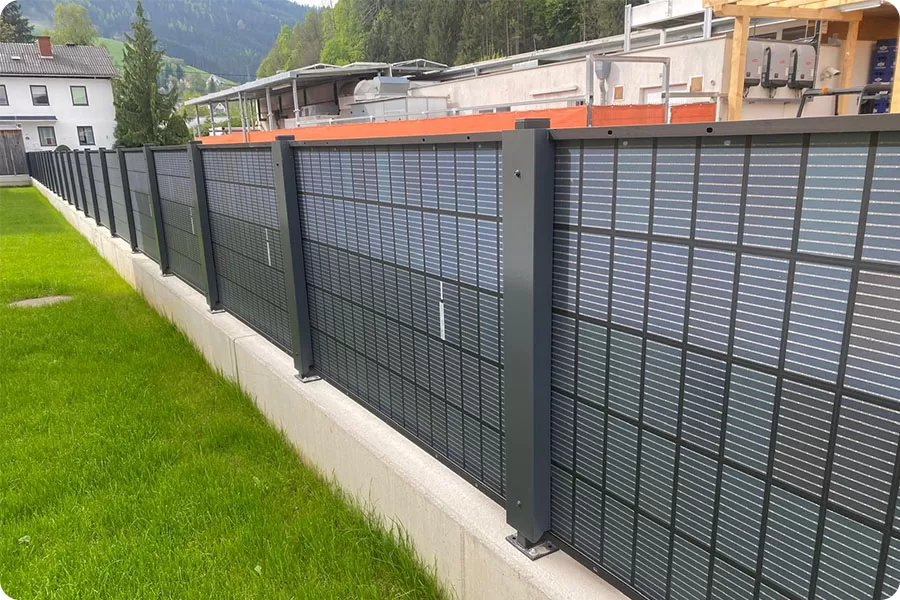
    Such as highway barriers or industrial site perimeters, where vertical bifacial panels enable power generation within limited space.
  • Projects in volatile electricity markets with a focus on morning and evening production
    Vertical systems often provide a more balanced generation profile during early and late hours, helping improve electricity utilisation value.

In rooftop projects with limited space or significant shading, this layout may not always offer advantages and should therefore be assessed in line with site-specific conditions. Even when a suitable application scenario is identified, system design considerations do not end there — module selection can also influence performance in vertical installations.

4.2 Which Modules Are Better Suited to Vertical Bifacial Applications?

In practical system selection, module type should align with the project’s intended use. For agrivoltaic, fencing, or space-sensitive projects, modules offering a degree of light transmission or reduced shading may integrate more effectively with surrounding environments.

European research indicates that in agrivoltaic systems, optimised light distribution can create synergy between PV generation and agricultural production, improving overall land-use efficiency (EPJ-PV, 2024). Field trials by Fraunhofer ISE have further observed that under certain crop conditions, semi-transparent PV systems not only provide electricity output but can increase combined land-use efficiency to over 160%, while also improving crop yield by approximately 16% in some cases (Fraunhofer ISE, 2019).

As a result, partially transparent or semi-transparent TOPCon modules are gaining attention in vertical bifacial layouts. By reducing front-side shading, these designs allow for more uniform light distribution between modules, supporting both energy generation and spatial compatibility. In agrivoltaic or fencing scenarios, this approach can help balance power production with functional land use.

It is important to note that transparent modules are not universally advantageous across all vertical PV systems. Actual performance still depends on site reflectivity, array spacing, and project yield objectives. In many cases, their value lies in the alignment between module selection strategy and application environment, rather than in any single technology pathway.

Vertical bifacial PV fencing application enabling power generation within limited space while optimising overall system yield structure.

Vertical bifacial systems do not inherently guarantee higher energy production across all projects. Their value often lies in optimising generation distribution and system behaviour under specific conditions. When site characteristics, reflective environment, and layout design are properly aligned, this approach can become an attractive option. In practice, the decision to adopt vertical bifacial systems should be based on comprehensive project evaluation rather than theoretical gain alone.

Maysun Solar provides a range of PV module technologies for the European market, including IBC technologyTOPCon technologyand HJT technology, to suit diverse site conditions and system needs. During project evaluation, we support partners in selecting module power and structure based on local environment, layout and generation goals — ensuring better alignment with real operating conditions.

Reference

pv magazine Global. Bifacial solar modules shine in snowy environments. 23 May 2022.
https://www.pv-magazine.com/2022/05/23/bifacial-solar-modules-shine-in-snowy-environments/

European Commission Joint Research Centre. PVGIS — Photovoltaic Geographical Information System.
https://joint-research-centre.ec.europa.eu/pvgis

Fraunhofer ISE. Photovoltaics Report. 2024.
https://www.ise.fraunhofer.de/en/publications/studies/photovoltaics-report.html

Fraunhofer ISE. Agrophotovoltaics: High harvesting yield in hot summer of 2018. 2019.
https://www.ise.fraunhofer.de/en/press-media/press-releases/2019/agrophotovoltaics-hight-harvesting-yield-in-hot-summer-of-2018.html

European Physical Journal Photovoltaics. Agrivoltaic systems and land-use efficiency analysis. 2024.
https://www.epj-pv.org/articles/epjpv/full_html/2024/01/pv20230076/pv20230076.html

International Energy Agency (IEA PVPS). Trends in Photovoltaic Applications 2023.
https://iea-pvps.org/trends-reports/

Recommend reading

April News from the European Solar Industry

April News from the European Solar Industry

The European solar market is showing clear signs of recovery: system value is being reaffirmed, German auction prices are stabilising, Italy’s rules are becoming clearer, and revenue certainty in France is improving.

Read More »