
Introduction: When New Developments Hit a Dead End
As Europe moves through 2026, a new paradox is defining the solar market.
Many EPC managers, installers and project developers are not short of customers, investment interest or project demand. What they lack is something far harder to secure: available grid connection capacity.
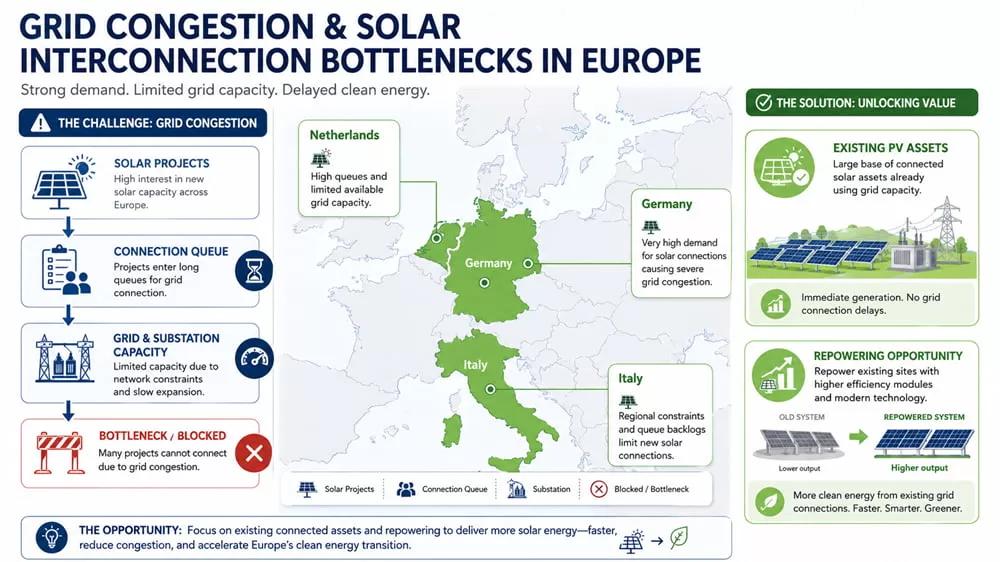
In core European markets such as Germany, the Netherlands and Italy, the bottleneck for new solar projects has shifted from “Is there demand?” or “Are modules affordable?” to grid connection, grid congestion and growing connection queues. The European Commission’s European Grids Package highlights efficient and timely grid connections as a key issue for the energy transition and calls for better use of existing grid infrastructure. (Energy)
This raises a critical industry question:
If new projects are increasingly constrained by grid “red lines”, why are large portfolios of already-connected solar assets still operating below their true potential?
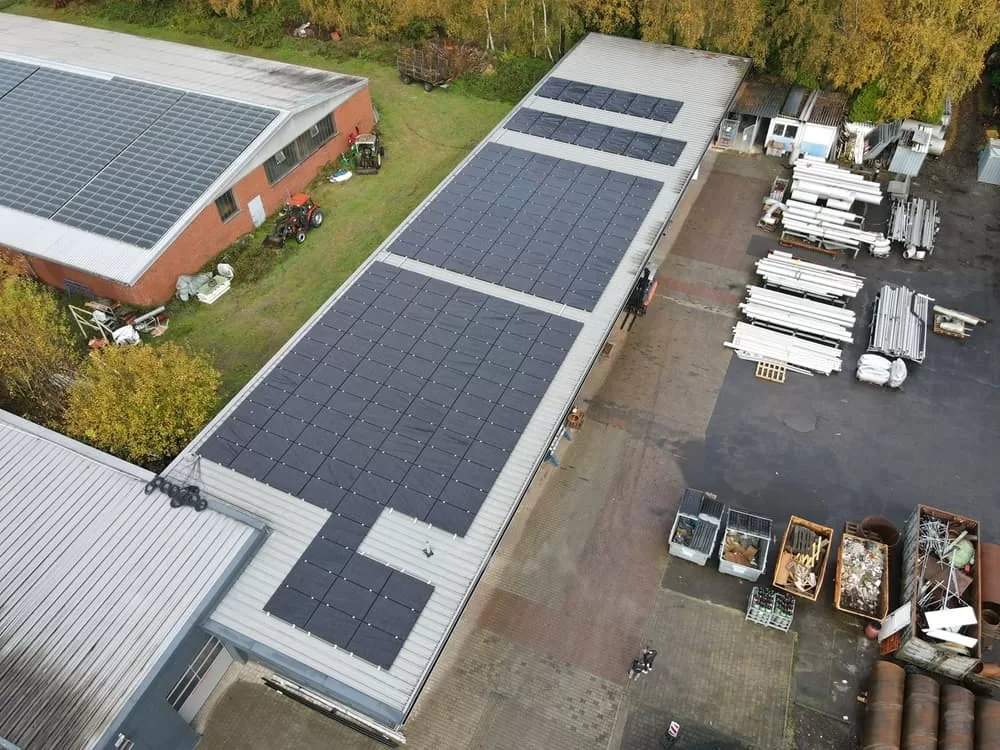
These legacy PV systems are not simply obsolete assets. They are undervalued invisible assets. They already hold what many new projects struggle to obtain today: grid access, land or roof rights, electrical infrastructure, operational history and a secured place in the power system.
In an era of grid congestion, the next wave of European solar growth may not come only from new land or new rooftops. It may come from unlocking the latent value of assets that are already connected to the grid.
Table of Contents
1. Vanishing Grid Quotas: The High Cost of “Occupying without Generating”
Many European solar projects built between 2010 and 2016 represented the technology level of their time. A decade later, however, these systems are revealing a structural problem.
They often occupy strong grid connection points, good rooftops or well-located land. But many of them were built with lower-power modules, older system designs and early-generation component technologies. After years of operation, additional issues may appear: module degradation, inverter aging, hotspot risk, cable losses and lower system availability.
The result is a form of grid underutilization: valuable connection capacity remains occupied, but the site does not generate the level of electricity value that its location and grid position could support.
This problem becomes more serious as grid congestion intensifies across Europe. In the Netherlands, RVO explains that grid congestion can lead both new and existing users to be placed on waiting lists for additional transport capacity or upgraded connections. RVO also states that, from 1 July 2026, small-scale users that have not been given priority will also be placed on waiting lists in congested areas. (RVO.nl)
Italy shows a similar pressure point. According to Terna’s 2025 Development Plan, renewable energy connection requests reached 348 GW by the end of 2024, including 152 GW of solar projects. This demonstrates that Europe does not lack project ambition; in many markets, it lacks available, usable and timely grid space. (Terna)
In this environment, every square metre of an underperforming rooftop becomes a financial leak.
It can mean:
lower annual yield;
weaker return per square metre;
reduced asset valuation;
lower financing attractiveness;
higher opportunity cost;
inefficient use of scarce grid capacity.
When grid access becomes scarce, low-efficiency operation is no longer just a technical issue. It becomes an asset management problem.
2. The Logic of Repowering: Asset Restructuring, Not Just Maintenance
Many owners still view PV repowering as a simple repair activity: replacing old modules, fixing underperforming equipment or extending the remaining lifetime of an aging plant.
That view is too narrow for the 2026 European market.
True repowering is not only about removing old modules and installing new ones. It is a form of asset restructuring: redefining the next 20 to 25 years of energy value within an already connected site.
Its business logic can be understood in three layers.
2.1 Maximizing Existing Grid Resources
The greatest advantage of a legacy PV asset is that it already has a grid connection.
In many cases, repowering can improve system performance while making better use of the existing connection point, provided that the original connection capacity, transformer limits and local grid requirements are respected. It is not necessarily about increasing permitted grid capacity. It is about improving the productivity of the capacity that already exists.
This is especially important in markets where new connection studies, grid approvals or waiting lists can delay projects for years.
A legacy C&I rooftop system that is already connected may be able to release additional value through module replacement, inverter review and system optimization much faster than a greenfield project starting from zero.
However, repowering does not automatically eliminate the need for technical review, documentation updates or DSO/TSO approval. Requirements depend on the country, grid operator, project size and the extent of system modifications. The correct approach is not to promise “no approval”, but to evaluate how far the asset can be upgraded within existing grid and regulatory constraints.
2.2 Leveraging Established Infrastructure
Legacy PV projects often already include:
roof or land rights;
mounting structures or foundations;
cable routes and electrical pathways;
inverters or grid interface equipment;
O&M access;
historical production data;
existing owner relationships and contracts.
These are all resources that a new greenfield project must secure, permit, build and finance from the beginning.
This changes the cost logic of repowering.
A repowering project is not the same as building a new plant. It is a yield optimization investment on an existing asset base.
2.3 From Engineering Upgrade to Asset Re-pricing
When an old PV system is upgraded with high-efficiency modules, improved inverter compatibility and optimized system design, its value changes in more than one way.
The asset may produce more electricity, but it may also become more attractive for refinancing, refinancing negotiations, secondary market transactions and long-term portfolio valuation.
For long-term asset owners, repowering is not simply “spending money on an old system”. It is the process of turning a low-efficiency asset back into a higher-quality cash-flow asset.
The core value of repowering is not replacing old equipment. It is re-pricing an undervalued PV asset.
3. Module Selection: Why the 2026 “Space Race” Leaves No Room for Cheap Components
Module selection in a repowering project is fundamentally different from module selection in a new-build project.
In a greenfield project, a developer may sometimes compensate for lower module efficiency by expanding land use. In repowering, that flexibility is often limited.
The project is already constrained by:
roof area;
land boundaries;
existing mounting layout;
structural load limits;
inverter configuration;
cable routes;
grid connection capacity.
This means repowering is a space-efficiency game.
Within a fixed footprint, the modules that can deliver higher usable power, lower degradation and stronger long-term performance will unlock greater asset value.
For this reason, comparing only the module price per watt can be misleading. In repowering, the real financial variables are:
power density;
reliability;
degradation rate;
temperature behaviour;
structural compatibility;
lifetime energy yield;
long-term LCOE.
3.1 TOPCon: The Standardized Upgrade Path for Most C&I Rooftops
TOPCon is well suited for a large share of commercial and industrial repowering projects, especially warehouses, factories, logistics buildings and large flat rooftops.
Its strength lies in the balance between efficiency, cost, supply maturity and system compatibility. For many legacy C&I rooftops still operating with older P-type modules, TOPCon can provide a practical upgrade path: higher power density without pushing project budgets too far outside mainstream expectations.
Typical applications include:
warehouse rooftops;
factory rooftops;
commercial buildings;
cost-sensitive C&I assets;
large-scale rooftop portfolio upgrades.
For EPCs, the value of TOPCon is scalability. It can serve as a repeatable, standardized solution for a broad range of repowering projects.
3.2 IBC: High-Value Density for Restricted and Premium Rooftops
IBC is especially relevant for rooftops where available space is limited, structural load must be carefully managed, or visual appearance matters.
Typical applications include:
premium commercial buildings;
office rooftops;
residential or mixed-use buildings;
limited-area C&I rooftops;
projects with aesthetic requirements;
sites where roof leasing costs make every square metre economically valuable.
The value of IBC is not simply that it is a higher-efficiency technology. Its value lies in improving revenue density per square metre.
For older buildings, roof space and structural capacity are often the main constraints. By using modules with higher power density, owners can increase system output without significantly increasing the project footprint or structural load.
This is where the IBC premium becomes easier to explain:
You are not only buying a more advanced module. You are buying higher revenue density from a limited rooftop asset.
3.3 HJT: Stability for Southern European and Long-Term Assets
HJT is particularly suitable for high-irradiance, high-temperature and long-term operating environments, especially in Southern Europe and older ground-mounted plants.
In markets such as Spain, Southern Italy and Greece, long-term performance is not determined only by nameplate power. It also depends on how the module behaves under heat, irradiance stress and long operating hours.
HJT’s lower degradation potential and stronger temperature behaviour can support more predictable long-term yield, making it attractive for owners focused on 25-year cash-flow stability.
Typical applications include:
Southern European high-temperature regions;
aging ground-mounted plants;
long-term ownership assets;
investors focused on yield stability;
projects sensitive to degradation and heat-related losses.
For owners who care less about short-term CAPEX and more about long-term cash flow, asset stability and financing credibility, HJT can be a strong technology option.


4. Financial Reflection: Don’t Audit 2026 Yields with 2016 Ledgers
Many asset owners hesitate to repower because they focus only on the cost of replacing modules.
But the real question is not only:
“How much does repowering cost?”
It is also:
“How much value is being lost every year by keeping an underperforming system in operation?”
In 2026, the opportunity cost of doing nothing is rising.
Inaction can mean:
lower yield per square metre;
weaker cash flow;
lower secondary market value;
reduced confidence from financing partners;
missed opportunities for asset optimization.
4.1 Fixed Engineering Costs Must Be Diluted Properly
In a repowering project, certain costs already exist regardless of the module choice.
These may include:
dismantling;
labour;
inspection;
mounting adjustment;
electrical adaptation;
engineering review;
project management.
If low-efficiency modules are used, these fixed costs are spread over a lower lifetime energy output.
If high-efficiency modules are used, the same engineering effort can support a larger lifetime production base, helping reduce long-term LCOE.
The key question in repowering is not how to buy the cheapest module. It is how to turn each unit of upgrade cost into the highest possible lifetime energy return.
4.2 From CAPEX Thinking to LCOE Thinking
Many owners still compare module prices as if they were evaluating a new procurement order. In repowering, this approach is incomplete.
The right financial assessment should include:
power per square metre;
lifetime energy yield;
degradation rate;
O&M impact;
cash-flow stability;
cost per lifetime kWh;
bankability;
resale potential.
A premium for high-efficiency modules is not necessarily a cost burden if it results in higher deliverable energy, lower long-term LCOE and stronger asset value.
SolarPower Europe’s EU Solar Market Outlook 2025–2030 shows that the EU is expected to install 65.1 GW of new solar PV capacity in 2025, a slight decline from 65.6 GW in 2024. This marks a shift after several years of strong expansion and reinforces the importance of optimizing existing assets as new installation growth becomes less automatic. (solarpowereurope.org)
4.3 Bankability: Upgraded Assets Are Easier to Finance and Trade
In a European market shaped by grid constraints, volatile power prices and stricter financing conditions, bankability matters more than ever.
Upgrading an asset with N-type high-efficiency modules may improve:
long-term yield predictability;
asset valuation;
secondary market attractiveness;
lender confidence in cash-flow stability;
long-term O&M planning;
refinancing potential.
Stable long-term generation quality is becoming part of the financial profile of a PV asset.
In a grid-constrained market, performance stability is not only a technical advantage. It is part of the asset’s bankability.
5. From Builders to Asset Optimizers
The competitive logic of the European solar market is changing.
The strongest EPCs in 2026 may not be those that find new land the fastest. They may be the ones that help customers unlock value from assets they already own.
When new-build projects are delayed by grid capacity, permitting, connection queues and local constraints, already-connected legacy PV systems become a more realistic and controllable growth path.
Repowering does not simply replace old modules. It reactivates undervalued assets.
With TOPCon, IBC and HJT modules, EPCs and asset owners can improve power density, reduce long-term LCOE, strengthen asset bankability and increase the value of existing grid-connected PV portfolios.
The next strategic advantage in European solar will not only come from building more projects.
It will come from operating existing assets better.
Those who help customers evolve from “building plants” to “optimizing assets” will be better positioned for the next phase of the European solar market.
Existing PV Assets Are Europe’s Next Solar Growth Engine
Europe’s solar market is no longer defined only by new capacity additions.
Grid congestion, connection queues, permitting pressure and electricity market volatility are changing the logic of project development. New projects remain important, but already-connected PV assets are becoming a critical pool of opportunity.
For EPCs, installers, distributors and C&I asset owners, repowering should not be treated as a passive maintenance response. It should be understood as an active asset optimization strategy.
It does not only answer the question:
“What should we do when old modules underperform?”
It answers a much larger strategic question:
“In a European market where grid capacity is increasingly scarce, how can every square metre of already-connected PV assets generate higher, more stable and more financeable long-term value?”
Expert Consultation & Roadmap Assessment
Instead of waiting indefinitely in the grid queue, it may be time to reassess the existing assets already in your portfolio.
If you manage aging C&I PV assets, or if new projects are delayed by grid capacity constraints, our technical team can support a customized PV Repowering Roadmap based on existing grid agreements, module specifications, roof conditions and long-term yield targets.
References
European Commission – European Grids Package
https://energy.ec.europa.eu/topics/infrastructure/european-grids_en
RVO Netherlands – What is grid congestion?
https://english.rvo.nl/topics/grid-congestion/what-grid-congestion
RVO Netherlands – Priority during power grid shortage
https://english.rvo.nl/topics/grid-congestion/priority-during-power-grid-shortage
Terna – 2025 Development Plan
https://www.terna.it/en/media/press-releases/detail/2025-development-plan
SolarPower Europe – EU Solar Market Outlook 2025–2030
https://www.solarpowereurope.org/insights/outlooks/eu-solar-market-outlook-2025-2030/detail