Table of Contents
What exactly are IBC solar panels?
IBC technology moves the positive and negative metal contacts to the back of the cell. Unlike other cell types, IBC completely eliminates front-side busbars and grid lines, significantly improving photoelectric conversion efficiency.
This efficiency advantage mainly comes from structural redesign and laser technology, which maximize light absorption and minimize optical losses. At the same time, the rear-side design of IBC offers strong compatibility, making it suitable for tandem applications with multiple technologies such as PERC, TOPCon, HJT, and perovskite.
Advantages of Using IBC Solar Panels
-
High Power Generation Performance
With no busbars on the front side, the active area is larger, allowing for greater light absorption. Even under low-light conditions, output remains stable. Overall power generation is about 5–8% higher than that of PERC and TOPCon modules, with superior performance throughout the day.
-
Stable and Reliable Operation
The IBC design eliminates hot-spot risks, reducing the number of soldering points by 80% and thereby lowering the risk of weak or excess soldering. Combined with excellent moisture resistance and UV protection, this ensures safer and more stable long-term operation.
-
Aesthetic and Low-Glare Design
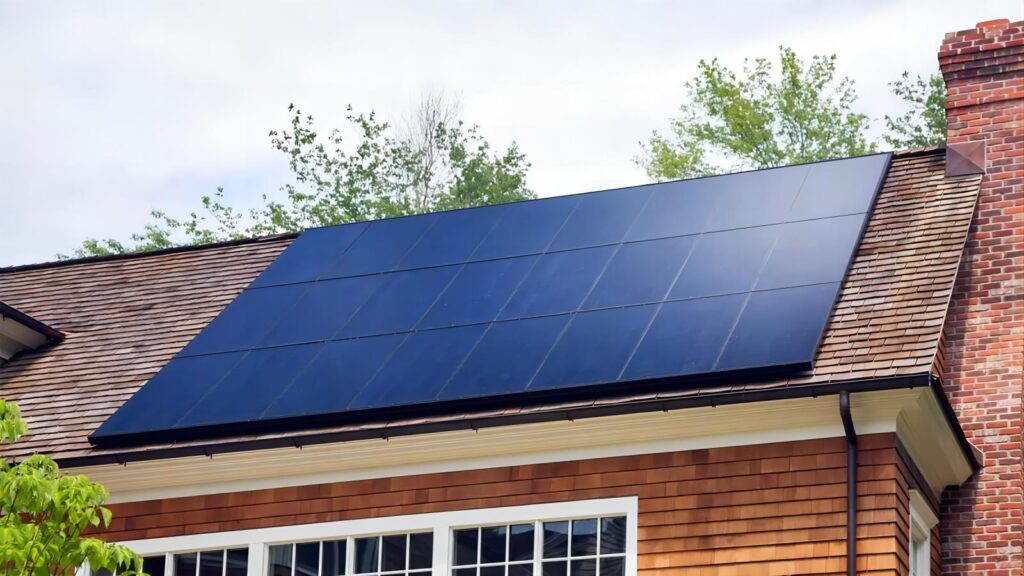
The all-black, ribbon-free appearance delivers a clean and elegant look, making it suitable for premium rooftops and design-sensitive locations. With an average reflectivity of just 1.7%, it reduces light pollution and better meets the needs of residential and public environments.
-
Strong Environmental Adaptability
Ribbon connections are unaffected by thermal expansion and contraction, significantly improving weather resistance. Whether on hot rooftops or in extreme climate conditions, the modules maintain reliable performance output.
-
Lower Degradation and Extended Warranty
Superior materials and structural design effectively reduce LID, LeTID, and UVID degradation. With a 25-year warranty, investment risk is lower and long-term returns are better secured.
-
Excellent Temperature Coefficient
With a temperature coefficient of up to -0.29%/°C, IBC modules experience far less power loss even in hot summer conditions, maintaining efficient output.
Single Glass vs. Dual Glass
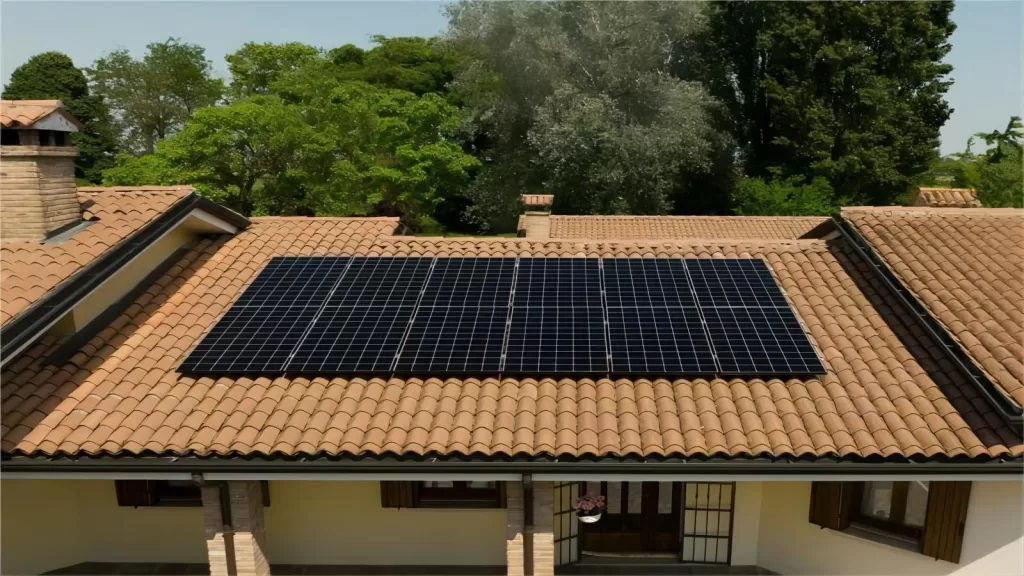
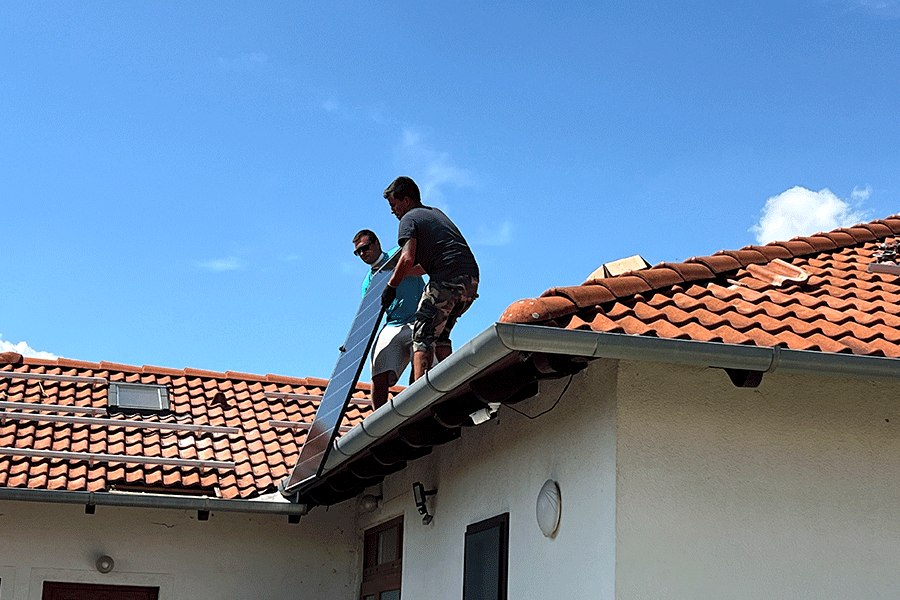
In addition to improvements in efficiency and stability, IBC also offers new design options — single-glass and dual-glass — allowing for more flexible applications across different rooftop scenarios. Compared to dual-glass modules, IBC single-glass modules are lighter, reducing roof load, especially on older or lighter structures. They are also more efficient to transport, lift, and install, cutting labor and logistics costs. This lightweight design provides greater flexibility for commercial and residential projects while also shortening construction timelines.
Comparison: IBC Single Glass vs. PERC and TopCon
Why does IBC single glass perform well?
1. PERC Single-Glass Experience: Proven in the Market
Before dual-glass TopCon appeared, PERC single-glass modules had already been sold for many years. Many customers have operated single-glass PERC systems for over a decade—well beyond their warranty periods—yet they still run reliably. For example, numerous systems installed in Germany and Italy between 2010 and 2012 continue to deliver 85%–90% of their initial output today, demonstrating the reliability of single-glass in real-world applications.
2. Why is TopCon mostly dual-glass?
Structurally, TopCon cells are more sensitive to moisture and environmental stress. To counter this, manufacturers generally adopt dual-glass designs to enhance moisture resistance and encapsulation. However, this comes at the cost of greater weight, more complex installation, and higher transport expenses. As a result, single-glass TopCon modules are rarely seen on the market.
3. Why is IBC suitable for single-glass?
IBC technology relocates all electrodes to the rear, with fewer solder points and fewer potential failure points, making it naturally well-suited to single-glass designs. In addition, thanks to its lower temperature coefficient (−0.29%/°C) and higher cell manufacturing precision, IBC single-glass modules maintain long-term stable performance even under high temperatures and strong irradiation.
2. IBC Single Glass vs. TopCon Dual Glass vs. PERC Single Glass
Comparison between IBC Single Glass, TopCon Glass-Glass and PERC Single Glass
| Comparison Dimension | PERC Single Glass | TopCon Glass-Glass | IBC Single Glass |
|---|---|---|---|
| Market Validation | In use for over 10 years, mature applications | Currently the main choice, focus on weather resistance | New high-efficiency technology, already applied in projects |
| Efficiency | 19–21% | 21–23% | 21.8%–23.5% |
| Temperature Coefficient | -0.35%/°C | -0.32%/°C | -0.29%/°C |
| Weight & Installation | Lightweight, suitable for rooftops | Heavy, increases transport and installation costs | Lightweight, reduces roof load, efficient and fast |
| Durability & Protection | Backsheet limited, faster degradation in humid environments | Glass-glass, resistant to moisture and corrosion | High-quality backsheet, optimized encapsulation |
| Fire Resistance Class | Mostly Class C | Class C or higher | Designed for higher fire resistance class, suitable for BIPV and rooftops |
| Payback Period | Lower efficiency, longer payback period | High efficiency, but weight and costs extend payback | High efficiency and low degradation, faster payback, benefits over 25 years |
| Future Potential | Mature technology, limited room for improvement | Still under optimization, but complex and costly process | Simple structure, suitable for future tandem layers |
3. IBC Single Glass vs. Common Market Modules
Fire Risk
The IBC single-glass module is designed to meet the requirements of higher fire protection classes, providing enhanced safety in building applications
Moisture Ingress
IBC single-glass modules use high-quality backsheet materials and optimized encapsulation, effectively blocking moisture penetration. By comparison, although TopCon dual-glass modules emphasize durability, IBC single-glass delivers higher returns over the 25-year warranty period. The ROI is achieved earlier, meaning that the “extra five years” of service life is not necessarily a decisive advantage.
Rapid Technological Evolution
With photovoltaic technology advancing quickly, enterprise users often achieve payback within 15–20 years and then look to upgrade to higher-efficiency modules. In other words, the strong early returns from IBC single-glass, thanks to high efficiency and low degradation, are already sufficient to offset concerns about product lifespan.
Challenges and Limitations of IBC Solar Panels
-
Since all electrodes are located on the rear side, higher demands are placed on insulation and material purity. The precision of the manufacturing process directly impacts cell performance.
-
The production process is more complex and requires higher-quality materials, making the overall cost of IBC cells higher than mainstream PERC and TopCon technologies.
-
The appearance and design of IBC modules are not suitable for all scenarios. They are better suited to distributed generation and BIPV applications, while for large-scale ground-mounted plants, cost-benefit considerations must be carefully evaluated.
Solutions and Cooperative Support
Although IBC technology still faces challenges in terms of production complexity and cost, these limitations are gradually being overcome through large-scale manufacturing and continuous process optimization. As a photovoltaic supplier focused on the European market, Maysun has already launched a wide range of IBC products to meet the needs of residential, commercial, and industrial projects. In addition, we provide localized after-sales support across Europe to help partners deploy IBC technology more efficiently and maximize the use of solar energy resources.
Conclusion
Overall, IBC single-glass modules demonstrate distinct advantages in terms of efficiency, stability, and aesthetic integration. They are not only well-suited for today’s commercial and industrial PV deployments but also leave room for future system upgrades. As manufacturing processes improve and costs decline, IBC technology is expected to play a role in a broader range of applications, delivering more sustainable and stable long-term returns for investors and enterprises.
Recommend Reading

Low-Carbon PV Procurement in France: Why ECS, PEP Ecopassport and Solar Carports Matter
Table of Contents France is becoming one of Europe’s most documentation-driven solar markets. For EPC companies, developers and commercial project owners, module selection is no longer based only on price-per-watt, efficiency or linear power warranties. Carbon documentation, supply-chain traceability and project-specific compliance files

PV Module Installation Beyond Rooftops: Multi-Scenario Applications for Bifacial N-Type Modules in Europe
PV module installation is not limited to rooftops. For residential users, small commercial users and distributed PV projects in Europe, spaces such as balconies, gardens, fences, carports, terraces, façades and pergolas can also provide additional installation areas when conditions allow. As solar use

Europe’s Grid Cap Era: Why High-Efficiency Solar Panels Matter More in 2026
Introduction In 2026, the economics of distributed solar in Europe are changing. Grid congestion, export limits, negative electricity prices and zero-export requirements mean that a solar project can no longer be judged only by how much electricity it generates. The more important question

How Do Solar Panel Delivery Delays Affect Installer Costs?
Solar panel delivery delays can affect installation schedules, project acceptance and payment collection.

The Forgotten “Invisible Assets”: Why Repowering Is the Strategic Key for European Solar in 2026
As grid congestion delays new solar projects across Europe, existing PV assets are becoming a strategic source of growth. This article explains why PV repowering can help EPCs and C&I asset owners unlock hidden value from already-connected solar plants, improve LCOE, and extend long-term asset performance with high-efficiency TOPCon, IBC and HJT modules.

Solar Panel Procurement in Europe: Why Stable Supply Matters More Than a One-Off Low Price
When European installers, distributors and corporate buyers choose solar panels, a one-off low price should not be the only factor. Stable supply, model continuity, technical documents and replenishment capacity often matter more for long-term cooperation and project delivery.