
Table of Contents
Introduction
Limited rooftop space, significant climate variations, and long payback periods have consistently been the core challenges faced by photovoltaic users in Europe. Whether for residential self-consumption or commercial and industrial system investments, multiple factors must be carefully considered when planning a solar project. How to achieve higher installed capacity per unit area and ensure long-term stable power generation under constrained resource conditions has become a key issue to address before system construction.
What Can the HJT 500W Series Offer Users?
Module Efficiency up to 23.4%
To achieve higher power output within limited space, Maysun Solar has designed the HJT module range at 500W–520W, with efficiencies from 22.5% up to 23.4%. This allows users to minimize the number of modules and installation costs, maximizing space utilization and accelerating return on investment.
Temperature Coefficient as Low as -0.24%/°C
HJT technology enables a temperature coefficient as low as -0.24%/°C, meaning less performance loss under high temperatures. For users in Southern Europe, this translates into more stable output power and annual energy yield.
Bifaciality up to 95%
In photovoltaic projects with favorable reflective conditions, a bifaciality of 95% delivers additional energy generation, resulting in higher overall system output and returns.
30-Year Product Warranty
With a first-year degradation of no more than 1% and an annual rate of no more than 0.35% thereafter, Maysun Solar provides a 30-year product and power warranty, ensuring stable performance throughout the module’s lifecycle.
Full Black Design for Performance and Aesthetics
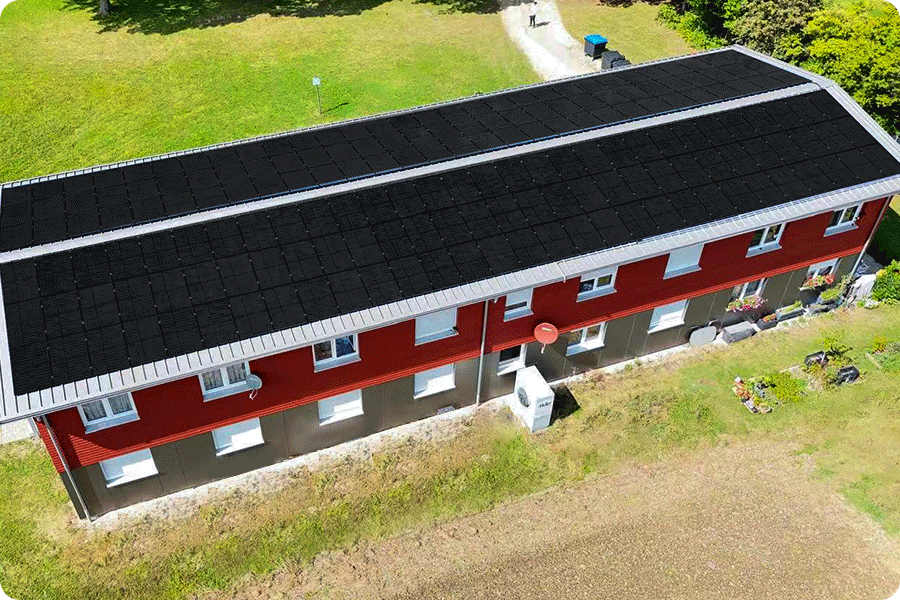
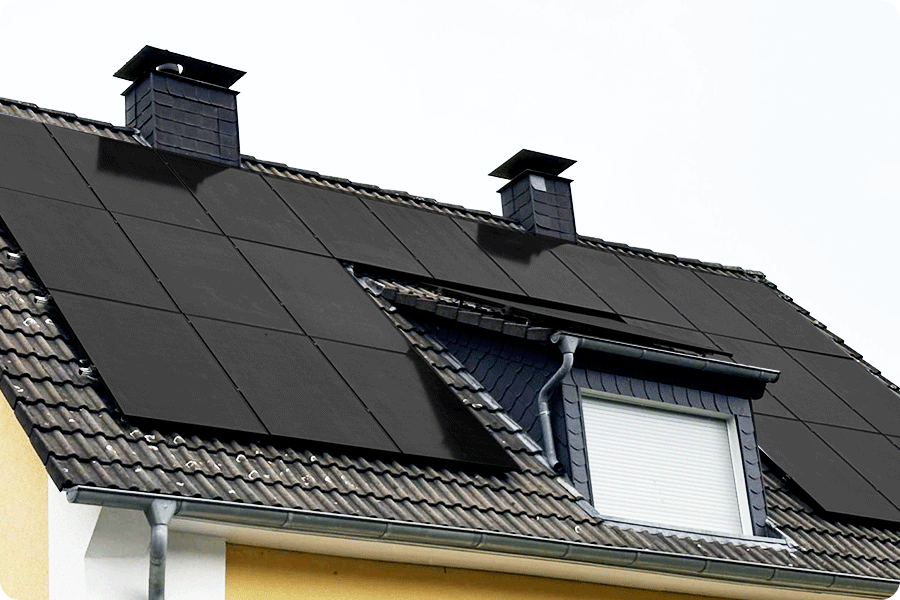
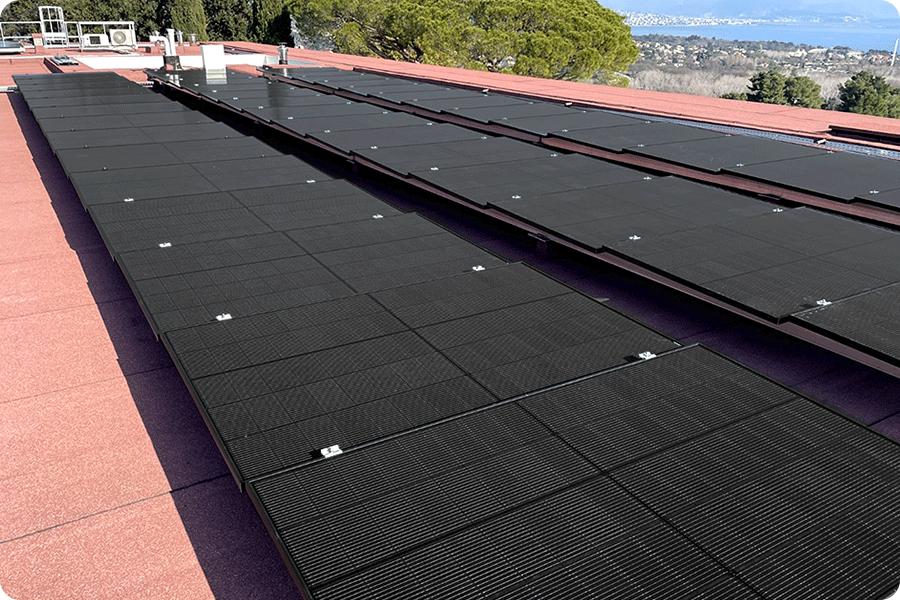
For residential and commercial projects with high aesthetic demands, the full black appearance ensures a uniform architectural look while maintaining high efficiency and reliable stability.
Where Can the HJT 500 Series Be Applied?
Residential and Commercial Projects with Limited Roof Space
In projects with limited roof area or complex roof surfaces, the number of modules that can be installed is restricted, making it difficult to reach the expected installed capacity and energy yield. The HJT 500–520W series solar modules helps users achieve optimal installed capacity and efficiency within limited space.
Assume a usable roof area of 40 m², layout factor of 0.95, reference yield of 1000 kWh/kWp·year, and 1000 full-load hours per year, using 500W modules:
HJT 500W (22.5% conversion efficiency): installable ≈8.55 kWp → annual generation ≈8,550 kWh
PERC 500W (21% conversion efficiency): installable ≈7.98 kWp → annual generation ≈7,980 kWh
Considering the bifaciality of HJT technology, actual annual generation can be even higher.
Note: Installable capacity = usable roof area (m²) × module efficiency × layout factor; Annual generation = installable capacity × reference yield.
High-Temperature Climate Regions
In regions such as Southern Europe, high summer temperatures often reduce PV system efficiency and may even cause hotspots, affecting module lifespan and overall returns. HJT modules feature a temperature coefficient as low as -0.24%/°C, compared to -0.35%/°C for PERC, significantly reducing losses caused by rising temperatures and ensuring stable output even under heat stress.
Assume a 10 kWp project operating 10°C above standard test conditions (25°C):
HJT (-0.24%/°C): annual generation ≈9,760 kWh
PERC (-0.35%/°C): annual generation ≈9,650 kWh
With greater real-world temperature variations, the performance gap is expected to widen further.
Note: Annual generation = total module power × reference yield × [1 − (temperature coefficient × ΔT)].
Projects with Strong Reflective Conditions
On light-colored rooftops, gravel-covered surfaces, or in winter high-albedo environments, bifacial generation can significantly increase total system output. HJT modules reach up to 95% bifaciality, while PERC modules achieve only 70%.
Assume a 10 kWp project, reference yield 10,000 kWh/year, and a roof reflectivity of 25%:
HJT (95%): annual generation ≈12,375 kWh
PERC (70%): annual generation ≈11,750 kWh
With higher reflectivity, the generation gap will expand further.
Note: Annual generation (bifacial) = reference yield × [1 + (reflectivity × bifaciality)].
BIPV and Premium Residential Projects with High Aesthetic Standards
For projects pursuing building-integrated design, the visual coordination between modules and architecture is essential. HJT modules feature a full black design that eliminates color inconsistencies, ensuring seamless integration with rooftops or façades. This delivers both high efficiency and long-term stable performance while providing superior aesthetics for BIPV systems and premium residential projects.
Conclusion
Whether for residential self-consumption or commercial and industrial photovoltaic projects, the ultimate goal is to secure stable and sustainable energy generation over the years to come. In this process, module selection is a critical step that should never be overlooked. It not only determines system performance but also impacts long-term maintenance costs and overall return on investment.
Before starting a project, evaluating factors such as roof structure, available area, and environmental conditions is essential to ensure consistent output throughout the system’s lifecycle. With high module efficiency, a low temperature coefficient, excellent bifacial performance, and a full black design, the HJT 500–520W series offers a compelling solution for users dealing with complex roof conditions, hot climates, or projects requiring architectural aesthetics.
Maysun Solar’s HJT 500–520W photovoltaic modules deliver high conversion efficiency, a low temperature coefficient, and outstanding bifacial performance. They ensure stable output even in limited rooftop spaces and under variable lighting conditions, making them well-suited for both residential and commercial PV projects across Europe, enhancing system stability and securing long-term returns.
Recommend Reading

Low-Carbon PV Procurement in France: Why ECS, PEP Ecopassport and Solar Carports Matter
Table of Contents France is becoming one of Europe’s most documentation-driven solar markets. For EPC companies, developers and commercial project owners, module selection is no longer based only on price-per-watt, efficiency or linear power warranties. Carbon documentation, supply-chain traceability and project-specific compliance files

PV Module Installation Beyond Rooftops: Multi-Scenario Applications for Bifacial N-Type Modules in Europe
PV module installation is not limited to rooftops. For residential users, small commercial users and distributed PV projects in Europe, spaces such as balconies, gardens, fences, carports, terraces, façades and pergolas can also provide additional installation areas when conditions allow. As solar use

Europe’s Grid Cap Era: Why High-Efficiency Solar Panels Matter More in 2026
Introduction In 2026, the economics of distributed solar in Europe are changing. Grid congestion, export limits, negative electricity prices and zero-export requirements mean that a solar project can no longer be judged only by how much electricity it generates. The more important question

How Do Solar Panel Delivery Delays Affect Installer Costs?
Solar panel delivery delays can affect installation schedules, project acceptance and payment collection.

The Forgotten “Invisible Assets”: Why Repowering Is the Strategic Key for European Solar in 2026
As grid congestion delays new solar projects across Europe, existing PV assets are becoming a strategic source of growth. This article explains why PV repowering can help EPCs and C&I asset owners unlock hidden value from already-connected solar plants, improve LCOE, and extend long-term asset performance with high-efficiency TOPCon, IBC and HJT modules.

Solar Panel Procurement in Europe: Why Stable Supply Matters More Than a One-Off Low Price
When European installers, distributors and corporate buyers choose solar panels, a one-off low price should not be the only factor. Stable supply, model continuity, technical documents and replenishment capacity often matter more for long-term cooperation and project delivery.