Table of Contents
Introduction
On July 1, 2025, China’s Central Financial and Economic Affairs Commission, in a high-level meeting, officially called for the “law-based governance of disorderly and low-price competition,” with a clear directive to phase out outdated production capacity in an orderly manner. This marked the first time that the central government has issued a formal judgment on the unchecked expansion of emerging industries such as photovoltaics, signaling a strategic policy shift from growth encouragement to structural governance.
Simultaneously, major state media outlets including People’s Daily and Qiushi Journal published consecutive commentaries criticizing the intensifying “involution-style” competition in the PV and energy storage sectors. These articles emphasized how certain production capacities are “barely surviving and unable to exit,” leading to distorted resource allocation and dysfunctional market mechanisms—echoing the government’s call for industry rectification.
China’s PV industry is now entering a new phase of restructuring, driven by top-level policy intervention and structural reform.
China’s Government Leads PV Industry Restructuring
In July 2025, China’s Central Financial and Economic Affairs Commission, for the first time at the national level, called for the “law-based governance of disorderly and low-price competition,” urging the orderly phase-out of outdated production capacity and the optimization of industry structure. Around the same time, state-run media outlets People’s Daily and Qiushi Journal published a series of articles highlighting the plight of industries such as photovoltaics and energy storage—where “struggling capacity lingers on”—signaling a clear escalation in the government’s restructuring efforts. Soon after, the Ministry of Industry and Information Technology held a closed-door meeting with 14 leading PV companies, including Tongwei, Jinko, Trina, LONGi, and JA Solar, reaching consensus on curbing new capacity, restoring a pricing mechanism, and improving product quality.
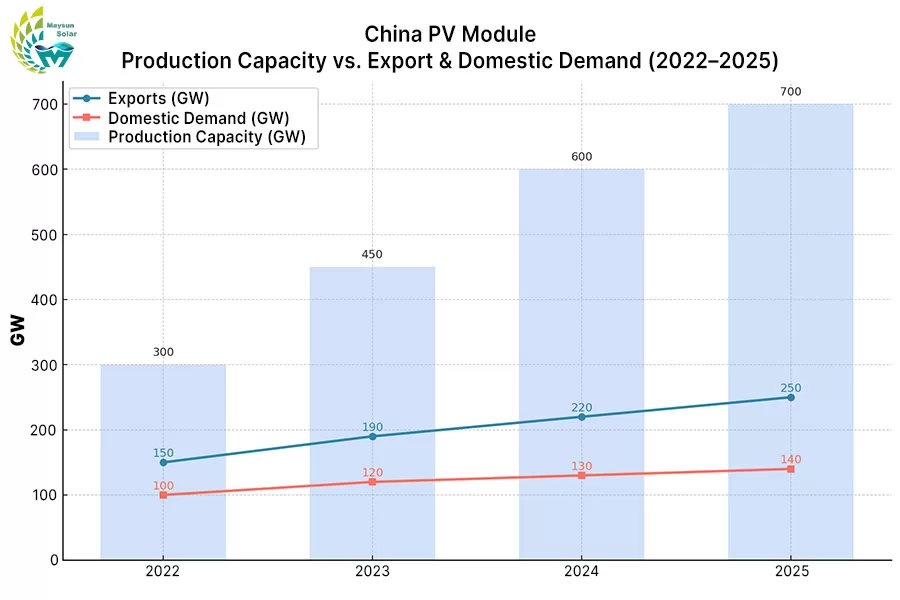
Enterprises responded swiftly. JinkoSolar announced a temporary reduction in battery cell production capacity utilization, while Tongwei Group stated it would “optimize the pace of new capacity deployment” to align with policy signals and ease structural pressures. At the same time, the solar glass sector announced a collective 30% production cut starting in July. According to InfoLink, China’s PV module production capacity exceeded 500 GW in 2023, while global demand stood at around 360 GW—revealing a stark supply-demand imbalance. Many midstream manufacturers fell into losses, with cell prices persistently below cash cost, raising serious concerns about the long-term sustainability of the supply chain.
It’s important to note that current PV module price distortions are not solely a result of unchecked expansion. They are also driven by a temporary mismatch between rapidly improving technical efficiency and sharply falling costs. In May 2025, the spot price of TOPCon modules in China dropped to around €0.082/W at its lowest point, reflecting both the pressure of inventory clearance and weak short-term demand. Launching this round of restructuring at this point represents a proactive government intervention to stabilize market mechanisms.
For European markets that rely heavily on Chinese PV modules, this adjustment cycle will directly impact price expectations and product mix. In the first half of 2024, China exported 94.4 GW of PV modules to Europe, accounting for over 40% of total shipments. However, reports by PV-Tech and Euractiv indicate that several European markets are now dealing with excess inventory and product inconsistency, with growing concerns from end customers about delivery quality.
This policy-driven shakeout is expected to bring three major benefits:
Suppression of irrational price competition;
Improved supply-demand predictability in the medium to long term;
Stronger enforcement of quality and compliance standards.
For European PV developers, this represents not only a crucial window to mitigate risks but also a potential turning point for reevaluating procurement strategies and supplier partnerships.
Multiple industry indicators show the restructuring is already reshaping PV pricing mechanisms. According to Bloomberg, citing the China Silicon Industry Association, N-type wafer prices surged 22% in a single week in July 2025—the largest weekly increase since 2023—due to production cuts and reduced utilization rates. PV InfoLink simultaneously reported an average price rise of 13%. At present, the capacity utilization rates of major wafer producers have dropped below 50%, with production expansion slowing noticeably. As terminal inventories begin to clear, the module segment is entering a restocking cycle. This marginal shift in supply-demand dynamics is driving prices back to rational levels, creating a more stable foundation for high-quality industry development.
Capacity Control Drives Stabilization in Module Quality and Pricing
Why are PV module prices in China gradually rebounding?
Following the government’s policy shift, PV module prices are showing signs of structural stabilization. According to TrendForce, the average export price for TOPCon modules in China rose to approximately €0.091/W in Q2 2025, with some Tier 1 manufacturers reaching between €0.095 and €0.105/W. This price range reflects a partial easing of inventory pressure and suggests that the previous price war is coming to an end.
More importantly, this price rebound is no longer driven by broad market recovery but by demand for high-efficiency products. TOPCon and HJT modules maintain strong pricing power in utility-scale and high-yield projects, while PERC technology is rapidly exiting the mid-to-high-end market. Developers increasingly seek a balance between long-term returns and product reliability.
Which PV module technologies are best suited for European projects?
In Europe, the focus of module procurement is shifting toward lifecycle power generation efficiency and system stability.
PERC modules are losing competitiveness in mainstream commercial projects due to challenges in batch consistency and varied warranty structures. In contrast, TOPCon and HJT modules, with their superior initial efficiency and better thermal tolerance, now dominate utility-scale and C&I rooftop installations.
Additionally, IBC modules are gaining traction in premium projects where temperature fluctuations, heavy structural loads, or aesthetic requirements are critical, thanks to their excellent temperature coefficient and superior low-light performance.
What procurement standards should European developers prioritize?
Across major European markets, compliance capabilities are becoming a core part of module evaluation criteria. Several banks and institutional investors now require EL imaging, carbon footprint certifications, and batch consistency documentation. In some municipal tenders, RFPs explicitly call for traceable production processes and environmental responsibility metrics.
Of particular note, the Solar Stewardship Initiative (SSI) introduced the world’s first traceability standard for the solar supply chain in 2024. It has already been adopted as a procurement reference by developers and public institutions in countries like Germany and the Netherlands.
The traditional price-first procurement model is being replaced by a new logic: deliverability, warranty reliability, and supply chain traceability. For European buyers, this shift is not just a response to rising prices—it marks a fundamental upgrade in how supplier quality and sustainability are assessed.
European PV Procurement Strategies Are Undergoing a Shift
Against the backdrop of an industry cycle shift and regulatory restructuring in China, European buyers can no longer rely solely on price comparisons to manage costs and risks. Over the past two years, many PV projects have faced warranty disputes and financing delays due to batch inconsistencies, delivery setbacks, or missing certifications.
While price remains important, the decision-making logic is evolving. Since early 2025, export quotes for TOPCon modules from some Tier 1 manufacturers have stabilized between €0.095 and €0.105/W, maintaining a consistent premium over Tier 2 suppliers. This reflects a revaluation of high-efficiency product structures and shows that, under policy intervention, the supply of ultra-low-cost modules is contracting. In projects with tight grid connection timelines or complex financing structures, buyers increasingly prefer long-term suppliers with capacity planning, complete certification portfolios, and verifiable factory locations—rather than those offering short-term price advantages.
Procurement strategy adjustments must go beyond theoretical logic and be implemented through concrete mechanisms. For European companies preparing or revising mid-term procurement plans, three priorities stand out:
Prioritize suppliers with carbon footprint accounting capabilities or third-party process verification to enhance success rates in bidding and financing stages;
Build core technology portfolios around TOPCon or HJT modules, while reserving IBC modules for high-temperature, low-light, or design-sensitive applications;
Integrate supply stability and batch consistency into project evaluation criteria, especially for phased deliveries or syndicated financing structures—setting minimum traceability thresholds and delivery tolerance buffers.
As China’s PV industry undergoes a policy-driven structural transformation, the real challenge for European buyers is whether they can pivot in time—establishing supplier relationships that align with the new global supply-demand landscape.
Since 2008, Maysun Solar has been both an investor and manufacturer in the photovoltaic industry, providing zero-investment commercial and industrial rooftop solar solutions. With 17 years in the European market and 1.1 GW of installed capacity, we offer fully financed solar projects, allowing businesses to monetize rooftops and reduce energy costs with no upfront investment. Our advanced IBC module, HJT module and TOPCon module panels, and balcony solar stations, ensure high efficiency, durability, and long-term reliability. Maysun Solar handles all approvals, installation, and maintenance, ensuring a seamless, risk-free transition to solar energy while delivering stable returns.
Reference
Bloomberg News. (2025). China’s wafer prices jump most since 2023 on production cuts. https://www.bloomberg.com/news/articles/2025-07-17/china-s-wafer-prices-jump-most-since-2023-on-production-cuts
InfoLink Consulting. (2025). PV spot price update: Cell and module prices rally. https://www.infolink-group.com/energy-article/pv-spot-price-20250702
TrendForce. (2025). Price Trends. https://www.trendforce.com/price/pv/polysilicon
People’s Daily. (2025, June 29). Breaking “involution‑style” competition to pursue high‑quality development. http://opinion.people.com.cn/n1/2025/0629/c1003-40510840.html
Qiushi Journal. (2025). How “involution‑style” competition forms? https://www.qstheory.cn/20250710/a5d15679bc5b4173a93ecf9a3694bcea/c.html
Recommend Reading

Low-Carbon PV Procurement in France: Why ECS, PEP Ecopassport and Solar Carports Matter
Table of Contents France is becoming one of Europe’s most documentation-driven solar markets. For EPC companies, developers and commercial project owners, module selection is no longer based only on price-per-watt, efficiency or linear power warranties. Carbon documentation, supply-chain traceability and project-specific compliance files

PV Module Installation Beyond Rooftops: Multi-Scenario Applications for Bifacial N-Type Modules in Europe
PV module installation is not limited to rooftops. For residential users, small commercial users and distributed PV projects in Europe, spaces such as balconies, gardens, fences, carports, terraces, façades and pergolas can also provide additional installation areas when conditions allow. As solar use

Europe’s Grid Cap Era: Why High-Efficiency Solar Panels Matter More in 2026
Introduction In 2026, the economics of distributed solar in Europe are changing. Grid congestion, export limits, negative electricity prices and zero-export requirements mean that a solar project can no longer be judged only by how much electricity it generates. The more important question

How Do Solar Panel Delivery Delays Affect Installer Costs?
Solar panel delivery delays can affect installation schedules, project acceptance and payment collection.

The Forgotten “Invisible Assets”: Why Repowering Is the Strategic Key for European Solar in 2026
As grid congestion delays new solar projects across Europe, existing PV assets are becoming a strategic source of growth. This article explains why PV repowering can help EPCs and C&I asset owners unlock hidden value from already-connected solar plants, improve LCOE, and extend long-term asset performance with high-efficiency TOPCon, IBC and HJT modules.

Solar Panel Procurement in Europe: Why Stable Supply Matters More Than a One-Off Low Price
When European installers, distributors and corporate buyers choose solar panels, a one-off low price should not be the only factor. Stable supply, model continuity, technical documents and replenishment capacity often matter more for long-term cooperation and project delivery.