
Table of Contents
When companies invest in photovoltaic systems, roof space is often the most critical limiting factor. The number of panels that can be installed, the amount of electricity generated, and the payback period all ultimately depend on how much revenue each square meter can produce. Today’s market offers a wide range of high-efficiency solar panels, typically rated between 400 W and 810 W, but a “higher power rating” does not necessarily mean “higher returns.”
The key factors that influence actual profitability include the panel’s electrical performance, temperature behavior, shading tolerance, and long-term degradation rate.
Why do solar panels with the same power rating produce different outputs?
Many people assume that if two solar panels have the same rated power, their energy generation should be roughly identical regardless of brand, technology, or structure. However, once installed and operating, it quickly becomes apparent that system outputs vary—some installations generate several hundred kilowatt-hours more each year. This difference is not accidental; it stems from the internal structural design and manufacturing process of the modules.
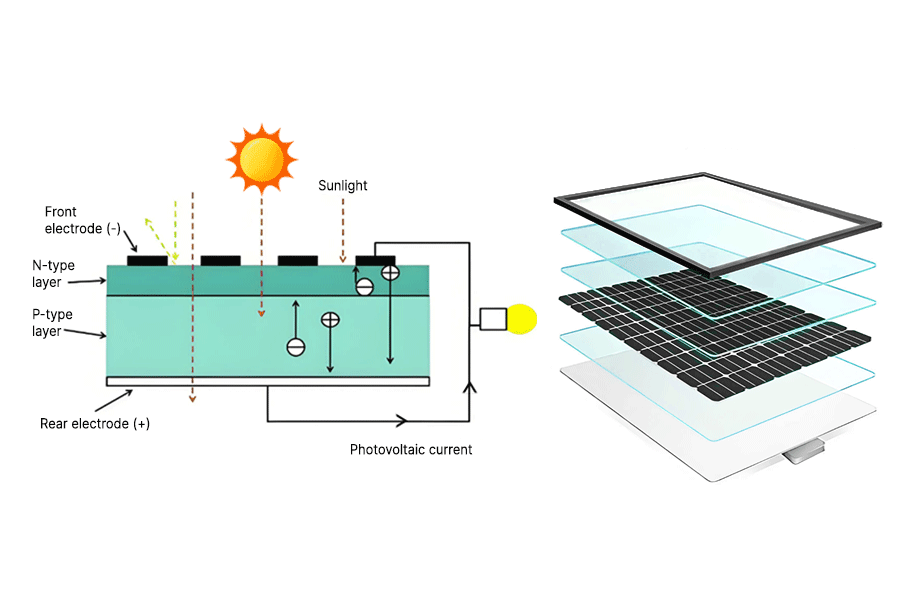
Although photovoltaic panels may look similar on the outside, the internal configuration—from solar cells to encapsulation materials—determines their true performance. The rated power only reflects the peak output under Standard Test Conditions (STC) in the laboratory, while real-world generation depends on key factors such as temperature response, current loss, and material degradation.
These seemingly minor differences can lead to a 3% to 8% variation in energy production among panels with identical nominal power, especially under high temperatures, shading, or low-light conditions. To understand why, one must return to the technical level and compare how different structural designs manage energy conversion and loss control.
What determines energy yield when space is limited?
Many companies face the same challenge when planning a photovoltaic system: roof space is limited, but they still want to generate more electricity.
When installation space becomes the main constraint, maximizing returns is no longer about installing more panels—it’s about ensuring each square meter consistently delivers higher and more stable energy output. For example, on the same 100 m² roof, differences in efficiency, temperature behavior, and loss control between modules can lead to significantly different financial results.
These differences are not determined solely by the rated power but by the panel’s overall performance under real operating conditions. The key factors include:
Current design: For modules with the same wattage, operating at a lower current reduces internal losses (I²R losses) and provides more stable output.
Temperature response: For every 1 °C increase in temperature, power output decreases by about 0.3%. Panels with better thermal design, more even heat dissipation, and finer cell segmentation experience lower temperature rise and slower degradation.
Shading and localized loss: On rooftops, partial shading is common. If it affects an entire string, system output drops significantly; finer segmentation (such as one-third-cut design) limits the impact to smaller areas.
With ongoing technological evolution, the market has moved from PERC to higher-efficiency routes such as TOPCon, HJT, and IBC. Each offers distinct advantages in efficiency, cost, and application scenarios, collectively improving the energy yield per unit area. Among them, TOPCon technology has become the mainstream choice for commercial and industrial projects, thanks to its balance of efficiency gains and cost control. Within the TOPCon family, the one-third-cut design further reduces current density and optimizes heat dissipation, enhancing energy utilization under high-temperature and partially shaded conditions—making it a key direction for projects aiming at higher ROI.
| Technology Type | Typical Efficiency | Temperature Coefficient | Degradation Rate | Cost Level | Features & Suitable Scenarios |
|---|---|---|---|---|---|
| PERC | 21–22% | −0.35%/℃ | Medium | Low | Mature process and low cost, but performs poorly under high temperature and low-light conditions |
| TOPCon | 21.5–23.22% | −0.32%/℃ | Low | Medium | Significant efficiency improvement and controllable cost; the main direction of mainstream technology upgrades |
| HJT | 21.7–23.4% | −0.234%/℃ | Low | High | Excellent temperature coefficient and good low-light performance, but high manufacturing cost |
| IBC | 21.7–23.5% | −0.29%/℃ | Very Low | High | High aesthetics and extremely low degradation; suitable for premium rooftops and building-integrated applications |
A More Efficient Structure?
Two panels may share the same power rating, yet their internal current paths and heat distribution determine their real-world performance. Traditional half-cut modules reduce current density and resistive losses by splitting each cell in two—an effective approach at medium power levels. However, as panel power ratings continue to rise and single-cell areas grow larger, the half-cut design has shown its limits: higher current increases localized heating, which in turn raises power losses and the risk of hot spots.
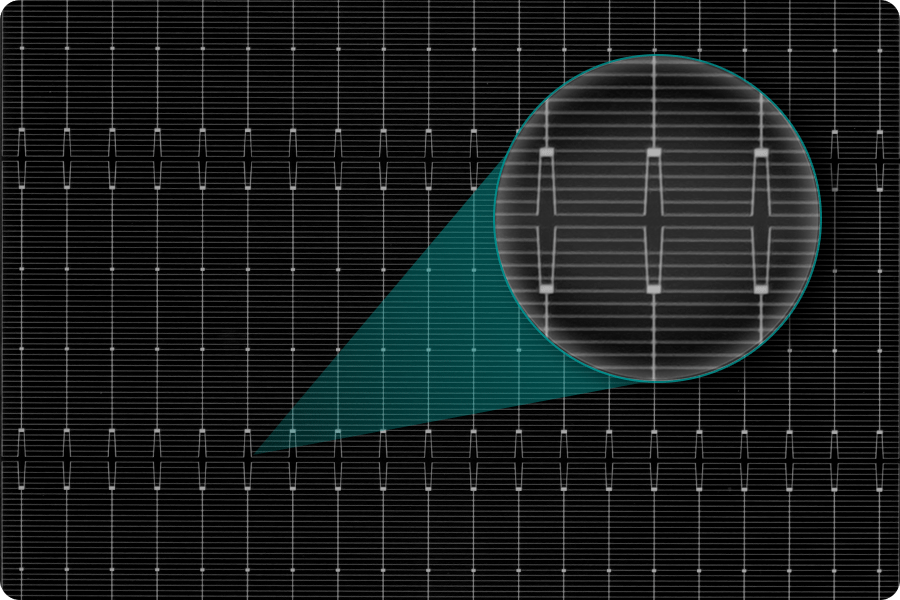
The one-third-cut technology was developed to address these challenges. By dividing each cell into three equal sections, it reduces the current in each path by roughly 1/3 design, effectively lowering I²R losses. Lower current means reduced operating temperature, more uniform heat distribution, and more stable long-term output performance.
In real-world applications, dust accumulation or equipment shading is often unavoidable. With traditional half-cut modules, partial shading can affect an entire string, causing significant power losses. In contrast, the 1/3-cut design confines the impact to smaller localized areas, minimizing overall generation loss. This makes it particularly advantageous for factory rooftops, carports, and other distributed scenarios where partial shading is common.
From a system perspective, 1/3-cut is not merely an improvement in cutting technology but a comprehensive optimization of electrical pathways and thermal management:
- Lower current density reduces conductor heating;
- More sub-strings lessen shading impact;
- More uniform heat distribution extends module lifespan;
- Smoother output curves enhance overall system efficiency.
To better visualize the design and performance improvements of 1/3-cut technology, the following table compares key differences between TOPCon half-cut and one-third-cut modules with the same power rating.
Twisun Pro 1/3-Cut Technology vs. Half-Cut Modules: Technical and Performance Differences
| Comparison Criteria | Half-Cut Module | Twisun Pro 1/3-Cut Technology |
|---|---|---|
| Cutting Method | 1/2 cut, higher current density | 1/3 cut, more precise current control |
| Current Density | High (around 15A), generates more heat | Low (around 10A), better thermal management |
| Hot Spot Risk | Moderate | Lower (reduced by about 40%) |
| Performance Loss | Higher series loss | Lower loss, better performance |
| Temperature Control | Heat accumulation, shorter lifespan | More stable performance under low temperatures |
| Application Scenarios | Suitable for standard rooftops | Better suited for high-temperature, light-load, and commercial rooftops |
Different Technological Paths: Balancing Efficiency and Return on Investment
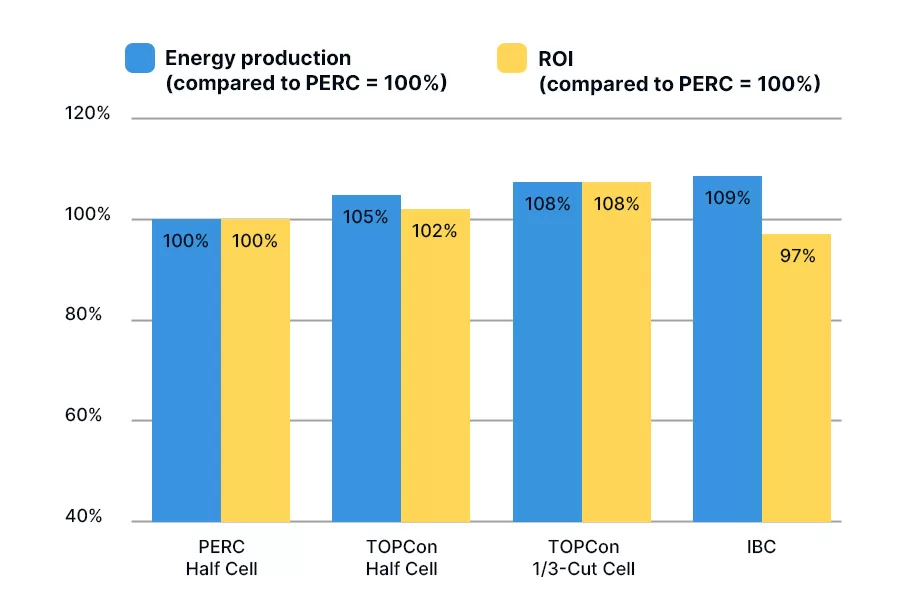
Once structural optimization resolves current and heat distribution issues, the difference in long-term system returns depends mainly on the cell technology’s energy conversion efficiency and degradation control. TOPCon technology, with its lower recombination losses and temperature coefficient, demonstrates higher energy output and better economic returns over time.
According to experimental data published by Springer Nature, n-type TOPCon cells use a tunnel oxide passivation structure that significantly reduces carrier recombination losses, allowing the modules to maintain higher power output under high-temperature and low-light conditions. Under the same operating environment, TOPCon modules generate approximately 6–9% more energy per year than PERC modules, providing a more stable overall energy yield. For a typical commercial rooftop system, this translates to an additional 50,000–70,000 kWh per MW annually—equivalent to roughly €10,000–14,000 in extra revenue each year, assuming an electricity price of €0.20/kWh.
When TOPCon technology is combined with 1/3-cut design, current density decreases even further, minimizing energy loss and improving overall system efficiency by an additional 1–2 percentage points. While IBC modules still lead in terms of cell efficiency and visual appeal, their higher silver consumption and complex back-contact design significantly raise production costs. In contrast, TOPCon solutions achieve higher energy yield while maintaining a lower cost per installed kilowatt and a shorter payback period—further improving ROI.
This dual balance between efficiency and cost is the key reason TOPCon has become the dominant choice in today’s photovoltaic market.
Note: Data is based on a typical 100 kWp commercial rooftop system (module power 440 W, full-load hours 1200 h/year, average electricity price €0.20/kWh). Actual results may vary depending on regional solar irradiance, temperature, and installation conditions.
Conclusion: Making Every Square Meter More Valuable
The profitability of a photovoltaic system is never just about wattage—it’s the result of a balanced combination of efficiency, stability, and economic performance. For most businesses, roof space is limited while electricity demand keeps rising, so choosing the right module is essentially a decision about long-term returns. Through structural optimization and improved energy management, 1/3-cut solar modules enable higher utilization of the same roof area, bringing investments closer to the goal of steady and sustainable growth.
In the future, the solar market will continue to seek balance between efficiency and cost. Yet the most valuable choice is not necessarily the most expensive or the highest in wattage, but the one that best matches the project’s specific conditions and consistently delivers real-world returns—making the roof truly create value.
Maysun Solar has deep roots in the European market, serving wholesalers and distributors with a diverse and stable supply of photovoltaic modules covering major technologies such as IBC technology, TOPCon technology, and HJT technology. Our goal is to help clients achieve higher energy efficiency, faster payback, and more stable system performance within limited roof space—maximizing the value of every square meter.
Recommend reading

Low-Carbon PV Procurement in France: Why ECS, PEP Ecopassport and Solar Carports Matter
Table of Contents France is becoming one of Europe’s most documentation-driven solar markets. For EPC companies, developers and commercial project owners, module selection is no longer based only on price-per-watt, efficiency or linear power warranties. Carbon documentation, supply-chain traceability and project-specific compliance files

PV Module Installation Beyond Rooftops: Multi-Scenario Applications for Bifacial N-Type Modules in Europe
PV module installation is not limited to rooftops. For residential users, small commercial users and distributed PV projects in Europe, spaces such as balconies, gardens, fences, carports, terraces, façades and pergolas can also provide additional installation areas when conditions allow. As solar use

Europe’s Grid Cap Era: Why High-Efficiency Solar Panels Matter More in 2026
Introduction In 2026, the economics of distributed solar in Europe are changing. Grid congestion, export limits, negative electricity prices and zero-export requirements mean that a solar project can no longer be judged only by how much electricity it generates. The more important question

How Do Solar Panel Delivery Delays Affect Installer Costs?
Solar panel delivery delays can affect installation schedules, project acceptance and payment collection.

The Forgotten “Invisible Assets”: Why Repowering Is the Strategic Key for European Solar in 2026
As grid congestion delays new solar projects across Europe, existing PV assets are becoming a strategic source of growth. This article explains why PV repowering can help EPCs and C&I asset owners unlock hidden value from already-connected solar plants, improve LCOE, and extend long-term asset performance with high-efficiency TOPCon, IBC and HJT modules.

Solar Panel Procurement in Europe: Why Stable Supply Matters More Than a One-Off Low Price
When European installers, distributors and corporate buyers choose solar panels, a one-off low price should not be the only factor. Stable supply, model continuity, technical documents and replenishment capacity often matter more for long-term cooperation and project delivery.