All prices in this article are based on publicly available industry data and research as of October 2025. Domestic pricing refers to “tax-included, excluding freight,” and export prices refer to “FOB/CIF.” All RMB figures are converted at approximately €1 ≈ ¥7.8 RMB for reference only.
Table of Contents
Have prices really bottomed out?
Over the past eighteen months, PV module procurement prices in Europe have seen an unusually prolonged decline — falling from around €0.23/W in mid-2023 to approximately €0.08/W. A price war became the dominant industry theme.
By the summer of 2025, however, Chinese regulators introduced guidance to “lawfully curb malicious price competition.” Combined with energy-intensity limits on polysilicon production and adjustments to export tax rebates, this shifted manufacturers’ focus from price competition to cost control.
Since more than 80% of Europe’s PV modules are sourced from Asian production, these shifts quickly translated into offer prices.
Entering Q4, signs of price correction have become increasingly evident, with several key segments trending upward simultaneously:
TOPCon modules: up roughly 10–15% from mid-year lows, with stronger increases in high-power models
HJT modules: modest increase of about 5–10%, remaining at relatively high price levels
N-type polysilicon: surged nearly 50% in September alone, reaching around €6.5/kg
G12 wafers: month-on-month increase of 35–40%
For European buyers, these movements may signal that, after a prolonged period of aggressive price compression, the industry is attempting to return to a more sustainable pace.
Beyond policy shifts, what exactly is driving PV module prices upward? For companies planning new projects or annual procurement, understanding the underlying logic may prove more valuable than simply chasing the lowest quote.
What is driving PV module prices higher?
The recent price rebound is no coincidence. From supply-side shifts to market dynamics, it reflects multiple forces across the entire value chain. For procurement teams and businesses, understanding these changes is essential for better forecasting price trends.
1. Capacity contraction on the supply side
Over the past two years, the PV industry saw significant capacity expansion, leading to oversupply and sharply suppressed prices. By the second half of 2025, however, Chinese policy developments led to a noticeable drop in operating rates for polysilicon and wafer production.
Major polysilicon producers reduced utilization rates to around 55–65%
N-type polysilicon prices rose approximately 45–50% since August
Wafer manufacturers began cutting production, with some G12 wafer prices rebounding to around €1.40/pc
Once upstream suppliers stop “trading volume for price,” procurement costs in Europe naturally begin to rise.
In addition, China plans to cancel the 13% VAT export rebate starting in Q4 2025, which could directly push export quotations up by around 9%, further reinforcing expectations of a price increase.
2. Technology transition driving higher costs
The industry is shifting from p-type to n-type modules. While n-type technology offers higher efficiency, it also brings increased costs.
N-type production lines are still in the tuning stage, with paste, glass, and yield performance not yet fully optimized
Key bill-of-materials items (silver paste, EVA, backsheet, etc.) have risen 10–15% since summer
Higher-power modules also raise transportation, mounting, and installation costs
For buyers, price movement reflects a transitional phase — part of an industry upgrade cycle rather than a simple market fluctuation.
3. Market expectations and inventory behavior
Unlike last year, European buyers began accounting for inventory security and FX risks in the second half of the year.
Some distributors are locking in prices and rebuilding inventory ahead of time
Project acceleration in Eastern and Southern Europe is triggering short-term concentrated procurement
Exchange-rate volatility is prompting importers to price more cautiously
These factors are stabilizing market quotations and reducing the appetite for aggressive price cuts.
From supply-side tightening to technological shifts and changing market expectations, this combination of forces is reshaping Europe’s PV price curve. The next question is: How will this adjustment affect downstream project investment and procurement decisions?
How will rising prices be passed on to the end market?
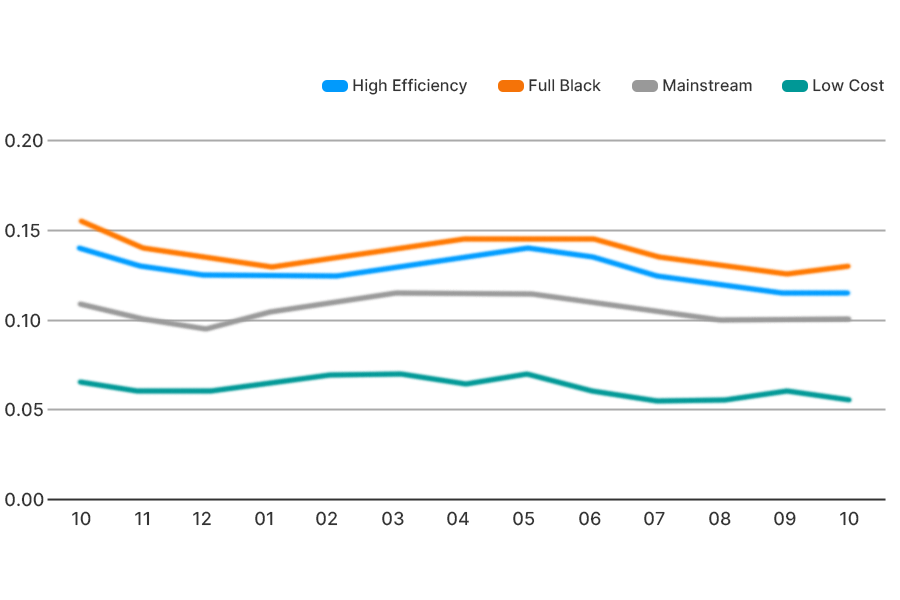
According to the pvXchange Europe spot price index for October 2025:
Full Black modules saw a modest month-on-month increase of around 4%
High-efficiency products remained stable
Low-cost modules continued to decline by roughly 8%
Overall price volatility remains limited, but clear divergence is emerging: high-efficiency products have stabilized first, while low-cost inventory continues to be cleared out.
This suggests that price changes are gradually moving downstream from manufacturers to end-market buyers.
Note: Data sourced from the pvXchange Europe Price Index (October 2025), showing price trends from Oct 2024 to Oct 2025. Low-cost module prices continued falling, Full Black modules increased, and high-efficiency and mainstream models remained stable.
EPC and project pricing reactions
Typically, modules account for approximately 45–55% of total system cost.
For every €0.01/W increase in module price, total system cost rises by an estimated 2–3%. While a €0.01 fluctuation appears small, it significantly squeezes margins for EPCs working under fixed-price contracts. As a result, more prudent project owners are adding price-adjustment clauses, index-linked terms, or materials cost-pass-through mechanisms to hedge against uncertainty.
This cautious approach signals a return to a more rational market rhythm.
Channel inventory and procurement timing adjustments
Over the past year, many European distributors locked in large volumes of older module models at price lows.
As market demand shifts toward higher-power and higher-stability products, older models are now priced below newer ones, creating “inverted pricing” risks for some inventory.
To manage this, distributors are moving from bargain-stockpiling to stable-price replenishment, prioritizing early Q4 lock-ins to reduce capital pressure and price volatility risk. Batch purchasing and shorter procurement cycles are being adopted to adapt to market conditions.
Overall, market pricing appears to be stabilizing.
Cost transmission to end users
For commercial end-users and investors, moderate module price increases will not drastically alter ROI, but they are prompting more cautious investment sentiment.
With electricity prices holding at €0.18–0.22/kWh, self-consumption project payback periods have generally extended by 6–12 months, requiring adjustments in budgeting and cash-flow planning.
Some investors are postponing new project approvals or lengthening tender cycles to observe price stability.
More end-users now prefer reliable, secure, and long-term-stable PV systems — and the pricing resilience of high-efficiency, high-stability modules reflects growing acceptance of this shift.
What does this mean for the European market?
After several quarters of decline, module prices have flattened and the volatility range has narrowed. With upstream production adjustments and technology shifts underway, pricing and procurement in Europe are becoming increasingly transparent and structured.
For distributors and EPCs, this means more transparent pricing mechanisms and greater certainty in project delivery and specifications
For corporate investors, financial modeling is becoming more predictable, with reduced uncertainty in return estimates
From current pricing trends, high-efficiency and high-stability products have stabilized and may even experience upward momentum.
Wood Mackenzie notes that this shift resembles a structural correction — a transition from “price war” to “value-driven competition.”
Regardless of short-term price fluctuations, a high-performance, stable, and long-term reliable PV system is becoming a shared priority across the European market.
Before the next period of price stability fully forms, planning ahead and securing supply may prove to be the more prudent strategy.
Data Sources: Wood Mackenzie (Oct 2025 Market Outlook), pvXchange Europe Price Index (Oct 2025), National Standard Information Public Service Platform (SAC, 2025 Draft for Comments), China Silicon Industry Association Monthly Price Report (Sept 2025), Digital New Energy Industry Research (Oct 2025).
Maysun Solar focuses on high-efficiency PV module technology and supply for the European market, covering TOPCon modules, IBC modules, and HJT modules with power ratings from 410W to 800W. Leveraging a mature manufacturing system and European local warehouse network, we support customers from product selection to delivery coordination, helping projects achieve efficient, stable, and long-term energy yields.
Recommend reading

Low-Carbon PV Procurement in France: Why ECS, PEP Ecopassport and Solar Carports Matter
Table of Contents France is becoming one of Europe’s most documentation-driven solar markets. For EPC companies, developers and commercial project owners, module selection is no longer based only on price-per-watt, efficiency or linear power warranties. Carbon documentation, supply-chain traceability and project-specific compliance files

PV Module Installation Beyond Rooftops: Multi-Scenario Applications for Bifacial N-Type Modules in Europe
PV module installation is not limited to rooftops. For residential users, small commercial users and distributed PV projects in Europe, spaces such as balconies, gardens, fences, carports, terraces, façades and pergolas can also provide additional installation areas when conditions allow. As solar use

Europe’s Grid Cap Era: Why High-Efficiency Solar Panels Matter More in 2026
Introduction In 2026, the economics of distributed solar in Europe are changing. Grid congestion, export limits, negative electricity prices and zero-export requirements mean that a solar project can no longer be judged only by how much electricity it generates. The more important question

How Do Solar Panel Delivery Delays Affect Installer Costs?
Solar panel delivery delays can affect installation schedules, project acceptance and payment collection.

The Forgotten “Invisible Assets”: Why Repowering Is the Strategic Key for European Solar in 2026
As grid congestion delays new solar projects across Europe, existing PV assets are becoming a strategic source of growth. This article explains why PV repowering can help EPCs and C&I asset owners unlock hidden value from already-connected solar plants, improve LCOE, and extend long-term asset performance with high-efficiency TOPCon, IBC and HJT modules.

Solar Panel Procurement in Europe: Why Stable Supply Matters More Than a One-Off Low Price
When European installers, distributors and corporate buyers choose solar panels, a one-off low price should not be the only factor. Stable supply, model continuity, technical documents and replenishment capacity often matter more for long-term cooperation and project delivery.