Key Changes in PV Module Selection in the European Solar Market in 2026

Key Changes in PV Module Selection in the European Solar Market in 2026

Table of Contents

Introduction

The key changes in the European PV market in 2026 are not driven by installation demand, but by the fact that PV module selection is now directly influencing whether projects can move forward smoothly.
Against a backdrop of changing grid access conditions, electricity prices and policy frameworks, PV modules are no longer merely a cost item; they are increasingly becoming a critical variable that determines execution timelines and revenue certainty.

These changes are not uniform across Europe. Looking at several representative markets:

  • Germany: Tighter grid connection conditions and a rising frequency of negative electricity prices mean that whether the actual power output of PV modules can be fed into the grid and settled has become a key concern.

  • Italy: Rooftop conditions, high-temperature environments and the pace of policy implementation determine whether PV modules are practically deployable and remain suitable over the long term.

  • France: Regulatory requirements and system compatibility directly affect whether PV modules can be incorporated into project frameworks and assume long-term operational responsibility.

Across these typical markets, a clear shift can be observed: in 2026, PV module selection in Europe is moving away from competition based on single performance parameters, towards a more comprehensive assessment focused on grid compatibility, application-specific suitability and long-term risk controllability.

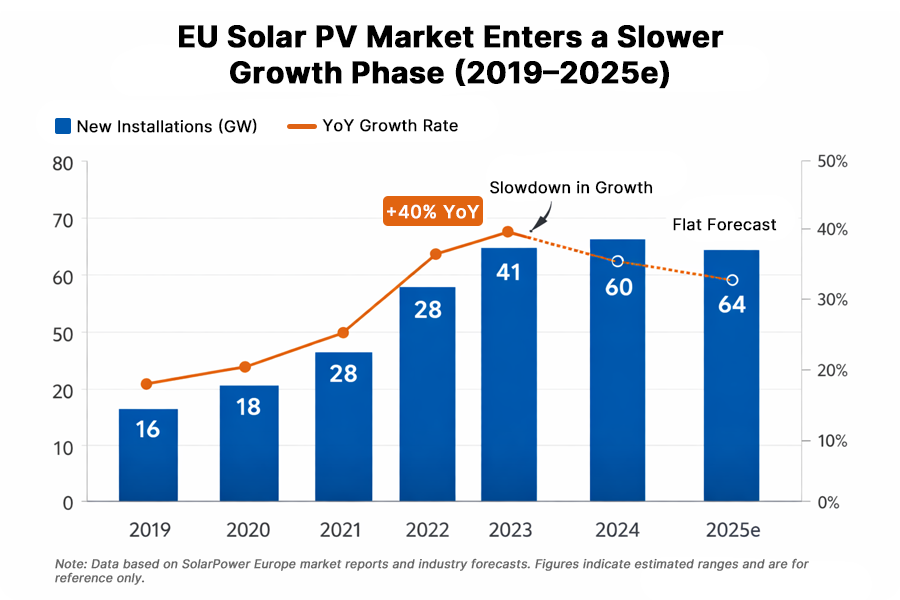
Chart showing new PV installations in Europe and year-on-year growth rates (2019–2025), indicating that installed capacity remains high while growth momentum has clearly slowed.

Germany: PV Module Risk Management in a Mature Market

Trend 1: Under grid and power limits, value per square metre takes priority over nominal power

The German PV module market is highly mature, and the main constraint for rooftop projects has shifted from installable capacity to grid-eligible output. In certain scenarios, small and medium-sized systems are still subject to the 70% feed-in limitation, and for new connections, an increasing number of regions assess projects based on approved grid capacity rather than installed module capacity.

Under grid-constrained conditions, the continuous increase in nominal peak power of PV modules does not translate proportionally into billable electricity. High-output periods are more likely to trigger curtailment or peak shaving, meaning that surplus peak power cannot be settled through the grid and effective usable output is significantly limited.

As a result, the German market is placing greater emphasis on usable energy yield per unit area and on the ability of PV modules to maintain power output during operation, rather than focusing solely on STC peak power values.

Trend 2: Negative electricity prices become structural, making the generation curve a key metric

As the share of solar generation continues to rise, electricity prices during midday high-output periods in Germany have been significantly compressed, with the frequency of negative prices increasing. The time windows with the highest generation volumes are gradually losing their price advantage.

In this context, the value of PV modules is no longer defined only by peak power, but by whether generation is excessively concentrated. PV modules that can maintain output under non-ideal conditions such as high temperatures or low irradiance are better suited to shaping a flatter generation curve, reducing the proportion of electricity produced during low-price periods compared to short-lived peak output.

Trend 3: Long-term reliability becomes a prerequisite for financing and insurance

In the German market, the long-term stability of PV modules has been directly incorporated into financing and insurance assessments. Banks and insurers are no longer focused solely on theoretical revenue models. Any uncertainty related to module performance is reflected early in financing conditions and insurance terms, reshaping the overall risk profile of the project.

As a result, PV modules are gradually shifting from being interchangeable components to becoming a core risk factor influencing project bankability and executability. In practical selection processes, this trend has increased attention on N-type technologies with stronger long-term power retention and degradation performance, such as TOPCon and HJT, particularly in long-term asset-based projects.

Trend 4: Standardisation and certification completeness become procurement thresholds

In Germany’s highly standardised market, compliance with IEC standards and certifications such as TÜV has become a basic requirement for entry into mainstream projects rather than a competitive advantage. PV module procurement is shifting away from parameter-driven competition towards standardisation and system compatibility.

Compared with pursuing extreme performance metrics, PV module solutions that can be repeatedly deployed across different projects and that align closely with existing grid rules and system configurations are more readily accepted by the market. This trend reduces uncertainty during project execution and improves the replicability of PV module solutions at scale.

Common PV module certifications and standards required in solar projects, including IEC, TÜV, ISO and CE.

Italy: PV Module Adaptation Requirements in a Rooftop-Driven Market

Trend 1: Under rooftop constraints, module size and efficiency must be considered together

In the Italian market, a large share of commercial, industrial and agricultural rooftops feature irregular layouts, dense structural elements or limited load-bearing capacity. As a result, PV module dimensions and weight become critical constraints in real-world deployment. In most projects, reliably deployable module power typically falls within the 500–600 W range. By contrast, large-format modules in the 650–700 W class are not universally applicable; they offer advantages mainly on structurally regular commercial and industrial rooftops with sufficient load capacity, and their performance is highly dependent on specific structural conditions.

Against this backdrop, simply pursuing higher power per module does not lead to a proportional increase in overall installed capacity. In practical projects, high-efficiency N-type PV modules are often better suited to achieving higher coverage ratios and more rational layouts under size and weight constraints, and are increasingly becoming a key decision factor in the Italian market.

Trend 2: High-temperature conditions amplify differences in thermal stability

Italy experiences prolonged periods of high summer temperatures, making high-temperature operation a normal condition for PV modules. On sunny days, rooftop module operating temperatures often reach 60–70 °C, significantly above the standard test condition of 25 °C.

Under these conditions, output differences between PV modules become more pronounced. As installed capacity and solar irradiance continue to increase, temperature coefficients and power retention at elevated temperatures are emerging as critical factors affecting usable energy yield. Looking towards 2026, technologies that demonstrate greater stability in high-temperature environments—such as HJT and TOPCon modules with three-cut cell structures—are more likely to gain attention in hot-climate applications.

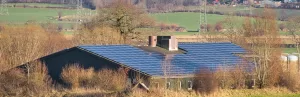
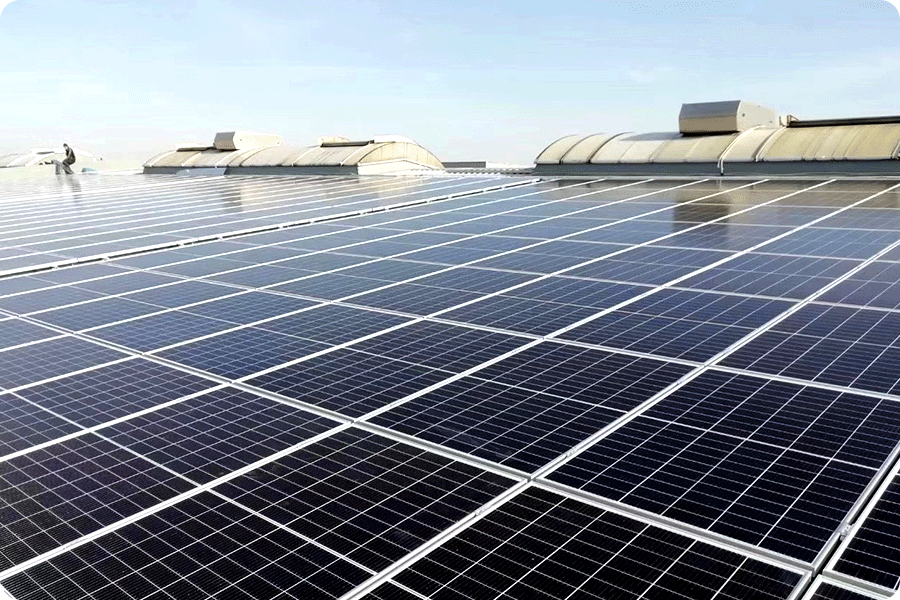
Typical applications of commercial and industrial rooftop PV systems in Italy under high-temperature conditions, with densely arranged modules to increase self-consumption ratios.

Trend 3: Tightening policy conditions reduce the margin for error in module selection

In Italian rooftop projects, PV modules typically need to be locked in at an early project stage, as system layout, load calculations and electrical configurations are all highly dependent on module parameters. With policy developments between 2025 and 2026, compliance requirements for PV modules are becoming more stringent. For example, the 2026 budget law limits certain tax incentives to high-efficiency modules manufactured in Europe, while the 2025 Transizione 5.0 tax credit further increases incentives for EU-made modules.

As a result, compliance completeness and performance consistency carry significantly greater weight in module selection. PV modules that remain compliant across different policy windows and offer clearly defined performance expectations are more aligned with the market’s growing preference for certainty.

Trend 4: Rising self-consumption rates make stable output a priority

As the share of self-consumption-based projects increases, PV systems in Italy are increasingly deployed for peak shaving and cost reduction rather than purely for feed-in, directly reshaping how module value is assessed.

In self-consumption-oriented deployment models, the match between PV module output profiles and on-site load demand begins to influence final project returns. In many commercial and industrial rooftop projects, daytime self-consumption rates typically fall within the 60–80% range. Under these conditions, a module’s ability to provide sustained output during key consumption periods is often more meaningful than simply expanding installed capacity.

France: PV Module Selection Under Regulatory and System Constraints

Trend 1: Regulatory and building-integration requirements raise the threshold for module suitability

In France, PV modules are increasingly being managed as part of the building envelope across a growing number of projects. As the share of BIPV installations and PV applications on public buildings rises, modules are no longer treated merely as add-on generation equipment, but must simultaneously comply with building, fire safety and energy regulations.

Under the French RE2020 building energy efficiency framework and current practices in public-sector projects, factors such as module structural design, mounting approach and fire performance ratings have become critical elements in compliance assessments. Whether PV modules can be smoothly integrated into the building system now directly affects approval pathways and overall project feasibility.

Trend 2: The importance of quality, durability and certification continues to increase

The French market has long maintained high standards for PV module quality and certification. In public and commercial projects, modules are typically required not only to comply with IEC standards, but also to meet stricter requirements related to fire resistance, durability and quality assurance, often directly linked to insurance coverage.

As the share of public projects and long-term asset-holding investments grows, long-term performance consistency is increasingly viewed as a baseline requirement in module selection. PV modules that offer comprehensive certification and stable performance over extended operating periods are more readily incorporated into mainstream project configurations.

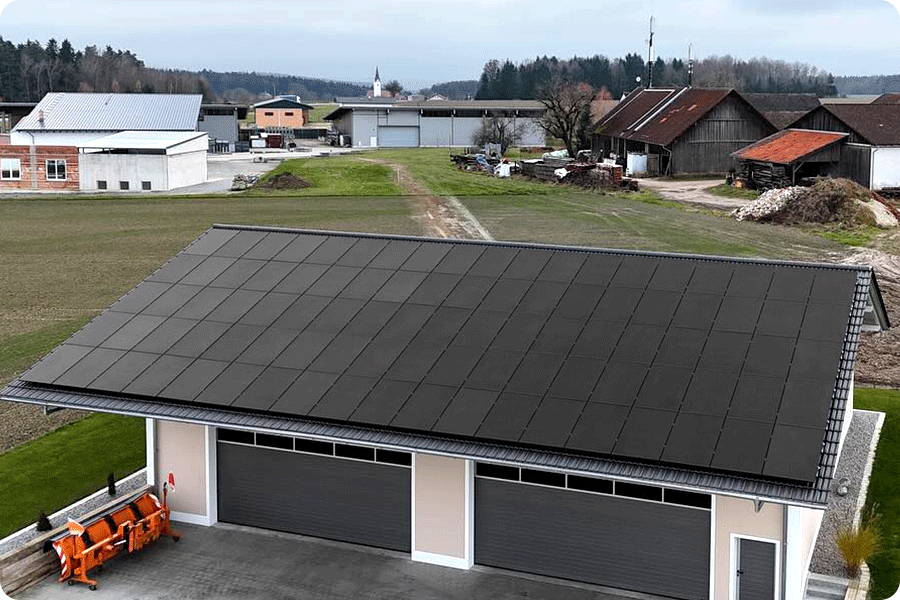
Typical PV system applications on residential and public building rooftops in France, where modules form an integral part of the building system.

Trend 3: Power demand remains rational, with compatibility taking precedence

Unlike markets that pursue extreme module power ratings, demand in France remains relatively rational in terms of nominal output. The market places greater emphasis on whether PV modules are compatible with existing system designs, electrical standards and building structures, rather than on achieving higher nameplate power alone.

In practical applications, module dimensions, string configuration and overall system compatibility often play a more decisive role than the peak power rating of individual modules. Module solutions that integrate seamlessly into existing systems while reducing design complexity and execution risk are therefore more strongly favoured.

Trend 4: From a long-term O&M perspective, module reliability becomes a core metric

French PV projects are typically characterised by long operating lifetimes and clearly defined operation and maintenance pathways. Once deployed, module performance continues to influence project operation over many years. Under this logic, PV modules are no longer just part of upfront procurement costs, but a component of long-term asset management.

Modules that can deliver stable performance over extended periods and minimise maintenance intervention are better aligned with the French market’s practical requirements for sustainable, long-term operation.

Conclusion

As Europe moves into 2026, the way PV modules are understood within the European solar market is undergoing a clear shift. Modules are no longer viewed solely as tools for increasing installed capacity, but are increasingly assessed as integral components of grid systems, building structures and long-term asset management frameworks.

Against a backdrop of grid constraints, electricity price volatility and rising self-consumption ratios, module dimensions, efficiency, thermal behaviour and power retention are directly determining whether generated output can be effectively absorbed by the system. Higher nominal power ratings do not automatically translate into greater billable electricity; instead, they place greater emphasis on the stability of the generation curve.

At the same time, practical constraints such as rooftop load capacity, high-temperature operating conditions, fire safety and building regulations have made module structural design, weight control and certification completeness prerequisite factors for project execution. PV modules are no longer parameters that can be adjusted late in the process, but key specifications that must be fixed at an early project stage.

From a long-term perspective, module consistency, degradation pathways and reliability have been incorporated into risk assessments by financing and insurance institutions. As a result, the core question in European PV module selection in 2026 is no longer a simple comparison of technical parameters, but which module characteristics can deliver more stable and predictable system performance within specific application scenarios.

Maysun Solar is firmly established in the European market, supplying a broad range of solar modules for wholesale and distribution partners, including IBC technologyTOPCon technologyand HJT technology. In an environment of tighter project timelines and narrower deployment windows, our focus is on power density per square metre, generation stability and system compatibility, enabling more predictable project delivery and stable long-term returns.

Reference

SolarPower Europe. EU Market Outlook for Solar Power 2024–2028. 2024.
https://www.solarpowereurope.org/insights/market-outlooks/

pv magazine Germany. Germany adopts “Solarspitzen” rules limiting feed-in support during negative prices. 2024.
https://www.pv-magazine.com

pv magazine Italy. Iperammortamento 2026: continuità degli incentivi e orientamento alla transizione energetica. 2025.
https://www.pv-magazine.it

ENTSO-E. Transparency Platform – Electricity prices and market data. 2024.
https://transparency.entsoe.eu/

European Commission. REPowerEU Plan and Renewable Energy Directive (RED III). 2023–2024.
https://energy.ec.europa.eu/

Recommend reading