
430–460W or 600W+? How Should You Choose Solar Panel Power for Rooftop Projects?

430–460W or 600W+? How Should You Choose Solar Panel Power for Rooftop Projects?

In European commercial and industrial rooftop projects, interest in 600W solar panels is increasing, while the 430–460W solar panel range remains widely used. Roof structures and regulatory constraints mean that differences in module size and layout across power classes can affect installation stability. As a result, solar panel selection is gradually shifting towards roof compatibility rather than simply choosing higher power.

Table of Contents

High-power solar panels are not suitable for every roof

Higher-power solar panels do not necessarily mean a better choice for every rooftop project.

As panel power continues to increase, large-format modules are attracting growing market attention. 600W solar panels and 700W solar panels are gradually becoming common options. This trend is evident both on the supply side and in project planning.

However, higher power is usually accompanied by increases in size and weight, which affects the compatibility between the system and building conditions.

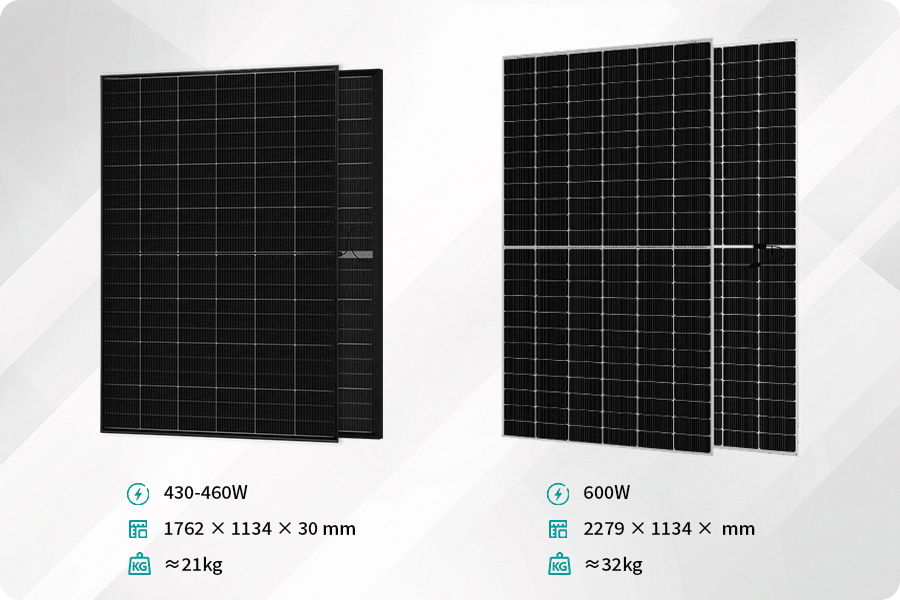
Typical products illustrate this difference:

While power output increases, panel area and unit weight also grow significantly. These physical changes directly influence layout methods and the system’s compatibility with roof load capacity and space utilisation.

Therefore, in rooftop projects, solar panel selection is essentially a matter of compatibility. Its suitability should be assessed according to specific roof conditions.

Compared with 430–460W solar panels, 600W solar panels are significantly larger and heavier, which may affect roof structural suitability.

Larger panel size increases installation complexity

As solar panel size increases, the complexity of layout and installation in rooftop projects also rises.

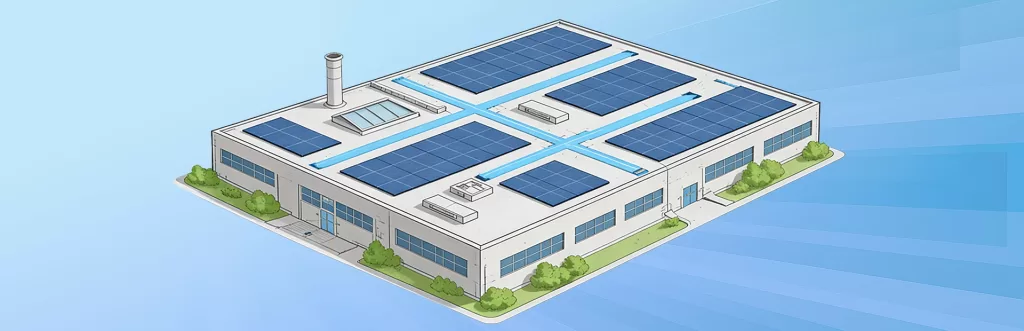
On an ideal continuous surface, larger panels can mean higher coverage efficiency. However, real rooftops are often divided by skylights, equipment bases, chimneys, parapets and maintenance walkways, leaving the available area split into multiple irregular sections.

Typical products illustrate this difference:

  • 430–460W solar panels: single-panel area of about 2.0 m²
  • 600W solar panels: single-panel area of about 2.6 m²

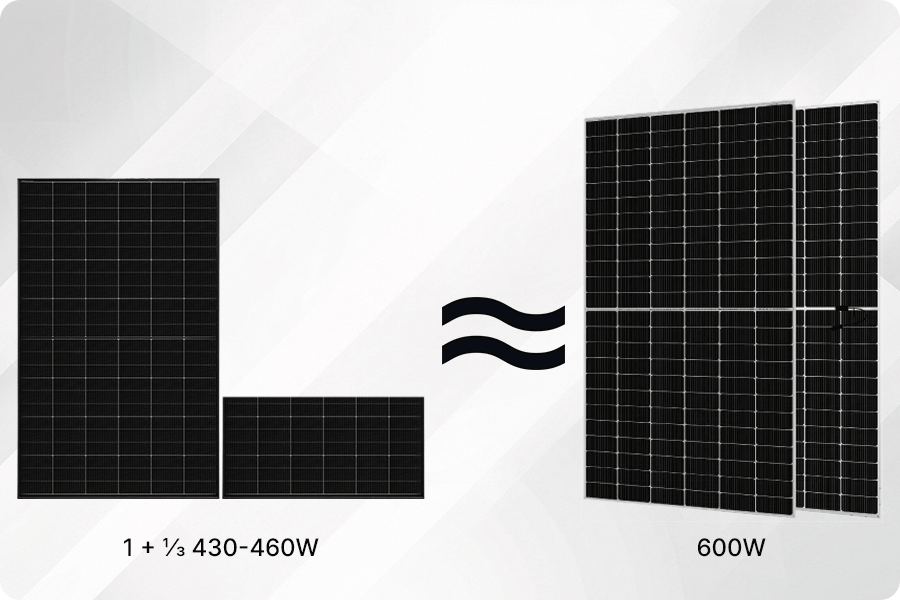
When the area of a single panel increases by around 30%, it becomes more difficult to achieve continuous layouts within these fragmented roof spaces. Corners and areas around obstacles are more likely to become unusable fragments, reducing overall layout flexibility.

600W solar panels have about 30% larger single-panel area than 430–460W solar panels, making fragmented roof spaces harder to utilise.

The weight of a single panel also increases from about 21 kg to around 32 kg, raising handling and coordination requirements and placing additional pressure on rooftop access routes and installation workflow.

The increase in panel size is therefore not just a parameter change; it can significantly amplify layout and installation complexity in rooftop solar projects.

Power selection should prioritise roof compatibility

In rooftop projects, solar panel selection often involves balancing efficiency and practical feasibility.

European rooftop projects typically require reserved maintenance walkways, safety edge distances and fire clearance spacing. These regulatory requirements reduce the available installation area, making layout continuity an important constraint. While high-power solar panels can reduce the number of panels needed, their larger size and weight may increase layout risks under certain roof conditions.

Project decisions often revolve around two considerations:

  • whether to prioritise single-panel efficiency
  • whether to prioritise continuous system layout and installation stability

When roof space is continuous and structural capacity is sufficient, the coverage advantage of 600W solar panels is more likely to translate into real benefits. However, when space is limited or regulatory constraints are strict, reducing installation complexity and maintaining layout continuity may become more critical factors.

As a result, power selection becomes more about roof compatibility rather than simply comparing peak output.

430–460W panels offer greater stability across multiple rooftop scenarios

Across many rooftop conditions, mid-power panels typically provide higher project stability.

A 430–460W solar panel measuring 1762 × 1134 mm and weighing around 21 kg has a single-panel area of about 2.0 m². Compared with 600W solar panels at roughly 2.6 m², it allows more room for local layout adjustments.

This difference becomes evident under various rooftop conditions:

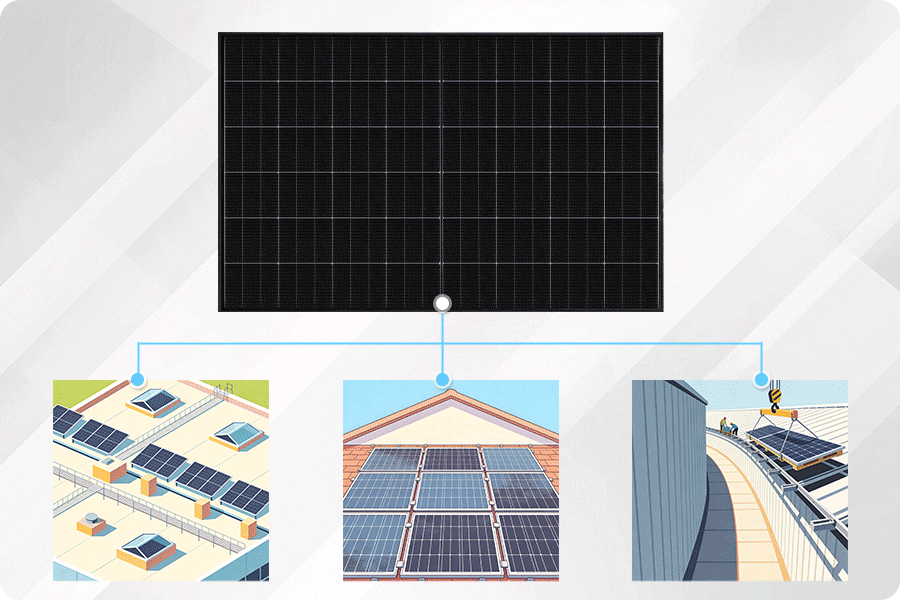
  • Fragmented rooftops: When skylights, equipment bases or maintenance walkways are present, smaller panels allow easier continuous layouts between obstacles, reducing unusable corner areas.
  • Boundary-sensitive roofs: Where safety margins or fire clearance distances are required, minor adjustments are easier to maintain a complete layout.
  • Installation-constrained roofs: When access paths are narrow or transport routes are limited, smaller panels help maintain a stable handling and positioning workflow.

Requirements for layout continuity and controlled installation mean mid-size panels retain greater layout flexibility and are less affected by local constraints.

Under multiple rooftop constraints, solar panel selection therefore becomes more about system stability rather than a single efficiency-driven decision.

430–460W solar panels provide higher layout stability across a wide range of rooftop scenarios.

As a solar panel manufacturer, Maysun Solar supplies the European wholesale and distribution market with 410–800W solar panels, including IBC technology, TOPCon technology, and HJT technology, designed for commercial and industrial rooftops and complex installation conditions, focusing on higher energy yield per unit area and better system compatibility.

Recommend reading

April News from the European Solar Industry

April News from the European Solar Industry

The European solar market is showing clear signs of recovery: system value is being reaffirmed, German auction prices are stabilising, Italy’s rules are becoming clearer, and revenue certainty in France is improving.

Read More »

3 Comments

  1. Sebastian Krüger

    Interesting point about module size. In many rooftop projects in Germany, layout constraints like fire safety corridors, roof edges and maintenance walkways often matter more than the nominal power of a module. Larger 600W panels can look attractive on paper, but their dimensions sometimes make continuous layouts harder on fragmented roofs. In several projects we worked on, modules around the 430–460W size simply allowed a more practical array design. So the idea of prioritising roof compatibility makes a lot of sense.

  2. Riccardo De Santis

    This matches what we often see in Italy as well. Higher power modules always sound better at first, but real rooftops are rarely ideal. Skylights, equipment and older roof structures can make the layout tricky. We had a warehouse project where larger modules left too many unused spaces, so we switched to 430–460W panels and the layout worked much better. In practice, choosing modules that fit the roof well is often more important than chasing the highest wattage.

  3. Markus Schneider

    We had a commercial roof in Baden-Württemberg where bigger modules were planned first. On paper it looked alright.
    On site it was different. Rooflights, vents, walkways, edge distances. Too many small sections, and with the bigger format it was not fitting well anymore. You lose space faster than expected.
    In the end we used a smaller module size, just over 400W. The layout was easier and installation on the roof was also less awkward.

Comments are closed