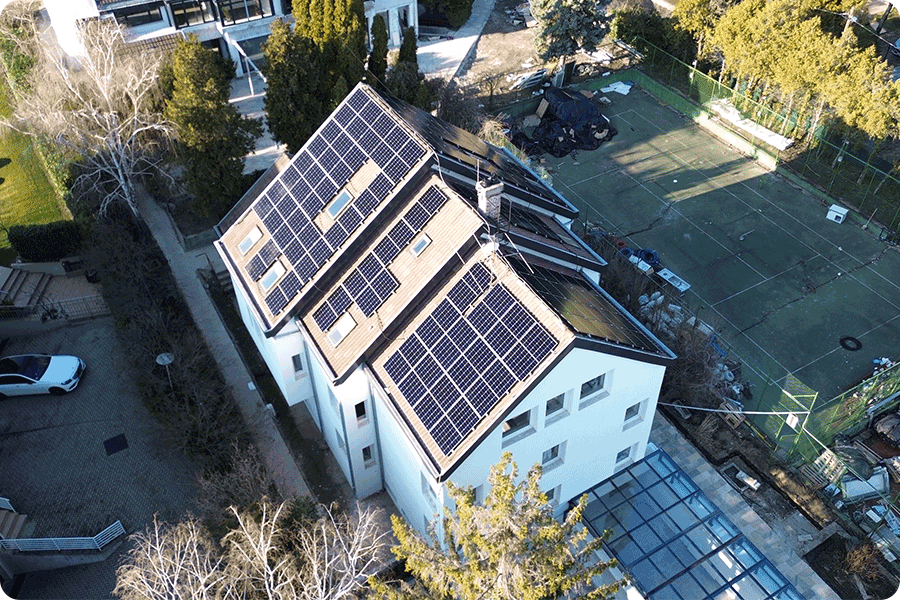

In European rooftop projects, the choice between HJT bifacial solar panels and IBC solar panels depends above all on what is limiting the roof.
Whether the roof has the conditions needed for bifacial gain, whether the project is more constrained by rear-side light exposure or available roof area, and whether appearance and architectural integration matter more will all directly affect which solar panel should be prioritised.
Table of Contents
Why are not all European rooftops suitable for bifacial solar panels?
In European rooftop projects, bifacial solar panels are not inherently the better option. The key question is whether the roof provides sufficient rear-side light exposure.
Public research, including studies from IEA PVPS, shows that the additional yield from bifacial solar panels on rooftops depends heavily on roof reflectivity, installation method and rear-side light conditions. Results can vary significantly from one roof to another.
To judge whether HJT or IBC is the better fit for a European rooftop project:
- whether the roof offers genuine conditions for bifacial gain
- whether the main constraint is rear-side light exposure or available roof area
- whether the project places greater value on appearance and architectural integration
What kind of roof can truly unlock the bifacial advantage of HJT solar panels?
The bifacial advantage of HJT solar panels is more likely to deliver real value on the following types of rooftop project:
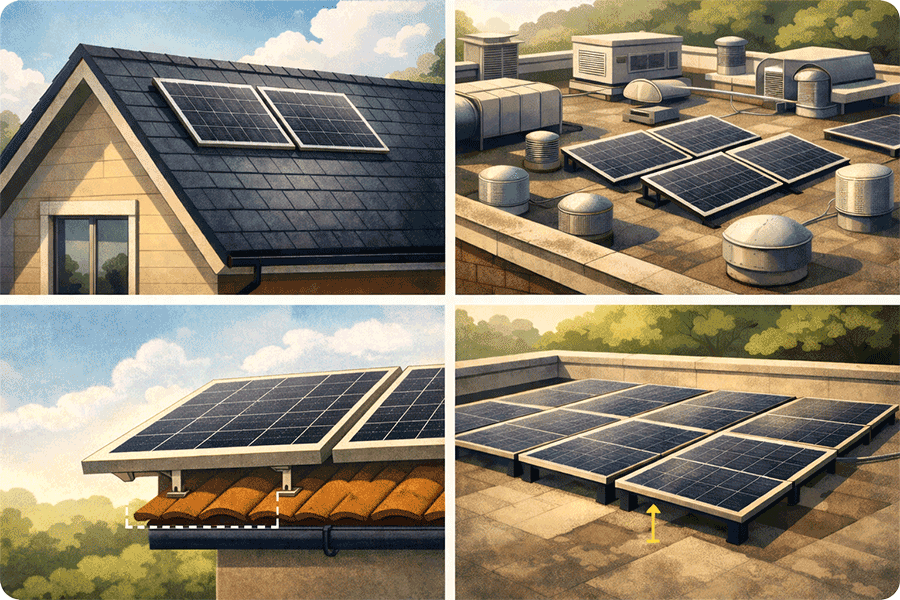
- roofs finished with light-coloured PVC or TPO membranes, light-coloured concrete, or other highly reflective surfaces
- roofs that allow enough clearance to elevate the solar panels
- roofs that are relatively flat, where rear-side light exposure is less affected by skylights, rooftop equipment and parapet walls, and where layout constraints are relatively limited
On these roofs, rear-side reflected light is more stable, making it easier for the high bifaciality of HJT solar panels to translate into real returns.
In these scenarios, the SMBB structure of HJT solar panels helps reduce shading and transmission losses, while the glass-glass design is also better suited to long-term outdoor use. These advantages are often easier to realise in carports, fencing or installations over highly reflective ground, but for rooftop projects, rear-side light conditions still need to be assessed first.
Research by ZHAW in Switzerland on flat roofs shows that bifacial solar panels used with a highly reflective roofing membrane can increase annual power generation by around 15% compared with a standard system. Related rooftop modelling also suggests that, under ideal conditions, the upper limit of additional yield can reach 22.6%.
When should the bifacial value of HJT solar panels not be overestimated?
Whether the bifacial advantage of HJT solar panels can turn into real returns depends less on panel specifications than on roof conditions.
The types of roof where the bifacial value of HJT is most often overestimated are:
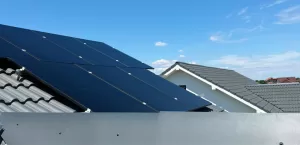
- pitched roofs with dark metal sheeting or dark tiles: roof reflectivity is relatively low, solar panels are usually installed close to the roof surface, and the rear side struggles to receive stable reflected light
- commercial and industrial roofs with heavy equipment: skylights, fans, exhaust outlets, pipework, access routes and parapet walls break up the layout and interrupt rear-side light exposure
- roofs with complex geometry: irregular roof shapes, mixed orientations and fragmented edges make the system more vulnerable to layout losses and shading
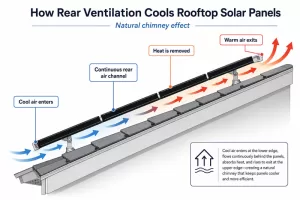
- projects with close-to-roof installation and very tight row spacing: the solar panels sit too close to the roof to leave meaningful space for rear-side light
The most common misjudgement in these projects is to treat high bifaciality as a way to compensate for weak roof conditions.
For many rooftop projects, the real limit on returns is not bifaciality, but usable roof area, layout efficiency, and fire safety and maintenance boundaries.
Assessment should start with the roof itself. Once area, shading and architectural fit are clearly understood, it becomes easier to judge whether it makes more sense to pursue bifacial gain or choose a solution better suited to the roof conditions.
When is IBC a better priority than bifacial solar panels?
When the main constraints of a rooftop project are area, appearance, architectural integration or layout efficiency, IBC solar panels are often the more suitable choice.
If rear-side light exposure is limited, bifacial solar panels are unlikely to deliver meaningful additional generation. Where installation area is constrained, projects tend to focus more on how much capacity can be installed per square metre and how much energy can be generated. In some cases, visual integration and overall roof aesthetics also become key factors.
HJT bifacial vs IBC: application guide
| Project criteria | Better suited to HJT bifacial solar panels | Better suited to IBC solar panels |
|---|---|---|
| Roof conditions | Light-coloured or highly reflective surfaces with good rear-side light exposure | Standard or dark roofs with limited rear-side light |
| Installation & layout | Elevated installation possible; flat roof with limited shading | Close-to-roof installation; fragmented layout with heavy equipment |
| Project focus | Maximising additional bifacial energy yield | Maximising value per square metre and layout efficiency |
| Architectural requirements | Standard aesthetic requirements; generation-focused | Stronger focus on roof appearance and building integration |
| Typical scenarios | Highly reflective flat roofs with elevated commercial and industrial installations | High-end residential, complex rooftops and urban renovation projects |
4.1 What should be assessed first when area is limited?
For roofs with limited usable space, the priority is value per unit area.
Many commercial and industrial rooftops in Europe may appear large, but the installable area is often fragmented by skylights, equipment, parapet walls, access routes, fire safety boundaries and shading. What ultimately determines project returns is how many additional solar panels can still be installed, whether edge spaces can be utilised, and whether the layout can remain efficient and continuous.
4.2 Why do appearance and architectural integration change the decision?
For high-end residential projects, urban redevelopment, showcase commercial buildings or highly visible rooftops, whether solar panels match the building’s appearance is often part of the selection criteria.
The value of IBC solar panels is not only aesthetic. With less visual disruption on the front side, they make it easier to achieve a clean and continuous roof surface. In such projects, solar panels effectively become part of the building envelope.
4.3 Which roofs are better suited to prioritising IBC solar panels?
Roofs where IBC solar panels are more suitable include:
- commercial and industrial roofs with limited usable area: fragmented layouts make value per square metre more critical
- residential and small-to-medium commercial roofs with higher aesthetic requirements: greater emphasis on visual outcome after installation
- projects focused on building renovation and façade integration: requiring solar panels to blend into the architecture
- projects without strong bifacial conditions but with a focus on long-term reliability: avoiding decisions based on uncertain bifacial assumptions
IBC solar panels are not a universal solution for every roof. Where roofs offer high reflectivity, sufficient elevation and stable rear-side light exposure, high-bifaciality options such as HJT solar panels are still worth evaluating.
What should be assessed first in European rooftop projects?
In European rooftop projects, the key is not which technology is more advanced, but what constraints define the project.
5.1 Does the roof provide a real basis for bifacial gain?
First assess roof reflectivity, installation method, rear-side light exposure space and layout integrity. Flat roofs with light-coloured or highly reflective surfaces, sufficient elevation and limited shading are more suitable for evaluating high-bifaciality solar panels. On dark roofs, with close-to-roof installation, dense equipment and tight layouts, bifacial advantages are usually difficult to translate into meaningful gains.
5.2 What is the real constraint of the project?
For many European rooftops, the limiting factor is not technology but restricted installable area, fragmented layout space, or a stronger focus on appearance, overall coherence and architectural integration. If the priority is additional energy generation, the comparison can remain focused on bifacial gain. If the priority is area, layout and building requirements, the focus should shift to value per square metre and roof suitability.
5.3 Which technology is better suited to this roof?
Where reflectivity is strong, rear-side light exposure is sufficient and installation conditions are appropriate, high-bifaciality options such as HJT solar panels are worth evaluating. Where area is constrained, layouts are fragmented, or aesthetic and architectural requirements are more critical, IBC solar panels should be prioritised.
HJT bifacial solar panels and IBC solar panels: common questions
1.Are bifacial solar panels really worth installing on European rooftops?
Not necessarily. Bifacial gain on rooftops is not guaranteed by default. It depends on roof reflectivity, installation height, layout design and available rear-side light exposure. When these conditions are not sufficient, the performance gap between bifacial solar panels and standard solutions can narrow significantly.
2.What kind of roof can truly deliver the additional yield of HJT bifacial solar panels?
Flat roofs with high reflectivity, sufficient elevation, limited shading and a relatively complete layout are more likely to convert the high bifaciality of HJT solar panels into real energy output. Research by ZHAW in Switzerland shows that bifacial solar panels combined with a highly reflective roofing membrane can increase annual generation by around 15%.
3.Are bifacial solar panels still suitable for dark roofs with close-to-roof installation?
In most cases, their value should not be overestimated. Dark roofs have low reflectivity, and close-to-roof installation further limits rear-side light exposure. Under these conditions, it is difficult for bifacial solar panels to deliver meaningful additional yield.
4.When roof area is limited, should HJT or IBC be prioritised?
If the project is primarily constrained by installable area, layout space, appearance or architectural integration, IBC solar panels are usually the better priority. If the roof offers strong reflectivity, sufficient rear-side light exposure and the goal is to maximise generation, HJT bifacial solar panels are worth comparing.
5.In European rooftop projects, how should HJT and IBC be selected?
Start by assessing whether the roof provides a real basis for bifacial gain, then identify whether the main constraint is rear-side light exposure or roof area, layout and architectural requirements. Where stable rear-side gain is achievable, HJT solar panels are worth considering; where space is limited, roofs are complex, or visual integration matters more, IBC solar panels are the better choice.
As a solar panel manufacturer, Maysun Solar has been providing a stable supply of panels for the European wholesale and distribution market, covering mainstream N-type battery technologies such as IBC technology, TOPCon technology, and HJT technology. We assist EPCs and project buyers in achieving higher power output per unit area and system efficiency, ensuring compatibility with project conditions.
Reference
Stein, J. S., Reise, C., Castro, J. B., et al. (2021). Bifacial Photovoltaic Modules and Systems: Experience and Results from International Research and Pilot Applications. Report IEA-PVPS T13-14:2021. https://iea-pvps.org/wp-content/uploads/2021/04/IEA-PVPS-T13-14_2021-Bifacial-Photovoltaic-Modules-and-Systems-report.pdf
ZHAW School of Engineering. (2025). Optimising the electricity yield of photovoltaics on flat roofs. https://www.zhaw.ch/en/engineering/institutes-centres/iefe/news/news/event-news/optimising-the-electricity-yield-of-photovoltaics-on-flat-roofs
Ernst, M., Liu, X., Asselineau, C.-A., Chen, D., Huang, C., & Lennon, A. (2024). Accurate modelling of the bifacial gain potential of rooftop solar photovoltaic systems. Energy Conversion and Management, 300, 117947. https://doi.org/10.1016/j.enconman.2023.117947
Recommend reading

When does HJT bifacial gain pay off on European rooftops, and when is IBC the better option?
When do HJT bifacial solar panels generate stronger returns on European rooftop projects, and when should IBC solar panels take priority?

Which homes are suitable for garden solar?
Which homes are suitable for garden solar? Assess space, shading, orientation and electricity-use goals to quickly judge whether garden solar is a suitable option.

Are Differences Between Solar Panels More Noticeable in High-Temperature Conditions?
High temperatures reduce solar panel efficiency, but the gap in summer power generation is not determined by temperature alone. This article compares the high-temperature performance of HJT, TOPCon and IBC, and explains how businesses should choose.

Why Have N-Type TOPCon Solar Panels Become the Market Mainstream?
N-type TOPCon solar panels have become one of the mainstream photovoltaic technologies thanks to their strong balance of efficiency, cost and mass-production maturity. This article briefly explains their structural features, practical advantages and typical application scenarios.

April News from the European Solar Industry
The European solar market is showing clear signs of recovery: system value is being reaffirmed, German auction prices are stabilising, Italy’s rules are becoming clearer, and revenue certainty in France is improving.

When Are More Expensive N-Type Solar Panels Worth Choosing?
Whether N-type solar panels are worth the extra cost depends on whether project duration, temperature load and roof conditions can turn that added cost into real returns.