
N-type TOPCon solar panels have become a mainstream technology for three main reasons: higher mass-production efficiency, lower long-term degradation, and a more mature industrial foundation.
In practical applications, TOPCon solar panels now typically achieve mass-production efficiencies of 22%–23% or more, putting them ahead of conventional PERC solar panels overall. At the same time, first-year degradation is generally controlled at around 1%, with annual degradation thereafter at about 0.4%, helping deliver more stable power generation over the full lifecycle. In addition, TOPCon can scale up quickly on the basis of the existing crystalline silicon supply chain, striking a solid balance between performance gains and cost control. This is why it is now widely used in commercial and industrial rooftop projects as well as large-scale ground-mounted solar plants.
Table of Contents
What Are N-Type TOPCon Solar Panels?
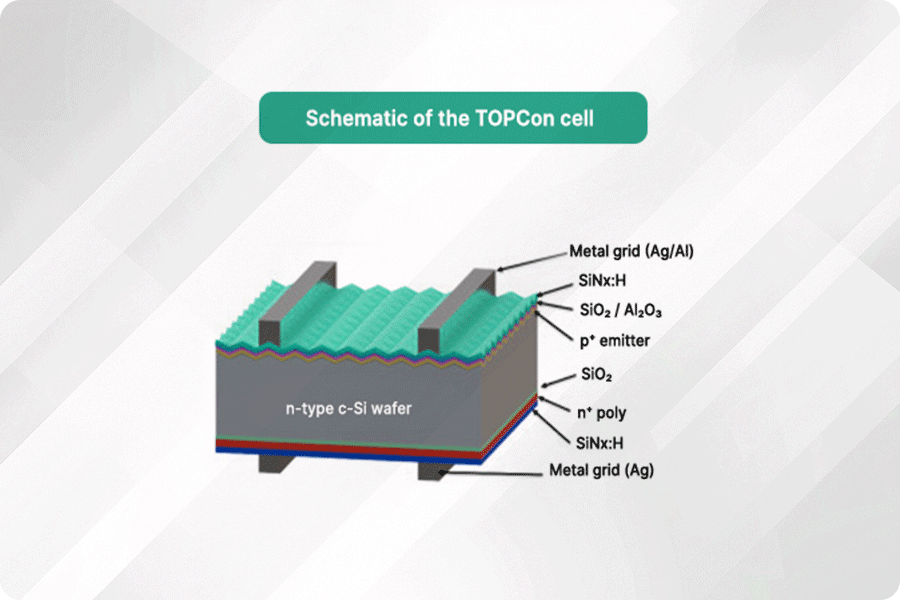
N-type TOPCon solar panels are a high-efficiency solar cell technology based on N-type silicon wafers. TOPCon stands for Tunnel Oxide Passivated Contact. Compared with conventional PERC cells, the key improvement in TOPCon is not simply the addition of more material layers, but the introduction of an ultra-thin tunnel oxide layer and a doped polysilicon passivated contact layer on the rear side of the cell. This helps reduce carrier recombination losses and improve electron transport efficiency.
Structurally, TOPCon still uses crystalline silicon as its core material, but with a more optimised rear-contact design that reduces current loss and interface recombination. This structure not only helps increase cell conversion efficiency, but also improves the stability of solar panels under high temperatures, low-light conditions and long-term operation.
At current mass-production levels, TOPCon cells have already achieved laboratory efficiencies of over 25%, while mass-produced solar panels generally reach 22% or above, making TOPCon one of the higher-performing mainstream crystalline silicon technologies in commercial production today.
Why Has N-Type TOPCon Become a Mainstream Solar Technology?
TOPCon has become mainstream in recent years not because of one single performance advantage, but because several factors have come together at the same time. For real-world projects, it offers a more balanced solution across performance, cost and supply reliability.
Efficiency and cost balance
Compared with conventional PERC solar panels, TOPCon typically delivers conversion efficiency gains of around 0.5–1.5 percentage points at mass-production level. It also shows better degradation performance, with first-year degradation at about 1% and annual degradation thereafter at around 0.4%, helping provide more stable power generation returns over an operating life of more than 25 years. Compared with higher-cost technologies such as HJT, TOPCon is easier to manufacture and scale at a controlled cost, which makes it more acceptable for most projects.
Mature mass production and supply
TOPCon can scale up quickly on the basis of the existing crystalline silicon supply chain. This means it is not only more mature as a technology, but also easier to supply consistently. For EPCs, installers and distributors, reliable availability and consistent product parameters often matter more than simply pursuing the highest possible laboratory efficiency.
Compared with other technology routes, TOPCon currently stands out in several key areas:
- A more mature production base and stronger supply stability
- Better suited to standardised procurement and large-volume project deployment
- A more complete supply chain and relatively lower procurement risk
Technology progress and solar panel design optimisation
Another reason TOPCon has spread so quickly is the continued optimisation of solar panel design. From full-cell layouts to half-cut cells and now more common multi-cut formats such as 1/3-cut, cell design has continued to improve, helping reduce resistive losses and deliver more stable power output.
Using 1/3-cut technology as an example, the current path is shortened further, which helps reduce heat loss and maintain more stable output under high temperatures. In addition, TOPCon solar panels typically have a temperature coefficient of around -0.29%/°C to -0.30%/°C, which is generally better than conventional PERC and helps limit generation losses in hot conditions. In practical applications, multi-cut designs can also improve panel output by reducing interconnection resistance loss and can enhance generation stability under partial shading, although the extent of the benefit still depends on the shading pattern, panel structure and overall system design.
These design improvements, combined with the high-efficiency TOPCon cell structure, make overall field performance more stable and further strengthen TOPCon’s market competitiveness.
Fit with current project needs
Many commercial and industrial projects today focus more on payback period, long-term stability and system compatibility than on chasing the highest single performance metric. TOPCon sits in a position that is clearly better than older technologies without being excessively expensive, which is why it has become easier to adopt as a mainstream option in standardised projects.
For that reason, TOPCon’s mainstream position has not been built on one isolated selling point. It has become dominant because it aligns more closely with the overall selection logic of most projects today.
Which Application Scenarios Are TOPCon Solar Panels Best Suited To?
TOPCon has become a mainstream technology, but that does not mean it suits every project. More accurately, it is best suited to projects that want better performance and reliable implementation while keeping budgets under control.
In applications where electricity prices are relatively high and self-consumption rates are also high, TOPCon solar panels can often deliver a gradual improvement in returns through higher power generation without significantly increasing upfront investment. However, the actual payback period still depends on electricity prices, self-consumption rates, system cost and local compensation mechanisms.
In practical terms, the following types of project are often more likely to prioritise TOPCon:
Commercial and industrial rooftop projects
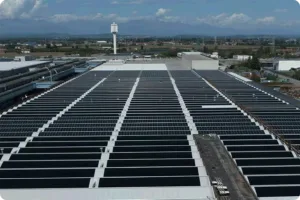
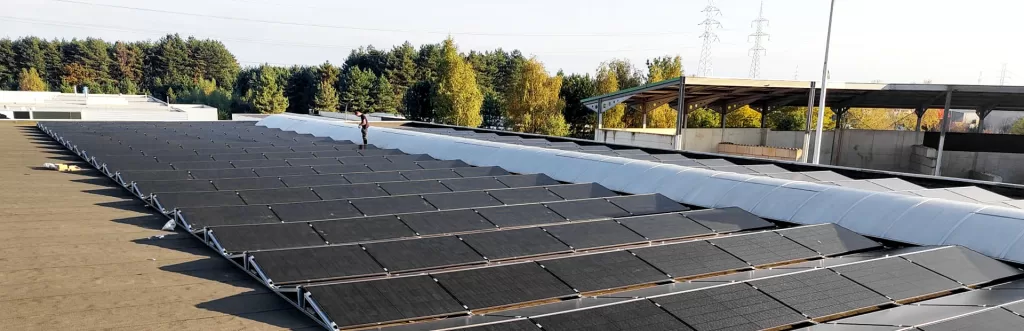
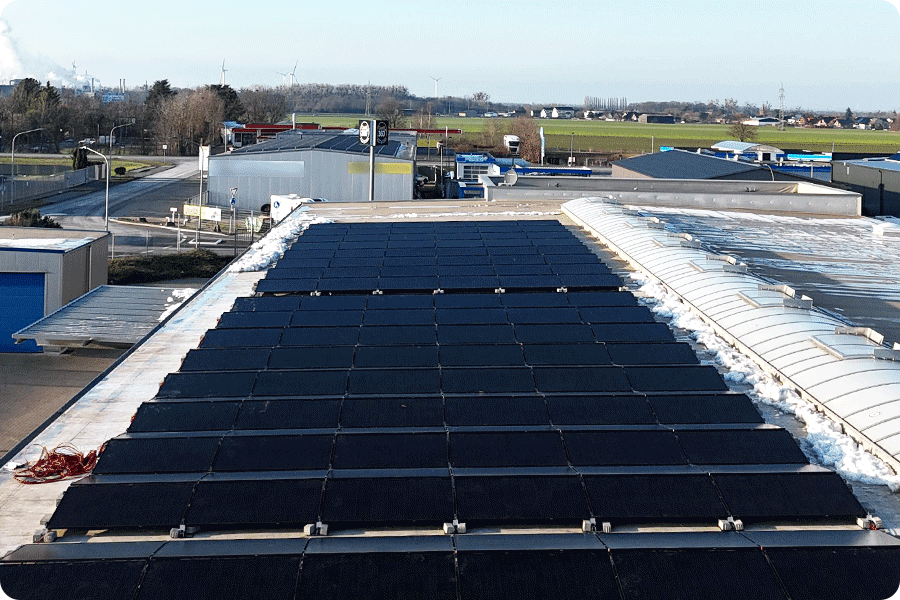
For warehouses, factories and commercial buildings, the priority is usually whether the system can run reliably, whether the solution can be replicated smoothly, and whether returns remain predictable. TOPCon offers a strong balance between efficiency, cost and supply maturity, which makes it well suited to these highly standardised rooftop projects.
Budget-sensitive projects
Some projects are not satisfied with the performance of conventional PERC, but are also unwilling to take on the extra cost of more premium technologies. In this case, TOPCon is often the most practical transition option: it can deliver better long-term performance without adding major pressure to the overall investment.
These projects usually share several common features:
- A desire to improve overall system efficiency
- High sensitivity to procurement cost
- Greater focus on payback period than on maximum technical performance
Focus on deployment efficiency
In many real projects, a solar panel does not exist in isolation. It needs to work smoothly with the inverter, mounting structure and electrical design. Because TOPCon is already industrially mature and its parameter range is easier for the market to accept, it is often easier to implement in standardised designs and repeatable project delivery.
Of course, if a project has more specific requirements around high-temperature performance, special structural adaptation or visual consistency, other technology routes may be more suitable. But for most standard commercial and industrial projects, TOPCon stands out not because it is the most extreme option, but because it is often the most dependable one.
What Are the Differences Between N-Type TOPCon, PERC and HJT?
PERC, TOPCon and HJT represent different levels of efficiency, cost and application focus. TOPCon has become the mainstream choice because it achieves a strong balance between efficiency, degradation control, cost and industrial maturity. The table below provides a clearer comparison of how these three mainstream technologies differ in practical solar projects.
Comparison of Three Mainstream Technologies
| Technology | Efficiency | Cost | Degradation | Typical Applications |
|---|---|---|---|---|
| PERC | Medium (approx. 20.5%–22%) | Low | Approx. 2.0% in the first year, then around 0.45% per year | Cost-sensitive projects |
| TOPCon | High (approx. 22%–23%) | Medium | Approx. 1.0%–1.5% in the first year, then around 0.40% per year | Mainstream commercial and industrial projects |
| HJT | Higher (approx. 22.5%–23.5%) | High | Approx. 1.0% in the first year, then around 0.35% per year | High-performance projects |
Frequently Asked Questions About N-Type TOPCon Solar Panels
1. Is the improvement of TOPCon over PERC significant?
Compared with PERC, TOPCon offers clear improvements in both conversion efficiency and long-term degradation control, particularly in terms of generation stability and service life. As a result, TOPCon has become the mainstream replacement for PERC in most new solar projects.
2. How should you choose between TOPCon and HJT?
Neither is inherently better in every case. TOPCon has stronger advantages in cost, production scale and supply stability, making it better suited to most standardised projects. HJT, by contrast, performs better in temperature coefficient and bifacial generation, so it is more suitable for specific scenarios where higher power generation performance is a priority. The right choice depends on the actual project conditions.
3. Is TOPCon suitable for all rooftop projects?
Not for every scenario, but it is suitable for most standard commercial and industrial rooftop projects. For projects that require a controlled budget and stable returns, TOPCon is often the easier option to justify. In premium residential or more specialised applications, however, other technologies such as IBC or HJT may also be selected.
4. Are TOPCon solar panels much more expensive than PERC?
At present, TOPCon solar panels are usually more expensive than PERC, but the price gap has narrowed significantly. When generation efficiency and long-term returns are taken into account, TOPCon often offers better overall value, which is why it is increasingly attractive for new projects.
5. Why do TOPCon solar panels often use half-cut or 1/3-cut designs?
Because multi-cut designs shorten the current path, reduce resistive losses and limit heat build-up, which helps improve panel operating stability. Compared with conventional full-cell structures, half-cut and 1/3-cut solar panels usually perform better under high temperatures, partial shading and long-term operation. For a high-efficiency cell technology such as TOPCon, combining it with a multi-cut design also helps unlock more of its overall performance potential.
Maysun Solar provides European customers with cost-effective solar panels tailored to different applications. Across PERC, TOPCon, IBC, HJT, shingled, bifacial and half-cut technologies, we focus on improving efficiency, temperature performance, long-term degradation and rooftop stability, helping residential and commercial projects strike a better balance between performance, cost and long-term returns.
Reference
Fraunhofer Institute for Solar Energy Systems ISE. Photovoltaics Report. https://www.ise.fraunhofer.de/en/publications/studies/photovoltaics-report.html
VDMA. International Technology Roadmap for Photovoltaics (ITRPV). https://www.vdma.eu/de/international-technology-roadmap-photovoltaic
IEA PVPS. Trends in PV Applications 2025. https://iea-pvps.org/trends_reports/trends-2025/
Trina Solar Co., Ltd. N-type i-TOPCon Backsheet Monocrystalline Module. https://static.trinasolar.com/sites/default/files/DT-M-0093%20A%20Datasheet_Vertex_NE19R_EN_2024_A_web_0.pdf
Trina Solar Co., Ltd. Global Limited Warranty for Trina Solar Brand Crystalline Solar Photovoltaic Modules. https://static.trinasolar.com/sites/default/files/PS-M-0135%20Z%20%20Global%20Limited%20Warranty%20Trinasolar%20Modules_EN.pdf
Recommend reading

PV Module Installation Beyond Rooftops: Multi-Scenario Applications for Bifacial N-Type Modules in Europe
PV module installation is not limited to rooftops. For residential users, small commercial users and distributed PV projects in Europe, spaces such as balconies, gardens, fences, carports, terraces, façades and pergolas can also provide additional installation areas when conditions allow. As solar use

Europe’s Grid Cap Era: Why High-Efficiency Solar Panels Matter More in 2026
Introduction In 2026, the economics of distributed solar in Europe are changing. Grid congestion, export limits, negative electricity prices and zero-export requirements mean that a solar project can no longer be judged only by how much electricity it generates. The more important question

How Do Solar Panel Delivery Delays Affect Installer Costs?
Solar panel delivery delays can affect installation schedules, project acceptance and payment collection.

The Forgotten “Invisible Assets”: Why Repowering Is the Strategic Key for European Solar in 2026
As grid congestion delays new solar projects across Europe, existing PV assets are becoming a strategic source of growth. This article explains why PV repowering can help EPCs and C&I asset owners unlock hidden value from already-connected solar plants, improve LCOE, and extend long-term asset performance with high-efficiency TOPCon, IBC and HJT modules.

Solar Panel Procurement in Europe: Why Stable Supply Matters More Than a One-Off Low Price
When European installers, distributors and corporate buyers choose solar panels, a one-off low price should not be the only factor. Stable supply, model continuity, technical documents and replenishment capacity often matter more for long-term cooperation and project delivery.

How Important Is the Temperature Coefficient When Choosing a Solar Panel?
How important is temperature coefficient when choosing a solar panel? This article answers that question directly and explains which projects should include it in early screening and which do not need to treat it as a top priority.