


When choosing a solar panel, the temperature coefficient is worth checking, but not every project needs to put it at the top of the list. Its real importance does not lie in being just another figure on the datasheet, but in how much output the panel loses under high operating temperatures. If a project operates for long periods in hot conditions, has average heat dissipation, and generates a large share of its electricity in summer, the temperature coefficient becomes more than a reference value and can directly affect early panel selection.
If you want to better understand the basic definition of temperature coefficient, how it changes, and how it relates to different solar panel technologies, you can also refer to the article “Why Is Temperature Coefficient Becoming a Key Factor in Solar Panel Selection?”.
Table of Contents
Why the Temperature Coefficient Affects Solar Panel Performance
When people first look at solar panel specifications, they often focus more on rated power and efficiency. But in real summer operating conditions, solar panels do not work at 25°C. When the air temperature reaches 32°C, the cell temperature can easily rise to 65°C. Based on a coefficient of -0.30%/°C, a 40°C increase above STC can result in an instantaneous power loss of around 12%. In other words, when sunlight is at its strongest, the solar panel is not necessarily operating under its easiest conditions.
From a selection perspective, the temperature coefficient matters not simply because “heat reduces output”, but because different solar panels lose performance differently under high temperatures. On the datasheet, the value that usually deserves the most attention is the Pmax temperature coefficient, because it is the one most directly linked to maximum output power. By comparison, Voc and Isc are more relevant to system design limits and safety checks, rather than being the primary indicators of real-world generation performance.
Should Temperature Coefficient Be a Priority in Solar Panel Selection?
Yes, but only where the project is genuinely exposed to high operating temperatures. A lower temperature coefficient is not automatically better in every case. It becomes a real selection factor only when the system is expected to operate under sustained high-temperature conditions.
If a project’s returns depend heavily on high-irradiance summer periods, or if rear-side roof ventilation is only average, differences in temperature coefficient are more likely to translate into real differences in annual energy yield. In such cases, a solar panel’s ability to maintain output in high temperatures often matters more than its nominal power rating on the datasheet.
By contrast, if system temperatures remain relatively manageable and heat is not a major factor in annual performance, the temperature coefficient should not be elevated into the sole decision criterion. Solar panel selection should always be based on an overall assessment, including power class, dimensions, degradation, bifacial conditions, price, and compatibility with the system design.
Which Projects Need to Pay More Attention to Temperature Coefficient?
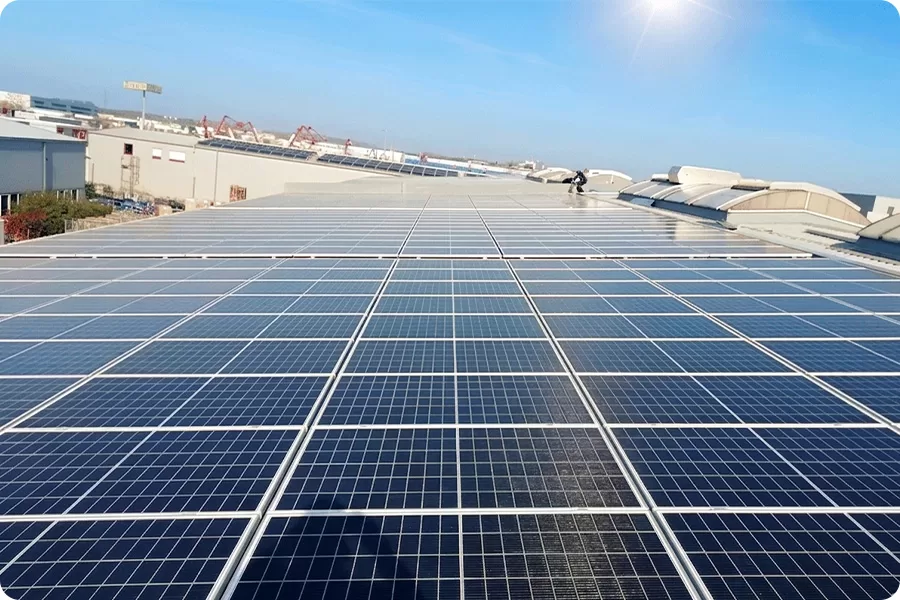
The projects that usually require closer assessment of temperature coefficient include commercial and industrial rooftops, carports and canopies, low-clearance mounting systems, and roof applications with restricted heat dissipation. What these projects have in common is not their location, but the fact that the solar panels are more likely to remain in high-temperature operating conditions for long periods, often during the very hours when power generation matters most.
For these projects, temperature coefficient is no longer just an extra line on the datasheet. It becomes a practical indicator during early-stage screening. This is especially true when comparing N-type TOPCon solar panels, N-type HJT solar panels, and conventional PERC solar panels, where differences in power loss under high temperatures can be much more meaningful in real applications.
Whether temperature coefficient deserves priority should not be judged by region alone, but by a few key operating realities: whether the solar panels are exposed to prolonged heat, whether rear-side ventilation is sufficient, and whether annual returns depend strongly on high-irradiance summer periods.
Key Conditions for Deciding Whether Temperature Coefficient Deserves Priority
At the early screening stage of a project, the following four factors can be used as a starting point:
- Whether the project operates under sustained high temperatures
If solar panel temperatures in summer are often significantly above 25°C, the temperature coefficient becomes clearly relevant for comparison.
- Whether system heat dissipation is only average
Systems with weak roof ventilation and restricted rear-side heat dissipation are more likely to magnify high-temperature losses, making temperature coefficient worth assessing early.
- Whether returns are concentrated in summer
If the hottest period also coincides with the main generation and revenue window, differences in temperature coefficient are more likely to translate into real differences in project returns.
- Whether the products being compared are in the same class
Temperature coefficient is a more useful basis for comparison only when power class, dimensions, price and structural conditions are broadly similar. Otherwise, the value of a single parameter becomes less meaningful.
At the parameter comparison level, the Pmax temperature coefficient is usually the value that deserves priority. Based on current technical data for commonly available products, the typical reference ranges of different technology routes under high-temperature conditions can be understood as follows:
| Solar Panel Technology | Temperature Coefficient (Pmax, %/°C) | Selection Guidance |
|---|---|---|
| HJT | ≈ -0.243 | Usually offers stronger power retention at high temperatures |
| IBC | ≈ -0.29 | Generally stable in high temperatures, usually better than conventional PERC |
| TOPCon | -0.29 ~ -0.32 | Usually performs better than PERC in high temperatures, close to some IBC products |
| PERC | ≈ -0.35 | Power output usually drops more noticeably at high temperatures |
It should be noted that these values are more suitable as an initial reference for comparison. In actual solar panel selection, the specific product datasheet should still be the main basis, alongside a combined assessment of power, dimensions, price, degradation and project scenario.
For projects that operate more frequently in high-temperature conditions, N-type HJT solar panels and some high-performance N-type TOPCon solar panels will often show stronger thermal performance advantages. Even so, whether that advantage justifies a higher budget should still depend on the specific conditions of the project itself.
Common Questions About Temperature Coefficient and Solar Panel Selection
1.Is a lower temperature coefficient always better?
Under otherwise comparable conditions, a smaller absolute value usually means more stable power retention at high temperatures. However, it should not be judged in isolation from price, size, power class or the actual project scenario.
2.Should you look at Voc, Isc or Pmax when selecting a solar panel?
If the question is which solar panel can better maintain output in high temperatures, Pmax temperature coefficient should be the priority. Voc and Isc are more relevant to system design and safety checks.
3.Do ordinary users also need to pay attention to temperature coefficient?
For general understanding, it is enough to know that it reflects how quickly output drops at higher temperatures. But for actual procurement or solution comparison, especially in high-temperature rooftop projects, this is a parameter worth taking seriously.
4.Does hot weather reduce solar panel output?
Yes. Once solar panel temperature rises above standard test conditions, output power falls as temperature increases. That is exactly why temperature coefficient matters more in high-temperature projects.
Temperature coefficient is not the most eye-catching parameter in solar panel selection, but in hot-climate or high-temperature projects, it is often one of the most underestimated. A genuinely professional approach is not to treat it as the only standard, but to assess it within the real operating conditions of the project.
As a long-standing solar panel manufacturer serving the European market, Maysun Solar continues to monitor how different technology routes perform under high-temperature operating conditions. By offering selection support across mainstream solutions including IBC technology, TOPCon technology, and HJT technology, it helps EPCs and project buyers make more targeted decisions based on roof conditions, operating temperatures and overall system goals.
Lorem ipsum dolor sit amet, consectetur adipiscing elit. Ut elit tellus, luctus nec ullamcorper mattis, pulvinar dapibus leo.

How Important Is the Temperature Coefficient When Choosing a Solar Panel?
How important is temperature coefficient when choosing a solar panel? This article answers that question directly and explains which projects should include it in early screening and which do not need to treat it as a top priority.

When does HJT bifacial gain pay off on European rooftops, and when is IBC the better option?
When do HJT bifacial solar panels generate stronger returns on European rooftop projects, and when should IBC solar panels take priority?

Which homes are suitable for garden solar?
Which homes are suitable for garden solar? Assess space, shading, orientation and electricity-use goals to quickly judge whether garden solar is a suitable option.

Are Differences Between Solar Panels More Noticeable in High-Temperature Conditions?
High temperatures reduce solar panel efficiency, but the gap in summer power generation is not determined by temperature alone. This article compares the high-temperature performance of HJT, TOPCon and IBC, and explains how businesses should choose.

Why Have N-Type TOPCon Solar Panels Become the Market Mainstream?
N-type TOPCon solar panels have become one of the mainstream photovoltaic technologies thanks to their strong balance of efficiency, cost and mass-production maturity. This article briefly explains their structural features, practical advantages and typical application scenarios.

April News from the European Solar Industry
The European solar market is showing clear signs of recovery: system value is being reaffirmed, German auction prices are stabilising, Italy’s rules are becoming clearer, and revenue certainty in France is improving.