Table of Contents
Introduction
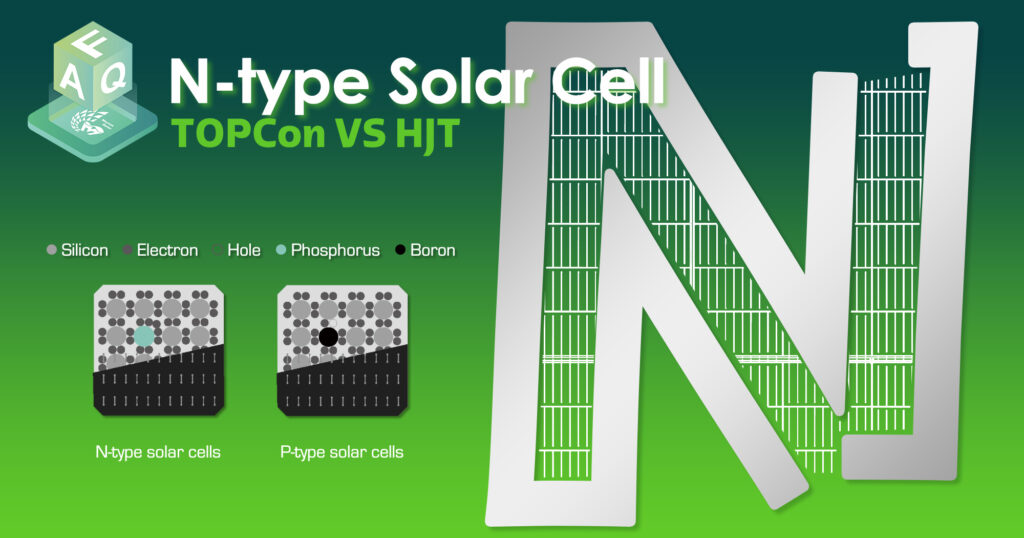
By 2025, the focus of solar cell technology has gradually shifted from P-type to N-type.
Compared with traditional PERC, N-type cells demonstrate clear advantages in terms of efficiency and long-term performance:
-
Efficiency levels: mainstream mass-produced modules reach 22–23%, with some products exceeding 23%, surpassing the P-type ceiling of around 21%;
-
Reliability: N-type cells perform better in temperature coefficient, low-light response, and degradation control;
-
Industry scale: global N-type cell capacity has surpassed 300 GW, with planned capacity approaching 800 GW, marking the first time it has overtaken P-type.
Against this backdrop, TOPCon and HJT have emerged as the two main N-type technology routes and are at the core of industry competition and upgrading.
Differences Between P-type and N-type Cells and Development Trends
History and Market Landscape of P-type Cells
Over the past decade, P-type cells have dominated the photovoltaic industry, with their technology pathway evolving from BSF to PERC:
-
BSF stage (before 2015): Adopted aluminum back surface field (Al-BSF). Monocrystalline efficiency was about 17–18%, while polycrystalline was around 15–16%. The process was mature but suffered from severe surface recombination, leaving limited room for improvement.
-
PERC stage (2015–2022): The rear side adopted Al₂O₃ + SiNx passivation, boosting cell efficiency to 22% and module efficiency to around 21–22%. According to PV InfoLink data, PERC’s market share rose from about 40% in 2018 to over 90% in 2022.
The widespread adoption of PERC effectively drove down the levelized cost of electricity (LCOE), playing a key role in achieving grid parity for solar between 2015 and 2020.
However, several issues remain:
-
LID and LeTID degradation: about 2% in the first year, followed by roughly 0.45% annually;
-
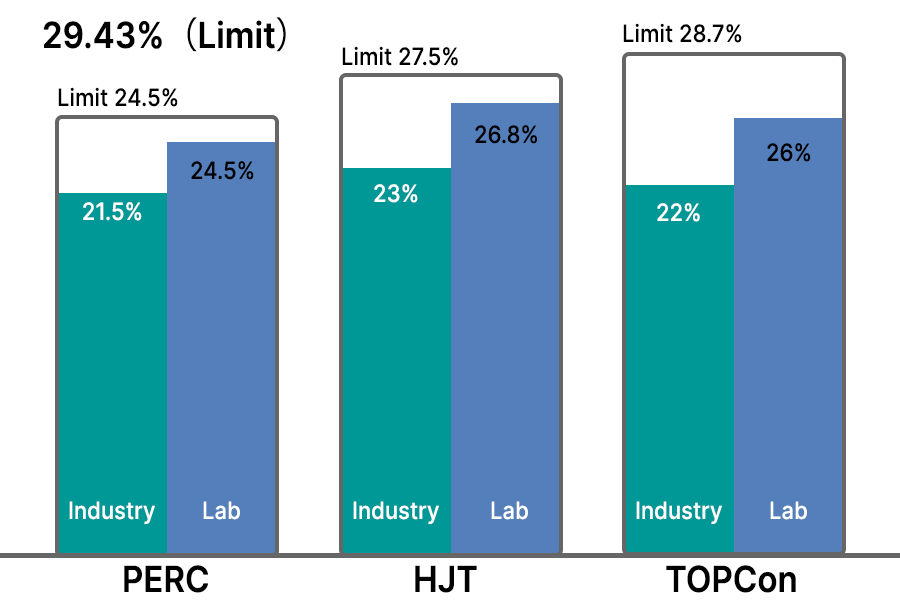
Efficiency ceiling: conversion efficiency is approaching the theoretical limit of 24%, leaving little room for further mass-production gains.
As N-type cells mature and expand, PERC has gradually lost its advantage in new capacity. According to InfoLink forecasts, by 2025 PERC’s market share will fall below 30% and will gradually exit the mainstream after 2026.
The Rise and Efficiency Advantages of N-type Cells
The core advantage of N-type cells lies in their material properties: phosphorus-doped wafers avoid the boron-oxygen complex common in P-type, thereby almost eliminating light-induced degradation (LID) and significantly extending carrier lifetime. This results in the following performance improvements:
-
Efficiency: mass production levels have stabilized at 22–23%, with some manufacturers exceeding 23%; PERC remains at around 21%.
-
Reliability: better low-light response compared to P-type, with temperature coefficients typically around -0.30%/°C.
-
Degradation: initial light degradation is close to zero, and the annual degradation rate is lower than PERC’s 0.45%/year.
On the market side, N-type is replacing P-type as the mainstream:
-
2023: global planned N-type capacity exceeded 600 GW;
-
2024: actual capacity surpassed 300 GW, overtaking P-type for the first time;
-
Forecast: by 2025–2026, N-type is expected to account for more than 70% of new capacity.
Classification and Mainstream Routes of N-type Cell Technologies
N-type cells offer advantages such as high efficiency, high bifaciality, low temperature coefficient, no light-induced degradation, strong low-light response, and long carrier lifetime. The main technology routes currently include:
-
TOPCon technology: mass production efficiency of 21–23%; can be achieved by upgrading PERC production lines with relatively low investment. Global capacity exceeded 300 GW in 2024, making it the current mainstream.
-
HJT technology: thanks to lower temperature coefficients and higher bifaciality, some manufacturers have achieved module efficiencies of 23% or higher, slightly above TOPCon’s ceiling, but with relatively higher costs.
-
IBC technology: with no front-side metal busbars, light reflectance can be reduced to about 1.7%. Suitable for high-end and BIPV applications, consistently achieving 22–23.5%, with advantages in the mid-to-high-end market.
Overall, TOPCon dominates in the short term, while HJT and IBC are viewed as more promising options in the medium to long term.
TOPCon Cell Technology
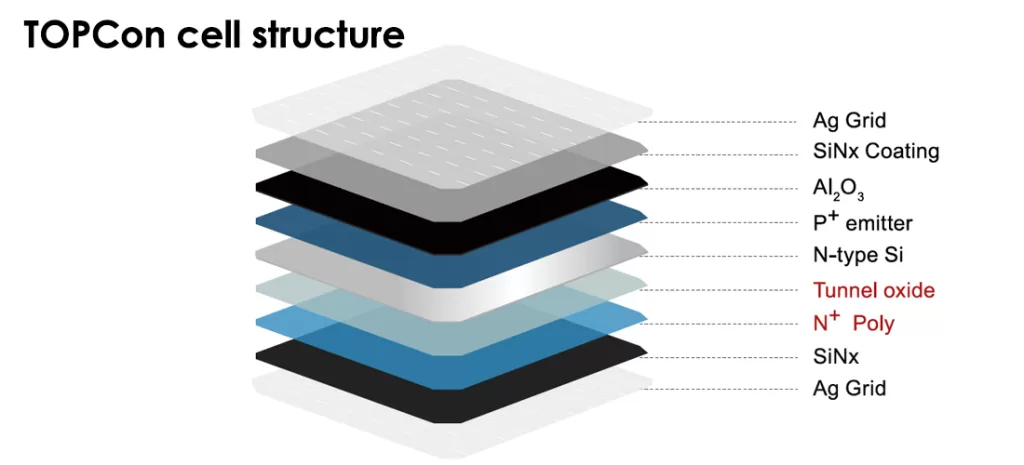
TOPCon (Tunnel Oxide Passivated Contact) is an improved route based on N-type cell processes. Its core lies in forming an ultrathin oxide layer and a doped polysilicon contact layer on the rear side of the wafer, reducing carrier recombination and enhancing open-circuit voltage and overall efficiency.
Key Advantages
-
Efficiency levels: mass production efficiency generally ranges from 21–23%, making it an industry mainstream. Some leading companies have achieved over 23%, while laboratory records approach 25–26%. Compared with PERC, TOPCon performs better under low-light conditions, in temperature coefficients, and in stability.
-
Cost compatibility: PERC production lines can be directly upgraded, requiring an additional investment of about €7–14 million per GW. It is highly compatible with high-temperature processes, avoiding large-scale sunk costs.
-
Long-term reliability: low module degradation rates ensure more stable power generation over time, making it suitable for commercial & industrial PV systems as well as large-scale ground-mounted plants.
Industrialization Progress
-
Capacity scale: by the end of 2024, global TOPCon cell capacity had exceeded 300 GW, taking an absolute lead in new capacity additions.
-
Major enterprises: Longi, Jinko, Trina, Zhonglai, Risen, and others have all completed large-scale mass production deployments.
-
Market forecast: by 2025–2026, TOPCon’s share in the global cell market is expected to exceed 60%, maintaining its dominant position.
Market Significance
-
Driving improvements in module efficiency and providing a core foundation for system cost reduction and performance gains.
With the continuous decline in LCOE, TOPCon has become the most cost-effective N-type cell technology today.
HJT Cell Technology
HJT (Heterojunction with Intrinsic Thin layer) is an N-type cell technology that combines a crystalline silicon substrate with thin amorphous silicon layers to form a heterojunction structure. Unlike TOPCon, which evolves from upgrading PERC lines, HJT requires new production lines, making it a completely independent process route.
Key Advantages
-
Short process flow: consists of only four steps—texturing, amorphous silicon deposition, TCO deposition, and screen printing—simpler than PERC’s 10 steps or TOPCon’s 12–13 steps. This allows new entrants to establish production more quickly.
-
High development potential: laboratory records reached 26.8% in 2023, with potential to combine with IBC or perovskite tandem structures, pushing theoretical efficiencies beyond 30%.
-
Low degradation: around 1% in the first year and about 0.35% annually thereafter, significantly lower than PERC (2% in the first year, 0.45% annually). Over its lifecycle, HJT delivers about 2% more generation per unit area than bifacial PERC.
-
Environmental adaptability: with a low temperature coefficient (around -0.243%/°C), HJT maintains stable performance under high-temperature and low-light conditions.
Industrialization Progress
-
Process compatibility: HJT is not compatible with PERC processes and requires new production lines, leading to higher investment costs. However, it is more favorable for new entrants since there is no legacy equipment depreciation.
-
Capacity plans: by 2024, over 20 companies—including CR Power, CNBM, Runyang, Huasheng, and Akcome—had announced HJT capacity plans totaling more than 100 GW, with some already reaching GW-level mass production.
Market Significance
-
HJT is considered a medium- to long-term potential technology, with advantages in tandem structures, BIPV, and high-temperature or low-light markets.
-
As silver paste substitution, copper plating, and thinner wafers mature, HJT is expected to reduce costs and eventually compete with TOPCon.
Data note: The N-type cell capacity figures in this article are compiled from public forecasts by InfoLink, EnergyTrend, and TaiyangNews. Differences exist among institutions (e.g., nominal vs. actual capacity, global vs. regional statistics), so the exact figures are for reference only. The overall trend is consistent: from 2024 onward, N-type cell capacity has surpassed P-type, with TOPCon dominating in the short term, while HJT and IBC hold greater long-term growth potential.
As PERC efficiency approaches its ceiling, the PV industry is accelerating its transition to N-type technologies. With higher efficiency potential, lower degradation rates, and compatibility with IBC and perovskite tandems, HJT is regarded as a leading candidate for next-generation solar cells. However, the theoretical limit for single-junction crystalline silicon is 29.43%, and with TOPCon and HJT already approaching 26–27% in laboratories, further breakthroughs will rely on tandem technologies.
Maysun Solar focuses on the European market, providing partners with reliable supply and modules of various power classes based on N-type cells, including IBC technology, TOPCon technology, and HJT technology, delivering the most suitable solar solutions for your rooftop.
Reference
Fraunhofer ISE. (2024). Photovoltaics report. Fraunhofer Institute for Solar Energy Systems. https://www.ise.fraunhofer.de/content/dam/ise/de/documents/publications/studies/Photovoltaics-Report.pdf
IEA. (2024). Renewables 2024: Analysis and forecast to 2029. International Energy Agency. https://www.iea.org/reports/renewables-2024
PV InfoLink. (2023). Explosive growth of TOPCon capacity accelerates p-n technology transition. PV InfoLink. https://www.infolink-group.com/energy-article/solar-topic-explosive-growth-of-topcon-capacity-accelerates-p-n-technology-transition
Recommend Reading

HEMS and Dynamic Electricity Pricing: From Solar Generation to Smart Energy Management
For years, home solar systems have focused on one main question:How much electricity can my rooftop solar system generate?But as home batteries, smart meters, electric vehicles and flexible electricity tariffs become more common, residential energy management is entering a new phase.The more important
Maysun Solar’s First 3.5 MW Solar EPC Project in Italy Enters Its Final Stage
A large-scale commercial and industrial rooftop solar project with a total capacity of approximately 3.5 MWp is now entering its final stage in the Turin area of Piedmont, Italy. Around 8,000 solar modules planned for the project have now been fully installed.

August European Solar Industry News
In August 2026, Europe’s solar market combined record PV generation with volatile power prices driven by heat, gas costs and low wind output. Policy support also expanded, including 800 W plug-in solar in Great Britain and greater EU flexibility for PV and storage investments, while module prices largely stabilized amid renewed oversupply.

Industrial Roofs with Limited Load Capacity: Lightweight or High-Efficiency Solar Panels?
On an existing industrial roof, “lighter is better” is not a reliable module-selection rule. The first question is how much additional load the roof can safely accept. Only then does it make sense to compare module weight, power density, mounting method and the

How to Verify Solar Panels Before Buying: Datasheets, Certifications, Warranties and Delivery Inspection
A datasheet, an IEC certificate and a 25- or 30-year warranty can make a solar module look fully validated on paper. For a reliable purchasing decision, however, those documents are only the starting point. The electrical ratings, mechanical design, certificates, connectors, warranty terms

How to Choose Solar Panels for Low-Load-Bearing Industrial Roofs: A Guide to Weight, Power Density and Mounting Systems
Choosing solar panels for a low-load-bearing industrial roof requires more than checking the weight of an individual module. A more reliable process starts by determining the roof’s remaining load-bearing capacity. The complete load from the modules, rails, fasteners and ballast must then be