

Table of Contents
Why Is Solar Module Innovation Returning to Structural Design?
Over the past decade, improvements in solar module efficiency have mainly relied on material upgrades.
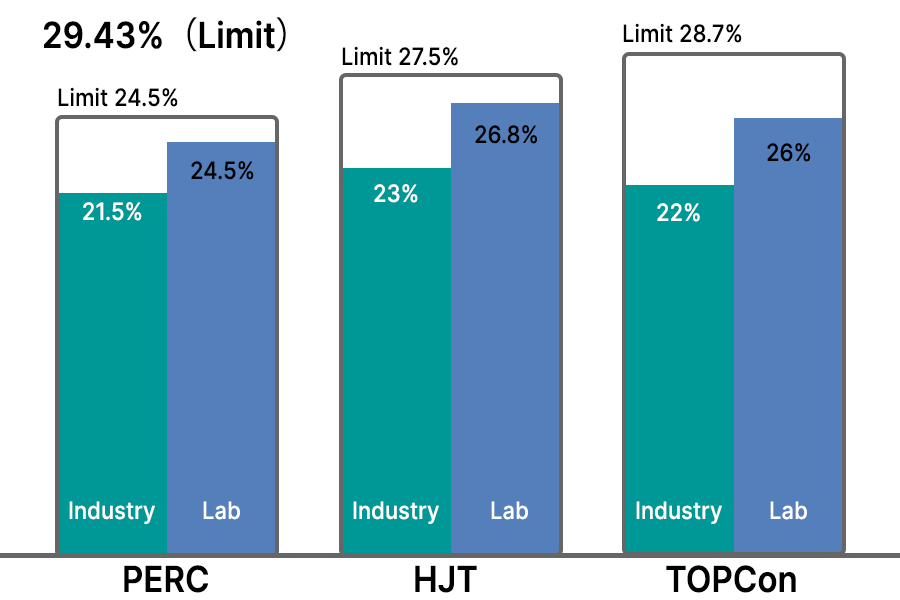
PERC, TOPCon, and HJT cells currently show:
Mass production efficiency typically between 21%–23%
Laboratory results reaching 25%–26%
A theoretical limit of around 28%
Each additional 0.1% efficiency gain requires higher silver consumption and more complex processes, reducing cost-effectiveness. Compared with the marginal improvements from material innovation, structural optimization offers more practical benefits in reducing losses, controlling temperature rise, and extending module lifespan.
As cell sizes increase to 182 mm and 210 mm, the string current often exceeds 13 A, nearly 40% higher than in earlier modules. Excessive current density can cause local overheating and solder joint stress concentration. According to TÜV Süd (2023), regions with a temperature difference greater than 5 °C show about 15% shorter encapsulation lifespan. Proper current redistribution can lower temperature rise by 2–4 °C, enhancing long-term stability.
Structural innovation is becoming the new direction for improving solar module efficiency. From half-cut to multi-busbar and now to 1/3-cut, design priorities have shifted toward refined current distribution—maintaining thermal balance and stable output under high power conditions.
What Structural Improvements Has the 1/3-Cut Technology Brought?
Although half-cut modules remain the market mainstream, they still face issues of current concentration and uneven heat distribution in high-power applications.
The 1/3-cut technology enhances system stability through more refined current allocation and optimized current pathways.
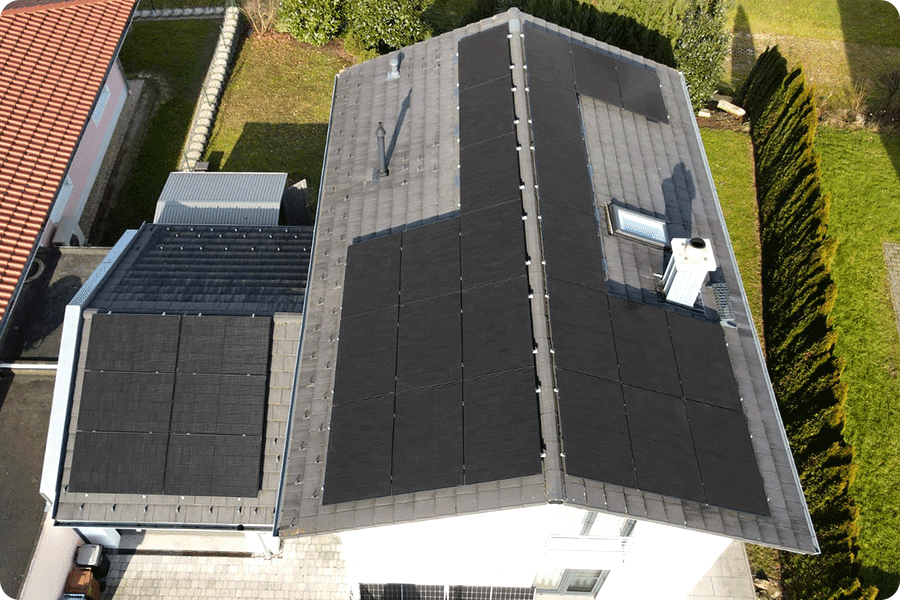
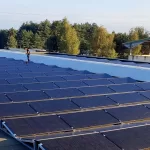
Note: This German residential system with 1/3-cut modules provides households with a long-term stable solar solution.
Compared with conventional half-cut modules, 1/3-cut solar modules achieve measurable structural improvements across multiple dimensions:
Current redistribution to reduce losses: String current decreases by about 27%, series resistance is halved, resistive losses drop by around 50%, and total energy loss is reduced by approximately 45%.
Improved thermal management: Operating temperature falls by about 40%, hotspot risk decreases significantly, and encapsulation material aging slows down.
Higher shading tolerance: The multiple parallel string configuration minimizes power loss caused by partial shading, allowing stable output even under tree shadows, fallen leaves, or building shading.
More stable power output: In an equivalent 10 kW system, annual energy loss is nearly 50% lower, with higher overall generation efficiency and better temperature control.
Mechanical and structural optimization: Current distribution becomes more uniform, solder joint stress drops by 15–20%, and the microcrack rate decreases. With a weight of around 21 kg, the design balances lightweight performance and installation compatibility.
Technical Comparison: 1/3-Cut Solar Modules vs Halfcut Solar Modules
| 1/3-Cut Module | Halfcut Module | |
|---|---|---|
| Energy efficiency (vs half-cut) | +7.22% | Baseline |
| String current (A) | 9.96–10.16 | 13–15 |
| Resistive losses (I²R) | ≈ −45% | — |
| Operating temperature | Approx. 40% lower | Baseline |
| Annual energy loss (10 kW equivalent) | 57.2 kWh | 108.6 kWh |
| Module weight | 21 kg | 22–28 kg |
| System compatibility | Standard size (1.998 m²) | Limited compatibility |
The essence of the 1/3-cut design lies in the reallocation of current and heat flow, achieving a synchronized enhancement in power density and system reliability.
What Advantages Do 1/3-Cut Modules Show in Real Operation?
In real-world applications, the advantages of 1/3-cut technology often become more evident over time.
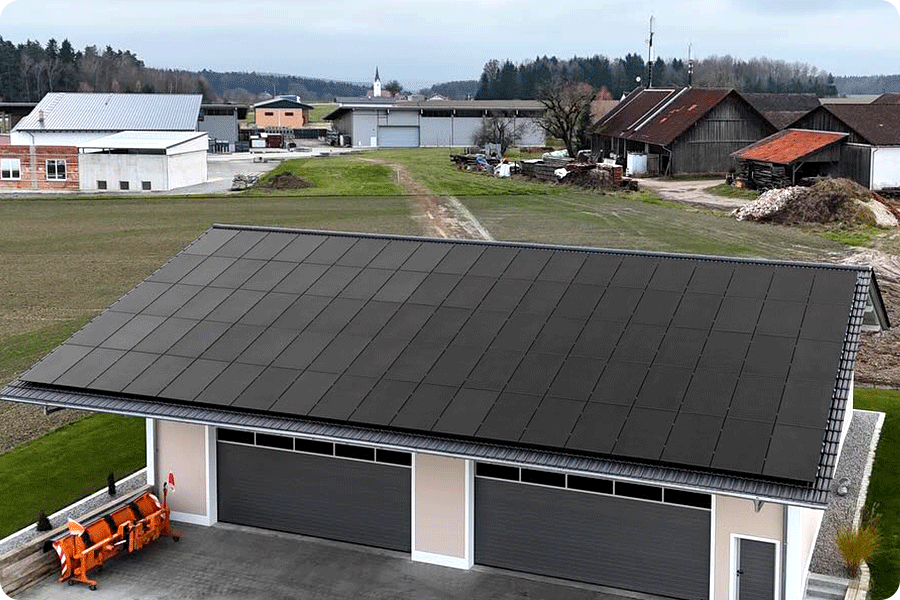
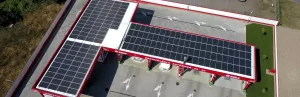
Note: This industrial rooftop equipped with 1/3-cut modules enables factories to achieve higher energy yields and improved market competitiveness.
In typical scenarios such as high-temperature rooftops in Southern Europe and light-load factory roofs in Central Europe, lower temperature rise and smoother power output curves allow for greater stability in both system efficiency and long-term returns.
System-Level Advantages of TOPCon 1/3-Cut Modules (Example: Twisun Pro)
| 1/3-Cut Performance | Real-World Effect | |
|---|---|---|
| Thermal performance | Average operating temperature 3–4 °C lower than half-cut; temperature coefficient −0.29 %/°C; power degradation reduced by 3–5 % |
Improved heat management, slower encapsulation ageing |
| Current control | String current 9.96–10.16 A (half-cut: 13–15 A) | Approx. 27% lower current density, terminal temperature drop of 4–6 °C |
| Power curve | Starts up 5–8 minutes earlier under low light; peak output sustained 6–10 % longer | Smoother generation curve, inverter efficiency gain of 0.3–0.5 pp |
| Structural compatibility | Weight 21 kg; size 1762 × 1134 mm; front load 5400 Pa, rear load 4000 Pa | Compatible with mainstream rooftop and light-mount systems |
| System yield | Annual energy loss 57 kWh (half-cut: 108 kWh); lifetime energy yield +3–5 % | IRR increased by 0.5–1 %, payback period shortened by approx. 4–6 months |
By optimizing the distribution of current and heat flow, 1/3-cut technology enables solar modules to maintain stable output and sustained efficiency even under high-temperature or long-duration operating conditions in residential and commercial rooftop systems.
Will 1/3-Cut Modules Become the Next Trend in High-Efficiency Solar Panels?
As the efficiency improvements of PERC, TOPCon, and HJT technologies gradually approach their limits, the next breakthrough is shifting back to structural innovation.
The 1/3-cut PV module, with its more balanced current and heat flow distribution, maintains stable power generation under high temperatures, light-load conditions, and long-term operation. Whether for commercial rooftops or residential self-consumption systems, it achieves an optimal balance among efficiency, stability, and cost.
With deep expertise in 1/3-cut technology, Maysun Solar provides high-efficiency, high-stability PV solutions for rooftop projects across Europe. Through precise current distribution and thermal flow control design, its 1/3-cut TOPCon solar modules deliver exceptional performance even under high-temperature, light-load, and long-term operation conditions—ensuring greater system reliability and sustained long-term returns.
Reference
Fraunhofer ISE. (2024). Advances in cell interconnection and current path design for high-power PV modules. https://www.ise.fraunhofer.de/en.html
Kiwa PVEL. (2024). PV Module Reliability Scorecard 2024. https://scorecard.pvel.com/wp-content/uploads/2024-PV-Module-Reliability-Scorecard.pdf
DNV Energy Systems. (2024). Photovoltaic module performance simulation and LCOE optimization. https://www.dnv.com/power-renewables/publications
Maysun Solar. (2025). Twisun Pro 1/3-Cut Module Technology. https://www.maysunsolar.de/triple-cut-technologie
Recommend reading

430–460W or 600W+? How Should You Choose Solar Panel Power for Rooftop Projects?
Compares 430–460W solar panels and 600W solar panels in C&I rooftop projects, showing that solar panel selection should prioritise roof compatibility and system stability.

Changes in the European Solar Policy and Market in 2026
Europe’s 2026 solar policy and grid changes are reshaping solar panel selection, shifting project returns towards market-driven mechanisms and highlighting the roles of TOPCon, HJT and IBC solar panels.
Why European EPCs Are Reassessing Large-Format Solar Panels
European EPCs are re-evaluating large-format solar panels. Panel size directly affects installation risk, system compatibility, and solar project ROI stability.

Do Vertical Bifacial Modules Really Deliver Additional Yield?
Vertical bifacial PV systems are gaining increasing attention across Europe. This article explores under what conditions a vertical layout can create additional value, how bifacial gain is influenced by site conditions, and which project types are best suited to this design.

Which rooftop scenarios make 700W+ solar panels a risk?
An analysis of the practical limits of 700W+ high-power solar panels on residential and commercial rooftops, and how space, load capacity, self-consumption and maintenance affect real returns.
February News in the Photovoltaic Industry
February overview of Europe’s photovoltaic market: module price trends, a rebound in the German PPA market, progress in Italian agrivoltaics and regulatory shifts in France, highlighting key industry signals.

great !