Which wiring configuration is best for your photovoltaic modules: series, parallel, or hybrid wiring?

Which wiring configuration is best for your photovoltaic modules: series, parallel, or hybrid wiring?

Which wiring method—series, parallel or hybrid—delivers the best overall system performance in a PV installation?

In brief:

  • Series wiring: higher DC voltage with constant current – ideal for string inverters and longer cable runs.
  • Parallel wiring: higher current at constant voltage – advantageous in cases of partial shading and for systems with battery storage.
  • Hybrid wiring: combines the benefits of voltage and current – flexible for different roof areas and varied module layouts.

Choosing the right wiring configuration has a significant impact on energy yield, system efficiency, cable sizing and the operational safety of a photovoltaic system.

This guide explains how the three wiring methods work, outlines their typical applications, and uses practical examples and wiring diagrams to illustrate which configuration is best suited to different roof conditions and system requirements.

Table of Contents

Comparison: series, parallel and hybrid wiring

When designing a photovoltaic system, it is essential to understand the differences between the various wiring configurations.

Depending on whether modules are connected in series, in parallel or in a hybrid arrangement, the behaviour of voltage, current flow and overall system efficiency can change significantly.

1.1 Series wiring

In a series connection, photovoltaic modules are linked one after another, with the positive terminal of one module connected to the negative terminal of the next.
As a result, the voltages are added together, while the current remains constant.

Example: Four 500 W TOPCon PV modules connected in series produce a combined system voltage of around 148 V at a current of 13.5 A, as shown in the illustration.

This wiring method is particularly suitable for systems that require higher voltage levels, such as installations using string inverters.

It is also efficient for long cable runs, as the lower current reduces transmission losses and allows the use of thinner cables.

Illustration of a series connection of four 500 W Maysun Solar TOPCon photovoltaic modules with an aggregated system voltage of 148.4 V and a constant current of 13.48 A.

1.2 Parallel wiring

In a parallel connection, the positive terminals of all modules are connected together, as are the negative terminals.

In this configuration, the voltage remains constant, while the current increases with each additional module.

Example: Four 500 W TOPCon modules connected in parallel generate a system voltage of approximately 37.1 V with a total current of 53.9 A, as shown in the illustration.

This wiring method is commonly used in low-voltage systems or battery storage solutions, where higher current is required to enable faster charging.

At the same time, the increased current necessitates larger cable cross-sections and appropriate protective devices to prevent overheating.

Illustration of a parallel connection of four 500 W Maysun Solar TOPCon photovoltaic modules with a constant system voltage of 37.1 V and a total current of 53.9 A.

1.3 Hybrid wiring (series–parallel connection)

Hybrid wiring combines the advantages of both series and parallel configurations.

First, several modules are connected in series to increase the voltage; then multiple of these strings are connected in parallel to raise the overall current.

Example: Eight 500 W TOPCon modules form four strings, each consisting of two modules connected in series.

Together, they generate a system voltage of around 74.2 V with a total current of 53.9 A, as shown in the illustration.
This configuration provides a balanced ratio of voltage and current and is frequently used in larger PV systems.

However, it requires careful planning of string lengths and the selection of suitable protective components.

Illustration of a series–parallel connection of eight 500 W Maysun Solar TOPCon photovoltaic modules (two in series per string and four strings in parallel) with a system voltage of 74.2 V and a total current of 53.9 A.

Comparison of wiring configurations in PV systems

Wiring configuration Voltage Current Advantages Typical applications
Series wiring increases with each module remains constant High DC voltage, low transmission losses String inverters, long cable runs, roofs without shading
Parallel wiring remains constant adds up Good shading tolerance, high current for storage systems Battery storage systems, partial shading, low DC voltage
Hybrid wiring medium (per string) medium (overall) Balanced performance, stable with mixed roof areas Larger PV systems, different orientations

Advantages and disadvantages of series, parallel and hybrid wiring

Each wiring configuration—series, parallel or hybrid—has its own strengths and weaknesses that affect the performance, efficiency and system design of a PV installation.

Each wiring configuration—series, parallel or hybrid—has its own strengths and weaknesses that affect the performance, efficiency and system design of a PV installation.

2.1 Series wiring

Advantages

  • Higher voltage: Series wiring is ideal for systems that require higher voltage levels, such as grid-connected installations or string inverters.
  • More efficient power transmission: The higher voltage results in lower transmission losses over long cable runs.
  • Cost benefits for cabling: Because the current remains lower, thinner and therefore more cost-effective cables can be used.

Disadvantages

  • Sensitive to shading: A shaded or faulty module reduces the output of the entire string. In such cases, parallel or hybrid wiring is often the better option.
  • Increased voltage risk: Higher system voltages require appropriate protective measures and professional installation, particularly in high-voltage systems.

2.2 Parallel wiring

Advantages

  • Higher current: Parallel wiring adds up the current of the individual modules. This makes it suitable for systems that require higher current at a constant voltage, such as those combined with MPPT charge controllers or battery storage systems.
  • Better shading tolerance: If one module is partially shaded, the output of the remaining modules is largely unaffected. Parallel wiring is therefore more resilient to partial shading.
  • Constant voltage: The voltage remains at the level of a single module, regardless of the number of connected modules—an advantage for low-voltage systems and sensitive inverters.
  • Easy expansion: Additional modules can be integrated without exceeding the inverter’s voltage limits.

Disadvantages

  • Higher transmission losses: In larger systems, higher currents lead to greater energy losses over long cable distances.
  • Increased heat generation: The higher current can cause more heat build-up in the system, which may reduce efficiency.
  • Larger cable cross-sections required: To prevent overheating, thicker and therefore more expensive cables are necessary.
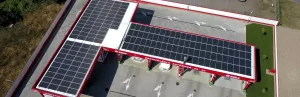
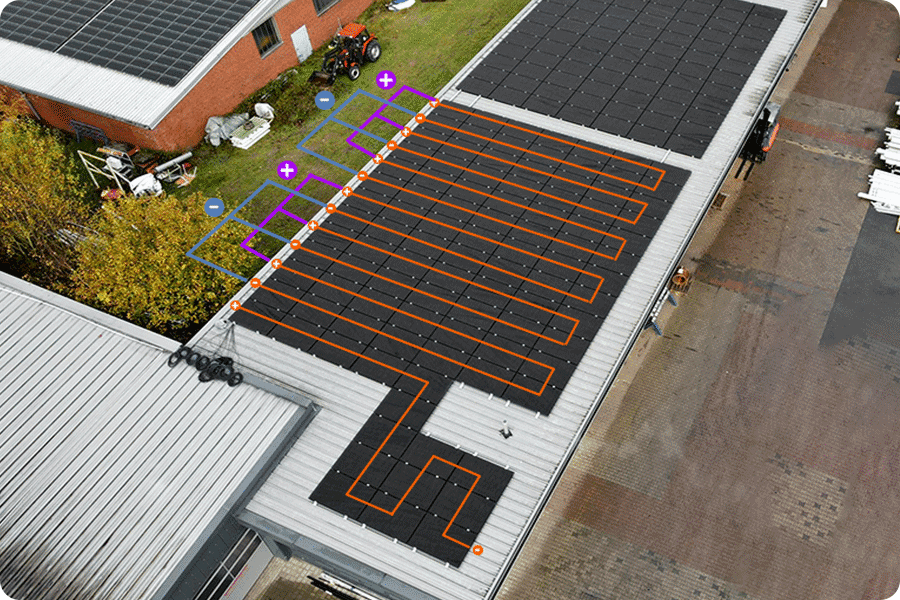
Germany – commercial and industrial PV installation with 222 photovoltaic modules rated at 450 W each, connected in strings of 13–15 modules and wired in parallel to the inverter (total capacity 100 kWp).

Image caption: Installed with 222 Twisunpro Full Black 450 W modules, connected in 13–15 module strings for efficient and stable system performance.

2.3 Hybrid wiring

Advantages

  • Balanced performance: Combining series and parallel wiring enables a stable balance between voltage and current, optimising energy flow.
  • Improved shading tolerance: Under partial shading, weaker modules have less impact on the overall system than in a purely series-connected configuration.
  • High system flexibility: Hybrid wiring can be easily adapted to different roof pitches, module groups or power ranges—ideal for larger PV systems with varying orientations.

Disadvantages

  • More complex planning: Combining different strings requires precise system design and careful string layout.
  • Higher installation effort: More cables and connections increase installation complexity and potential sources of error.
  • Uneven load distribution: Without accurate matching, differences between strings can lead to performance losses.

Series, parallel or hybrid wiring: which configuration is best for your PV installation?

The optimal wiring configuration depends on several factors—particularly voltage requirements, shading conditions, cable lengths and overall system size.

Example:

In a grid-connected PV system with eight TOPCon Twisun Pro 450 W modules (each rated at 41.6 V and 10.8 A), the modules are connected in series to achieve a system voltage of around 333 V.

This voltage lies within the optimal operating range of modern string inverters and helps reduce transmission losses over longer cable runs.

Series wiring:

8 modules × 41.63 V = ≈ 333 V (current remains at 10.8 A)

An MPPT inverter automatically adjusts the voltage and maximises the energy yield.

This configuration is particularly suitable for residential buildings and commercial rooftops with minimal shading and a central inverter.

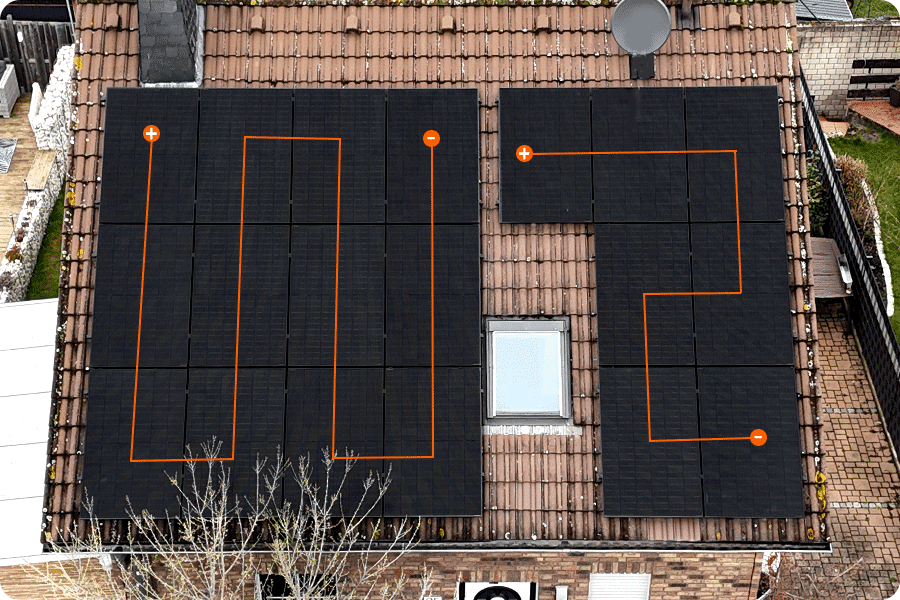
Germany – residential rooftop PV installation with 19 photovoltaic modules rated at 450 W each, connected in series strings of 12 modules to achieve high system voltage and low transmission losses (total capacity 8.55 kWp).

Image caption: Installed with 19 Twisunpro Full Black 450 W modules, wired in 12-module strings for efficient inverter operation and stable system performance.

Example

In a battery storage system or off-grid installation with four TOPCon Twisun Pro 450 W PV modules (each 41.6 V and 10.8 A), the modules are connected in parallel to maintain the voltage at around 41.6 V while increasing the current to approximately 43.2 A.
This design is typical for low-voltage storage systems or standalone PV applications.

Parallel wiring:

4 modules × 10.8 A = 43.2 A (voltage = 41.6 V)

This configuration is particularly well suited to partially shaded roofs or battery systems that require a higher charging current.

An MPPT charge controller makes optimal use of the input power and significantly improves charging efficiency.

Example

In a commercial rooftop installation with twelve 450 W N-type TOPCon modules (each 41.6 V and 10.8 A), six modules are connected in series, and the two resulting strings are then connected in parallel.

In this way, the system combines higher voltage with increased current while remaining less sensitive to partial shading.

Hybrid wiring:

6 modules × 41.63 V = ≈ 250 V per string → 2 strings in parallel = current ≈ 21.6 A

This configuration ensures efficient power transmission over long cable distances and stable energy yields, even when certain areas of the roof receive less sunlight.

It is particularly suitable for medium to large rooftop PV installations with varying irradiation conditions and a central MPPT inverter.

Common issues and system optimisation for series, parallel and hybrid wiring

In photovoltaic systems, long-term performance depends heavily on the chosen wiring configuration. Whether series, parallel or hybrid wiring is used, each option influences voltage levels, current flow and heat generation, directly affecting efficiency, maintenance requirements and system safety.

A solid understanding of typical fault sources and targeted maintenance measures helps minimise energy losses and ensures long-term system reliability.

4.1 Maintenance and fault analysis

Series wiring:

In a series configuration, module voltages are added together while the current remains constant. This enables efficient power transmission but makes the system more sensitive to failures of individual modules. Even partial shading or cell damage can reduce the output of the entire string. Regular voltage checks are therefore essential.

Typical issues:

  • Voltage deviations: A module with a lower voltage reduces overall system yield.
  • Loose connectors: Can cause voltage drops or short circuits.
  • Soiling: Dust or snow reduces light transmission.

Parallel wiring:

Here, the voltage remains constant while currents are added together. The failure of a single module has little impact on the rest of the system; however, too many parallel strings can overload the system current.

Typical issues:

  • Overcurrent: Too many parallel connections lead to increased heat generation.
  • Loose contacts: High currents accelerate material fatigue.
  • Single module failure: Results only in a minor loss of current.

Hybrid wiring:

Hybrid systems combine voltage increase and current distribution. Faults within one string can affect both parameters, making regular visual inspections and insulation testing particularly important.

4.2 System cost analysis

Series wiring:

Series-connected systems are generally more cost-effective to install, as cabling and installation are relatively simple. Combined material and labour costs typically range from €2,000 to €3,000 per kWp.
In the long term, however, maintenance costs can be higher, since the failure of a single module affects the entire string. Annual maintenance costs are around €250–400, with module replacement costing €1,200–1,500 every 10–12 years.

Parallel wiring:

Parallel systems involve higher upfront costs (€3,500–5,000 per kWp), as they require thicker cables and more robust inverters. In return, they offer greater redundancy and lower failure rates. Maintenance is simpler, at around €200–300 per year, and modules typically need replacement only every 12–15 years. In the long term, they are often more economical.

Hybrid wiring:

Hybrid systems combine both approaches and typically cost between €3,000 and €4,000 per kWp. They require more precise planning but provide a good balance between voltage, current and maintenance effort. With annual maintenance costs of €200–350, they are considered a stable solution for rooftops with mixed irradiation conditions.

4.3 Safety and installation recommendations

Regardless of the wiring configuration, safety is the top priority. Proper planning and professional installation are essential for long-term stability and reliable operation.

Series wiring:

As voltages are added together, inverters, circuit breakers and cables must be rated for higher voltage levels. Proper earthing and surge protection help prevent electrical hazards.

Parallel wiring:

Due to higher currents, cable cross-sections and fuses must be carefully selected. Overload protection and correctly installed connectors reduce the risk of overheating or fire.

Hybrid wiring:

Since both voltage and current loads are combined, planning and protection are more complex. Overvoltage and overcurrent protection, along with a reliable battery management system (BMS), are essential to ensure system stability.

Environmental factors:

Temperature, humidity and dust directly affect performance and safety. Corrosion-resistant materials, effective heat dissipation and waterproof designs protect the system even under harsh environmental conditions.

In photovoltaic systems, long-term performance depends heavily on the selected wiring configuration. Whether series, parallel or hybrid wiring is used, each approach influences voltage, current flow and heat generation, with a direct impact on efficiency, maintenance and safety.

Conclusion

The optimal wiring configuration for your solar modules depends on system size, site conditions and performance objectives.

Series wiring provides higher voltage and is well suited to long cable runs or compact installations.

Parallel wiring delivers higher current and is ideal for variable irradiation conditions or systems with battery storage.

Hybrid wiring combines both approaches, creating a balanced solution in terms of efficiency, flexibility and safety.

Ultimately, the wiring configuration must align with the technical design and energy yield targets of the system—only then can the full potential of modern photovoltaic modules be fully utilised.

FAQ

1. Which wiring configuration delivers the highest energy yield?

The highest energy yield is achieved when voltage and current operate within the inverter’s optimal MPPT range.
Series wiring increases voltage, while parallel wiring increases current—the right choice depends on the inverter specifications.

2. Which wiring configuration is best for partial shading?

Under partial shading conditions, parallel or hybrid wiring is advantageous, as the reduced output of individual modules does not affect the entire string.

3. How does the wiring configuration affect cable size and installation costs?

Series wiring generally requires smaller cable cross-sections and is more cost-effective to install.
Parallel wiring requires thicker cables and additional protective devices, resulting in higher installation costs.

4. Which wiring configuration is suitable for battery storage or off-grid systems?

Battery storage systems often use parallel wiring to achieve higher charging currents at lower voltage levels.
An MPPT charge controller optimises power flow and improves overall system efficiency.

Maysun Solar has been developing high-quality photovoltaic modules since 2008, using advanced technologies such as IBC technologyTOPCon technologyand HJT technology. Our modules—from rooftop systems to balcony PV solutions—can be flexibly integrated into series, parallel or hybrid configurations, combining efficiency and durability for a sustainable energy future.

Reference

Yasaswini. (2024, 27. August). Sollten Solarmodule in Reihe oder parallel geschaltet werden? Solarprodukte-Informationen. https://blog.solarclue.com/blog/should-solar-panels-be-connected-in-series-or-parallel/

Ecoflow. (2024, 18. November). Solarmodule in Reihe oder parallel verbinden: Was ist besser? EcoFlow UK Blog. https://blog.ecoflow.com/uk/wiring-solar-panels-parallel-vs-series/

Recommend reading

March European Solar Industry News

March European Solar Industry News

This article outlines recent developments in the European solar market, including the EU cross-border solar auction scheme, structural shifts in Germany, updated GSE regulation in Italy, and the recent recovery in solar panel prices.

Read More »

1 Comment

  1. Oliver Hawthorne

    Clear and practical breakdown. What works well here is that the wiring choice is framed around inverter operating range, shading behaviour and cable length — not just abstract pros and cons.
    In real installations, especially on commercial rooftops, hybrid wiring often ends up being the most realistic solution simply because roof sections and irradiation conditions are rarely uniform. Your examples make that trade-off very clear.

Comments are closed