
Improvements in the mass-production efficiency of TOPCon technology, together with the maturity of the 210 mm cell format and 132-cell layouts, have naturally shifted module power ratings into the 700W range. As larger formats change the effective irradiated area, current levels and system-side cost structures, high-power TOPCon modules are also beginning to influence the ROI profiles of commercial and industrial PV projects. Against this backdrop of technical fundamentals and application boundaries, the industry is reassessing the value proposition and trend of 700W TOPCon modules.
Table of Contents
Why can TOPCon move into the 700W high-power class?
The increase in TOPCon module power from 420W to 500W and further to 700W is not simply the result of larger module dimensions. It is driven by the fact that TOPCon technology provides the necessary foundations in terms of efficiency, electrical design and long-term performance to support higher power ratings.
The key factors enabling TOPCon modules to enter the 700W range include:
Expansion of the size architecture:
The combination of 210 mm cells and a 132-cell layout, in a large format of around 2384 × 1303 mm, provides the irradiated area and electrical conditions required for the 700W power class, forming an engineering-ready structural basis for high-power modules.Higher cell efficiency:
Advantages of TOPCon technology in terms of open-circuit voltage (Voc), carrier lifetime and passivation allow mass-production efficiencies to remain stable at around 22.5–23.3%, maintaining sufficient power density even with larger module areas.Adaptation to high current levels:
700W modules typically operate at currents of around 17–18 A. The passivated contact structure of TOPCon keeps losses relatively low under these conditions, whereas PERC modules are more susceptible to the combined effects of series resistance and LID/PID.Predictable degradation behaviour:
With around 1% degradation in the first year, approximately 0.4% linear degradation thereafter, and a temperature coefficient of about −0.29%/°C, large-format modules can maintain relatively stable output over long operating periods and under summer temperature increases.
Together, these factors form the technical basis that makes TOPCon modules in the 700W power segment viable for mass production.
New ROI dynamics introduced by 700W modules
700W modules do not directly change the cost per watt at module level, but they do affect several key parameters within ROI models, leading to quantifiable changes in overall system cost structures and energy yield performance.
2.1 Higher power density per unit area
For space-constrained commercial and industrial rooftops, higher module wattage allows a greater installed capacity to be deployed within the same footprint, thereby increasing the upper limit of annual energy generation.
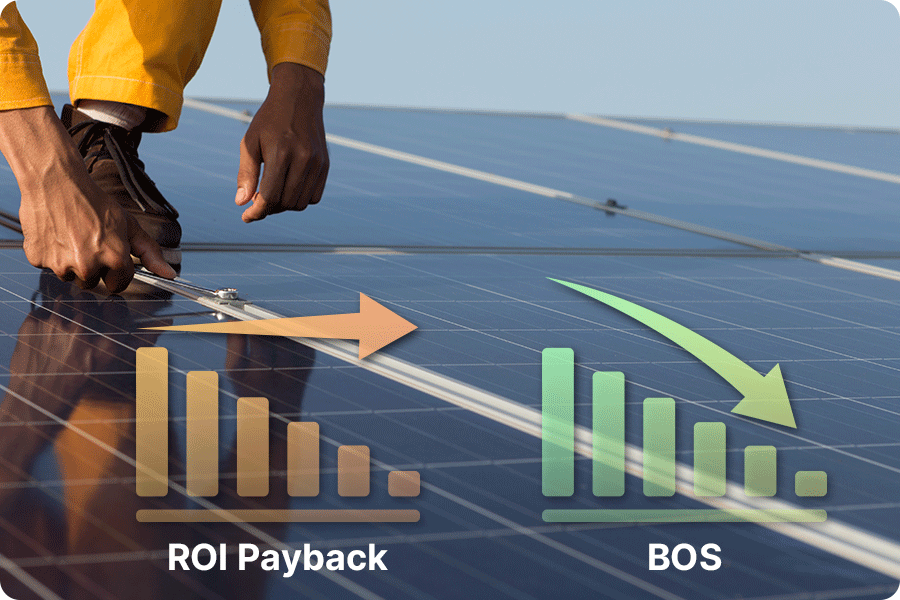
2.2 Allocation of BOS costs
A reduced number of modules helps spread system-level costs more efficiently on a per-watt basis, including:
installation labour;
mounting structures and clamps;
cabling and electrical connections.
In European markets, where labour costs are relatively high, this effect tends to deliver the most direct improvement in ROI.
2.3 More efficient inverter matching
700W modules are typically associated with higher operating currents, allowing a given inverter capacity to accommodate a larger DC-side installed capacity. In some projects, this results in slightly reduced cable losses and a more balanced DC/AC ratio, bringing actual energy output closer to modelled expectations.
2.4 Improved long-term ROI predictability
The degradation profile and low temperature coefficient of TOPCon technology enable high-power modules to maintain relatively stable output over many years of operation. For commercial and industrial projects with ROI horizons of 8–12 years, this long-term stability is more critical than first-year power ratings.
Will high-power TOPCon modules become a trend?
The emergence of 700W modules is a phase-specific outcome of simultaneous progress in efficiency, module size and manufacturing capacity. As TOPCon mass-production efficiency stabilises and 210 mm formats continue to mature, high-power modules increasingly meet the basic requirements to be considered a standard option.
3.1 Technical foundations for 700W mass production
TOPCon performs consistently within an efficiency range of around 22.5–23.3%. Improvements in cell-side yields and interconnection processes enable larger formats to meet mass-production requirements.
At the same time, upstream supply-chain elements—including glass, frames and ribbons—are gradually adapting to larger module sizes, making 700W a power class that can be manufactured within existing process frameworks.
3.2 How the 210 mm cell format expands power classes
The transition from 182 mm to 210 mm wafers has naturally shifted the power range of mainstream modules into the 650–725W band.
Equipment, production lines and materials increasingly configured around the 210 mm format have made 700W one of the more typical power classes under current industry conditions.
3.3 Real-world deployment of high-power modules
On the system side, high-power modules are still predominantly deployed in utility-scale projects, where design and engineering experience is relatively mature.
At the same time, some commercial and industrial rooftops with favourable structural conditions are beginning to adopt 700W TOPCon modules to increase installed capacity per unit area and further spread BOS costs. As mounting systems, installation methods and wind-load assessments increasingly incorporate large-format parameters, the range of applicable project scenarios continues to expand.
Overall, the use of TOPCon modules in the 700W power segment is increasing. However, their future share will depend on whether they can deliver verifiable improvements in LCOE across a broader set of applications. Under current technological and capacity conditions, high-power modules offer room for expansion, but actual adoption remains dependent on project structure and site-specific constraints.
As a module supplier with a long-standing presence in the European market, Maysun Solar has accumulated practical experience in the delivery of large-format modules, particularly with regard to format stability and electrical consistency. For TOPCon modules in the 700–725W power range, dedicated production and testing processes have been established to verify long-term performance and batch consistency, providing a reliable engineering reference for projects assessing the suitability of high-power modules.
Recommend reading

When does HJT bifacial gain pay off on European rooftops, and when is IBC the better option?
When do HJT bifacial solar panels generate stronger returns on European rooftop projects, and when should IBC solar panels take priority?

Which homes are suitable for garden solar?
Which homes are suitable for garden solar? Assess space, shading, orientation and electricity-use goals to quickly judge whether garden solar is a suitable option.

Are Differences Between Solar Panels More Noticeable in High-Temperature Conditions?
High temperatures reduce solar panel efficiency, but the gap in summer power generation is not determined by temperature alone. This article compares the high-temperature performance of HJT, TOPCon and IBC, and explains how businesses should choose.

Why Have N-Type TOPCon Solar Panels Become the Market Mainstream?
N-type TOPCon solar panels have become one of the mainstream photovoltaic technologies thanks to their strong balance of efficiency, cost and mass-production maturity. This article briefly explains their structural features, practical advantages and typical application scenarios.

April News from the European Solar Industry
The European solar market is showing clear signs of recovery: system value is being reaffirmed, German auction prices are stabilising, Italy’s rules are becoming clearer, and revenue certainty in France is improving.

When Are More Expensive N-Type Solar Panels Worth Choosing?
Whether N-type solar panels are worth the extra cost depends on whether project duration, temperature load and roof conditions can turn that added cost into real returns.