Europe’s Grid Cap Era: Why High-Efficiency Solar Panels Matter More in 2026

9.84KW High-efficiency solar panels on a European rooftop for self-consumption under grid constraints

Introduction

In 2026, the economics of distributed solar in Europe are changing. Grid congestion, export limits, negative electricity prices and zero-export requirements mean that a solar project can no longer be judged only by how much electricity it generates.

The more important question is: how much of that electricity can actually be used on site?

This is why grid caps do not make high-efficiency solar panels less relevant. In many cases, they make them more important. During early mornings, late afternoons, cloudy days and winter conditions — the so-called shoulder hours — N-type solar panels can help produce more usable electricity that stays behind the meter.

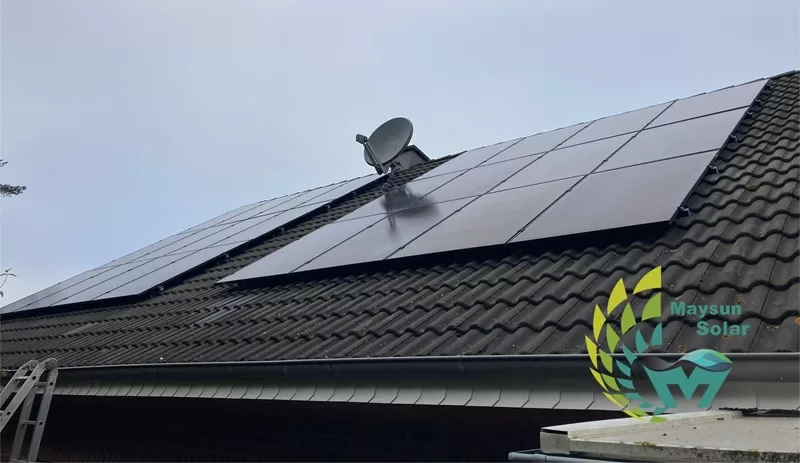
9.84KW High-efficiency solar panels on a European rooftop for self-consumption under grid constraints

Table of Contents

1. Europe’s Distributed Solar Market Is Entering a Grid-Constrained Phase

For many years, the logic of rooftop solar was relatively simple: use more roof space, install more capacity, generate more electricity and improve project returns. That logic is now becoming less reliable.

Across Europe, distributed solar is still growing, but grid access, export rules, feed-in value and local consumption are becoming more important to project economics. The IEA has warned that grid congestion can delay grid connections and undermine energy security, economic development and clean energy transitions. (IEA)

Germany shows the scale of this transition. According to Bundesnetzagentur, Germany added around 16.4 GW of solar capacity in 2025 and reached 117 GW of cumulative solar capacity by the end of 2025. (Bundesnetzagentur)

For installers, EPCs and B2B buyers, this changes the core question. It is no longer enough to ask whether the roof can fit more PV panels. The real question is whether the system can create more usable electricity under grid caps, export limits or low feed-in value.

2. What Grid Caps, Zero-Export and Clipping Actually Change

Grid constraints do not appear in the same way across all European markets. Depending on the country, region and grid operator, they may appear as export limits, reduced feed-in value, smart curtailment, inverter output limits or zero-export requirements.

Grid Caps: The grid operator limits the maximum AC output that a system can export. For example, a roof may technically support 15 kWp of solar panels, but the grid connection may only allow 10 kW of export capacity.

Zero-Export: The system is not allowed to send electricity back to the grid. All solar power must be consumed locally or stored.

Inverter Clipping: When solar output exceeds the inverter, grid connection or local load capacity, part of the potential generation is curtailed.

Negative Prices: During periods of high renewable output and low demand, wholesale electricity prices can turn negative, weakening the old “generate more, sell more” logic.

The Netherlands is a clear example. Electricity Maps reports that the Dutch electricity market saw 584 hours of negative prices in 2025, across 116 days, up from 458 hours in 2024. (Electricity Maps)

As a result, solar economics are shifting from total annual yield to load matching. In practical terms, midday peak generation is not always the most valuable part of the curve. Electricity produced during shoulder hours, cloudy periods and winter days may become more valuable if it can be consumed directly by heat pumps, batteries, EV chargers or business loads.

3. Why High-Efficiency Panels Win Under Grid Caps

3.1 Shoulder-Hour Yield Becomes More Important Than Midday Peak Output

In traditional solar sales, peak power was often treated as the main measure of value. But under grid caps or zero-export rules, midday output may hit a hard limit and create midday clipping losses.

In this situation, peak output under standard test conditions becomes less decisive. The real ROI often depends on the electricity generated outside the clipped midday window: early mornings, late afternoons, overcast days and winter months.

This is where high-efficiency N-type solar panels become more valuable. TOPCon panels, HJT panels and IBC panels usually offer stronger low-irradiance behaviour, lower temperature coefficients or higher power density. During shoulder hours, they can produce more electricity that is easier to absorb through local loads, battery storage, heat pumps or EV charging.

The key point is simple: under grid limits, the value of premium solar panels is not only about generating more power at noon. It is about creating more usable power when the grid is not the bottleneck.
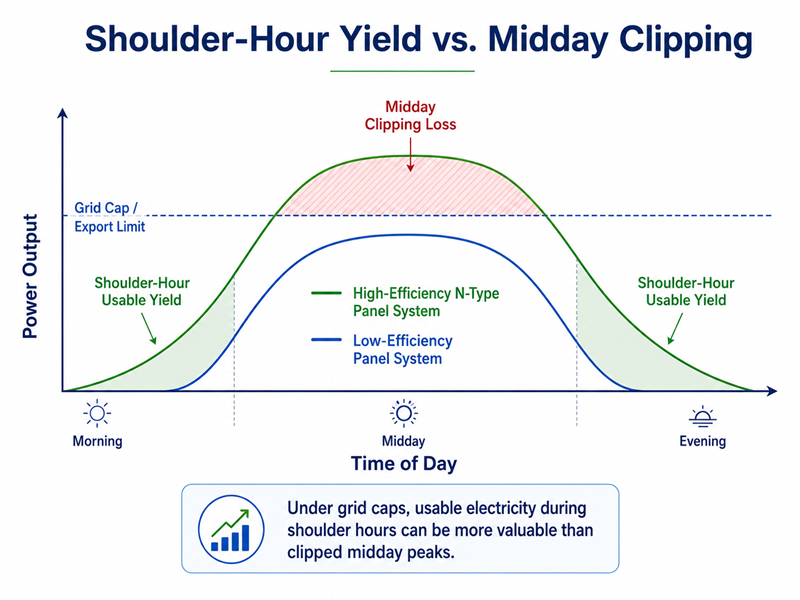
Solar generation curve showing shoulder-hour yield and midday clipping under grid caps

3.2 Higher DC/AC Ratios Require Better Roof-Space Efficiency

When AC export capacity is limited, system designers often use DC oversizing. This means installing more DC-side panel capacity than the inverter’s AC output rating. The goal is not to create a higher midday peak, but to keep the system closer to its output limit during weaker sunlight conditions.

For example, a system capped at 10 kW AC may be designed with 12 kWp, 13 kWp or more DC capacity to improve generation across the day and year.

But European roofs are rarely perfect rectangles. Residential roofs, carports, garden structures and light commercial roofs often include skylights, chimneys, parapets, ridge shadows, maintenance paths, fire-safety distances and local shading. These details reduce the usable installation area.

If low-efficiency PV panels are used, reaching the target DC capacity may require more panel area, more mounting hardware, more cabling and longer installation time. High-efficiency solar panels help installers reach a better DC/AC ratio within limited roof space, while keeping BOS complexity under control.

3.3 Self-Consumption, Batteries and Heat Pumps Need a More Useful Generation Curve

In a zero-export or low-feed-in environment, the value of solar depends increasingly on self-consumption. A system is no longer just “panels plus inverter.” It must work with battery storage, heat pumps, EV charging, smart appliances and home energy management systems.

This makes the daily generation curve more important. A short, sharp midday peak may look good on a datasheet, but it is not always useful if the system is clipped or if local demand cannot absorb the output.

By contrast, high-performance solar panels with stronger low-light behaviour and better temperature performance can improve useful output in mornings, evenings, winter and cloudy conditions. For self-consumption-focused systems, that electricity may be more valuable than additional clipped midday generation.

Italy’s grid planning also reflects the importance of better renewable integration. Terna’s 2025–2034 Development Plan includes more than €23 billion of grid investment and aims to support at least +65 GW of additional renewable capacity by 2030. (Terna)

Grid upgrades are moving forward, but for distributed solar projects, local consumption, storage integration and load matching will remain central to project value.
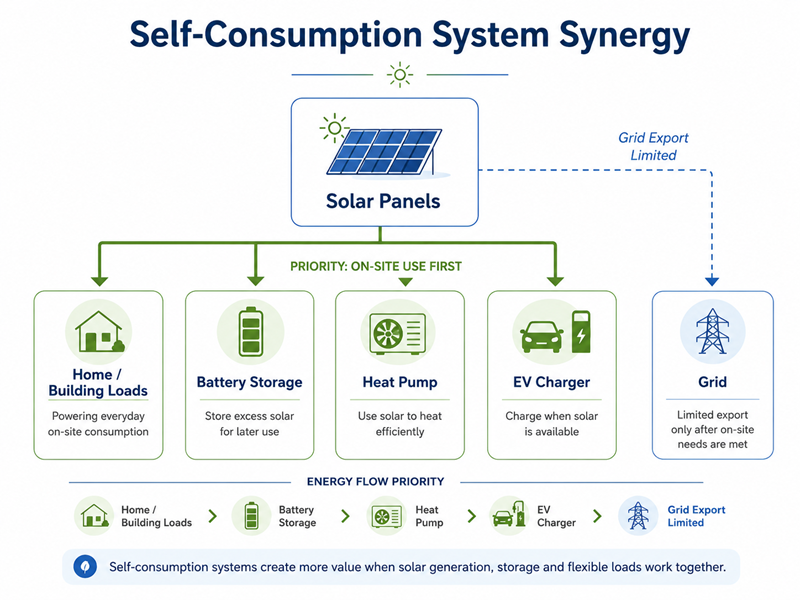

Solar panels integrated with battery storage heat pump and EV charger for self-consumption

4. Cheap Panels vs High-Efficiency Panels Under Grid Caps

In a grid-constrained market, cheap solar panels may reduce upfront procurement cost, but they do not always reduce total project cost. Installers and B2B buyers need to evaluate ROI at system level.

Evaluation Factor

Low-Cost / Low-Efficiency Panel System

High-Efficiency N-Type Panel System

Midday Generation

May reach the export limit, with excess output clipped

May also reach the export limit; value depends on system design

Clipping Risk

More peak energy may become unusable

Better design can reduce dependence on unusable midday peaks

Shoulder-Hour Yield

Weaker output in mornings, evenings, winter and cloudy periods

More usable electricity during non-peak windows

Footprint & Roof-Space Efficiency

More roof area needed to reach target capacity

Higher Wp/m², better for limited roof space

DC Oversizing

Higher DC/AC ratios may be harder to achieve on constrained roofs

More suitable for compact high DC/AC ratio design

BOS Cost

More mounting, cabling and installation time may be required

Fewer units can reduce installation complexity

HEMS & BESS Synergy

Weaker match with storage, heat pumps and EV charging

Better fit for self-consumption and load management

Long-Term Yield Stability

Degradation and low-light limits may extend payback time

Better support for long-term usable electricity generation

This is why low price per watt should not be treated as the same thing as low project cost. Under export limits, the real comparison is not only how cheap each panel is. It is whether the system can produce more electricity that can actually be used over 20 to 25 years.

For zero-export solar system ROI, the key metric is not theoretical annual output. It is how much electricity can avoid clipping, enter storage, match local demand and reduce electricity bills.

5. How Installers Can Explain This to Customers

For European installers, the sales conversation needs to change. In the past, it was often enough to tell a customer how much electricity a system could generate in a year.

In 2026, the better question is:

How much of that electricity can you actually use?

When customers worry about grid caps, zero-export rules, negative prices or lower feed-in value, installers can explain the value of high-efficiency panels in a more practical way:

In a grid-constrained project, the goal is not simply to push the highest possible midday peak. The real value is producing more electricity during mornings, evenings, cloudy periods and winter conditions — when that power can be used on site. The value of high-efficiency solar panels is shifting from generating more power to securing more usable power.

For commercial messaging, this idea can be condensed into one sentence:

It’s no longer about generating bulk power; it’s about securing usable power.

This is not just a slogan. It reflects the new economics of distributed solar. Customers care about whether their bills go down, whether their battery charges at the right time, whether their heat pump can run on solar power and whether the system payback remains stable.

For installers, this also helps move the conversation away from pure price competition. The strongest argument is no longer “this panel is cheaper.” It is: this panel helps the system leave more usable electricity behind the meter.

6. Common Questions About Grid Caps, High-Efficiency Panels and Self-Consumption

1. Do high-efficiency solar panels still matter if the grid limits export?

Yes. Grid limits mainly affect peak output or excess export. High-efficiency panels are especially valuable during mornings, evenings, cloudy periods, winter days and self-consumption windows, when the electricity is more likely to be used locally.

2. Why does a zero-export system still need high-efficiency panels?

A zero-export system cannot send electricity back to the grid, so it depends heavily on local consumption. High-efficiency solar panels can generate more usable electricity within limited roof space and improve matching with batteries, heat pumps and EV chargers.

3. Why does the DC/AC ratio affect solar ROI?

A higher DC/AC ratio can improve output under weaker sunlight conditions. But if roof space is limited, low-efficiency PV panels may require more area and higher BOS cost. High-efficiency panels make compact DC oversizing easier.

4. How should installers explain panel quality under grid caps?

The focus should shift from peak generation to usable electricity. Under grid constraints, customers need to understand how much solar electricity can be consumed locally and converted into real bill savings.

Conclusion: Grid Limits Do Not Reduce Panel Quality Requirements — They Redefine Them

Europe’s distributed solar market is no longer only about installing as much capacity as possible. Under grid caps, zero-export rules, negative prices and lower feed-in value, project performance increasingly depends on three questions:

Can the system produce more usable electricity during shoulder hours?

Can it achieve a practical DC/AC ratio within limited roof space?

Can it work effectively with batteries, heat pumps, EV chargers and local loads?

Grid limits do not make high-efficiency solar panels less important. They redefine their value.

In 2026, the strongest solar projects will not simply be those that generate the most electricity on paper. They will be the systems that keep more valuable electricity behind the meter.