Table of Contents
Many PV users notice an unusual phenomenon in summer: although sunlight is strongest at noon, the power curve shown in the monitoring app does not reach the expected peak. In contrast, on a sunny spring day, or just after a summer storm when the air temperature is still low, the system is more likely to reach a higher output.
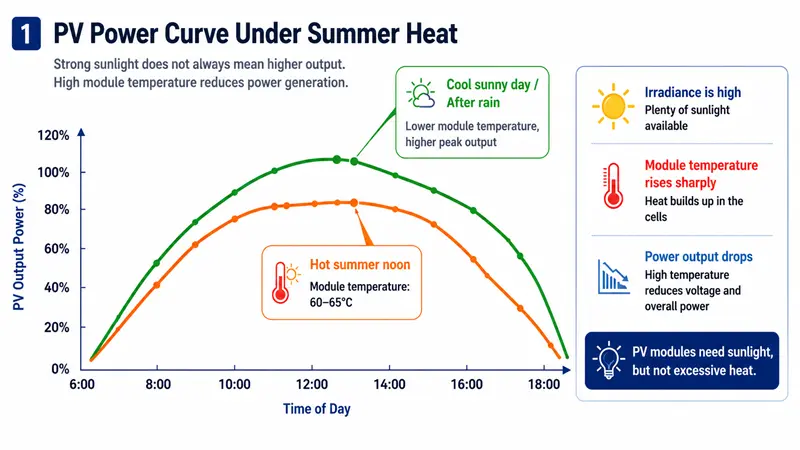
This does not necessarily mean that the modules or the inverter are faulty. PV power generation depends on solar irradiance, not on temperature. For PV modules, sunlight is the energy source, but high temperature reduces their actual output capability. In other words, strong summer sunlight helps power generation, while high temperature creates losses at the same time.
1. Why is PV output not always highest at noon in summer?
The rated power of a PV module is usually measured under Standard Test Conditions: irradiance of 1000 W/m², cell temperature of 25°C and AM1.5 spectrum. The problem is that modules installed on real rooftops rarely operate at 25°C for long periods.
In summer, the roof surface continuously absorbs heat, while heat dissipation on the rear side of the module may be limited. If the ambient temperature reaches 35°C, the actual operating temperature of the cells may rise to 60°C or even 65°C. At this point, even if the sunlight is strong, the higher internal temperature of the module still reduces its output power.
The core of this phenomenon is not that “the sun is not strong enough”, but that “the module is too hot”. Under high-temperature conditions, the open-circuit voltage of the cells drops significantly, and the voltage drop directly affects the maximum output power of the module. Therefore, many users will see that although irradiance is high at noon in summer, the power curve does not reach the rated module power. On sunny spring days or just after rain, when module temperature is lower, the system is more likely to produce an instantaneous output close to its peak.
2. Under high temperature, is it a module issue or an inverter issue?
When summer PV output drops, many people first suspect inverter power limiting. In fact, in most systems with normal ventilation and proper installation, the main source of high-temperature loss is usually the PV module itself, not the inverter.
Inverters can also be affected by high temperature. Especially when an inverter is installed on a sun-exposed wall, in an enclosed space or in a poorly ventilated location, excessive ambient temperature may trigger derating protection and reduce output power. However, in typical rooftop or commercial and industrial projects, power loss caused by rising module temperature is more common and occurs earlier.
In simple terms:
| Source of impact | Can it cause summer power reduction? | Typical performance |
|---|---|---|
| PV module heating | Yes, it is the main factor | Cell temperature rises, voltage drops, Pmax decreases |
| Inverter overheating | Yes, but it depends on the installation environment | Derating may occur under high temperature or poor ventilation |
| Insufficient sunlight | Yes | Irradiance decreases during cloudy, overcast or shaded conditions |
| System fault | Possible | Abnormal curve, one string significantly lower, frequent error reports |
Therefore, when evaluating summer PV performance, it is not enough to look only at whether the sunlight is strong. Module temperature, installation ventilation, inverter location and system design should also be considered together.
3. How much power can high temperature “take away”?
The most important parameter for evaluating module heat resistance is the Pmax temperature coefficient, also known as the Temperature Coefficient of Pmax.
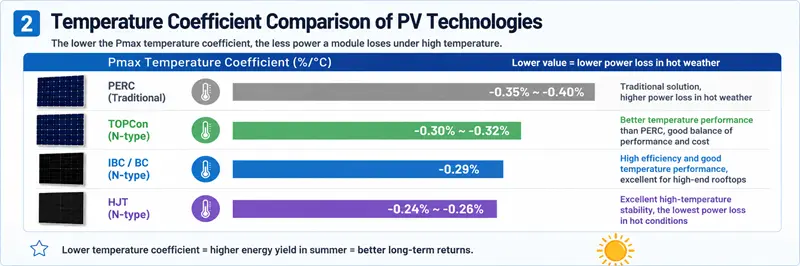
It indicates how much the maximum output power of a module decreases when the cell temperature rises by 1°C. The Pmax temperature coefficient of traditional crystalline silicon modules is usually around -0.35%/°C to -0.40%/°C. In other words, the higher the module temperature, the lower the actual output power.
Here is a simple example:
For a 430 W module with a Pmax temperature coefficient of -0.35%/°C, if the cell temperature reaches 65°C in summer, it is 40°C higher than the 25°C under Standard Test Conditions.
The power loss is approximately:
40 × 0.35% = 14%
This means that this 430 W module may lose about 60 W of instantaneous output power due to high temperature alone. In actual operation, dust, cable losses, inverter conversion efficiency, installation angle and other factors must also be considered. Therefore, it is normal for users to see AC-side output lower than the rated module power.
This also explains why some users find that when the sun comes out just after a summer storm, PV power can be relatively high. At that moment, irradiance recovers quickly, while the module temperature has not yet fully risen. For a short time, the system is in an ideal state of “strong sunlight + low temperature”.
4. TOPCon, HJT and IBC: how do different technologies perform under high temperature?
Under high-temperature conditions, the module technology route affects actual power generation stability. Different cell structures have different Pmax temperature coefficients, which also means different levels of long-term high-temperature loss.
| Technology type | Typical Pmax temperature coefficient | High-temperature performance | Suitable scenarios |
| Traditional PERC | Around -0.35%/°C to -0.40%/°C | High-temperature loss is relatively obvious | Cost-sensitive projects, general rooftops |
| N-type TOPCon | Around -0.30%/°C to -0.32%/°C | More stable than PERC | Commercial and industrial rooftops, carports, conventional distributed PV projects |
| HJT heterojunction | Around -0.24%/°C to -0.26%/°C | Outstanding high-temperature stability | Hot regions, projects with high self-consumption, long-term yield-focused projects |
| N-type IBC / BC | Around -0.29%/°C | Combines efficiency and aesthetics, with good high-temperature performance | High-end rooftops, projects with high aesthetic requirements |
From a selection perspective, the rated power of the module should not be the only factor. For example, two modules may both be 430 W under laboratory conditions, but if their temperature coefficients are different, their actual summer output on a rooftop may differ.
For Southern Europe, commercial and industrial rooftops, PV carports and rooftops with poor ventilation, the value of the temperature coefficient becomes more obvious. These projects often rely heavily on summer power generation for revenue, so high-temperature losses can directly affect annual yield and payback period.
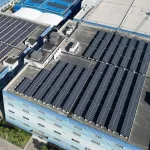
5. Why can DC/AC oversizing reduce summer power losses?
Many engineering projects use DC/AC oversizing, meaning that the DC capacity of the modules is higher than the AC capacity of the inverter. For example, a 100 kW AC inverter may be paired with 120 kWp to 130 kWp of module capacity.
This design does not mean “wasting modules”. Its purpose is to allow the inverter to operate close to full load during more time periods. In real environments, PV modules rarely operate at their rated power for long periods, especially under high temperature, low irradiance, and morning or evening conditions, when module output is lower than the rated value under STC.
Reasonable oversizing can:
- compensate for power reduction caused by high module temperature in summer;
- improve inverter utilisation during medium and low irradiance periods;
- improve the annual generation curve instead of only pursuing the instantaneous noon peak;
- create a more stable balance between cost and yield.
However, the oversizing ratio is not the higher the better. An excessively high DC/AC ratio may cause clipping losses, additional checks on the inverter input side and greater system design complexity. Therefore, for commercial and industrial projects, calculations should be made based on local irradiance conditions, module technology, installation angle, inverter specifications and the building’s self-consumption load curve.
6. Besides module selection, installation method also affects summer generation
High-temperature loss depends not only on module technology, but also on the installation environment.
If the module is installed close to the roof surface and airflow behind the module is insufficient, heat can accumulate more easily and the cell temperature will continue to rise. In contrast, if there is enough ventilation space behind the module, natural convection can help dissipate heat and reduce operating temperature.
In actual projects, the following details should be noted:
- rooftop installation should keep as much rear-side ventilation space as possible;
- BIPV or flush-mounted installations should pay special attention to thermal design;
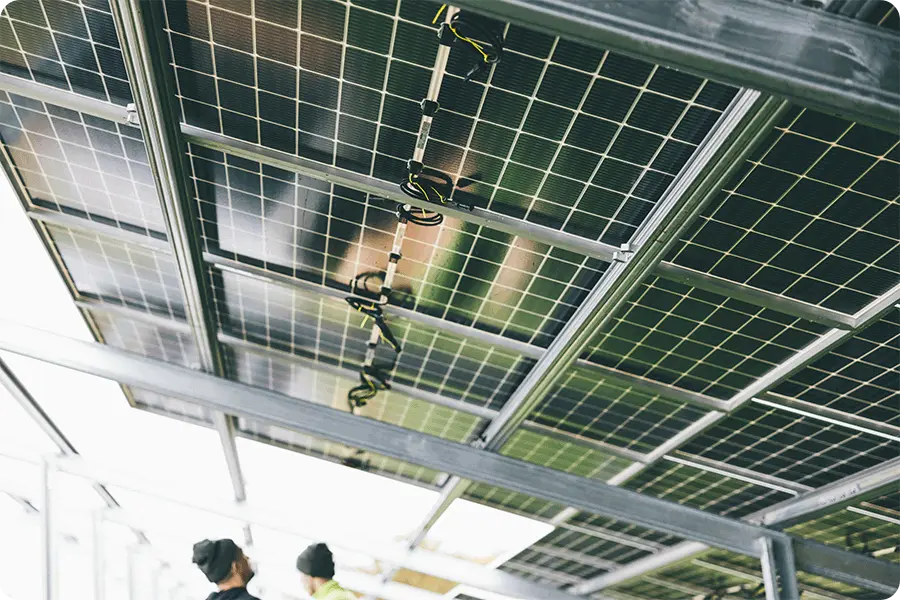
- carports, pergolas and open mounting structures usually have better ventilation conditions;
- dark roofs and metal roofs may further increase the module operating temperature in summer;
- dust, bird droppings, leaves and other local shading can increase the risk of hot spots and amplify operating pressure during high-temperature seasons.
For regions with high summer temperatures, module selection, mounting height, ventilation path and inverter installation location should be evaluated as a whole system, rather than only comparing module price per watt.
7. How can users judge whether their system is operating normally?
If the power generation at noon in summer is lower than the rated power, users can first check the following aspects:
| Check item | Normal situation | Situation requiring attention |
| Noon power lower than rated power | Normal, high temperature reduces output | Suddenly much lower than similar sunny days |
| Spring output higher than summer noon output | Normal, low temperature helps output | Abnormal curve fluctuation or frequent disconnection |
| Short-term power increase after a storm | Normal, strong sunlight and low temperature overlap | One string output is clearly inconsistent |
| Inverter casing is hot | Normal | Alarm, derating or frequent shutdown |
| Local heating on one module | Abnormal | Check shading, hot spots or connection issues |
If the overall system curve is smooth, there are no error reports, and the output difference between strings is not significant, lower-than-expected noon output in summer is often a normal high-temperature derating phenomenon. If there is abnormal string output, frequent disconnection, inverter alarms or local module overheating, professional inspection should be arranged.
Conclusion: when selecting PV modules for summer conditions, rated power is not enough
A reduction in PV output during summer does not necessarily mean a system fault. It is often the result of the combined effect of module physical characteristics and high-temperature conditions. PV power generation requires sunlight, but modules do not like high temperature.
For future residential and commercial or industrial PV projects, especially in Southern Europe, high-temperature rooftops, carports and high self-consumption scenarios, module selection should not focus only on module power and price per watt. Attention should also be paid to:
- Pmax temperature coefficient;
- N-type technology route;
- actual output stability under high temperature;
- reasonable DC/AC oversizing design;
- roof ventilation and system heat dissipation conditions;
- long-term power generation yield and payback period.
The value of next-generation module technologies such as TOPCon, HJT and IBC is reflected precisely in these real operating scenarios. Rated power determines laboratory performance, while temperature coefficient and system design determine the real power generation capability on summer rooftops.
Reference:
IEC 61853 Final Report — Photovoltaic Module Performance Ratings under STC
URL: https://sustainabletechnologies.ca/app/uploads/2016/01/IEC61853_FinalReport_Dec2015.pdf
PV Education — Nominal Operating Cell Temperature
URL: https://www.pveducation.org/pvcdrom/modules-and-arrays/nominal-operating-cell-temperature
NREL — PVWatts Version 5 Manual
URL: https://docs.nrel.gov/docs/fy14osti/62641.pdf
SMA Solar Technology — Sunny Boy / Sunny Tripower Temperature Derating
URL: https://files.sma.de/downloads/Temp-Derating-TI-en-15.pdf
NREL — The Effect of Inverter Loading Ratio on Energy Estimate Bias
URL: https://www.nrel.gov/docs/fy22osti/82812.pdf
NREL ATB — PV AC-DC / Inverter Loading Ratio
URL: https://atb.nrel.gov/electricity/2022/pv-ac-dc
Maysun Solar — PV Module Selector
URL: https://www.maysunsolar.com/pv-module-selector/
Maysun Solar — N-TopCon Series Solar Module
URL: https://www.maysunsolar.com/n-topcon-solar-panel/
Maysun Solar — HJT Series Solar Module
URL: https://www.maysunsolar.com/product-hjt-solar-panel/
Maysun Solar — Why Is the Temperature Coefficient Becoming a Key Factor in PV Module Selection?
URL: https://www.maysunsolar.com/blog-temperature-coefficient-and-solar-panels-why-is-it-so-important-in-solar-energy/
Recent Posts
- From Half-Cell to Multi-Cut: Why PV Modules Are Paying More Attention to More Segmented Circuit Design?
- Does Summer Heat Reduce Solar Panel Efficiency? What Really Happens to PV Output
- Low-Carbon PV Procurement in France: Why ECS, PEP Ecopassport and Solar Carports Matter
- PV Module Installation Beyond Rooftops: Multi-Scenario Applications for Bifacial N-Type Modules in Europe
- Europe’s Grid Cap Era: Why High-Efficiency Solar Panels Matter More in 2026