Table of Contents
Introduction
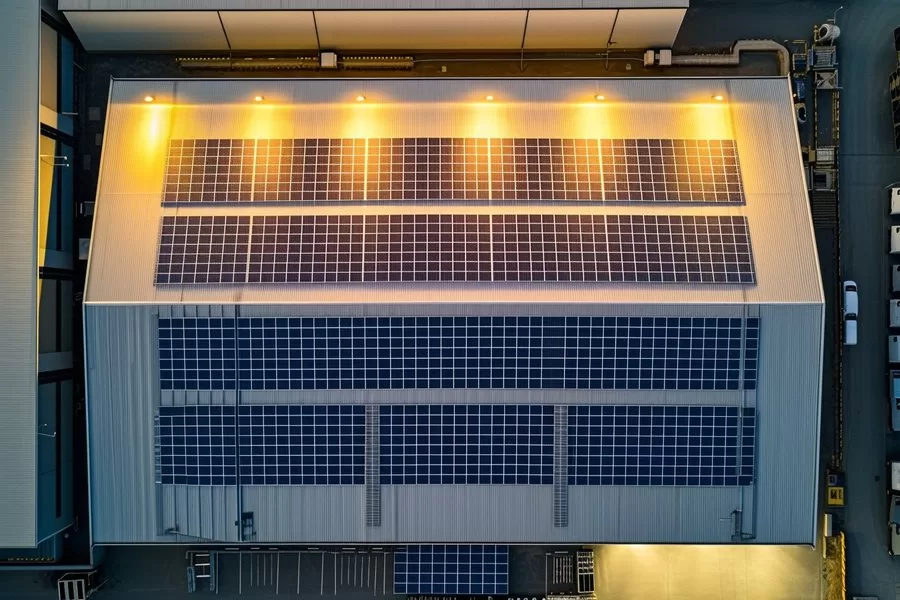
In the design and installation of photovoltaic systems, calculating rooftop solar panel dimensions is a critical factor that determines the success of a project. With limited roof space, inaccurate measurement and planning may result in insufficient installed capacity, wasted space, and an extended payback period.
During the installation process, mastering the methods of panel size calculation allows installers to provide more efficient and practical solutions for clients; for homeowners, understanding panel dimensions helps them clearly evaluate whether their rooftops can meet power generation needs.
Accurate calculations not only improve space utilization but also optimize energy output and shorten the return-on-investment cycle. Currently, most PV modules on the market range from 410W to 800W, enabling higher yields within limited roof areas and offering greater configuration possibilities for both residential and commercial rooftops.
Basic Specifications and Panel Types
The size of a solar panel is mainly determined by the number of cells, encapsulation method, and power rating. Currently, the most common monocrystalline modules on the market measure between 1.6–2.3 m in length, 1–1.3 m in width, and about 30–40 mm in thickness. The differences between models are primarily reflected in power and efficiency:
Standard modules: Typically range from 400–550W, with relatively compact dimensions. They are suitable for residential or small to medium rooftops, offering flexible installation and convenient transport.
Large-size modules: Often rated between 550–700W, with lengths exceeding 2.2 m and widths close to 1.3 m. These are ideal for commercial and industrial rooftops, enabling higher installed capacity with fewer panels.
High-power modules: Advanced cell technologies such as TOPCon, HJT, and IBC deliver higher output and lower degradation within similar dimensions, making them particularly suitable for projects with limited space and strict efficiency requirements.
For project developers and distribution partners, understanding these differences helps in selecting the most appropriate solution based on rooftop conditions. With today’s common power range of 410W–800W, PV modules can meet both the flexible needs of residential rooftops and the demands of commercial and industrial sites that require high power and cost control.
Rooftop Measurement and Usable Space Assessment
The first step in size calculation is to determine the effective roof area. While many rooftops may appear spacious, the portion that can actually be used for installation is often much smaller.
1.Determining effective area
Exclude unusable zones: such as ridges, gutters, skylights, chimneys, and ventilation openings.
Consider shading factors: trees or nearby buildings may cause shading at different times of the day, requiring safety margins in the design.
Leave maintenance pathways: walkways are usually reserved between panel rows or at roof edges to facilitate cleaning and future maintenance.
2.Roof type and structural conditions
Sloped roofs: Dimensions are influenced by tilt and orientation. South-facing slopes are typically optimal, generating higher annual yields.
Flat roofs: Require mounting structures to adjust the tilt angle. Greater spacing between panels is necessary to prevent shading.
Metal or concrete roofs: Load-bearing capacity must be verified to ensure they can support the weight of panels and racking. Structural reinforcement may be required.
3.Area-to-quantity conversion
Once the usable area is confirmed, the number of panels can be estimated based on user demand or target system capacity:
Required panel count = Required capacity (kWp) ÷ Rated power per panel (kW)
Example: 15 kW system (for residential or small commercial use)
Using 430W panels: 15,000 W ÷ 430 W ≈ 35 panels
Using 525W panels: 15,000 W ÷ 525 W ≈ 29 panels
Occupied area formula
Total area ≈ Panel length (m) × width (m) × number of panels
430W panel: size 1.762 × 1.134 m
1.762 × 1.134 × 35 ≈ 69.9 m²525W panel: size 1.944 × 1.134 m
1.944 × 1.134 × 29 ≈ 63.9 m²
Conclusion: For the same 15 kW capacity, 525W panels save about 6 m² of roof space compared to 430W panels, while also reducing the number of panels by 6—benefiting mounting, cabling, and labor costs.
In Southern Europe, where sunlight resources are abundant, a 15 kW system is usually sufficient to cover most household or small business energy needs. In Northern Europe, due to lower irradiation, larger roof areas or higher-efficiency panels may be required. Roof orientation, tilt angle, and local climate conditions must also be factored into size calculations.
Panel Spacing and Layout Constraints
In rooftop PV systems, why is the distance between solar panels so important? This is a step in dimension calculation that is often overlooked. Even if roof space seems sufficient, panels cannot be installed too close together. Proper spacing directly impacts system efficiency, safety, and lifespan.
1.Why spacing is necessary
If spacing is insufficient, panels may cast shadows on one another during winter or in the early morning and evening, reducing overall power generation. Small gaps also limit airflow, causing higher operating temperatures and lower efficiency. Adequate spacing ensures easier maintenance and keeps panels safely distanced from adjacent structures.
2.Boundary and safety distance
In addition to spacing between panels, the distance to rooftop edges must also be considered. In many countries and regions, building codes require PV modules to be set back from the roof edge. This reduces the risk of wind uplift, allows for proper drainage, and supports fire safety design.
3.Shading and minimum spacing calculation
Panel spacing is usually determined by local latitude and solar altitude angle. A common approach is to use the minimum solar altitude at winter solstice as the baseline, ensuring that shading is avoided for most of the year.
Height difference = sin(tilt angle) × panel width
Example: Panel width 1000 mm, tilt angle 15° → height difference ≈ 259 mm
Row spacing = height difference ÷ tan(solar altitude angle)
Example: Solar altitude angle at winter solstice 17° → row spacing ≈ 900 mm
In practical design, further factors are often considered:
Azimuth correction: When the roof is not perfectly south-facing, a cosine correction factor can be applied to optimize spacing and maximize space utilization.
Row width calculation: In CAD layouts, designers often use row width formulas to quickly determine the total occupied width of a row of panels, making array layouts more intuitive and efficient.
These advanced calculation methods are particularly valuable for narrow rooftops or large commercial facilities. Proper application can significantly increase system capacity and overall efficiency.
4. Layout Methods and Dimensional Impact
A common layout method is to align the long side of the modules parallel to the roof ridge, though they can also be arranged horizontally to adapt to different roof structures. Here, panel dimensions are a key parameter. Large-size modules require fewer units but demand greater spacing, while smaller modules require more units but offer greater flexibility on irregular rooftops. Accurate planning requires a clear understanding of panel dimensions to calculate the overall arrangement precisely and avoid wasted space.
Proper spacing and layout not only determine how many panels can fit on a roof but also directly influence power generation efficiency and system safety. Therefore, dimension calculation must balance panel size, layout method, and minimum spacing in order to achieve the most effective solar panel configuration and build an optimal PV system.
Conclusion
Rooftop solar panel dimension calculation is a critical step in the project design phase. Accurate planning ensures that limited roof space delivers maximum value, avoids wasted capacity, improves energy output, and secures long-term operational safety and stability.
Module selection should be guided by project requirements rather than simply opting for higher wattage. The 410–800W range covers most residential and commercial applications, but decisions must account for roof conditions, spacing and boundary constraints, structural and regulatory requirements, as well as levelized cost of electricity (LCOE) and payback period. By standardizing and parameterizing dimension calculations into reusable formulas and checklists, it becomes possible to consistently deliver PV systems that are technically reliable, economically viable, and easy to install and maintain.
Only through scientific planning at the design stage can a system provide stable and efficient green energy returns for the next twenty years.
Maysun Solar focuses on the European market, providing reliable supply and a broad range of modules from residential to commercial rooftops, including IBC technology, TOPCon technology, and HJT technology. We deliver standardized data and practical design guidance on roof area, spacing, and boundaries, helping EPCs and installers optimize systems and secure predictable returns.
Recommend Reading

Europe’s Grid Cap Era: Why High-Efficiency Solar Panels Matter More in 2026
Introduction In 2026, the economics of distributed solar in Europe are changing. Grid congestion, export limits, negative electricity prices and zero-export requirements mean that a solar project can no longer be judged only by how much electricity it generates. The more important question

How Do Solar Panel Delivery Delays Affect Installer Costs?
Solar panel delivery delays can affect installation schedules, project acceptance and payment collection.

The Forgotten “Invisible Assets”: Why Repowering Is the Strategic Key for European Solar in 2026
As grid congestion delays new solar projects across Europe, existing PV assets are becoming a strategic source of growth. This article explains why PV repowering can help EPCs and C&I asset owners unlock hidden value from already-connected solar plants, improve LCOE, and extend long-term asset performance with high-efficiency TOPCon, IBC and HJT modules.

Solar Panel Procurement in Europe: Why Stable Supply Matters More Than a One-Off Low Price
When European installers, distributors and corporate buyers choose solar panels, a one-off low price should not be the only factor. Stable supply, model continuity, technical documents and replenishment capacity often matter more for long-term cooperation and project delivery.

How Important Is the Temperature Coefficient When Choosing a Solar Panel?
How important is temperature coefficient when choosing a solar panel? This article answers that question directly and explains which projects should include it in early screening and which do not need to treat it as a top priority.

When does HJT bifacial gain pay off on European rooftops, and when is IBC the better option?
When do HJT bifacial solar panels generate stronger returns on European rooftop projects, and when should IBC solar panels take priority?