Table of Contents
Since the rapid development of distributed photovoltaic systems, solar power generation has gradually entered the public’s awareness. Whether in large cities, rural areas, or desert regions, its presence is becoming increasingly common. With this rise in popularity, many users have raised questions regarding the potential radiation from photovoltaic systems and their safety. Since launching our photovoltaic blog section, we have received such inquiries every day.
We fully understand the public’s concern about health, but we also want to assure everyone that there is no need to worry excessively. In this article, we will provide a comprehensive analysis of photovoltaic radiation to help ease any doubts. We encourage readers to share their thoughts and opinions in the comments section, so we can learn and grow together! This article is focused on the photovoltaic industry, aiming to provide clear and reliable information.
What is Electromagnetic Radiation?
Electromagnetic radiation refers to the process by which electromagnetic waves spread outward in the form of waves. These waves include radio waves, microwaves, infrared, visible light, ultraviolet rays, X-rays, gamma rays, and more, spanning a wide range of frequencies from low to high. In our daily lives, various devices such as power facilities, mobile phones, computers, microwaves, and Wi-Fi equipment emit electromagnetic radiation at different frequencies.
Electromagnetic radiation can be categorized into two types based on frequency:
a)Non-ionizing Radiation: This has lower frequencies and insufficient energy to ionize atoms or molecules. Common examples include radio waves, microwaves, and infrared radiation.
b) Ionizing Radiation: This has higher frequencies and enough energy to ionize atoms or molecules. Examples include ultraviolet rays, X-rays, and gamma rays.
Photovoltaic (PV) systems primarily involve non-ionizing radiation. The electromagnetic waves they produce have low frequencies and do not possess the energy required to disrupt molecular structures.
Standards for the Impact of Electromagnetic Radiation on the Human Body
The World Health Organization (WHO) and other relevant national organizations have established safety standards regarding the impact of electromagnetic radiation on human health.
International Commission on Non-Ionizing Radiation Protection (ICNIRP) Standards:
- For a 50 Hz frequency (power frequency electric fields), the recommended exposure limit is 5kV/m (electric field strength).
- For power frequency magnetic fields, the recommended exposure limit is 100 µT (magnetic flux density)
Electromagnetic Radiation Levels in Photovoltaic Systems
The working principle of a photovoltaic (PV) system involves converting solar energy into electrical energy. Through devices like inverters, direct current (DC) electricity is converted into alternating current (AC) and delivered to the grid. During this process, although there is power transmission and conversion, the level of electromagnetic radiation is extremely low. Research shows that the electromagnetic radiation in PV systems primarily originates from the electromagnetic fields around the inverter and cables. However, even near the inverter, the electromagnetic radiation levels are typically between 0.01 and 0.02 microteslas, which is far below the safety limit of 100 microteslas.
Furthermore, the radiation intensity of PV systems decreases rapidly with distance. Even near inverters or PV cables, the radiation levels are no higher than those emitted by common household electrical devices.
Comparison of Radiation from Household Appliances and Photovoltaic Systems
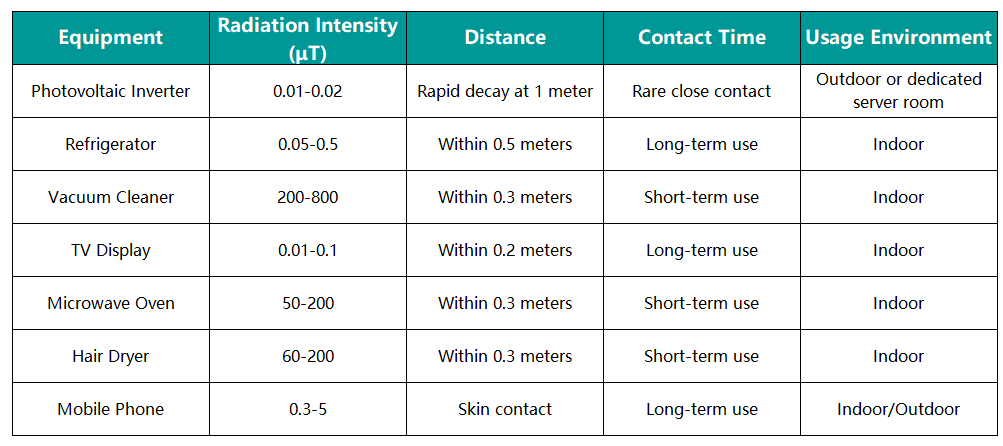
Many customers may wonder whether photovoltaic systems still emit radiation. This question has indeed been raised by some readers. To address this, MAYSUN has specifically referred to comparison data from household appliances. We believe that the following comparison will help you feel more at ease. We have conducted a comprehensive comparison based on three key dimensions: time, space, and radiation intensity, to help everyone better understand the differences.
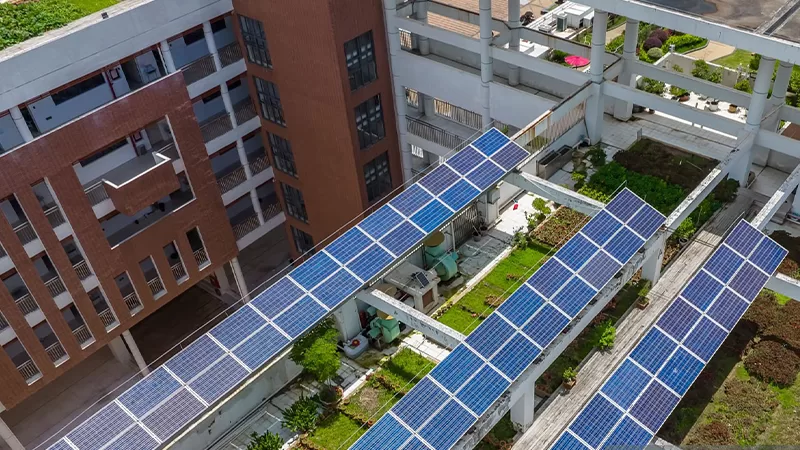
As shown in the table, the electromagnetic radiation levels of common household appliances are generally higher than those of photovoltaic (PV) systems. Additionally, household appliances are typically used indoors, leading to longer exposure times, while PV systems are primarily installed outdoors or on rooftops, limiting human contact and exposure. This significantly reduces the potential impact of electromagnetic radiation on the human body. Therefore, there is no need for concern. It’s worth noting that many schools, hospitals, and government buildings already have PV systems installed on their roofs. The only key point to emphasize is that when selecting an inverter, it is essential to choose certified products from reputable brands.
How to Reduce Electromagnetic Radiation from Photovoltaic Systems?
Although the electromagnetic radiation from PV systems is very low, there are still some measures that can be taken to further reduce the potential impact:
Optimize Equipment Placement: Install devices like inverters in areas away from living spaces, such as on rooftops or in garages, to reduce human exposure.
Regular Maintenance: Conduct regular inspections and maintenance of the PV system to ensure it operates properly and to avoid potential equipment malfunctions that could lead to increased electromagnetic radiation.
Use Shielding Materials: In certain cases, shielding materials can be used to reduce the electromagnetic fields around cables and equipment.
Through this detailed analysis, you should now understand that the electromagnetic radiation from PV systems has a negligible impact on human health, and there is no need to worry about any harmful effects. On the contrary, as a clean and environmentally friendly energy source, solar power not only helps reduce carbon emissions but also represents a safe and reliable option for electricity generation.
Since 2008, Maysun Solar has been dedicated to producing high-quality photovoltaic modules that contribute to combating climate change. Our advanced technology in IBC, HJT, TOPCon, and balcony solar panels ensures exceptional performance and reliability, capable of withstanding harsh weather conditions for long-term operation. We have established offices and warehouses in multiple countries and built lasting partnerships with top installers to provide comprehensive support. For the latest quotes or any inquiries related to photovoltaics, feel free to reach out to us—we’re here to help!

430–460W or 600W+? How Should You Choose Solar Panel Power for Rooftop Projects?
Compares 430–460W solar panels and 600W solar panels in C&I rooftop projects, showing that solar panel selection should prioritise roof compatibility and system stability.

Changes in the European Solar Policy and Market in 2026
Europe’s 2026 solar policy and grid changes are reshaping solar panel selection, shifting project returns towards market-driven mechanisms and highlighting the roles of TOPCon, HJT and IBC solar panels.

Why European EPCs Are Reassessing Large-Format Solar Panels
European EPCs are re-evaluating large-format solar panels. Panel size directly affects installation risk, system compatibility, and solar project ROI stability.

Do Vertical Bifacial Modules Really Deliver Additional Yield?
Vertical bifacial PV systems are gaining increasing attention across Europe. This article explores under what conditions a vertical layout can create additional value, how bifacial gain is influenced by site conditions, and which project types are best suited to this design.

Which rooftop scenarios make 700W+ solar panels a risk?
An analysis of the practical limits of 700W+ high-power solar panels on residential and commercial rooftops, and how space, load capacity, self-consumption and maintenance affect real returns.

February News in the Photovoltaic Industry
February overview of Europe’s photovoltaic market: module price trends, a rebound in the German PPA market, progress in Italian agrivoltaics and regulatory shifts in France, highlighting key industry signals.