France is becoming one of Europe’s most documentation-driven solar markets. For EPC companies, developers and commercial project owners, module selection is no longer based only on price-per-watt, efficiency or linear power warranties.
Carbon documentation, supply-chain traceability and project-specific compliance files are now part of the buying decision. Depending on the project type, buyers may need an ECS certificate for CRE tenders, PEP Ecopassport data for building-related projects, or additional mechanical documentation for solar carports and commercial parking-lot installations.
In this context, the most competitive module is not simply the cheapest or the most powerful. It is the one that can meet the technical, environmental and regulatory requirements of the project.
Quick Reference: Which Document Matters for Which Project?
| Project type | Main document or requirement | Why it matters |
|---|---|---|
| CRE tender projects | ECS certificate | Carbon eligibility and tender compliance |
| New buildings / RE2020-related projects | PEP Ecopassport / INIES data | Building-level Life Cycle Assessment |
| Commercial parking-lot solarization | ECS or PEP depending on project type, plus mechanical documents | Legal compliance, structural review and procurement approval |
| Solar carports | Datasheet, mechanical load data, certification package, installation guidance | Safety, durability and project feasibility |
This distinction is important. ECS and PEP Ecopassport do not serve the same purpose. ECS is mainly linked to carbon evaluation in solar tender contexts, while PEP Ecopassport is used in building environmental assessment. Solar carport projects may require both environmental documentation and stronger mechanical evidence.
1. ECS: The Carbon Gatekeeper for CRE Tender Projects
The ECS, or Évaluation Carbone Simplifiée, is France’s simplified carbon assessment methodology for photovoltaic modules. It expresses the carbon footprint of a PV module in kg CO₂/kWp and is used in public tender frameworks, especially those managed by the French Energy Regulatory Commission, CRE.
In CRE tender projects, ECS is not a marketing label. It can determine whether a project is admissible.
For example, recent specifications for PPE2 ground-mounted PV tenders refer to an ECS eligibility threshold below 550 kg CO₂/kWp. From the 10th period of the same call for tenders, the specifications introduce a revised calculation methodology and a threshold below 740 kg CO₂/kWp. This does not mean buyers can apply one number across all project types. The applicable threshold depends on the exact tender category, period and calculation method.
For EPCs and developers, the key lesson is simple: the carbon value must be checked against the tender version, not treated as a generic number.
Why ECS changes module procurement
ECS shifts procurement from product comparison to document verification. Buyers need to confirm:
- whether the exact module model is covered by the certificate;
- whether the manufacturing site and supply-chain assumptions match the declared data;
- whether the certificate is valid for the tender period and methodology;
- whether module changes, factory changes or material substitutions affect eligibility.
High-efficiency N-type technologies such as TOPCon and HJT can support a lower carbon-to-power ratio because more power is delivered per module. However, technology alone is not enough. The final ECS value also depends on manufacturing processes, energy mix, material sourcing and third-party verification.
2. PEP Ecopassport and INIES: Why Building Projects Need LCA Data
While ECS is central to many CRE tender projects, PEP Ecopassport plays a different role. It is used for environmental declarations of electrical, electronic and HVAC equipment and provides Life Cycle Assessment data for building-related evaluation.
In France, PEP Ecopassport data can be published in the INIES database, the national reference database for environmental and health data on construction products and equipment. For building professionals, INIES data supports the calculation of a building’s environmental performance.
This matters for photovoltaic projects when PV modules become part of a building-related scope, such as:
- new commercial buildings;
- rooftop PV on regulated building projects;
- building-integrated photovoltaic systems;
- projects where the PV system is included in the building environmental calculation.
PEP Ecopassport should not be presented as a substitute for ECS. It serves a different procurement context. ECS is used for carbon eligibility in tender frameworks, while PEP supports building-level Life Cycle Assessment and environmental documentation.
For manufacturers, this means that one document package is no longer enough for all projects. A module intended for the French market may need different compliance files depending on whether it is used in a CRE tender, a commercial rooftop project, a new building, or a solar carport.
3. Solar Parking Mandates: Why Carports Add Mechanical Requirements
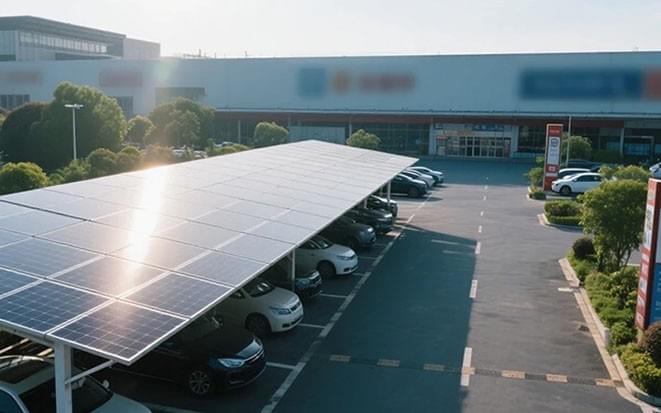
Commercial parking-lot solarization is becoming one of the most important drivers of PV demand in France.
Existing outdoor parking lots larger than 1,500 m² in mainland France are subject to a gradual obligation to install shading structures on at least half of their surface area. These shading structures should include renewable energy production, commonly photovoltaic panels. The compliance schedule runs progressively from July 1, 2026 to July 1, 2028, depending on parking-lot size and project conditions.
For module buyers, this is not only a regulatory topic. Solar carports create a very different technical environment from standard rooftop PV.
Modules used in carport applications must be evaluated against:
- open exposure to wind and weather;
- mechanical load and uplift forces;
- public access and overhead safety;
- possible bifacial gain from ground reflection;
- heat from asphalt or paved surfaces;
- long-term maintenance and replacement access;
- compatibility with the carport mounting structure.
This is why glass-glass TOPCon or HJT modules are often evaluated for such projects. Not because every solar carport requires the same module type, but because long-term mechanical stability, weather resistance, bifacial yield potential and complete documentation become part of the procurement decision.
For commercial parking lots, the module package must support more than power generation. It must support project approval, financing review, engineering validation and long-term operation.
4. From Price to Proof: How B2B Procurement Is Changing
In the French solar market, low upfront module cost is no longer enough to win serious B2B projects. EPCs and developers are increasingly evaluating the full risk profile of the module supply.
That includes technical performance, but also the quality and consistency of the supporting documents.
| Procurement question | Why it matters |
|---|---|
| Is the ECS certificate valid for the specific tender? | Determines project eligibility or scoring |
| Is PEP Ecopassport data available when the project falls under building LCA? | Supports RE2020-related building calculations |
| Is the module model clearly linked to the declared production site and material assumptions? | Reduces compliance and audit risk |
| Are mechanical load values and installation instructions available? | Supports engineering review for carports and exposed structures |
| Can the supplier provide consistent documentation over multiple batches? | Helps EPCs manage project continuity and procurement risk |
This shift is especially important for international manufacturers. The French market is not asking only for modules; it is asking for auditable modules.
A supplier that cannot connect product model, production site, certification data and technical documentation may face barriers even if the module is competitive on price or efficiency.
5. What EPCs and Developers Should Check Before Choosing Modules
For French B2B projects, procurement teams should review module documentation before finalizing the technical and commercial decision.
A practical checklist includes:
- Project category
Is the project a CRE tender, a building-related project, a parking-lot solarization project, or a private commercial installation? - Carbon documentation
Does the project require ECS, PEP Ecopassport, INIES data, or a combination of environmental documents? - Model consistency
Does the certificate refer to the exact module model, production site and technology used in the project? - Mechanical suitability
For carports, are glass structure, load values, mounting zones and installation conditions clearly documented? - Technology fit
Are TOPCon, HJT, glass-glass, bifacial or full-black modules being selected for a project-specific reason, rather than as a generic upgrade? - Batch and supply-chain continuity
Can the supplier maintain consistent documentation if the project is delivered in multiple phases or batches?
The goal is not to collect documents after the project is designed. The goal is to make documentation part of the design and procurement process from the beginning.
6. What This Means for International PV Manufacturers
For international PV manufacturers, France is no longer a market where price and power class alone can secure long-term growth.
To compete in France, manufacturers need to build a stronger compliance package around their modules. This may include:
- ECS certificates for tender-related projects;
- PEP Ecopassport data for building-related environmental assessment;
- INIES-compatible product data where applicable;
- mechanical load documentation for carports and exposed structures;
- warranty documents and installation instructions;
- clear links between certified models, production sites and material assumptions.
This is not only about meeting regulation. It is also about reducing friction for EPCs, developers, investors and engineering teams.
In a market where project approval, tender eligibility and environmental performance are increasingly document-based, the supplier with better documentation can become easier to work with.
France has moved beyond purely price-driven solar procurement.
ECS, PEP Ecopassport, INIES data and solar parking mandates are reshaping how PV modules are selected, specified and approved. For EPCs and developers, the module datasheet is no longer enough. Carbon documentation, Life Cycle Assessment data, mechanical proof and supply-chain consistency are becoming part of the core procurement process.
For manufacturers, this creates a clear message: low-carbon credentials and transparent documentation are no longer optional premium features. They are becoming baseline requirements for doing business in the French solar market.