Is Silver Still Essential in PV Module Technology?

Is Silver No Longer the Only Option? What Changes Are Taking Place in PV Module Technology?

In recent months, international silver prices have continued to climb, briefly exceeding USD 80 per ounce—more than a 150% increase from previous lows. As a critical material in solar cell metallisation, this surge is significantly raising manufacturing costs for cells and PV modules, while the pressure has not been fully passed through to end markets.

Against this backdrop, discussion around reducing reliance on silver has intensified. Several leading PV manufacturers have publicly highlighted efforts to lower silver consumption and to explore alternative metallisation routes, including silver-coated copper and copper-based solutions, in order to mitigate cost risks linked to raw material price volatility. Some have already announced clear mass-production timelines, and the topic is increasingly featured in European PV media and industry analysis as a key direction in current PV module technology development.

In response, the industry is undergoing a more pragmatic reassessment. The following sections outline the real progress of de-silvering, the cost implications of alternative approaches, and their impact on PV module performance.

Table of Contents

How Far Can De-silvering Progress?

De-silvering does not mean eliminating silver entirely in the short term. More accurately, it refers to a gradual reduction in silver consumption per unit of power output, rather than a full substitution with alternative materials.

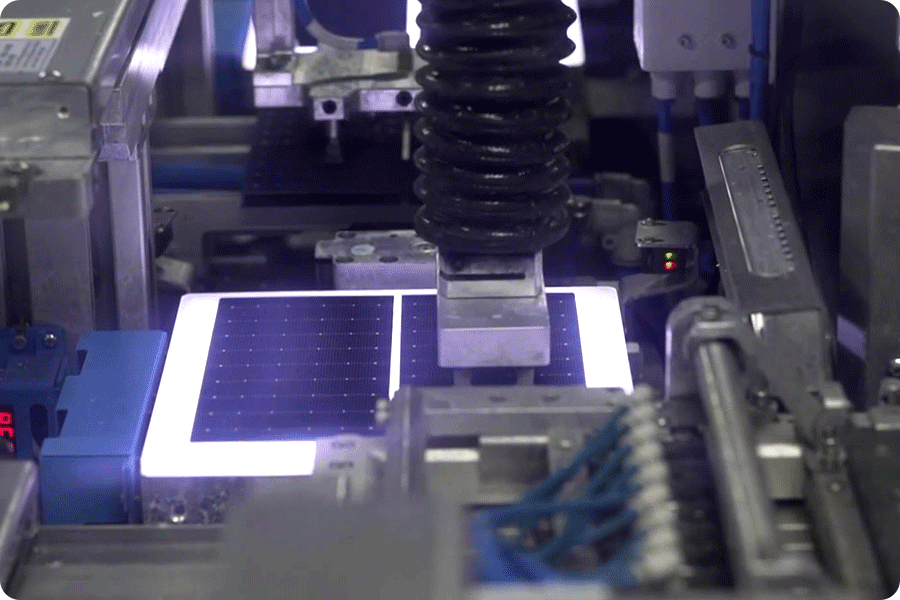
Taking n-type cell technologies as an example, continuous optimisation of grid design and printing processes has already reduced silver usage per cell by around 20–30% compared with earlier levels in some mass-production lines. This improvement results from a combination of process advances, including narrower finger widths of around 13–15 μm, the adoption of 0BB (busbar-free) designs, and the introduction of laser-based transfer processes (PTP).

Without major changes to existing production line architectures, such optimisations have been implemented at scale across multiple technology routes, including TOPCon, HJT and IBC. As a result, silver consumption per watt has been systematically and continuously compressed.

However, silver reduction is not infinitely scalable. As silver usage declines, requirements for process stability and manufacturing consistency increase significantly, making further reductions progressively more challenging. At this stage, de-silvering is therefore better understood as a gradual cost-optimisation pathway rather than a one-off structural material replacement.

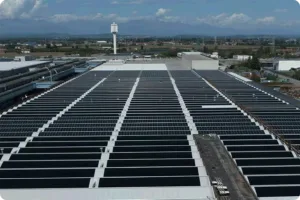
PV cell metallisation production line, showing fine-line printing and laser transfer processes used to reduce silver consumption per watt.

What Alternative Solutions Are Available, and How Much Cost Pressure Can They Relieve?

Beyond continued reductions in silver consumption per watt, the industry is also assessing the phased introduction of other metals into the metallisation process to reduce sensitivity to silver price volatility.

According to technical analysis by Germany’s Fraunhofer ISE, multiple mainstream cell technologies—including TOPCon, HJT and IBC—are exploring different pathways to lower silver usage. Research indicates that, under laboratory and pilot conditions, silver consumption can be further reduced through silver–copper combinations or more refined printing processes.

2.1 Silver-Coated Copper Paste: The Most Practical Transitional Solution

Silver-coated copper does not fully eliminate silver. Instead, copper serves as the primary conductive material, with a thin silver layer retained on the surface to balance performance and cost. Given the significantly lower price of copper compared with silver, this approach is widely regarded as the most feasible silver-reduction pathway in the near term.

Publicly available information suggests that in HJT and some TOPCon technology routes, silver-coated copper solutions have already entered mass production or near-mass-production stages. Silver usage per watt can be reduced from around 9 mg/W to below 6 mg/W, corresponding to a metallisation cost buffer of approximately CNY 0.02–0.03/W. Under conditions of sustained silver price volatility, this reduction is commercially meaningful.

At the same time, this approach places higher demands on printing precision, firing windows and yield control. As a result, it is more readily deployed on production lines with established process know-how and scale advantages, and cannot be easily replicated across all existing lines in the short term. Silver-coated copper is therefore best viewed as a proven but technically demanding transitional solution.

2.2 Pure Copper Paste: Greater Cost Potential, Limited by Stability

Compared with silver-coated copper, pure copper paste offers greater theoretical cost-reduction potential, as it contains no silver at all. Cost savings of around CNY 0.04–0.06/W per watt are possible in principle. However, the practical challenges are equally clear: copper is more prone to oxidation under high-temperature and high-humidity conditions, raising concerns around conductivity and long-term stability.

Despite these challenges, some paste suppliers have disclosed phased mass-production progress on TOPCon technology routes, alongside gigawatt-scale validation results. This indicates that pure copper paste has moved beyond the conceptual stage into controlled pilot deployment, though it is unlikely to become a mainstream industry choice in the near term.

2.3 Copper Plating: The Greatest Long-Term Potential, with the Highest Barriers

Copper plating is widely regarded as the most fundamental route to eliminating reliance on silver. By forming copper gridlines through electrochemical processes and incorporating anti-oxidation structures, it theoretically enables complete de-silvering.

  • At the material level, potential cost reductions of around CNY 0.05–0.08/W per watt

  • Structurally, better suited to technologies with no front-side shading and wider rear electrodes (such as BC architectures)

  • Some manufacturers have disclosed progress on 10 GW-scale pilot or mass-production lines

At the same time, copper plating requires substantial equipment investment, higher process complexity and greater capital intensity. Equipment investment per gigawatt is significantly higher than for conventional metallisation routes. As a result, this approach is more aligned with medium- to long-term strategies rather than near-term large-scale deployment.

Do Material Changes Affect PV Module Performance?

As metallisation routes evolve, the market has focused on a central question:
after reducing silver usage or introducing alternative metals, will power output and long-term reliability be materially affected?

Based on currently available mass-production data and test results, the impact is not a simple yes-or-no issue. Instead, it depends on the conditions under which effects occur, where they arise within the cell structure, and—crucially—whether they can be controlled through process design and manufacturing stability.

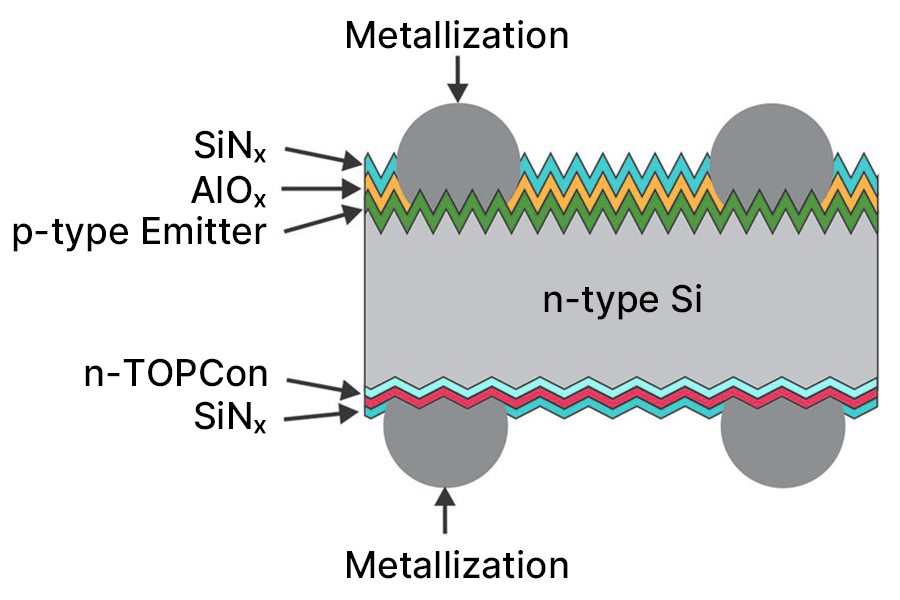
TOPCon solar cell metallisation schematic, illustrating the role of the emitter, passivation layers, and front and rear electrodes in current transport.

3.1 Power Output: An Effect Exists, but Not a Linear Decline

From a materials perspective, silver remains the most conductive option in PV metallisation systems. Reducing silver content alone does not inherently lead to higher efficiency.

In practice, however, module power output is not determined by metallisation materials in isolation. It is shaped by a combination of grid layout, current path design and printing precision. Current de-silvering approaches primarily rely on finer grid structures—such as multi-cut or 1/3-cut designs—and more uniform metallisation patterns to offset the effects of material changes.

As a result, under mainstream mass-production conditions, power differences introduced by these adjustments are typically kept within acceptable ranges and have not emerged as a primary determinant of module performance.

3.2 Electrical Conductivity and Thermal Behaviour: Driven by Process, Not Material Alone

Compared with silver, copper does exhibit differences in electrical and thermal behaviour, which represents one of the key challenges for alternative metallisation routes. At the module level, however, metallisation materials are not present as exposed conductors. Their performance is mediated through firing processes, interface contact design and protective structures.

Accordingly, changes in conductivity and heat dissipation are influenced more by the stability of process control than by the choice of metal itself. This also explains why identical silver-reduction solutions can deliver different outcomes across production lines or under different manufacturing conditions.

3.3 Long-Term Reliability: Effects Emerge Over Time

Compared with initial power output, weather resistance and long-term stability are more likely to differentiate de-silvering approaches over extended operation.

Under high-temperature, high-humidity or complex climate conditions, material chemistry, interface protection and process consistency are progressively amplified over time. The prevailing industry view is therefore not that lower silver usage inevitably compromises module reliability, but that continued silver reduction significantly raises the requirements for manufacturing control.

This also explains why some solutions have already entered mass production, while others remain at controlled validation or pilot stages.

Overall, reducing silver content does not automatically weaken PV module performance. Instead, it shifts performance differentiation toward process control, long-term stability and manufacturing consistency.

How Are Industry Trends Evolving?

Discussion around reducing silver usage is gradually moving beyond technical exploration toward broader assessments at the manufacturing and supply-chain levels. Coverage in European industry media indicates that the focus is shifting toward how exposure to silver price volatility can be reduced under controllable risk, rather than debating the merits of individual material substitution routes.

Recent reporting by pv magazine shows that an increasing number of manufacturers have included low-silver metallisation solutions, silver-coated copper approaches and copper-based metallisation in their medium-term evaluations. This trend does not suggest that any single route is about to become dominant. Instead, it reflects a growing emphasis on cost predictability as raw material price volatility intensifies.

At the same time, these changes are beginning to surface across the wider value chain. For potential alternative materials such as copper, some industry bodies have launched initiatives around supply transparency and responsible sourcing—for example, governance frameworks for copper supply promoted by the Solar Stewardship Initiative. Such developments are often seen as signals that material pathways are moving from technical discussion toward readiness for scaled deployment.

For investors and project developers, the implications lie more in decision-making frameworks than in material choice itself. More practical evaluation approaches include:

  • Including metallisation routes in supplier assessment
    Understanding whether module suppliers have reached stable mass production in silver reduction, or remain at validation or pilot stages.

  • Prioritising production consistency and long-term validation
    As materials and processes evolve, reliability testing, batch consistency and quality traceability often provide more insight than single-point efficiency metrics.

  • Building risk buffers into procurement and contract structures
    In periods of high raw material price volatility, measures such as phased procurement, technical optionality or delivery consistency clauses can help limit the impact of cost and delivery risks on overall project bankability.

  • Tracking supply-chain readiness signals rather than isolated breakthroughs
    When certification schemes, governance frameworks or scale-up preparations begin to appear around a given material pathway, it often indicates a transition from evaluation toward practical application.

Overall, reducing silver usage is not a one-off technical decision, but a continuously evolving process of cost and risk management. For decision-makers in the European market, a more robust strategy is to assess the maturity and risk boundaries of different approaches based on verifiable evidence, rather than committing prematurely to a single, insufficiently validated pathway.

Maysun Solar provides PV modules for the European market across mainstream technologies, including IBC technologyTOPCon technologyand HJT technology. In module selection and supply, the focus is on matching metallisation structures with project conditions, taking installation environments and long-term performance into account to balance power output, structural compatibility and system reliability.

Reference

Fraunhofer ISE. Development of heterojunction solar cells with ultra-low silver consumption. 2025.
https://publica-rest.fraunhofer.de/server/api/core/bitstreams/1689e201-a36c-4414-b99e-b25301a083b0/content

pv magazine. Silver prices surge, yet ‘thrifting’ poses little threat to solar cell, module quality. Oct 9, 2025.
https://www.pv-magazine.com/2025/10/09/silver-prices-surge-yet-thrifting-poses-little-threat-to-solar-cell-module-quality/

pv magazine. Silver price surge drives PV makers to cut silver usage further. Sep 26, 2025.
https://www.pv-magazine.com/2025/09/26/silver-price-surge-drives-pv-makers-to-cut-silver-usage-further/

Recommend reading

February News in the Photovoltaic Industry

February News in the Photovoltaic Industry

February overview of Europe’s photovoltaic market: module price trends, a rebound in the German PPA market, progress in Italian agrivoltaics and regulatory shifts in France, highlighting key industry signals.

Read More »