
How to Detect Hotspots and PID Effects in PV Modules to Prevent Long-Term Losses?

How to Detect Hotspots and PID Effects in PV Modules to Prevent Long-Term Losses?

Introduction

Photovoltaic power generation is sweeping across Europe, yet hidden risks in long-running modules are gradually emerging. The hotspot effect, though seemingly minor, can cause overheating or even burning of modules due to partial shading or slight damage. The PID effect is more severe in hot and humid regions, potentially causing a rapid performance drop of over 30%, directly impacting investment returns.

How can these issues be detected early? How can they be scientifically prevented? This article starts from the formation mechanisms of hotspots and PID, introducing key detection methods, repair solutions, and preventive strategies, along with typical case studies, to help enterprises achieve long-term and stable power generation yields.

1. Formation Mechanisms of Hotspots and PID Effects in PV Modules

1.1 Hotspot Effect: Small Issues Can Lead to Major Risks

The hotspot effect is not a remote technical failure—it often begins with a small issue. A fallen leaf or a bird dropping left uncleared on the roof can cause a cell to operate in reverse and continuously heat up, eventually leaving scorch marks, burning out, or even affecting the performance of the entire string of modules.

In most rooftop or small-to-medium ground-mounted systems, modules are connected in series. If one cell malfunctions, the others must “carry its current.” If the faulty cell has microcracks, manufacturing errors, or performance deviations, it acts like a blockage in a pipeline, turning current into heat—this is the hotspot.

Even more dangerously, if the bypass diode is improperly configured or damaged, the abnormal current cannot bypass the affected area in time, and heat will continue to accumulate. This process is often silent, but under summer heat or poor ventilation conditions, it can escalate rapidly, significantly shortening the module’s lifespan.

In Europe, hotspot effects are not uncommon. Especially in urban residential systems installed on sloped roofs with leaf coverage or poor ventilation, if cleaning and inspections are neglected, hotspot marks may appear within the second or third year of operation. Such losses are often overlooked during initial project assessments.

Hotspot Effect: Small Issues Can Lead to Major Risks

1.2 PID Effect: Invisible, Chronic Degradation

Compared to the “visible heating” of hotspots, the PID effect (Potential Induced Degradation) is an invisible, chronic form of damage. It usually occurs silently under conditions of high temperature, high humidity, and high voltage—particularly in systems without optimized grounding or anti-PID materials. Significant degradation may appear within just three years of operation.

The essence of PID lies in the migration of charges caused by potential differences inside the module, gradually damaging the passivation layer on the surface of the cells. It’s like a protective film meant to maintain efficiency starts to peel off—even with strong sunlight, current cannot be generated effectively.

Many factors can trigger PID. The most typical is improper system grounding. If P-type modules are not negatively grounded, a strong potential difference forms between the frame and the cells. Combined with external conditions such as sea breeze, humidity, and intense summer sunlight, the encapsulation material begins to leak current, accelerating aging.

Furthermore, modules using standard EVA encapsulants or soda-lime glass are inherently more vulnerable to PID. P-type cells are naturally more sensitive to PID, and if combined with inconsistent resistance or unstable anti-reflective layer structures, degradation becomes almost unavoidable.

2. How to Accurately Detect Hotspots and PID Effects?

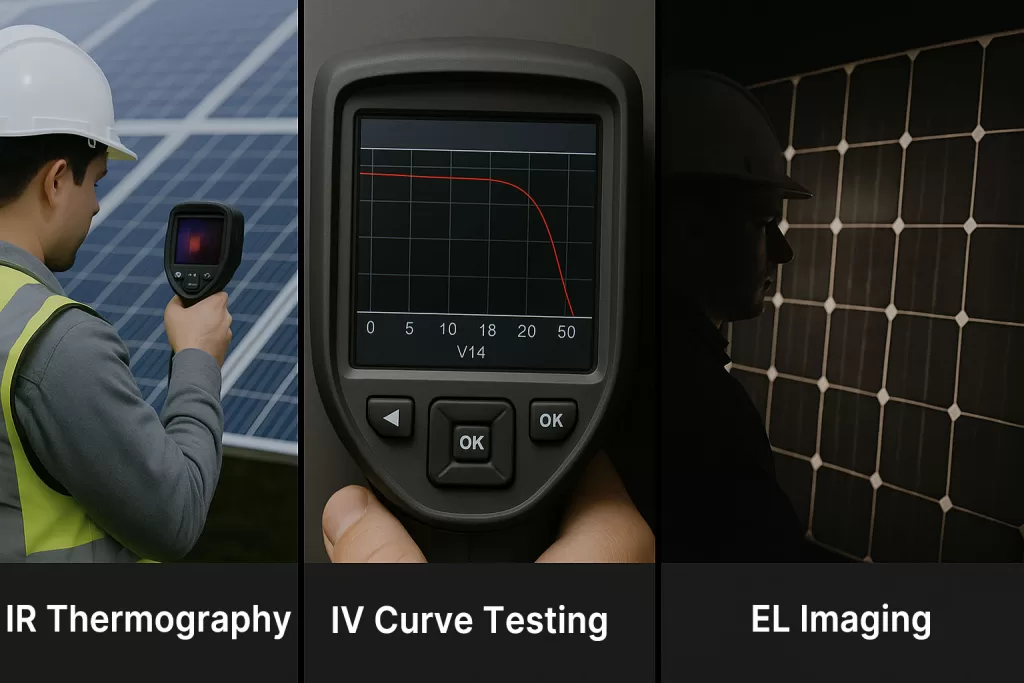
Early detection and timely intervention are key to reducing long-term losses in photovoltaic systems. Hotspot and PID issues do not necessarily wait until power output drops significantly to be noticed. In fact, with appropriate detection methods, many problems can be identified in their invisible early stages. Below are the three most common and practical detection techniques.

Infrared Thermography: Quickly Identifying Hotspot Areas

Infrared Thermography: Quickly Identifying Hotspot Areas

The most visible sign of a hotspot is a temperature increase, making infrared thermography the most direct detection method. On a sunny midday, maintenance personnel can scan the modules row by row using a thermal imaging camera. If a localized area shows a temperature significantly higher than its surroundings (typically more than 10°C), it should raise concern.

This method allows quick issue identification without dismantling the modules and effectively locates potential risk sources such as shading, microcracks, or uneven current flow. For rooftop projects or complex racking systems, infrared imaging is almost a standard tool in every inspection.

IV Curve Testing: The Health Report of Module Performance

The IV curve (current-voltage) reflects the actual output status of a module and is a common tool for diagnosing PID. If a module is affected by PID, the output curve typically shows a reduced slope, a clear shift of the maximum power point, and a significant drop in the fill factor (FF).

Using a handheld tester to collect data string by string allows for the creation of comparison charts across different time periods, helping determine whether there is an ongoing trend of electrical degradation. Compared to infrared thermography, this method is more suitable for deeper analysis once the problem has reached a noticeable scale.

EL Imaging: Revealing Hidden Microcracks and Degradation

EL (Electroluminescence) testing is commonly used to detect microcracks and localized degradation. Modules are placed in a dark room and excited with current to induce luminescence, allowing internal structural changes to be clearly visualized.

Especially for PID-induced “dark spots”, comparing EL images before and after can visually reveal which cells have lost passivation or where performance degradation has started. It is generally recommended to perform EL inspections once at the beginning of operation and again in the third year to capture early signs of degradation.

From module anomalies to power degradation and PID confirmation, real-world diagnostics often follow a clear diagnostic pathway. The following diagram summarizes a typical PID detection workflow:

PID detection workflow

Application Case:

A 2.4 MW rooftop project in Sicily, Italy, experienced abnormal drops in module performance after two years of operation. EL imaging revealed large darkened areas on edge modules, confirming PID-induced degradation. Some modules lost more than 25% of their output. After replacing the damaged modules and adjusting the grounding design, the project is expected to avoid over €40,000 in losses over the next three years.

Comparison of PID and Hotspot Risk Impacts in the European Market

Country Common Issue Average Annual Yield Loss Typical Cause
Germany Hot-Spot 2%–4% Snow cover, shading, wiring aging
France Hot-Spot + PID 3%–6% Coastal humidity + poor shading design
Italy PID 5%–8% (higher in south) High heat & humidity + ungrounded P-type modules

3. Quick Handling Guide for Module Abnormalities

When hotspot or PID effects begin to impact power generation performance, timely and tiered handling is essential to prevent further loss. The following measures apply to systems already showing significant power decline or signs of thermal runaway.

1. Handling of Hotspot-Affected Modules

  • Mild hotspots (temperature difference within 10°C): Reposition the affected modules to the end of the string to reduce their working current and extend service life.

  • Severe hotspots (EVA discoloration, backsheet scorching): It is recommended to replace the modules directly to avoid long-term fire or electrical hazards during operation.

  • Clearing onsite shading sources: Regularly remove shading caused by trees, snow, bird droppings, or dust, and adjust the mounting tilt angle to minimize shading risks.

2. Emergency Repair of PID Failures

  • Reverse electric field restoration: Mild PID effects can be reversed by applying a +800V to +1000V voltage at night. Most modules can recover over 90% of their power within 24–48 hours.

  • Replace modules in high-risk areas: For modules that cannot be restored or suffer severe power loss, it is recommended to replace them with PID-Free certified products to avoid affecting the performance of the entire string.

  • Electrical structure inspection: Check for issues in system grounding, insulation aging, and terminal oxidation to prevent recurring PID triggers.

4. From Design to Operation: Key Steps to Prevent Hotspots and PID

Effectively controlling hotspot and PID issues requires a closed-loop management system that spans module selection, system design, and routine operation and maintenance. For European projects in hot, humid, and shaded environments, early risk planning is especially critical.

1. Optimize Module Selection and Encapsulation Materials

The core of PID and hotspot problems lies in the module’s weather resistance, electrical consistency, and encapsulation structure. Risk sources should be strictly controlled at the selection stage:

  • Prioritize modules with PID-Free certification, ensuring that key materials (EVA, backsheet, glass) have high insulation and low water permeability. In hot and humid regions, dual-glass or N-type modules are preferred.

  • Prevent microcracks or inconsistencies in electrical parameters from entering production by using sorting tests and electroluminescence (EL) inspections.

  • For projects with heavy shading or complex installation conditions (e.g., sloped roofs, irregular curtain walls), IBC architecture modules can be used. For example, Maysun Solar’s gridless IBC modules offer significant advantages in shading resistance and low-light performance, suitable for a variety of residential and commercial scenarios.

2. Optimize System Grounding and Installation Structure

  • Use design software such as PVsyst for shading modeling, and optimize row spacing and tilt angles to avoid fixed shading and seasonal light gaps that cause localized hotspots.

  • Design grounding schemes properly: P-type modules should be negatively grounded, N-type modules positively grounded, to reduce potential difference between the frame and cells and suppress PID at the source.

3. Strengthen Routine Maintenance and Regular Inspections

  • Regularly clean surface pollutants such as dust and bird droppings. In sandy areas, clean monthly; in humid coastal regions, clean at least quarterly, and inspect for shading simultaneously.

  • Use infrared thermography regularly to identify hotspots. Combine with EL imaging to detect early signs of hotspots, microcracks, and PID. Full-site inspection is recommended once per year, along with establishing a basic maintenance archive.

4. User Training and Awareness Improvement

  • Enhance user understanding of hotspots and PID. Regularly conduct online training and technical seminars to share hotspot and PID cases and handling methods, improving the maintenance team’s risk recognition and prevention capabilities.

For users planning projects in coastal or humid areas, selecting PID-resistant modules is essential. Maysun Solar’s IBC modules have been operating stably in multiple European projects with excellent performance:

Conclusion

In European photovoltaic systems, hotspot and PID effects are often not sudden failures, but rather chronic issues that silently accumulate from the early stages of a project, ultimately causing substantial impacts on energy yield. Although the causes are diverse, they fundamentally point to one core issue—imbalances in early system design and quality control.

To truly minimize losses, it is crucial not only to strictly control quality during equipment procurement and system configuration but also to establish early detection and response mechanisms throughout the operation and maintenance cycle. In the future, the widespread adoption of PID-resistant materials, the advancement of gridless technology, and the implementation of intelligent diagnostic tools will bring greater stability and investment returns to photovoltaic systems.

Since 2008, Maysun Solar has been both an investor and manufacturer in the photovoltaic industry, providing zero-investment commercial and industrial rooftop solar solutions. With 17 years in the European market and 1.1 GW of installed capacity, we offer fully financed solar projects, allowing businesses to monetize rooftops and reduce energy costs with no upfront investment. Our advanced IBCHJT and TOPCon panels, and balcony solar stations, ensure high efficiency, durability, and long-term reliability. Maysun Solar handles all approvals, installation, and maintenance, ensuring a seamless, risk-free transition to solar energy while delivering stable returns.

References

MDPI Sensors – L. Wang, H. Li, Y. Zhao et al., “Comprehensive assessment of hotspot and PID degradation in crystalline silicon photovoltaic modules using infrared thermography and electroluminescence,” Sensors 23(21), 8780 (2023) https://www.mdpi.com/1424-8220/23/21/8780

OFweek Solar – “Analysis of PV module degradation: hot spot, PID and aging mechanisms” http://www.ofweek.com/solar/article-2022-01/ART-310079

ASTM International – ASTM E2481-12 “Standard Test Method for Hot Spot Protection Testing of Photovoltaic Modules”
https://www.astm.org/e2481-12r18.html

PVsyst SA – “PVsyst User’s Guide” (latest edition) https://www.pvsyst.com/

Recommend Reading