Table of Contents
Can Solar Panels Work Efficiently in Winter?
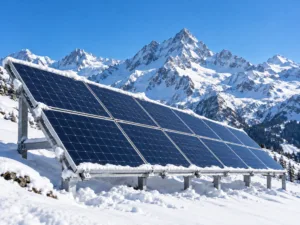
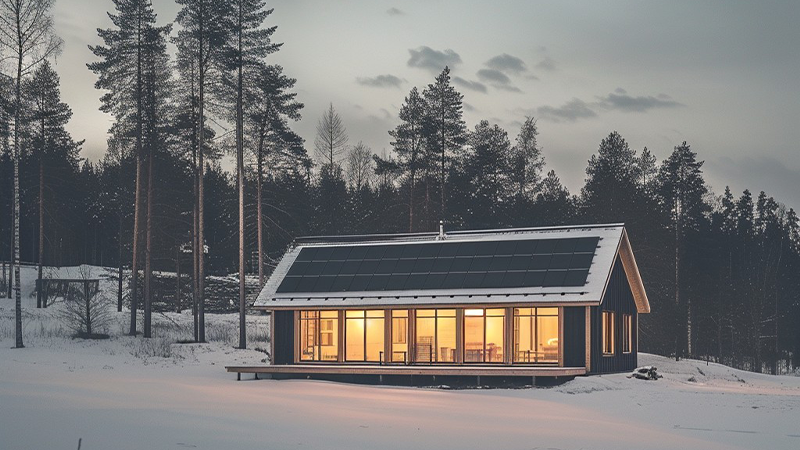
Yes, solar panels can work efficiently even in winter. While winter days offer less sunlight, and using solar energy for heating might seem counterintuitive, the primary factor for photovoltaic (PV) panel performance is sunlight intensity, not temperature. In fact, solar panels tend to operate more efficiently in cooler temperatures.
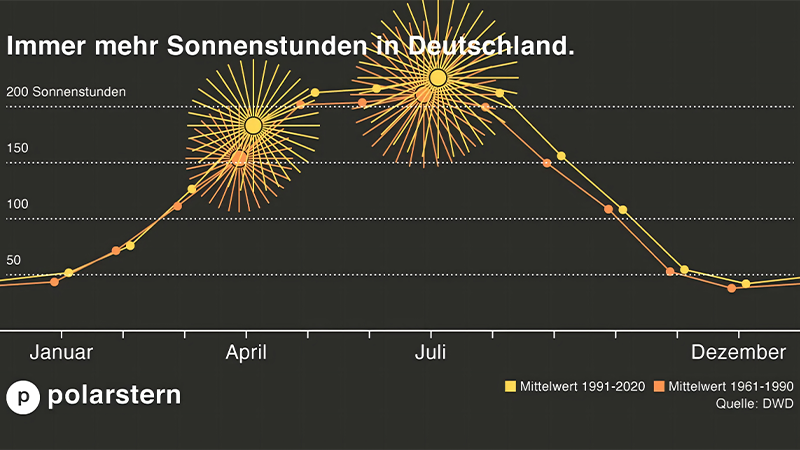
According to the German Weather Service, daylight hours have increased by 4.8 hours over the last 70 years (from 1951 to 2020). This rise in daylight hours benefits solar energy production, even during the winter months.
Although PV systems generate around 30% of their annual electricity output during winter, they can still cover a substantial portion of household energy needs, with some reliance on grid electricity. Here’s a detailed calculation to demonstrate:
For example, consider a 10 kWp solar PV system located in Stuttgart (50 square meters, 18% efficiency). The output formula is:
Output = Global Radiation x Area x Efficiency
- December: With global radiation of 21 kWh/m², the system’s potential output is 189 kWh.
- January: With global radiation of 26 kWh/m², the system’s potential output is 234 kWh.
- February: With global radiation of 46 kWh/m², the system’s potential output is 414 kWh.
Over the winter period (December to February), the 10 kWp system will generate approximately 837 kWh. Assuming an average household consumes around 14 kWh per day during winter (compared to 10 kWh in summer), the total consumption for the 90-day winter period is 1,260 kWh. This means the PV system can provide about two-thirds of the household’s electricity needs (837 kWh / 1,260 kWh = 0.664).
Can Solar Power Be Used for Heating in Winter?
Yes, part of the electricity generated by your solar photovoltaic (PV) system can be used to power electric heaters or heat pumps. However, relying solely on solar power to operate a heat pump is often not cost-effective, as the PV system needs to be significantly larger and produce far more electricity than the household’s actual demand.
Generally, solar power can meet about 10% to 15% of total heating needs, but every kilowatt-hour (kWh) generated from solar is valuable. First, solar power is 100% renewable and helps protect the environment. Second, the production cost of solar energy ranges from €0.11 to €0.13 per kWh, while grid electricity costs around €0.32 per kWh. A heat pump can generate approximately 4 kWh of heat from 1 kWh of electricity. If the cost of solar electricity is €0.12 per kWh, using a PV system to power a heat pump would yield heat at only €0.03 per kWh. In contrast, a gas boiler would produce the same amount of heat for about €0.11 per kWh.
Optimization and Maintenance of Photovoltaic Systems in Winter
1.Correct Tilt Angle
For optimal sunlight capture in regions with heavy snowfall, solar panels should be tilted at approximately 55°. In contrast, during the summer months, when the sun is positioned higher in the sky, an ideal tilt angle is around 20°. Therefore, a 55° angle can hinder energy production during the summer. Maysun recommends a tilt of about 30° as a balanced solution to optimize energy yield for both winter and summer.
2.Maintenance and Cleaning
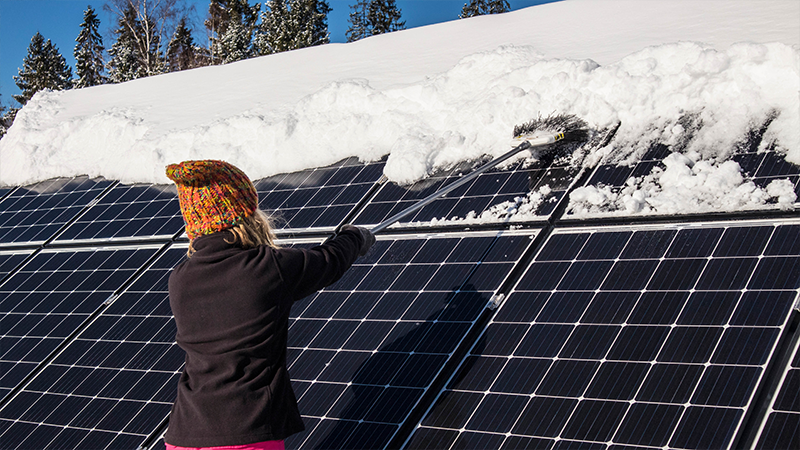
While snow accumulation can affect the performance of photovoltaic systems, frequent cleaning of solar panels is not necessary, as the return on investment (ROI) has already accounted for the reduced output during winter. Should cleaning be required, it is essential to engage professional services to prevent damage. Professional cleaning companies are equipped to ensure that the modules are maintained without risk to their integrity, safeguarding both the equipment and your safety.
Choosing the Right Photovoltaic Modules for Winter Conditions
When selecting the best photovoltaic modules for winter, system owners should pay special attention to performance under low temperatures and low light conditions.
Bifacial Modules:
Bifacial modules can be an excellent choice, as they can also harness light reflected from the snow on their backside, increasing energy output on snowy days. Additionally, some manufacturers offer specialized glass-glass modules that are particularly resistant to extreme weather conditions due to their robust structure.
Temperature Coefficient:
It’s essential to consider modules with a lower temperature coefficient to minimize performance loss in cold temperatures. Maysun recommends using IBC (Interdigitated Back Contact) modules, as they provide better light absorption and higher efficiency under low light intensity.
Snow Load Capacity:
When planning a solar system in snowy regions, it’s crucial to choose components and mounting systems designed to withstand high snow loads. Module manufacturers typically specify the maximum snow load their modules can endure without damage in their datasheets. A common specification is around 1,000 Pa, indicating that each square meter of the module can withstand a maximum pressure of 1,000 newtons. Given that one kilogram of snow exerts approximately 10 newtons of pressure on the module, a 1,000 Pa rating means the module can support up to 100 kilograms of snow per square meter. Most reputable manufacturers’ modules can handle a standard pressure load of up to 5,400 Pa, making them suitable for a wide range of environmental conditions across the country.
Since 2008, Maysun Solar has been dedicated to producing high-quality photovoltaic modules. Our range of solar panels, including IBC, HJT, TOPCon panels, and balcony solar stations, are manufactured using advanced technology and offer excellent performance and guaranteed quality. Maysun Solar has successfully established offices and warehouses in many countries and built long-term partnerships with top installers! For the latest quotes on solar panels or any photovoltaic-related inquiries, please contact us. We are committed to serving you, and our products provide reliable assurance.
Reference:
Wegatech. (2024, August 15). Photovoltaik im Winter – die wichtigsten Infos im Überblick. https://www.wegatech.de/ratgeber/photovoltaik/die-anlage-im-betrieb/winter/
Test, T. (2024, July 8). Was bringt Photovoltaik im Winter wirklich? Alle Infos zusammengefasst. Solario24. https://www.solario24.com/ratgeber/was-bringt-photovoltaik-im-winter-wirklich-alle-infos-zusammengefasst?srsltid=AfmBOopPGjirD7AvopUnUaPfiwGeRaP4yw7IZa35fmhCJZDm5RcE8Yxu
Heizen im Winter mit PV & Solarthermie – wie geht das? (n.d.). Polarstern – 100% Ökostrom Und 100% Ökogas. https://www.polarstern-energie.de/magazin/artikel/solar-heizen-winter/
Engie. (2023, February 22). Panneaux solaires en hiver : fonctionnement, rendement et entretien. ENGIE My Power SAS. https://mypower.engie.fr/conseils/energie-solaire/avantages-conseils-solaire/panneaux-solaires-en-hiver.html
You may also like:

When does HJT bifacial gain pay off on European rooftops, and when is IBC the better option?
When do HJT bifacial solar panels generate stronger returns on European rooftop projects, and when should IBC solar panels take priority?

Which homes are suitable for garden solar?
Which homes are suitable for garden solar? Assess space, shading, orientation and electricity-use goals to quickly judge whether garden solar is a suitable option.

Are Differences Between Solar Panels More Noticeable in High-Temperature Conditions?
High temperatures reduce solar panel efficiency, but the gap in summer power generation is not determined by temperature alone. This article compares the high-temperature performance of HJT, TOPCon and IBC, and explains how businesses should choose.

Why Have N-Type TOPCon Solar Panels Become the Market Mainstream?
N-type TOPCon solar panels have become one of the mainstream photovoltaic technologies thanks to their strong balance of efficiency, cost and mass-production maturity. This article briefly explains their structural features, practical advantages and typical application scenarios.

April News from the European Solar Industry
The European solar market is showing clear signs of recovery: system value is being reaffirmed, German auction prices are stabilising, Italy’s rules are becoming clearer, and revenue certainty in France is improving.

When Are More Expensive N-Type Solar Panels Worth Choosing?
Whether N-type solar panels are worth the extra cost depends on whether project duration, temperature load and roof conditions can turn that added cost into real returns.
-1024x576.png)