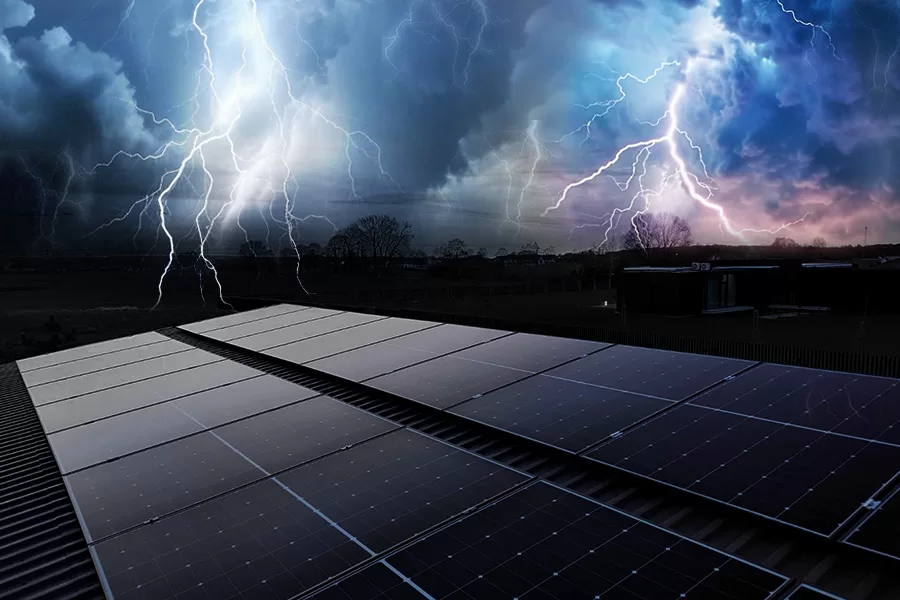

How Can Photovoltaic Systems Be Protected from Lightning Strikes in Summer?

How Can Photovoltaic Systems Be Protected from Lightning Strikes in Summer?

Why Is Lightning So Destructive to Photovoltaic Systems?

The destructive power of lightning lies not only in the chance of a direct strike, but also in the massive energy released in an instant. A typical lightning strike can generate a peak current of 30–200 kA, with voltages reaching up to 100 million volts, all within just a few microseconds. Its damaging effects stem primarily from three physical mechanisms:

  • Thermal effect: When lightning current passes through metal conductors, PV modules, or cables, it can raise local temperatures to several thousand degrees Celsius in an instant, causing metal to melt, connectors to explode, or modules to burn out.

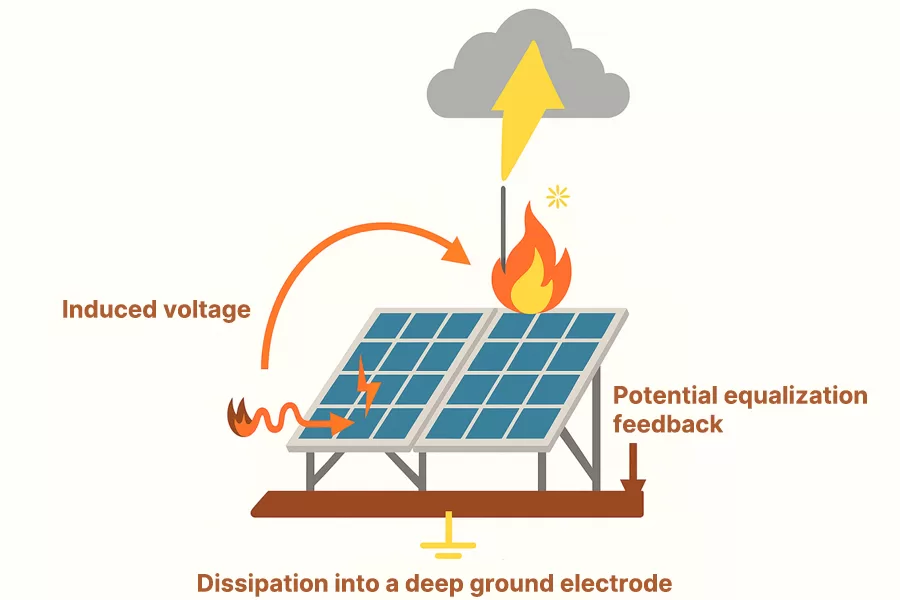
  • Electromagnetic induction: The strong electromagnetic field released by lightning can induce voltages of several thousand volts in nearby circuits—even if not directly hit—posing a serious threat to low-voltage components such as RS485 buses, communication modules, and monitoring systems.

  • Potential rise: When lightning strikes the ground, its current travels through the grounding network and may cause momentary potential differences of tens to hundreds of volts at grounding points. This so-called “ground potential rise” can feed back through grounding wires, damaging inverters, batteries, and other system components.

Photovoltaic systems are made up of many series-connected silicon-based semiconductor devices, which are highly sensitive to transient overvoltage. When voltage spikes exceed 1kV, components like bypass diodes and MOSFETs are easily damaged. Moreover, PV systems are often installed in open, unshaded areas with metal structures—natural high-risk zones—making them far more vulnerable to lightning than typical household appliances.

Therefore, lightning protection for photovoltaic systems is not just about coping with extreme weather—it’s a systematic safety strategy tailored to their structure and operational principles.

Three lightning damage paths in PV systems — direct strike, thermal induction, ground potential rise

(Illustration: Three lightning damage paths in PV systems — direct strike, thermal induction, ground potential rise)

1. Why Are Photovoltaic Systems at High Risk During Frequent Lightning Events?

Unlike standard electrical equipment, photovoltaic systems are typically installed on rooftops, in open fields, or at high altitudes—natural high-risk locations for lightning strikes. The risk doesn’t just lie in being directly struck; before exploring how to protect against lightning, it’s crucial to understand the three primary ways lightning can damage a PV system:

1. Direct Strike: The Most Destructive

When lightning directly hits PV modules, mounting structures, or the top of a building, the resulting surge of current and intense heat can cause:

  • Bypass diode breakdown or cell burn-out inside PV modules

  • Cable fires or breakage due to extreme heat, potentially triggering hot spot effects

  • System-wide failure, such as entire strings going offline or the full system collapsing

This risk is particularly high for buildings with tall, unshaded rooftops in thunderstorm-prone areas. In such cases, it is advisable to install lightning rods, ensure a robust grounding system, and keep down conductors away from signal and control cables.

Direct Strike: The Most Destructive

2. Electromagnetic Induction: A Hidden but Common Threat

Even without a direct strike, lightning’s powerful electromagnetic pulses can induce dangerously high voltages in nearby metal structures and communication lines, potentially damaging:

  • Communication modules (e.g. data loggers, RS485 buses)

  • Inverter interface circuits

  • Low-voltage smart monitoring devices

When the induced voltage exceeds 1kV, minor disruptions can affect communication, while severe surges may lead to local arcing or fires. To mitigate this, multi-level surge protection devices (SPDs) should be installed at inverter terminals, combiner boxes, and communication ports—alongside shielding and equipotential bonding.

3. Ground Potential Rise: The Hidden “Backfire”

When lightning strikes the ground or nearby structures, the resulting current flows through the grounding network and may “backfeed” into the PV system via grounding cables, leading to:

  • Combiner box damage

  • Battery overvoltage, capacity loss, or even explosion

  • Reverse surges from the grid side, harming inverters or connected loads

If the grounding system is poorly designed—with high resistance, improper isolation, or shared grounding with other electrical systems—the system becomes more susceptible to these ground potential rise (GPR) events. It’s recommended to design a dedicated grounding network with resistance ≤ 4Ω, avoid common grounding with unrelated systems, and install isolators or current limiters at key points.

2. So, Do All PV Projects Need Lightning Rods?

1. Are Lightning Rods Necessary in All Situations?

Scenario Type Lightning Rod Recommendation Explanation
Rural residential rooftop ❌ Usually not necessary Low roof, many obstructions, insufficient surface area
Tall city building ✅ Recommended Tall structure, no obstructions, high lightning risk
Industrial/commercial facility ✅ Recommended Large surface area, concentration of electrical equipment
Areas with frequent thunderstorms ✅ Strongly recommended High lightning frequency, advanced protection required

2. Key Considerations When Installing Lightning Rods

Even if a project qualifies for lightning rod installation, certain technical conditions must be met to ensure its effectiveness and safety:

  • The rod must be higher than the PV modules and form a protective cone; a protection angle within 45° is recommended to ensure full coverage.

  • Maintain at least 5 meters of distance between the rod and the modules to prevent shading that could reduce power output.

  • The ground resistance of the lightning rod should be ≤ 4Ω, and it must be connected to a reliable grounding system to avoid false grounding.

  • Down conductors should be routed along walls or external structures, away from PV cables, to minimize induced voltage risks.

  • Installation must be carried out by a licensed electrical contractor and must comply with building lightning protection standards (such as IEC 62305 or GB 50057).

Lightning Rod System Schematic

If poorly designed, a lightning rod can attract but fail to safely discharge lightning, increasing system risk. Therefore, it must be installed strictly according to standards—not just for peace of mind—and tailored to each project based on building height, surrounding structures, and regional lightning activity.

3. Which Photovoltaic Projects Should Invest in a Complete Lightning Protection System?

Lightning protection is not mandatory for every PV project. However, under specific conditions—considering cost, risk, and compliance—a comprehensive protection system is no longer just a recommendation, but a necessity. The following three typical scenarios should be prioritized for full lightning protection investment.

1. PV Systems in Lightning-Prone Areas

For systems located in Mediterranean coastal zones, mountainous highlands, or coastal regions with frequent thunderstorms, even smaller-scale installations should be designed with full lightning protection in mind. In these areas, frequent summer storms increase long-term exposure to repeated strikes. Even without direct hits, repeated surges can gradually damage components and communication systems—or in severe cases, cause total system failure or fire.

A dual-layer strategy is recommended:

  • External protection: lightning rods and equipotential grounding rings

  • Internal protection: multi-level SPDs on inverter terminals and signal ports; optional power isolators to ensure safety in high-frequency lightning zones

2. Systems with Low-Voltage Equipment like Storage Units

PV systems equipped with battery storage, smart monitoring, RS485 communication, or remote control modules may not be high-power, but they include sensitive low-voltage electronics highly vulnerable to induced surges. This is especially true for commercial rooftops, agricultural greenhouses, and remote data stations, where lightning-induced failures in communication or monitoring are common.

Such systems require enhanced internal protection:

  • Multi-level SPDs at communication ports, storage interfaces, and inverter control terminals

  • Consistent equipotential bonding and a closed-loop grounding system to prevent surge currents from infiltrating communication circuits

3. Projects on Lightweight, Unshaded Rooftop Structures

Rural workshops, farm greenhouses, and small warehouse rooftops often use light steel or sandwich panel roofing, with no shading or surrounding structures. These setups easily become local high points, increasing the risk of direct strikes. Moreover, these structures often lack pre-embedded grounding or lightning design, making them prone to penetration damage or leaks after a strike.

A simplified but effective external protection approach is advised:

  • Use lightweight lightning rods, basic down conductors, and segmented grounding

  • Integrate protection components directly into module installations to create a cost-effective protective loop without increasing structural load

4. How to Build “Sufficient” Lightning Protection at Minimal Cost

Not every PV project requires a fully equipped, high-cost lightning protection system. When budgets are limited and risks are manageable, a well-planned, streamlined design can still offer a cost-effective and reliable protection strategy. The following three suggestions serve as key decision-making references for businesses planning PV deployments.

1. Simplify External Protection—But Don’t Skip It

For small to mid-sized PV systems installed on open rooftops with exposed metal structures, there may be no need for a large-scale lightning rod array. However, basic external protection, such as simple lightning rods or down conductors with reliable grounding, should still be in place.
Using lightweight brackets with embedded down conductors connected to a grounding grid can effectively direct lightning current into the ground without increasing structural load, making it one of the most cost-efficient options.

2. Prioritize Key Nodes for Internal Protection

If the system includes low-voltage components such as battery storage, monitoring, or remote data interfaces, focus protection efforts on critical points. Install multi-level SPDs at communication ports, inverter inputs, and combiner boxes to avoid full-site coverage that would drive up costs.
Opt for replaceable modular SPDs, which simplify future maintenance and reduce long-term O&M expenses.

3. Leverage Built-in Lightning Resistance of PV Modules

Some advanced PV modules now come with integrated bypass diode protection, low-inductance structures, or optimized grounding interfaces, which help mitigate the impact of induced lightning or ground potential rise.
Prioritize such modules during product selection, and pair them with a light protection + module synergy strategy based on project layout. This can significantly lower total lightning protection investment.

For users planning building-integrated PV (BIPV) projects, it’s worth integrating lightning protection, grounding, and SPD systems at the design stage, ensuring an optimal blend of structural integrity and electrical safety.

Additional Implementation Tips:

  • PV cables should be routed away from rooftop metal objects (e.g. antennas, water heaters) to reduce induction risk

  • Seal all wall and roof cable penetrations to prevent water ingress or fire hazards

  • Regularly inspect SPDs for aging, and check if grounding wires are loose or corroded

  • Never place items on top of PV modules, as they may cause hot spots and lead to fire hazards

Conclusion

Frequent summer thunderstorms make lightning protection design for photovoltaic systems far more than just a regulatory formality—it is essential for ensuring long-term system stability and return on investment. From project selection and regional climate analysis to system structure and power configuration, every detail has a direct impact on the value of lightning protection investment.

Only by establishing a tiered assessment, scenario-based planning, and closed-loop execution strategy—and ensuring these measures are properly implemented—can safe and stable solar power generation be achieved, allowing PV plants to consistently deliver value to users.

Since 2008, Maysun Solar has been both an investor and manufacturer in the photovoltaic industry, providing zero-investment commercial and industrial rooftop solar solutions. With 17 years in the European market and 1.1 GW of installed capacity, we offer fully financed solar projects, allowing businesses to monetize rooftops and reduce energy costs with no upfront investment. Our advanced IBCHJT and TOPCon panels, and balcony solar stations, ensure high efficiency, durability, and long-term reliability. Maysun Solar handles all approvals, installation, and maintenance, ensuring a seamless, risk-free transition to solar energy while delivering stable returns.

Reference

IEC. (2010). IEC 62305 – Protection against lightning. International Electrotechnical Commission. https://webstore.iec.ch/publication/2472

Phoenix Contact. (2023). Lightning and surge protection for photovoltaic systems. Phoenix Contact GmbH & Co. KG. https://www.phoenixcontact.com/en-us/products/lightning-and-surge-protection

SMA Solar Technology AG. (2022). Technical information – Surge protection for inverters. SMA Solar Technology AG. https://www.sma.de/en/products/solar-inverters.html

Meteonorm. (2024). Global meteorological database for engineers and planners. Meteotest AG. https://meteonorm.com

Recommend Reading

February News in the Photovoltaic Industry

February News in the Photovoltaic Industry

February overview of Europe’s photovoltaic market: module price trends, a rebound in the German PPA market, progress in Italian agrivoltaics and regulatory shifts in France, highlighting key industry signals.
Read More »