Table of Contents
Introduction
With the rapid development of high-efficiency technologies such as HJT and TOPCon, technological trends in the photovoltaic industry are evolving at an accelerated pace. The market share of polycrystalline modules is steadily shrinking, while monocrystalline modules not only remain dominant but are also integrating with next-generation processes to continuously push the boundaries of efficiency. Although the differences between monocrystalline and polycrystalline have long been widely recognized, their shifting market positions and future trajectories remain a key focus for investors and enterprises. This article will examine the comparison between the two and, in light of the latest trends, explore the technological direction of PV modules in 2025.
What Are the Differences Between Monocrystalline and Polycrystalline Solar Panels?
1. Silicon Processing:
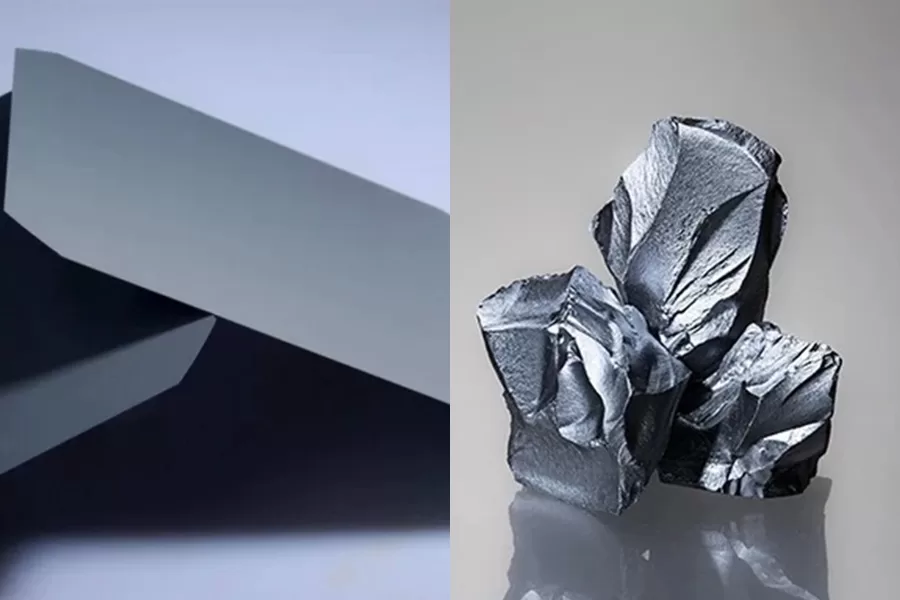
Polycrystalline: During production, silicon crystals are melted and poured into square molds to cool, forming ingots composed of multiple crystals, which are then cut into wafers. The process is relatively simple, consumes less energy, and comes with lower manufacturing costs.
Monocrystalline: Silicon is melted at high temperatures and then drawn into a single crystal ingot using a special pulling process, which is sliced into wafers. With uniform lattice arrangement and fewer defects, current flows more smoothly, resulting in higher efficiency, though production costs are relatively higher.
2. Module Appearance and Color:
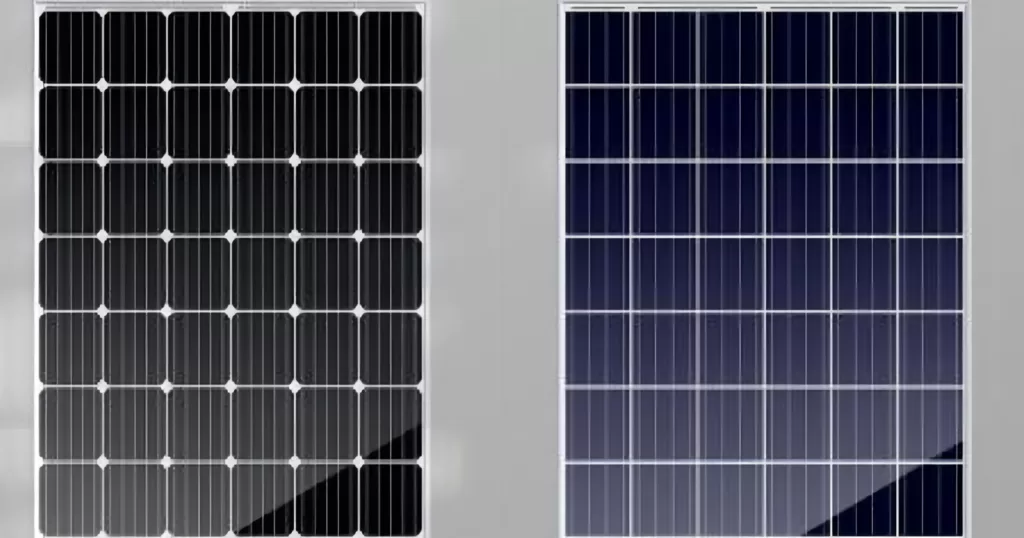
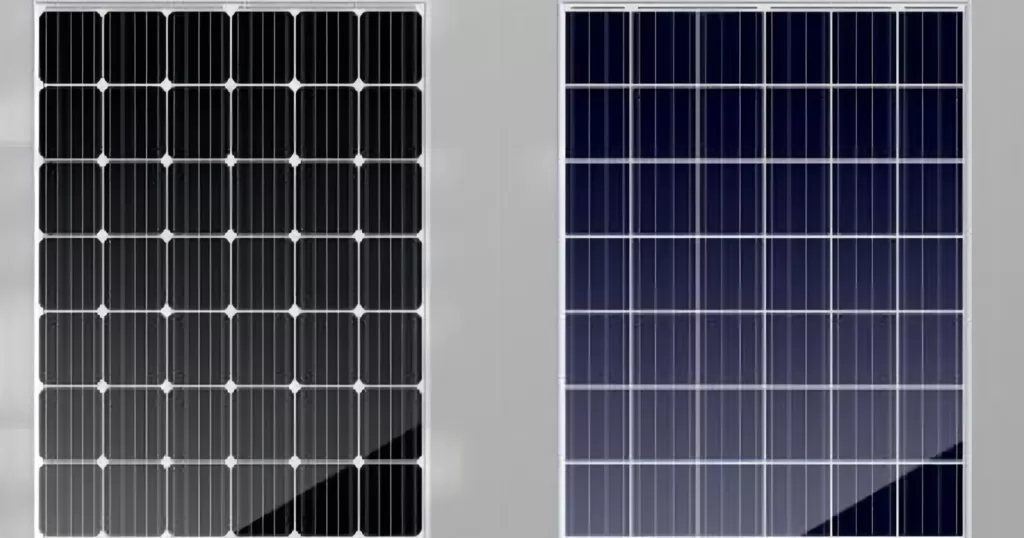
Polycrystalline: Due to varying grain orientations, the surface typically appears blue with a mottled reflection.
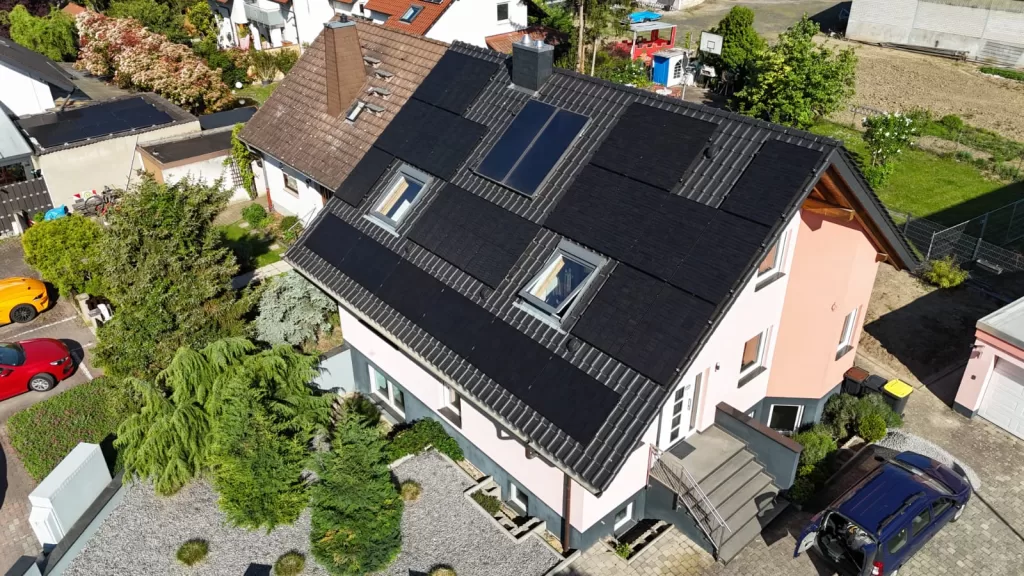
Monocrystalline: With uniform crystal orientation, the surface usually appears black or dark gray to the naked eye, aligning better with modern architectural aesthetics.
3. Conversion Efficiency:
Polycrystalline: Efficiency generally ranges from 13–16%, suitable for projects where efficiency is not critical and the focus is on reducing initial investment.
Monocrystalline: Efficiency ranges from 18–22%. New generations incorporating PERC, TOPCon, HJT, and IBC technologies have already surpassed 23%. They generate more electricity within the same surface area, making them better suited for rooftops with limited space. While earlier monocrystalline modules had slight disadvantages in high-temperature and low-light conditions, modern designs with half-cut, 1/3-cut (Twisun Pro), and shingled technologies have optimized stability and efficiency.
4. Cost:
Monocrystalline: Initially priced higher than polycrystalline, but with expanded production capacity and process improvements, costs have significantly declined, and module prices have dropped considerably. Combined with higher efficiency, which brings BOS savings and energy yield gains, the levelized cost of electricity (LCOE) is usually lower.
Polycrystalline: The process is simple and energy consumption is low, but as demand decreases and economies of scale weaken, the price advantage is no longer significant. To achieve the same capacity, they often require larger surface area and more mounting structures and cabling, resulting in weaker overall economics.
Within monocrystalline options, there are cost gradients: PERC offers the lowest cost but is nearing its efficiency ceiling (~22%); TOPCon costs slightly more but delivers higher efficiency and lower degradation; HJT and IBC involve higher costs and are mainly used in high-efficiency or premium projects.
Monocrystalline vs Polycrystalline Modules (2025 Technology Trends)
| Category | Monocrystalline Modules | Polycrystalline Modules |
|---|---|---|
| Market Position | Mainstream, dominating nearly the entire market | Rapidly shrinking share |
| Conversion Efficiency | 18–22%, over 25% with new technologies | 13–16%, limited improvement |
| Cost & Return | Costs declining, higher long-term returns | Lower initial cost, weaker long-term returns |
| Application Scenarios | Rooftops, commercial & industrial, high-efficiency power plants | Essentially exiting the market |
How to Choose Among Monocrystalline Process Routes After Polycrystalline Fades Out?
1. Why Does Monocrystalline Remain the Mainstream?
Polycrystalline modules have lower efficiency and a diminishing cost advantage, and are gradually exiting the mainstream market. By contrast, monocrystalline modules deliver higher efficiency and longer service life, and they support next-generation processes such as PERC, TOPCon, HJT, and IBC. For distributors and investors, virtually all partnerships and supply arrangements now center on monocrystalline.
2.Route Selection Within Monocrystalline
PERC: Mature process with the lowest cost, but efficiency is nearing its ceiling (around 22%). It is being phased out in new projects and will mainly suit price-sensitive markets going forward.
TOPCon: Slightly higher cost than PERC, with efficiency commonly reaching 23–24%; currently the most mainstream choice.
HJT and IBC: Higher process and material costs, but superior performance in low light and high temperatures, and better aesthetics (e.g., full black, bifacial). Often used in premium rooftops or specific C&I projects.
3.The Potential Impact of Perovskite Tandems
At present, mass-production efficiency of perovskite–silicon tandem modules has exceeded 26% and is gradually entering industrial validation. Combining them with a monocrystalline silicon bottom cell is a key pathway to further efficiency gains, but stability, long-term reliability, and cost convergence still require verification. In the near term, monocrystalline TOPCon remains the most prudent mainstream option; paired with the latest 1/3-cut designs, it can effectively reduce current losses, increase power density, and improve stability under partial shading. Perovskite tandems merit medium- to long-term attention.
4.Investment and Partnership Recommendations
Developers and investors: Continue to prioritize monocrystalline TOPCon in the short term, while tracking the application value of HJT and IBC in specific scenarios.
Distributors and supply partners: Structure inventory and marketing around a smooth transition from PERC to TOPCon, and selectively introduce high-efficiency modules to meet differentiated customer needs.
Forward planning: Closely monitor the industrialization progress of perovskite tandems. Once breakthroughs in stability and cost convergence are achieved, they will open a new track for distribution and investment cooperation.
The PV industry has entered a new phase dominated by monocrystalline. Companies need to keep pace with the latest technologies, align with iteration trends, and make the right choices at the right time. With monocrystalline firmly established, true competitiveness lies in who can grasp the next-generation technologies faster and more reliably—planning ahead to see the landscape clearly and avoid blind investment.
As a long-term supplier in the European market, Maysun Solar has consistently provided stable supply and distribution support across Europe and other core regions. Its product range covers high-efficiency technologies such as IBC technology, TOPCon technology, and HJT technology, combined with designs like half-cut and 1/3 cut technologies, offering EPCs and installers reliable high-performance module options.
Recommend reading

Low-Carbon PV Procurement in France: Why ECS, PEP Ecopassport and Solar Carports Matter
Table of Contents France is becoming one of Europe’s most documentation-driven solar markets. For EPC companies, developers and commercial project owners, module selection is no longer based only on price-per-watt, efficiency or linear power warranties. Carbon documentation, supply-chain traceability and project-specific compliance files

PV Module Installation Beyond Rooftops: Multi-Scenario Applications for Bifacial N-Type Modules in Europe
PV module installation is not limited to rooftops. For residential users, small commercial users and distributed PV projects in Europe, spaces such as balconies, gardens, fences, carports, terraces, façades and pergolas can also provide additional installation areas when conditions allow. As solar use

Europe’s Grid Cap Era: Why High-Efficiency Solar Panels Matter More in 2026
Introduction In 2026, the economics of distributed solar in Europe are changing. Grid congestion, export limits, negative electricity prices and zero-export requirements mean that a solar project can no longer be judged only by how much electricity it generates. The more important question

How Do Solar Panel Delivery Delays Affect Installer Costs?
Solar panel delivery delays can affect installation schedules, project acceptance and payment collection.

The Forgotten “Invisible Assets”: Why Repowering Is the Strategic Key for European Solar in 2026
As grid congestion delays new solar projects across Europe, existing PV assets are becoming a strategic source of growth. This article explains why PV repowering can help EPCs and C&I asset owners unlock hidden value from already-connected solar plants, improve LCOE, and extend long-term asset performance with high-efficiency TOPCon, IBC and HJT modules.

Solar Panel Procurement in Europe: Why Stable Supply Matters More Than a One-Off Low Price
When European installers, distributors and corporate buyers choose solar panels, a one-off low price should not be the only factor. Stable supply, model continuity, technical documents and replenishment capacity often matter more for long-term cooperation and project delivery.


It’s interesting to see how quickly monocrystalline is overtaking polycrystalline, especially with TOPCon and HJT pushing efficiency even further. One challenge I think will be important to watch is how recycling processes adapt, since newer module technologies often use different materials and structures. The industry’s ability to scale both performance and sustainability will likely define the next phase of PV growth.
I agree, the market has clearly moved toward monocrystalline with TOPCon and HJT driving most of the efficiency gains we see today. The point on recycling is very relevant, since new cell structures bring added complexity, and how the industry handles that will say a lot about its long-term sustainability.