
High-power or low-power modules at the same installed capacity: which should you choose?

High-power or low-power modules at the same installed capacity: which should you choose?

In the European photovoltaic industry, installed capacity is often treated as the primary indicator of project scale and progress. By contrast, module power rating—despite being a fundamental parameter—is frequently viewed simply as a means of reaching a capacity target, rather than as a decision that merits deeper consideration.

Yet once installed capacity is fixed, the choice between high-power modules and low-power modules is not merely a question of module count. Different power classes imply different layout strategies, system configurations and levels of tolerance to real-world irradiance conditions—differences that typically become evident during operation.

Table of Contents

Why do systems perform differently at the same installed capacity?

In commercial PV projects, installed capacity is usually the first parameter to be defined.

Whether the target is 300 kW, 500 kW or 1 MW, once the capacity is fixed, module selection is often simplified to a seemingly straightforward question:

should the target capacity be achieved with fewer high-power modules, or with more low-power modules?

In practice, however, many system-level differences begin to take shape precisely at this stage.

1.1 Differences start at the initial stage

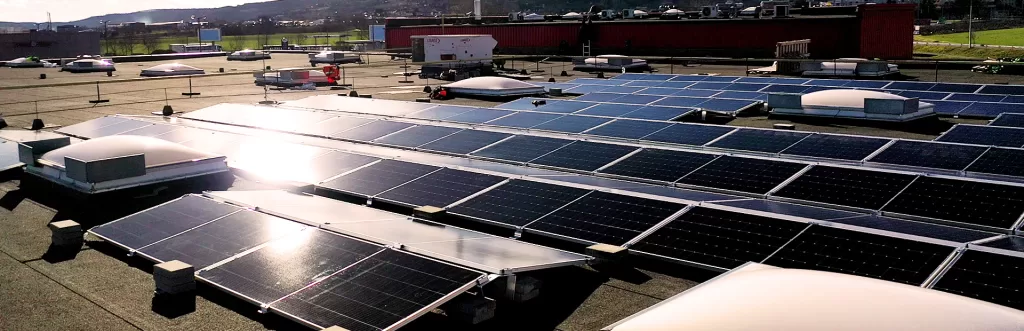
Take a typical European C&I rooftop project as an example: a concrete roof with skylights and technical zones, and a target installed capacity of 500 kW.

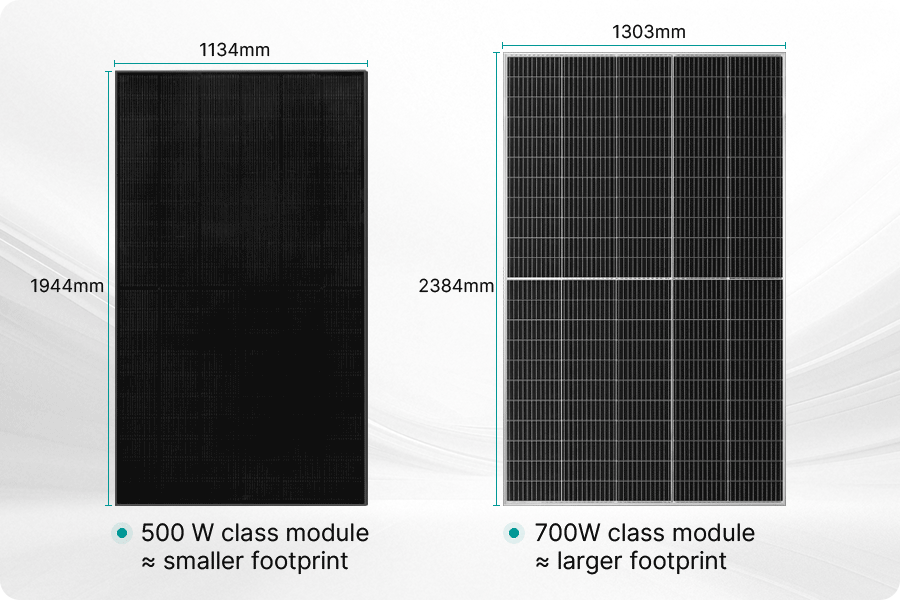
  • Using modules rated at around 700 W, the system requires just over 700 modules

  • Using modules rated at around 500 W, the module count rises to nearly 1,000 modules

From a capacity perspective, the two options are identical. Yet the physical configuration of the system is already fundamentally different.

The first impact of module power is not on energy yield, but on module count, individual module size, and the degree to which arrays can be subdivided.

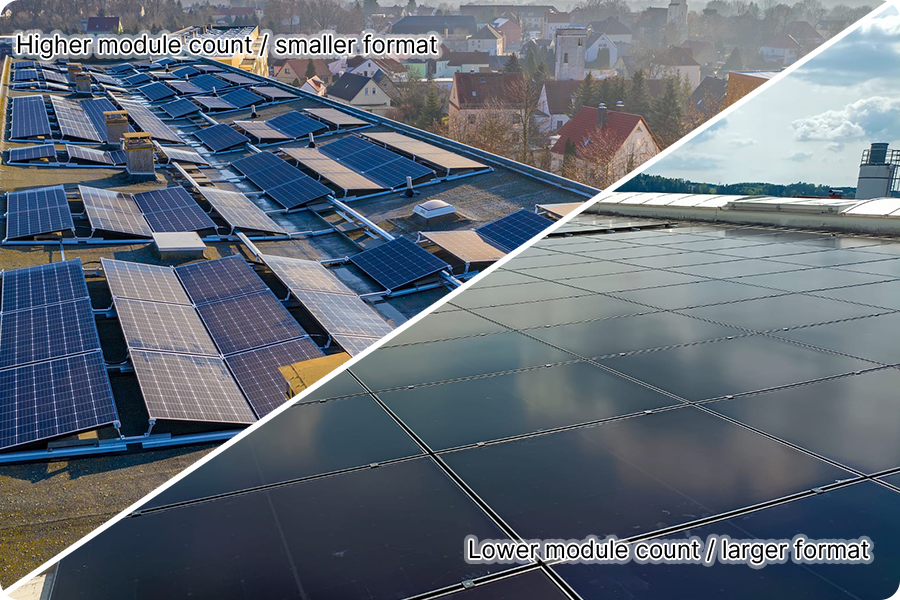
Comparison of size and rooftop area coverage between 500 W and 700 W PV modules

1.2 Differences in system layout

At the design stage, the two options show little difference in theoretical energy yield, and both can meet grid-connection and capacity requirements.

The real divergence emerges at the level of layout and structure.

In option A, larger modules require more continuous and unobstructed roof areas. When skylights, exclusion zones or irregular edges are present, array layouts often need to be adjusted as a whole, sometimes leaving usable roof space unused.

In option B, a higher module count combined with smaller module dimensions allows arrays to be split into more independent sections. This makes it easier to work around obstacles and irregular roof geometry. While such differences may be subtle on drawings, they tend to become much more pronounced during on-site marking and installation.

1.3 System losses are not evenly distributed

In European C&I rooftop projects, system losses are rarely uniform. They are typically concentrated in a few key areas:

  • Array mismatch caused by local shading

  • Differences in irradiance utilisation due to varying tilt angles or orientations

  • The influence of sub-array configuration on inverter operating ranges

In systems with fewer modules and more concentrated arrays, shading in a single area often affects a larger share of total capacity.

By contrast, systems with more modules and more segmented arrays tend to disperse the impact of individual shading events across the system.

As a result, under the same installed capacity, differences in annual energy yield are often driven less by the performance of individual modules, and more by the system’s tolerance to non-ideal irradiance conditions.

Why are high-power modules becoming increasingly common in Europe?

In recent years, high-wattage modules (typically in the 600–800 W range) have become a mainstream option in the European C&I PV market. This shift is not driven by higher power ratings alone, but by a combination of market constraints and technological progress.

2.1 Rooftop constraints drive higher power per module

In European C&I PV projects, the rooftop area available for PV installation is often fixed.

Whether retrofitting existing buildings or developing new facilities, roof structure, load-bearing capacity and functional zoning impose practical limits on usable area.

Under these constraints, increasing installed capacity per square metre by raising single-module power becomes a direct way to achieve higher capacity targets. This trend is not simply the result of larger module formats, but is underpinned by the maturation of next-generation technologies such as n-type cell architectures and TOPCon. For projects with continuous, regular roof layouts, high-power modules make it easier to maximise capacity within limited space—one of the key reasons for their widespread adoption in Europe.

2.2 Fewer modules reduce system complexity

As project scale reaches several hundred kilowatts or even the megawatt range, module count itself becomes a critical driver of system complexity.

At the same installed capacity, higher-power modules typically reduce module numbers by around 20–30%, affecting multiple aspects of the system:

  • Number of mounting structures and fixing points

  • DC cabling and combiner architecture

  • On-site installation pace and construction logistics

  • Fault tracing and maintenance pathways during operation

Where rooftop conditions are relatively favourable, fewer modules help create a clearer, more centralised system layout—particularly attractive for projects pursuing standardisation and scalable deployment.

2.3 Investment assessments favour predictable delivery

From an investment and project management perspective, evaluation priorities in the European market are evolving.

In many C&I projects, assessment is no longer focused solely on theoretical energy yield, but increasingly on:

  • Clarity of system structure

  • Ease of design evaluation

  • Predictability of construction and operation

Where roof conditions allow, the more centralised layouts associated with high-power modules tend to produce systems with consistent parameters and clear boundaries. In some markets, this translates into lower installation costs per watt (€/Wp) in practice—an effect that is particularly pronounced in regions with high labour costs.

This predictability reduces uncertainty during both evaluation and delivery, making such solutions more readily accepted by investors and project managers.

2.4 Improved supply chain stability

Although small- and mid-power modules have a longer track record in Europe, the availability and delivery stability of high-power modules have improved markedly in recent years.

The 600–800 W power range has gradually converged towards more standardised specifications and supply structures. Across power classes, module dimensions and system compatibility, the market is forming product combinations that support long-term availability and repeatable delivery.

As a result, high-power modules are no longer limited to isolated pilot projects. They have become replicable system options across a growing number of C&I applications—another key reason for their increasing presence in the European market.

Why do many systems still opt for more low-power modules?

Although high-power modules are appearing more frequently in European C&I PV projects, many installed systems still achieve the same installed capacity using a larger number of small- or mid-power modules. This is not a sign of market inertia or technological conservatism, but a rational response to project-specific constraints.

3.1 Roof conditions are not always regular or continuous

Across Europe’s existing stock of C&I buildings, rooftops are often fragmented by skylights, technical areas, fire lanes, parapets and legacy extensions. As a result, usable PV areas are rarely continuous.

In such scenarios, modules with smaller physical dimensions—typically in the 400–550 W range—allow arrays to be subdivided more flexibly, improving effective coverage. Larger high-power modules, by contrast, often require sacrificing local areas to maintain array integrity when dealing with complex boundaries.

When layouts cannot be fully regularised, module structure and cell technology begin to materially influence both power density and operational stability:

  • IBC modules, with front-side shading-free back-contact designs, increase the effective light-receiving area, helping maintain higher output density where size is constrained;

  • TOPCon modules in mid-power ranges commonly use half-cut or 1/3-cut cells, reducing string current and improving performance under irregular layouts and partial mismatch;

  • HJT modules, with higher bifaciality, can provide additional energy gains where height differences or uneven reflection conditions are present.

In projects with constrained roofs and non-uniform arrays, these technologies are not aimed at maximising single-module power. Instead, they help strike a more balanced trade-off between layout flexibility, power density and system stability, giving low- and mid-power solutions clear engineering justification under complex roof conditions.

3.2 Greater tolerance to local shading and non-ideal orientations

In C&I rooftop systems, energy losses are not evenly distributed. They are typically concentrated in areas affected by local shading, orientation deviations and inconsistent tilt angles.

Where systems comprise more modules and more sub-arrays, the proportion of capacity impacted by any single shading event is usually smaller. Finer array segmentation allows the effects of non-ideal conditions to be distributed locally rather than concentrated on large capacity blocks.

As a result, in projects with shading risks or heterogeneous roof conditions, systems using more low- and mid-power modules—often incorporating half-cut or 1/3-cut designs—tend to limit the impact of individual mismatch events and maintain more stable performance under complex conditions.

3.3 Better compatibility with existing systems and electrical infrastructure

In Europe, many projects involve system extensions or retrofits rather than greenfield installations. In these cases, inverter configurations, DC voltage windows and existing mounting structures are often better aligned with mid-power modules (typically 400–500 W).

Selecting power classes with higher compatibility reduces retrofit complexity and limits the need for structural reconfiguration. This compatibility-first approach is particularly common in legacy systems and phased developments.

3.4 System flexibility can outweigh maximum density

For some projects, the primary objective is not to achieve the highest possible power density per square metre, but to maintain adjustability under uncertain conditions.

A higher module count offers greater flexibility during construction, operation and future optimisation. Whether for partial replacement, sectional maintenance or later upgrades, these systems are generally easier to modify locally without disrupting overall operation.

In such cases, choosing more low- or mid-power modules is not a compromise on efficiency, but a deliberate trade-off in favour of system flexibility and risk control.

Module power selection: the answer depends on system conditions

In European C&I PV projects, there is no single “optimal” module power. Suitability is determined not by wattage alone, but by how well the module power class aligns with roof conditions and overall system structure.

For this reason, effective power selection starts with clarifying the project’s key constraints, rather than simply choosing between different power ratings:

  • Whether the roof is continuous and the usable area intact;

  • Whether the system prioritises a centralised layout or greater flexibility and fault tolerance;

  • Where the balance lies between installation efficiency and long-term operational stability.

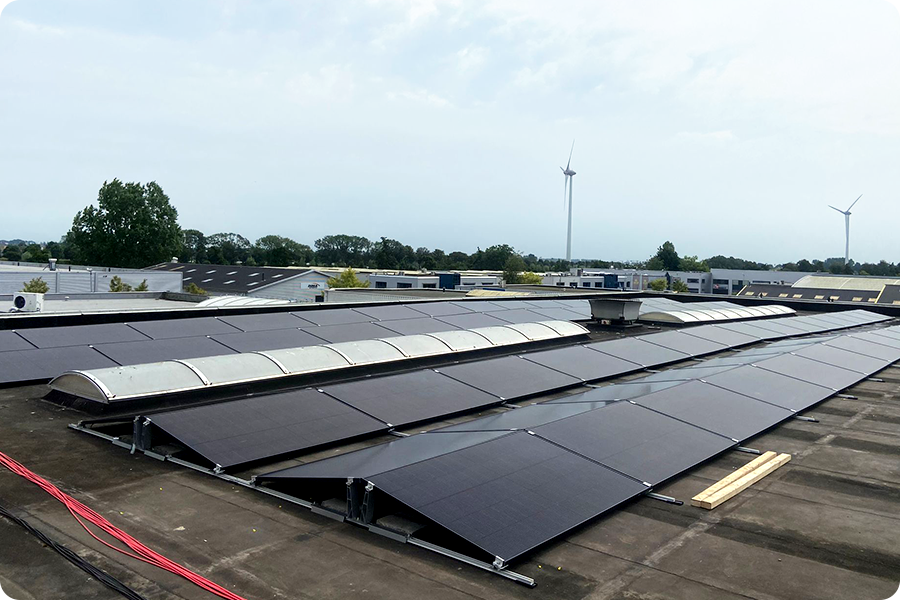
Illustration of how module count and array segmentation affect loss distribution in C&I rooftop PV systems

Once project conditions are clearly defined, module power selection typically converges on a reasonable matching range. These condition-driven ranges allow multiple power solutions to coexist within the same market, each aligned with different project constraints and decision priorities.

Maysun Solar provides PV module solutions for the European market across mainstream technologies, including IBC technologyTOPCon technologyand HJT technology. This allows partners to align module power selection and system structure more effectively with roof conditions, system constraints and operational priorities under different installed capacity targets.

Recommend reading

February News in the Photovoltaic Industry

February News in the Photovoltaic Industry

February overview of Europe’s photovoltaic market: module price trends, a rebound in the German PPA market, progress in Italian agrivoltaics and regulatory shifts in France, highlighting key industry signals.
Read More »

2 Comments

  1. Matthias Renaud

    We ran into this exact choice on a few warehouse roofs last year. On paper the high-power option looked cleaner, but once we started marking layouts around skylights and fire lanes, the larger modules were harder to work with than expected. With more mid-power modules we could break the arrays up and keep more usable area.
    In the end both systems hit the same capacity, but the one with smaller modules was easier to adapt on site and ended up with fewer shading headaches. The article is right that the real difference shows up in layout and tolerance, not in the headline wattage.

  2. Anselm Vogt

    In rooftop projects we often see that different module wattages can lead to very different system results, even when the installed capacity is the same. Large, regular roof areas usually benefit from high-power modules because the structure and installation are simpler. But on roofs with skylights or irregular sections, mid-power modules tend to allow more flexible layouts and more stable output. In practice, the choice really depends on the system conditions, not just on chasing higher wattage.

Comments are closed