Table of Contents
What is a single-glass module?
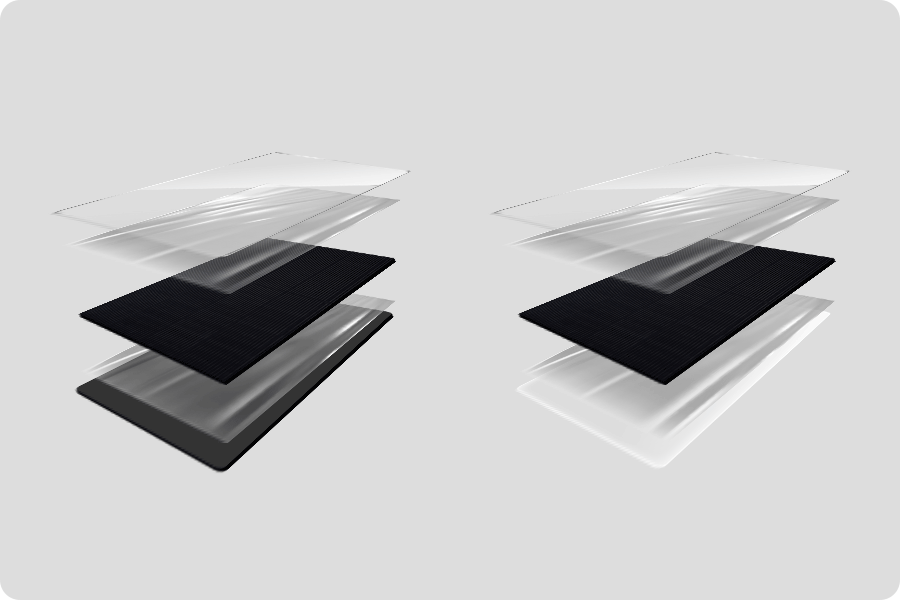
The full name of a “single-glass module” is a glass-backsheet module. Its encapsulation structure is:
Front side: one layer of tempered glass + Back side: one layer of polymer backsheet (glass-backsheet).
In the early stages of the PV industry, almost all modules were built with this structure. At that time, there was no such term as “single-glass”:
They were simply called conventional modules;
Or, more technically, glass-backsheet modules.
As double-glass modules gradually became popular, the market adopted the term “single-glass” to differentiate the two structures. Thanks to its lighter weight, easier handling, simpler installation, and lower transportation cost, the single-glass module has long been the mainstay of the rooftop and commercial & industrial markets. These advantages make it particularly suitable for projects where building load capacity is limited or construction space is constrained.
Why is the market share of PERC single-glass modules declining?
Between 2014 and 2020, with the rise of PERC technology, PV module efficiency increased significantly. During this period, single-glass PERC modules quickly became the most common and representative market configuration.
In terms of encapsulation materials, PERC single-glass modules typically use EVA film combined with a fluorinated backsheet. At the time, this process was already effective in addressing PID effects, damp heat aging, and degradation issues.
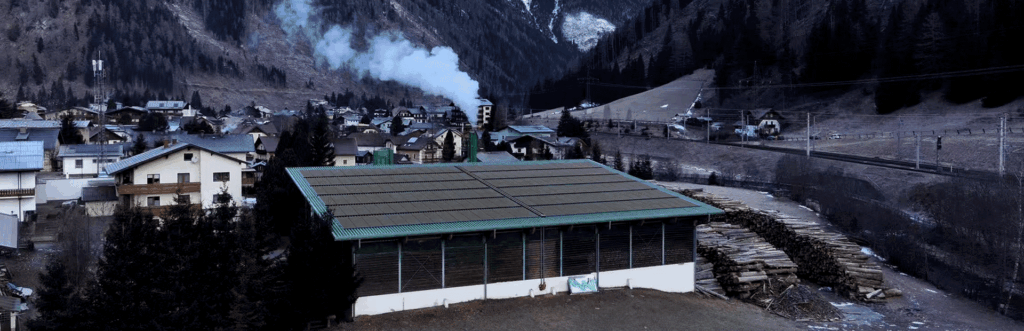
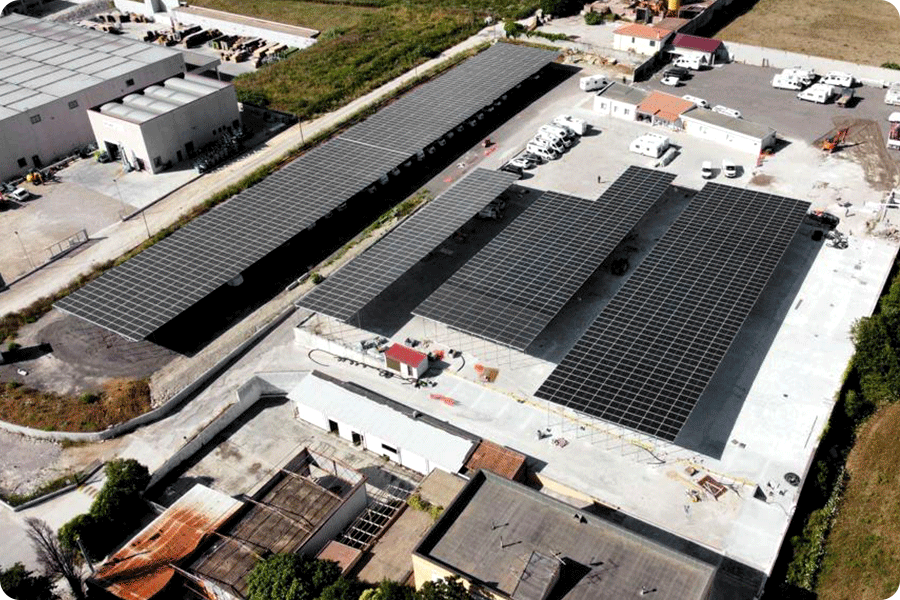
Note: A carport project in Sardinia, Italy, equipped with PERC single-glass modules.
Thanks to their lightweight design and mature manufacturing process, PERC single-glass modules long dominated the residential and commercial rooftop markets. However, as the cost advantages of double-glass bifacial modules gradually emerged, the market share of single-glass PERC began to decline.
Although PERC single-glass modules once offered high cost-effectiveness and large-scale production capacity, their disadvantages became more evident with the development of double-glass modules:
Efficiency losses due to light-induced degradation and temperature sensitivity;
Unstable performance under partial shading;
Limitations in the appearance of traditional backsheets, making them less attractive for premium rooftop projects.
The shortcomings of PERC modules in efficiency, aesthetics, and reliability created market space for the new generation of IBC single-glass modules.
How is the IBC single-glass module different from PERC?
IBC technology (Interdigitated Back Contact) is a high-efficiency cell technology. Unlike traditional PERC, both the positive and negative contacts are located on the back of the cell. With no front-side busbars or shading, light absorption and visual uniformity are significantly improved. At the same time, thanks to higher standards in encapsulation and material selection, IBC single-glass modules also show notable improvements in fire resistance and moisture protection.
Comparison between single-glass IBC and single-glass PERC solar modules
| Comparison criteria | Single-glass IBC module | Single-glass PERC module |
|---|---|---|
| Structural design | Back-contact, no front busbars, full-black appearance with low glare | Front metal busbars, sensitive to partial shading |
| Encapsulation materials | Typically uses high-barrier backsheet, POE or co-extruded (EPE) film, offering higher reliability | Common configuration with EVA film and fluorinated backsheet, lower cost but limited durability |
| Efficiency performance | Active area increased by around 2.5%, delivering higher efficiency | Active area partly shaded by front busbars |
| Low-light performance | Absorption range extended from 300 to 1200 nm, with low-light gain up to 2.01% | Limited generation efficiency at dawn and dusk |
| Glare and process | Busbar-free design, reflectance around 1.7%, reduced glare | Conventional soldering process, higher reflectance |
| Temperature coefficient | Around −0.29%/℃, more stable performance in hot environments | Around −0.35%/℃, faster power loss at high temperatures |
| Ease of installation | Lighter single-glass IBC, easier to transport and install on rooftops | Highly mature technology, but moderately heavy |
Note: The configurations listed are mainstream encapsulation solutions, based on production from Maysun Solar and other leading manufacturers. Some single-glass PERC modules may also use POE film or non-fluorinated backsheet; specific materials vary depending on manufacturer and product series.
Why are IBC single-glass modules favored by the market?
In the residential and commercial rooftop sector:
IBC single-glass modules have secured a stable market share thanks to their high efficiency and lightweight design;
Compared with PERC’s 15-year warranty, IBC modules offer both product and performance warranties of up to 25 years;
With higher standards in materials and encapsulation, IBC modules deliver reliable performance in terms of fire safety and moisture resistance.
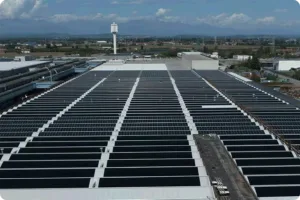
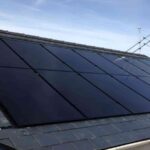
Note: A commercial rooftop project in Hungary using IBC single-glass modules, combining aesthetics with power generation efficiency.
Scenario demand: Residential and commercial rooftop users today place greater emphasis on lightweight design, aesthetics, and low glare, balancing harmony with efficiency.
Technical advantages: Compared with PERC, IBC offers clear improvements in efficiency, shading tolerance, and long-term reliability.
Market trend: While some large-scale projects still prefer double-glass modules, many residential and C&I rooftop users are already opting for IBC.
- Return on investment: IBC single-glass modules are lighter and easier to handle during transportation and installation, leading to a faster overall ROI. Over the 25-year warranty period, their cumulative power generation is typically higher than that of standard double-glass modules, sufficient to offset the differences in lifespan.
By adopting advanced IBC technology, Maysun Solar has launched high-efficiency IBC photovoltaic modules. The back-contact design not only increases power density but also delivers excellent low-light performance, ensuring more stable and reliable operation under Europe’s limited rooftop space and variable light conditions. IBC modules provide efficient and long-lasting photovoltaic solutions for both commercial and residential rooftops.
Recommend reading

August European Solar Industry News
In August 2026, Europe’s solar market combined record PV generation with volatile power prices driven by heat, gas costs and low wind output. Policy support also expanded, including 800 W plug-in solar in Great Britain and greater EU flexibility for PV and storage investments, while module prices largely stabilized amid renewed oversupply.

Industrial Roofs with Limited Load Capacity: Lightweight or High-Efficiency Solar Panels?
On an existing industrial roof, “lighter is better” is not a reliable module-selection rule. The first question is how much additional load the roof can safely accept. Only then does it make sense to compare module weight, power density, mounting method and the

How to Verify Solar Panels Before Buying: Datasheets, Certifications, Warranties and Delivery Inspection
A datasheet, an IEC certificate and a 25- or 30-year warranty can make a solar module look fully validated on paper. For a reliable purchasing decision, however, those documents are only the starting point. The electrical ratings, mechanical design, certificates, connectors, warranty terms

How to Choose Solar Panels for Low-Load-Bearing Industrial Roofs: A Guide to Weight, Power Density and Mounting Systems
Choosing solar panels for a low-load-bearing industrial roof requires more than checking the weight of an individual module. A more reliable process starts by determining the roof’s remaining load-bearing capacity. The complete load from the modules, rails, fasteners and ballast must then be

Why Do Solar Panels Lose Power in Hot Weather? How Temperature Coefficient and Roof Ventilation Affect Summer Energy Yield
Summer brings stronger sunlight and longer daylight hours, so it is normally one of the most productive seasons for a solar system. However, some system owners notice that solar panel output does not continue to rise during the hottest part of the day.

How to Design a Low-Maintenance Rooftop Solar System
Introduction A low-maintenance rooftop solar system is not created after installation. It is designed before installation. Over a 20–30 year operating life, rising O&M costs are rarely caused by dirty glass alone. They are more often caused by design decisions made at the