
Why Dual-Glass Is Not the Same as Bifacial: A Guide to Structural Differences, Power-Generation Mechanisms and Selection Criteria

Why Dual-Glass Is Not the Same as Bifacial: A Guide to Structural Differences, Power-Generation Mechanisms and Selection Criteria

Table of Contents

Why “Dual-Glass” Is Not the Same as “Bifacial”?

In the PV market, dual-glass and bifacial are often confused.

Many users simply assume that “rear-side generation” depends on “whether the back is made of glass”, believing that “all dual-glass modules are bifacial, and all bifacial modules must be dual-glass”.

However:

  • Dual-glass refers to an encapsulation structure;

  • Bifacial refers to a power-generation mechanism.

Dual-glass is an encapsulation structure, while bifacial is a power-generation mechanism.

This misunderstanding mainly comes from the fact that many bifacial solar modules on the market do use dual-glass encapsulation, which leads people to assume that “bifacial = dual-glass”.

But they solve different problems: one relates to durability, the other to power generation.

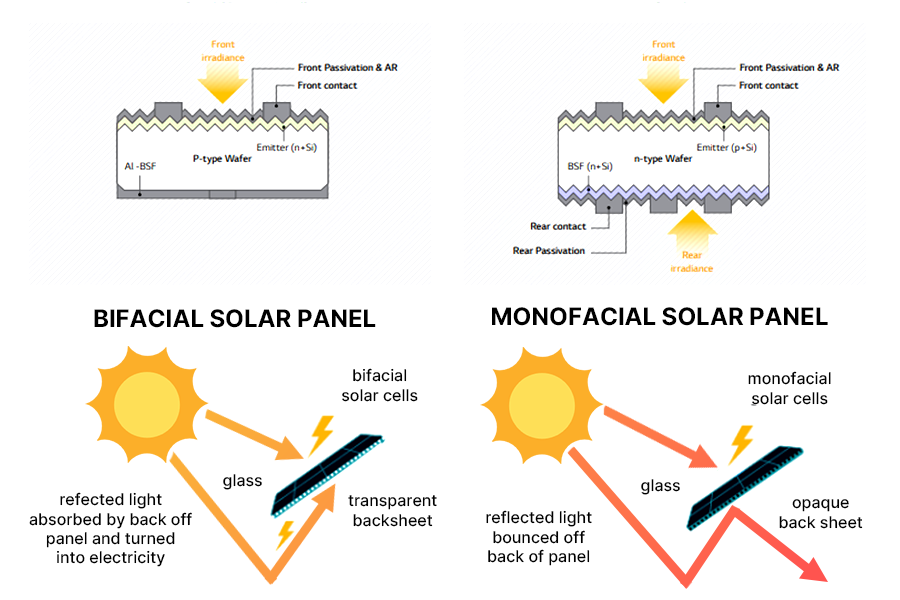
  • A dual-glass module can still be a monofacial module — the rear side may be glass but does not generate electricity;

  • A bifacial module does not have to be dual-glass — it can use a transparent backsheet;

  • Dual-glass bifacial solar modules are just one common combination, not a mandatory pairing.

To make the right selection decision, the structural layer and the power-generation layer must be evaluated separately.

The Fundamental Difference Between Single-Glass, Dual-Glass and Bifacial

In photovoltaic modules, single-glass, dual-glass and bifacial are not concepts of the same category.

  • Single-glass and dual-glass refer to encapsulation structures;

  • Bifacial refers to a power-generation mechanism.

Whether a module can generate electricity from the rear side is determined by the cell technology, not the glass.

Type Single Glass Dual Glass Bifacial
Core Attribute Encapsulation structure Encapsulation structure Generation mechanism
Back-side Material Backsheet Glass Transparent backsheet / dual glass
Does the back generate power? Normally no; only generates with transparent backsheet + bifacial cells Depends on the cells; dual glass alone does not define bifaciality Yes; driven by bifacial cells, not by the glass type
Key Features Lightweight, easy installation, lower cost Higher durability, moisture resistance, better PID resilience Rear-side gain; bifaciality determined by the cell technology
Typical Applications Residential rooftops, metal roofs with limited load capacity, lightweight installations Commercial/industrial rooftops, high-humidity, coastal or harsh environments C&I rooftops, ground-mounted systems with good reflectivity
  • Single-glass or dual-glass structures only affect encapsulation; they do not determine whether a module is bifacial.

  • Bifacial is a power-generation mechanism that can be paired with either single-glass or dual-glass encapsulation.

  • The structure determines long-term durability, while the cell determines electricity generation.

Therefore, module selection should consider which encapsulation structure suits the roof conditions and whether rear-side gain is needed.

Bifacial ≠ Dual-Glass: What Determines Rear-Side Generation?

Whether a module can generate electricity from the rear side is not determined by the glass or the backsheet, but by the cell structure.

1. Only bifacial cells can produce rear-side power

Regardless of whether the module is single-glass or dual-glass, rear-side generation is only possible when bifacial cells are used.

The mainstream bifacial cell technologies on the market today are TOPCon and HJT.

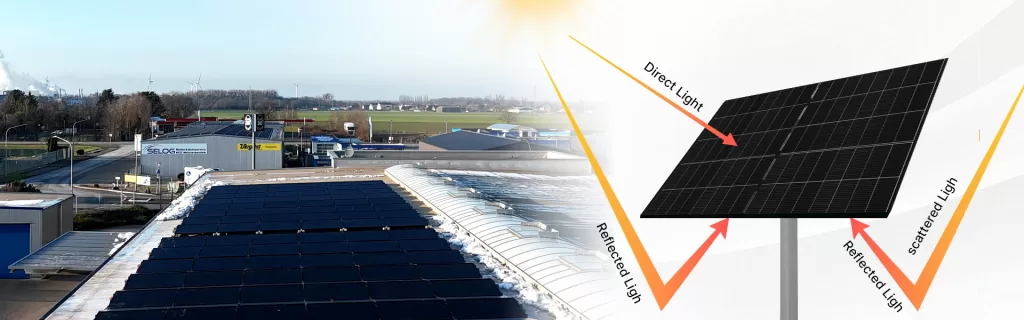
These cells have conductive and passivation structures on the rear side capable of absorbing reflected and diffused light from the ground or rooftop.

2. Rear-side materials only provide a light-transmission path

The rear material simply determines whether light can enter — not whether it can be converted into electricity.

Common rear materials include:

  • Transparent backsheet (single-glass): allows light transmission, supports bifacial generation;

  • Glass (dual-glass): allows light transmission, supports bifacial generation;

  • White backsheet (single-glass): opaque, only monofacial generation.

As long as the rear side allows light to pass through and the cells are bifacial, the module can operate as a bifacial solar module.

Backsheet type also affects optical loss and long-term durability.

3. What determines rear-side power output?

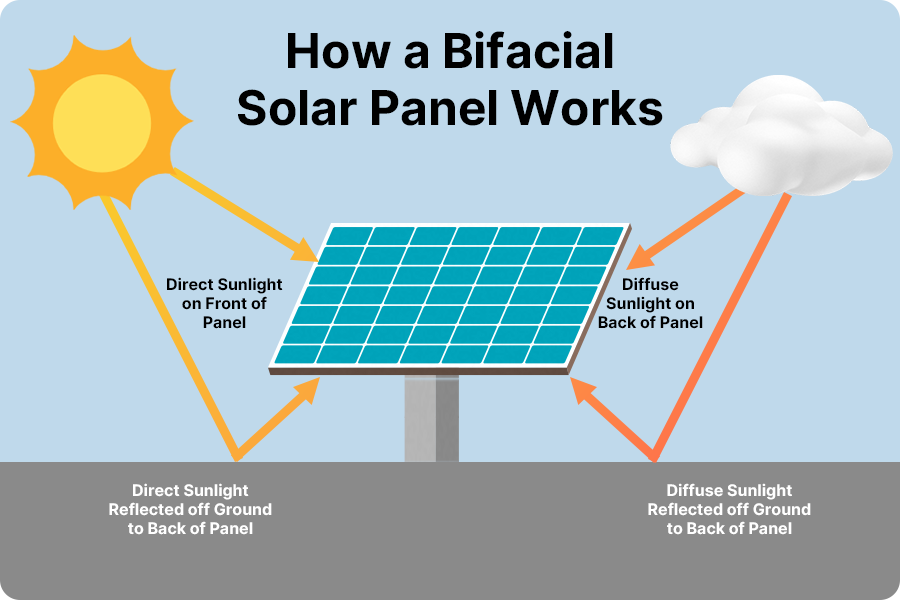
Rear-side generation is influenced by several factors, including the bifaciality of the cells, reflectivity of the environment, installation configuration, and rear-side material.

Bifaciality

The ratio of rear-side output to front-side output — a key indicator of bifacial potential:

  • HJT: ~95%

  • TOPCon: ~85%

  • PERC: ~70%

Reflection conditions

Rear-side usable light mainly comes from ground or rooftop reflection. Different surfaces deliver different levels of gain:

  • White roof / high-reflective film: high

  • Light-coloured metal roof: medium–high

  • Cement or light-grey surface: medium

  • Grassland / soil: low

Thus, bifacial solar modules are especially effective on commercial rooftops or ground-mount systems with strong reflectance.

Mounting height & array configuration

The fewer the obstructions and the better the angle for reflected light to enter, the higher the rear-side gain. Influencing factors include:

  • Height of the module above the ground

  • Row spacing

  • Presence of rear-side shading

  • Type of mounting structure

Optical losses from encapsulation

Both transparent backsheets (single-glass) and dual-glass allow light through, but with slight differences:

  • Glass has higher transmittance and lower long-term degradation

  • Transparent backsheets have slightly lower initial transmittance and higher long-term decay

These differences are small — typically within 2–4%.

4. Why bifacial ≠ dual-glass

In summary:

  • If the cells are bifacial and the rear-side material allows light to pass through, both single-glass and dual-glass modules can achieve bifacial generation.

  • Conversely, even if a module uses dual-glass, if its cells are monofacial, it cannot produce rear-side power.

Bifacial is a cell mechanism.

Dual-glass is an encapsulation structure.

There is no inherent link between the two.

When Should You Use Dual-Glass Modules, and When Should You Use Bifacial Modules?

1. Why do dual-glass modules offer greater long-term advantages?

Over long-term operation, the encapsulation structure often creates a larger performance gap than the initial power rating.

The core value of dual-glass solar modules lies in their long-term reliability.

In ageing tests required by IEC 61215 / 61730 — such as Damp Heat (DH1000/2000h), UV exposure, and Thermal Cycling (TC200/TC600) — dual-glass encapsulation typically maintains a more stable structure and degradation curve, making it better suited to humid, salty or high–temperature-difference environments.

  • Stronger moisture resistance: the water vapour transmission rate (WVTR) of glass is close to 0 g/m²·day, while most backsheets fall between 0.5–3 g/m²·day. Dual-glass more effectively reduces finger corrosion, crack propagation and PID risks.

  • Better mechanical stability: glass on both sides provides higher bending stiffness, offering better protection for large M10/G12 cells and resulting in more controlled deformation under thermal cycling and mechanical loads.

  • More predictable ageing: field records show that backsheets often exhibit yellowing or delamination after more than 10 years of UV and humidity exposure (3–6% occurrence), while glass maintains much higher optical and structural stability.

Dual-glass does not increase initial output, but it significantly reduces lifecycle uncertainty.

On commercial rooftops, in high-humidity regions or long-duration projects, this performance gap widens steadily over 20–30 years.

2. Under what conditions is bifacial generation truly effective?

Bifacial power generation depends on three key factors: environmental reflectance, the rear-side light-entry path, and the bifaciality of the cells.

Rear-side gain becomes meaningful only when all the following conditions are met:

  • Good reflectance: high-reflective surfaces (white rooftops, light-coloured metal, reflective film) significantly improve rear-side light utilisation; grassland or dark surfaces offer limited gain.

  • Clear rear-side light-entry path: when the rear is unobstructed and the module is elevated sufficiently (typically ≥0.8 m), reflected light can enter more effectively. Dense row spacing or proximity to walls can reduce the bifacial effect.

  • High cell bifaciality: rear-side potential is determined mainly by the cells; encapsulation structure does not determine bifaciality.

Bifacial gain is highly dependent on reflectance and rear-side illumination.

According to PVGIS bifacial modelling, increasing reflectance from 20% to 50% can typically raise rear-side gain by 3–6%, consistent with field measurements across many sites.

3. Why is the dual-glass bifacial combination common in commercial projects?

Whether for residential or commercial roofs, users generally want a module that delivers both high generation efficiency and long-term reliability.

Dual-glass bifacial solar modules are widely used because they simultaneously fulfil both requirements.

  • More stable encapsulation: commercial roofs cover large areas, operate for long hours, and experience diverse environmental stresses. Dual-glass performs more consistently under humidity, corrosion and long-term ageing, reducing degradation uncertainty.

  • Rear-side gain is easier to achieve: commercial rooftops typically offer 20–50% reflectance, higher mounting height and minimal rear-side shading — allowing bifacial modules to gain 5–10% additional annual generation.

  • More stable long-term output: dual-glass modules exhibit lower degradation variability. PVEL’s DH2000h and TC600 results show that dual-glass maintains encapsulation integrity better under damp heat and thermal cycling, keeping real-world degradation closer to rated values. This predictability is crucial for projects relying on long-term cash flow.

The combination of dual-glass reliability and bifacial gain helps shorten ROI periods for both residential and commercial PV systems, making dual-glass bifacial modules a widely adopted choice.

Conclusion: Where Do Dual-Glass Bifacial Modules Deliver Value, and When Should They Be Used?

Dual-glass solar modules and bifacial solar modules are often discussed together because, in real-world projects, this combination meets two core needs simultaneously:

  • Stable operation for 25 years or more;

  • Higher effective energy yield within a limited rooftop area.

The value of dual-glass lies in long-term reliability.

Its strong moisture resistance and slower ageing make degradation more predictable in humid, coastal or high–temperature-variation environments.

For example, TOPCon and HJT modules typically offer 30-year warranties, which means more stable performance and more predictable cash flow for long-duration projects.

The value of bifacial design depends on environmental conditions.

On light-coloured metal roofs, white roofs or reflective membranes, rear-side gain typically reaches 5–10%.

As long as the rear side has sufficient clearance and the array is not mounted too low, this gain accumulates over 20–30 years, directly improving ROI.

However, not every rooftop is suitable for dual-glass bifacial modules:

  • When the roof has low reflectance, the rear side is too close to the surface, or load limits are restrictive, the bifacial advantage is reduced, and the main benefit of dual-glass becomes durability.

  • When the roof requires long-term operation, has moderate reflectance and an unobstructed rear side, dual-glass bifacial modules can provide both stability and additional energy gain.

  • When reflectance is modest but the priority is better low-light performance, a lower temperature coefficient and improved visual appearance, single-glass IBC modules remain a reliable choice for many businesses and homeowners. Their low-glare characteristics are also well suited to rooftops sensitive to light pollution.

As a module supplier serving the European rooftop market for many years, Maysun Solar has extensive experience in deploying dual-glass bifacial solar modules. Our 420 W–725 W product range adopts a dual-glass encapsulation combined with a bifacial generation design, delivering more controlled degradation under high temperatures, high humidity and long-term mechanical load, while ensuring stable rear-side gain on rooftops with suitable reflectance conditions.

Reference

IEA PVPS. (2021). Bifacial Photovoltaic Modules and Systems – Field Performance and Analysis. https://iea-pvps.org/wp-content/uploads/2021/04/IEA-PVPS-T13-14_2021-Bifacial-Photovoltaic-Modules-and-Systems-report.pdf

Joint Research Centre (European Commission). (2020). State-of-the-art assessment of solar energy technologies. https://publications.jrc.ec.europa.eu/repository/bitstream/JRC130086/JRC130086_01.pdf

Fraunhofer ISE. (2025). Photovoltaics Report. https://www.ise.fraunhofer.de/content/dam/ise/de/documents/publications/studies/Photovoltaics-Report.pdf

National Renewable Energy Laboratory (NREL). (2019). Backsheet Reliability and Degradation After Long-Term Field Exposure. https://www.nrel.gov/docs/fy19osti/73303.pdf

Recommend Reading

February News in the Photovoltaic Industry

February News in the Photovoltaic Industry

February overview of Europe’s photovoltaic market: module price trends, a rebound in the German PPA market, progress in Italian agrivoltaics and regulatory shifts in France, highlighting key industry signals.
Read More »