Table of Contents
Slower Installation Growth and Regional Disparities
2025 will be the first year since 2015 that the European photovoltaic (PV) market experiences negative growth. According to the latest report from SolarPower Europe, the growth in new PV installations slowed in the second quarter (Q2) of 2025, with the total new installation forecast for the year at 64.2GW, a slight decrease of approximately 1.4% compared to the first quarter (Q1) target. This change marks a transition for the European market, which, after experiencing rapid expansion in 2022 and 2023 and a slowdown in growth in 2024, is entering a new phase characterized by structural adjustments.
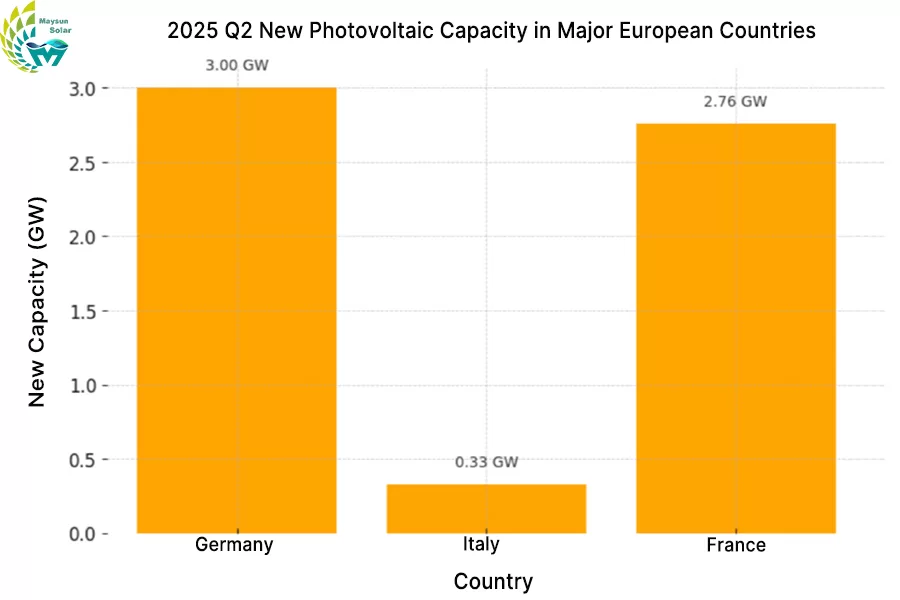
At the national level, regional differentiation is becoming increasingly evident. Germany’s Q2 new installation capacity is around 3GW, down approximately 12% from Q1, primarily due to the removal of subsidies during negative electricity price periods. Additionally, the tightening of subsidies for “balcony solar” systems has also had a suppressive effect on the residential market.
Italy continued its relatively weak performance from Q1, with quarterly new installations remaining between 300–350MW. The country has not introduced any new incentive mechanisms at the national level, and the inconsistency of regional policies remains a significant barrier, limiting the progress of most small and medium-sized projects.
France has shown more stability, with a cumulative new PV installation capacity of 2.76GW in the first half of 2025, representing a year-on-year increase of approximately 30%-35%. The proportion of commercial, industrial, and agricultural building projects has continued to expand, partly benefiting from policy support for self-consumption and energy storage integration projects.
Overall, the phase of slowed installation growth is not due to a decrease in market demand, but rather the result of adjustments in incentive policies, grid access limitations, and optimization of development costs. The regional differences are also widening, reflecting the varied energy transition paths being taken by different European countries.
Price Trends Stabilize
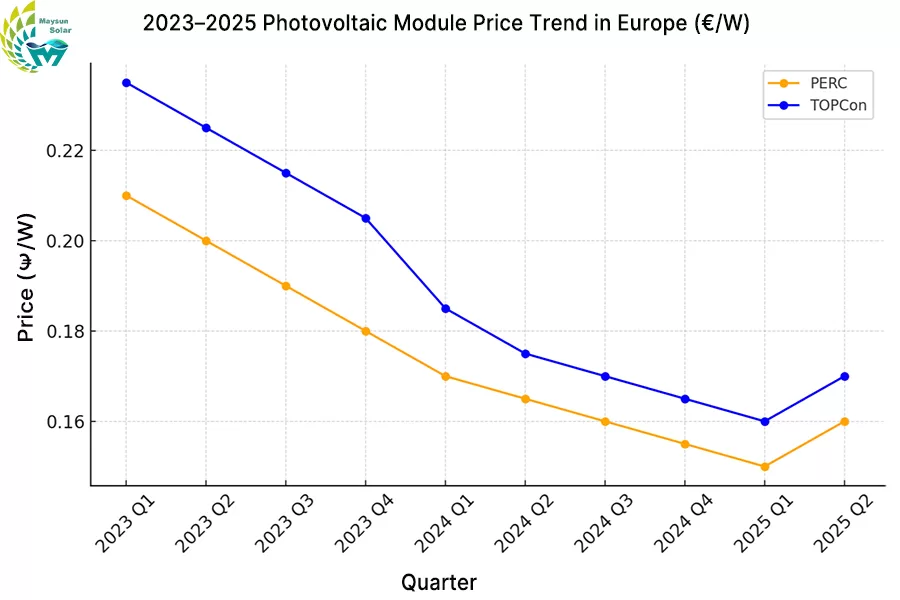
In the second quarter of 2025, the prices of mainstream components in the European market remained stable, ending the continuous downward trend since 2024. According to reports from pvXchange and industry sources, the price of PERC components stabilized at €0.11/W, while TOPCon components were priced around €0.13/W. Compared to the first quarter of 2025, there was a slight rebound, indicating that the market’s supply and demand balance is gradually being restored.
From a long-term perspective, the current price level is still far below the historical highs of 2020–2021. For example, the prices of PERC and TOPCon components have decreased by about 66.4% and 80.8%, respectively, compared to the peak prices in 2020.
This slight price rebound in Q2 is partly due to the demand surge caused by earlier installation rushes, and partly influenced by China’s implementation of production capacity and price control policies in Q2 2025. Leading companies (such as Tongwei, Jinko, LONGi, etc.) have expressed their support for “controlling production capacity and stabilizing prices,” aiming to curb the expansion of low-price capacity. This move prompted European buyers to “lock prices” in advance during Q2 to mitigate potential future price fluctuations.
Overall, although the prices of photovoltaic components remain at a low level, irrational competition has significantly eased, and the European market is entering a phase where the price structure is gradually being restructured and procurement decisions are becoming more rational.
Policy Direction: From Incentive-driven Growth to Structural Optimization
In the second quarter of 2025, photovoltaic policies in major European countries gradually shifted from broad subsidies to structural adjustments. This change not only marks the end of subsidy dependence but also reflects a shift in policy focus towards improving project implementation efficiency and system value transformation capabilities.
Germany’s implementation of the “Solar Peak Act” has led to the cancellation of subsidies for grid electricity during negative price periods, suppressing irrational revenue expectations from electricity generation. At the same time, some federal states have reduced local financial subsidies for balcony solar systems, indicating that policies are beginning to focus on the integration capabilities and grid efficiency of distributed projects, rather than simply increasing installation numbers.
Although Italy did not introduce any new national subsidy policies in Q2 2025, TERNA and GSE have continued to promote transparency in grid capacity management. For example, TERNA has published “capacity maps (Mappe di capacità)” in multiple regions, helping developers assess project feasibility and optimize the grid access application process, providing more predictable policy support for small and medium-sized businesses.
France’s Energy Regulatory Commission (CRE) has officially abolished the full feed-in tariff subsidy mechanism for residential PV systems and shifted towards encouraging a “self-consumption + surplus electricity feeding into the grid” model. To support this transition, tiered incentives have been set up for commercial and industrial PV projects with energy storage, accelerating the development of projects with higher self-consumption ratios.
Overall, the policy direction in Q2 2025 places more emphasis on the system coordination and resource utilization efficiency of projects. Policy objectives are gradually shifting from increasing installed capacity to improving system efficiency, with storage, integrated systems, and self-consumption ratios becoming the key focus areas for policy evaluation and support. Although the policy paths of different countries vary, the overall direction is towards strengthening system efficiency and investment sustainability.
Development Trends: A New Cycle May Begin in the Second Half of the Year
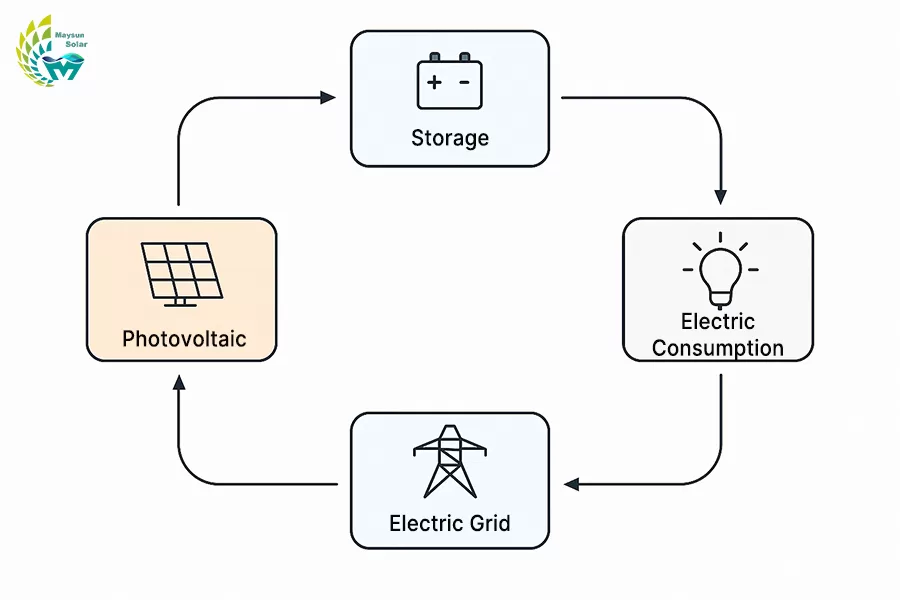
With prices stabilizing, policy focus becoming clearer, and market structures accelerating their differentiation, the European photovoltaic (PV) market is gradually shifting from relying on a single incentive mechanism to a transformation phase centered on structural optimization and system integration. With energy storage subsidies and the promotion of commercial and industrial projects, more integrated PV-storage deployments are expected to emerge in the second half of the year, driving projects to focus more on local electricity consumption and system operation efficiency.
Looking back at Q2 2025, the European PV market has transitioned from a period of rapid expansion to one of structural adjustment. Although the overall installation growth rate has slowed, prices have stabilized, and policies are becoming more focused on system adaptation and resource efficiency. The industry is beginning to enter a more refined and sustainable management model.
Looking ahead to the second half of 2025, as policies are gradually implemented and supply chain structures continue to optimize, the European market is expected to enter a new development cycle focused on long-term returns and project stability. With the gradual implementation of energy storage-related policies, integrated PV and energy storage projects will see more widespread deployment across Europe.
In the second quarter of 2025, the European photovoltaic (PV) market transitioned from rapid expansion to structural optimization and a long-term value orientation. Maysun Solar has been deeply engaged in the European market for many years, continuously optimizing product paths in the fields of high-efficiency modules such as IBC modules, TOPCon modules, and HJT modules, balancing efficiency, environmental adaptability, and system stability. We are committed to providing competitive photovoltaic solutions for corporate clients across different policy and market environments, helping them achieve stable returns in future market cycles.
Reference
SolarPower Europe. EU Market Outlook for Solar Power 2024–2028, Brussels, 2024.
https://www.solarpowereurope.org
pvXchange. Photovoltaic Price Index – Europe Quarterly Trends, 2020–2025. https://www.pvxchange.com
GSE – Gestore dei Servizi Energetici. Rapporto Statistico sul Solare Fotovoltaico in Italia, 2024.
https://www.gse.it
IRENA – International Renewable Energy Agency. Renewable Energy Statistics 2024, Abu Dhabi, 2024.
https://www.irena.org
European Commission. Energy Transition Policy Brief – REPowerEU and Grid Modernisation, Brussels, 2023.
https://energy.ec.europa.eu
Recommend Reading

Low-Carbon PV Procurement in France: Why ECS, PEP Ecopassport and Solar Carports Matter
Table of Contents France is becoming one of Europe’s most documentation-driven solar markets. For EPC companies, developers and commercial project owners, module selection is no longer based only on price-per-watt, efficiency or linear power warranties. Carbon documentation, supply-chain traceability and project-specific compliance files

PV Module Installation Beyond Rooftops: Multi-Scenario Applications for Bifacial N-Type Modules in Europe
PV module installation is not limited to rooftops. For residential users, small commercial users and distributed PV projects in Europe, spaces such as balconies, gardens, fences, carports, terraces, façades and pergolas can also provide additional installation areas when conditions allow. As solar use

Europe’s Grid Cap Era: Why High-Efficiency Solar Panels Matter More in 2026
Introduction In 2026, the economics of distributed solar in Europe are changing. Grid congestion, export limits, negative electricity prices and zero-export requirements mean that a solar project can no longer be judged only by how much electricity it generates. The more important question

How Do Solar Panel Delivery Delays Affect Installer Costs?
Solar panel delivery delays can affect installation schedules, project acceptance and payment collection.

The Forgotten “Invisible Assets”: Why Repowering Is the Strategic Key for European Solar in 2026
As grid congestion delays new solar projects across Europe, existing PV assets are becoming a strategic source of growth. This article explains why PV repowering can help EPCs and C&I asset owners unlock hidden value from already-connected solar plants, improve LCOE, and extend long-term asset performance with high-efficiency TOPCon, IBC and HJT modules.

Solar Panel Procurement in Europe: Why Stable Supply Matters More Than a One-Off Low Price
When European installers, distributors and corporate buyers choose solar panels, a one-off low price should not be the only factor. Stable supply, model continuity, technical documents and replenishment capacity often matter more for long-term cooperation and project delivery.