According to Reuters, by the end of 2025 international silver prices briefly exceeded USD 70 per ounce, representing a cumulative annual increase of more than 130%. This surge has been driven not only by rising industrial demand, but also reflects structural shifts within the precious metals market.
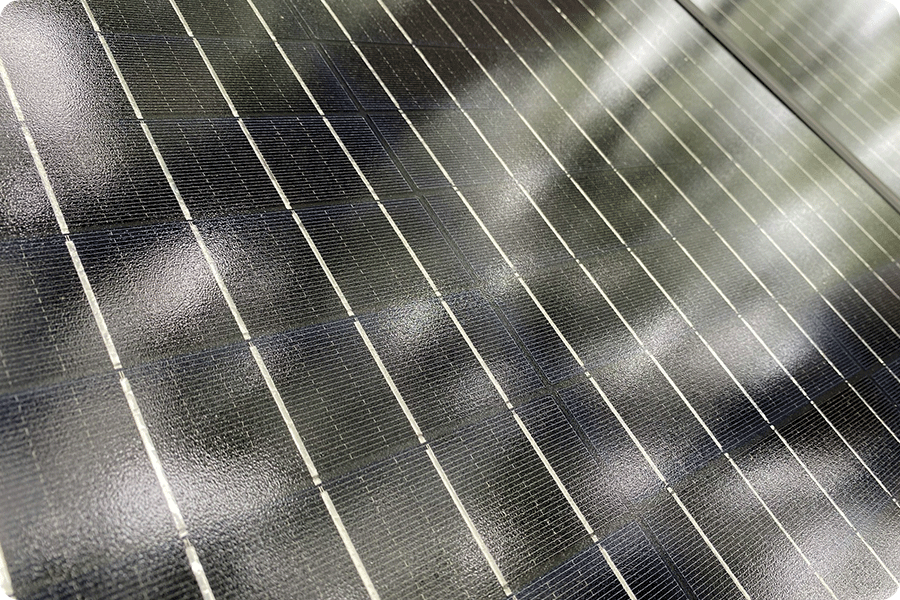
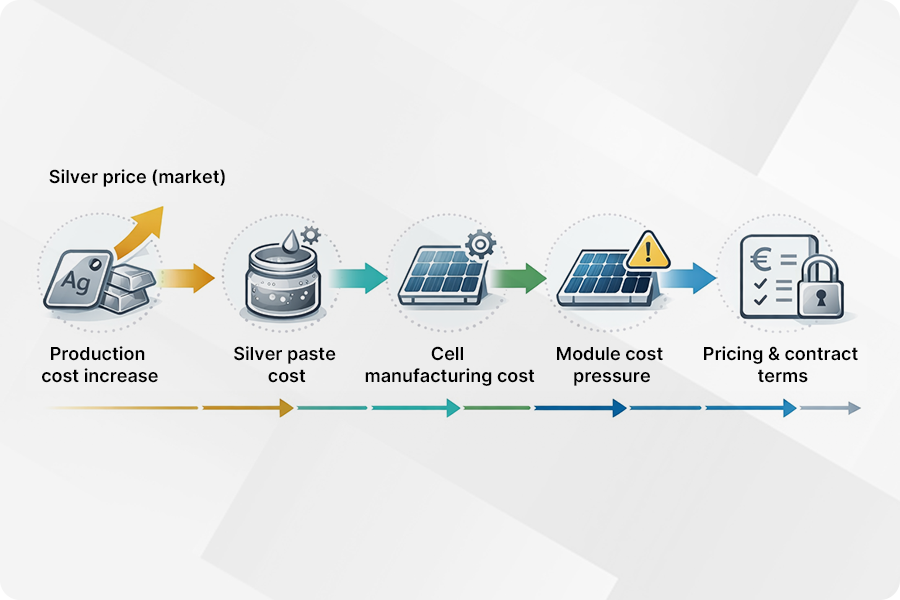
For silver, this rally is not merely a financial-market fluctuation. As a critical material in the metallisation stage of photovoltaic cells, silver is widely used in silver paste, electrodes and current-conduction processes. Changes in silver prices are now materially reshaping the cost structure of solar cells and photovoltaic module manufacturing.
Table of Contents
Silver Price Increases Are Driving Higher PV Module Manufacturing Costs
The current sustained rise in silver prices is not the result of short-term market sentiment, but rather the combined effect of multiple structural factors. While demand for safe-haven assets has increased, industrial demand for silver from the new energy manufacturing sector continues to grow, and limited supply-side flexibility has further intensified upward price pressure.
Against this backdrop, photovoltaic module manufacturing costs have clearly entered an upward trajectory. Cost pressure is first being felt in silver paste and solar cell production. At present, silver paste accounts for around 15% of total module costs, surpassing polysilicon, with these costs increasingly concentrated at the module level. Looking ahead, as global solar installations continue to expand, silver consumption within the photovoltaic industry is expected to remain elevated over the coming years.
From the perspective of module cost structures, silver is not the single largest cost component. However, it is one of the most price-volatile materials and one of the few key raw materials that is difficult to fully substitute in the short term.
When silver prices remain within a relatively stable range, cost fluctuations can typically be absorbed through improvements in manufacturing efficiency or economies of scale.
Once prices continue to rise over a sustained period, these fluctuations inevitably translate into higher cost risks at the manufacturing stage.
Rising Costs Are Being Passed Through to the Module Segment
Under current European market conditions, photovoltaic manufacturers are finding it increasingly difficult to fully absorb fluctuations in raw material costs. As a result, different suppliers are beginning to pass cost pressure downstream through various mechanisms, leading to a shift in pricing logic at the PV module level:
Shorter quotation validity periods: Compared with the longer quotation periods seen in the past, manufacturers are now more inclined to shorten quote validity in order to limit the impact of raw material price volatility on their profit margins.
Stricter price-locking conditions: Conditions for fixing prices have become more stringent, often requiring contract signature or receipt of a deposit before prices can be confirmed. In practice, this represents a clearer transfer of part of the cost risk from manufacturers to buyers.
Earlier risk allocation: As project delivery cycles lengthen or become more complex, cost risks arising from raw material price fluctuations are increasingly being borne by purchasers, rather than being fully absorbed by manufacturers.
These changes are not merely procedural adjustments, but reflect a substantive shift in the PV module pricing system. Rising costs are now being transmitted through multiple pricing mechanisms, rather than being reflected solely in headline list prices.
Pricing Logic Is Shifting: Upward Price Signals Are Being Released in Advance
From an industry perspective, these changes are not isolated cases. Recent market feedback indicates that several leading photovoltaic module manufacturers have already adjusted their quotation strategies for selected product lines. In terms of magnitude, these adjustments correspond to cost increases of approximately €0.02–0.05 per watt.
Notably, these changes have not been fully reflected through public list price increases. Instead, they are first emerging in the pace of quotation updates, shortened validity periods and tighter price-locking conditions. This typically signals that manufacturers have begun to define their cost boundaries, rather than continuing to absorb rising costs internally to maintain previous pricing structures.
Looking at past PV module pricing cycles, when tier-one manufacturers are the first to adjust their pricing strategies, the market has often already entered an early phase of a broader price uptrend. Whether this subsequently translates into widespread list price increases depends more on project demand and delivery schedules than on the mere existence of cost pressure.
For buyers, the key question at this stage is no longer whether higher prices have already appeared on price lists, but rather when and under what conditions prices can still be secured. Once prices move into a phase of concentrated adjustment, the decision-making window for procurement typically narrows significantly.
Technical Responses Face Limitations: Reducing Silver Usage Cannot Immediately Offset Cost Pressure
As silver prices remain at elevated levels, the photovoltaic industry is accelerating efforts to optimise silver consumption and improve manufacturing processes. However, in practice, reducing silver usage is not a solution that can be fully implemented in the short term:
Differences in cell technology pathways and production processes mean that silver-reduction solutions vary significantly in their applicability across different production lines.
Even if silver usage per cell is reduced, overall raw material costs will continue to trend upwards as long as silver prices remain high and volatile.
Maintaining cell performance consistency and long-term reliability remains a top priority for manufacturers, which limits the pace at which more aggressive silver-reduction strategies can be adopted.
As a result, lowering silver consumption should be viewed primarily as a medium- to long-term cost-buffering measure, rather than a means of immediately offsetting the current upward pressure on manufacturing costs.
Conclusion: Procurement Decisions Need to Move Earlier as the Price Increase Window Narrows
Based on current market conditions and evolving cost structures, it is increasingly clear that upward pressure on photovoltaic module prices is no longer a future possibility, but an ongoing process. While the pace of change varies across markets and product lines, the overall direction is becoming progressively clearer.
For companies with defined project pipelines and procurement requirements, the focus has shifted away from waiting for visible price movements towards assessing how to secure more favourable cost terms and delivery arrangements within the current pricing framework. In an environment characterised by shorter quotation validity periods and tighter price-locking conditions, delaying procurement decisions itself carries higher price and risk costs.
For further analysis of price trends or delivery timelines based on specific projects, product lines and current quotation conditions, please feel free to contact our team to obtain insights and recommendations that more closely reflect real market dynamics.
Maysun Solar has a long-established presence in the European market, supplying wholesale and distribution partners with PV modules across multiple technologies, including IBC technology, TOPCon technology, and HJT technology. As pricing and delivery conditions tighten, we focus on helping partners secure greater certainty on prices and delivery at the right time.
Reference
Reuters. Silver quietly outperforms gold as precious metal rally accelerates. 2025. https://www.reuters.com/markets/commodities/silver-quietly-outperforms-gold-precious-metal-podium-2025-11-27
Fraunhofer ISE developing heterojunction solar cells with silver consumption below 2 mg/W.2025. https://www.pv-magazine.com/2025/04/17/fraunhofer-ise-developing-heterojunction-solar-cells-with-silver-consumption-of-less-than-2-mg-per-w/
pv-magazine.com. Silver prices surge, yet ‘thrifting’ poses little threat to solar cell, module quality. Oct 9, 2025. https://www.pv-magazine.com/2025/10/09/silver-prices-surge-yet-thrifting-poses-little-threat-to-solar-cell-module-quality/
pv-magazine.com. Silver price surge drives PV makers to cut silver usage further. Sep 26, 2025. https://www.pv-magazine.com/2025/09/26/silver-price-surge-drives-pv-makers-to-cut-silver-usage-further/
Recommend reading

Low-Carbon PV Procurement in France: Why ECS, PEP Ecopassport and Solar Carports Matter
Table of Contents France is becoming one of Europe’s most documentation-driven solar markets. For EPC companies, developers and commercial project owners, module selection is no longer based only on price-per-watt, efficiency or linear power warranties. Carbon documentation, supply-chain traceability and project-specific compliance files

PV Module Installation Beyond Rooftops: Multi-Scenario Applications for Bifacial N-Type Modules in Europe
PV module installation is not limited to rooftops. For residential users, small commercial users and distributed PV projects in Europe, spaces such as balconies, gardens, fences, carports, terraces, façades and pergolas can also provide additional installation areas when conditions allow. As solar use

Europe’s Grid Cap Era: Why High-Efficiency Solar Panels Matter More in 2026
Introduction In 2026, the economics of distributed solar in Europe are changing. Grid congestion, export limits, negative electricity prices and zero-export requirements mean that a solar project can no longer be judged only by how much electricity it generates. The more important question

How Do Solar Panel Delivery Delays Affect Installer Costs?
Solar panel delivery delays can affect installation schedules, project acceptance and payment collection.

The Forgotten “Invisible Assets”: Why Repowering Is the Strategic Key for European Solar in 2026
As grid congestion delays new solar projects across Europe, existing PV assets are becoming a strategic source of growth. This article explains why PV repowering can help EPCs and C&I asset owners unlock hidden value from already-connected solar plants, improve LCOE, and extend long-term asset performance with high-efficiency TOPCon, IBC and HJT modules.

Solar Panel Procurement in Europe: Why Stable Supply Matters More Than a One-Off Low Price
When European installers, distributors and corporate buyers choose solar panels, a one-off low price should not be the only factor. Stable supply, model continuity, technical documents and replenishment capacity often matter more for long-term cooperation and project delivery.


The point about silver reduction having limited short-term impact is important.
Process optimisation helps over time, but it does not remove the immediate cost exposure when raw material prices stay volatile.
For buyers, this makes quotation structure and timing just as relevant as nominal module prices.
This aligns with what we are seeing in recent quotations.
Even without visible list price increases, shorter validity periods and tighter price-locking conditions are already changing how procurement decisions are made.
The cost pressure seems to be moving through commercial terms first, rather than headline prices.