
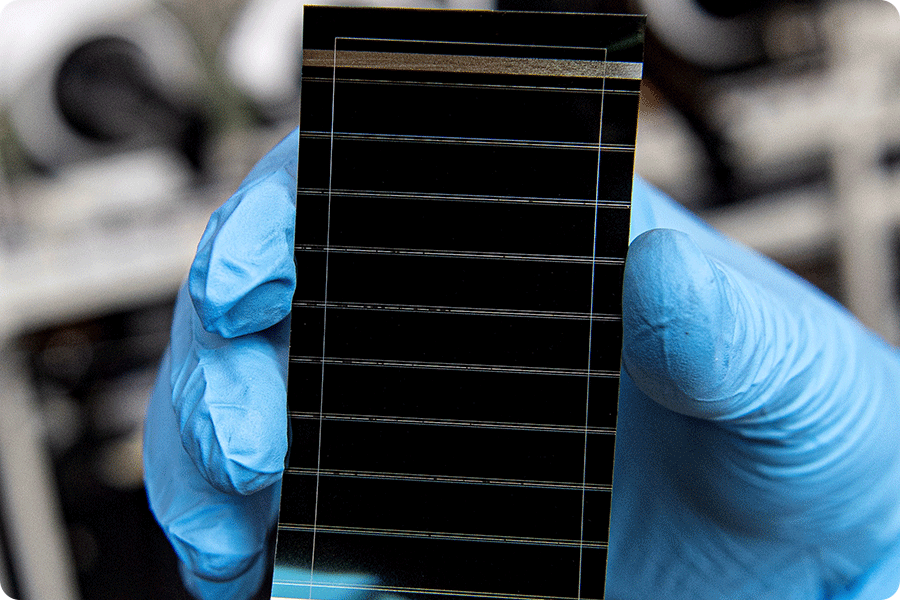
From an engineering and system-level perspective, this article examines the practical role of perovskite solar technology within the photovoltaic sector. It explains the reasons behind the rapid rise in perovskite PV efficiency under laboratory conditions, as well as the key barriers it faces in real-world PV systems. Considering the industry landscape up to 2026, mature silicon-based PV technologies remain the more viable option for commercial projects, while perovskite PV is better viewed as a medium- to long-term research direction rather than an immediately deployable solution.
Table of Contents
What Is Perovskite in the Photovoltaic Context?
In the photovoltaic industry, perovskite does not refer to a single, specific material. Instead, it describes a class of materials defined by a particular crystal structure.
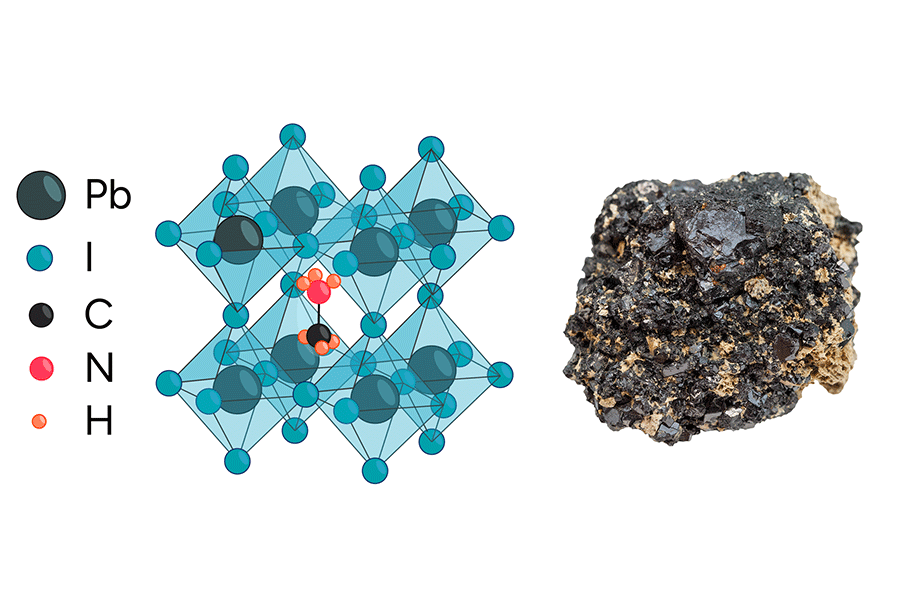
The term “perovskite” originates from the natural mineral perovskite (such as CaTiO₃), characterised by an ABX₃ crystal structure. In photovoltaics, synthetic perovskite materials are designed around this structural framework and have attracted attention primarily because of their strong light-absorption properties.
Over the past decade, perovskite materials have demonstrated relatively high power conversion efficiency under laboratory conditions. Compared with conventional silicon-based materials, they offer greater flexibility in device design and fabrication pathways, which has accelerated technological iteration at the research stage.
In today’s industry context, however, perovskite is still largely regarded as a research-oriented material system. Most discussions focus on material properties and laboratory test results, rather than on an engineering technology that has undergone long-term operational validation and can be directly deployed in real-world photovoltaic systems.
Why Has Perovskite Solar Cell Efficiency Improved So Rapidly?
The rapid improvement in perovskite solar cell efficiency is largely driven by their strong light absorption and relatively low energy losses under laboratory conditions. However, these advantages are highly dependent on ideal, controlled testing environments.
When perovskite materials were first used for solar power generation in 2009, the reported conversion efficiency was only 3.8%. Over the following decade, continuous optimisation of material systems and device architectures pushed laboratory-scale perovskite PV efficiency beyond 25%.
In recent years, research into perovskite–silicon tandem structures has brought conversion efficiencies close to 30% under controlled test conditions.
Such a rapid efficiency gain is uncommon in the evolution of photovoltaic technologies and helps explain why perovskite has long been regarded as a high-potential research pathway.
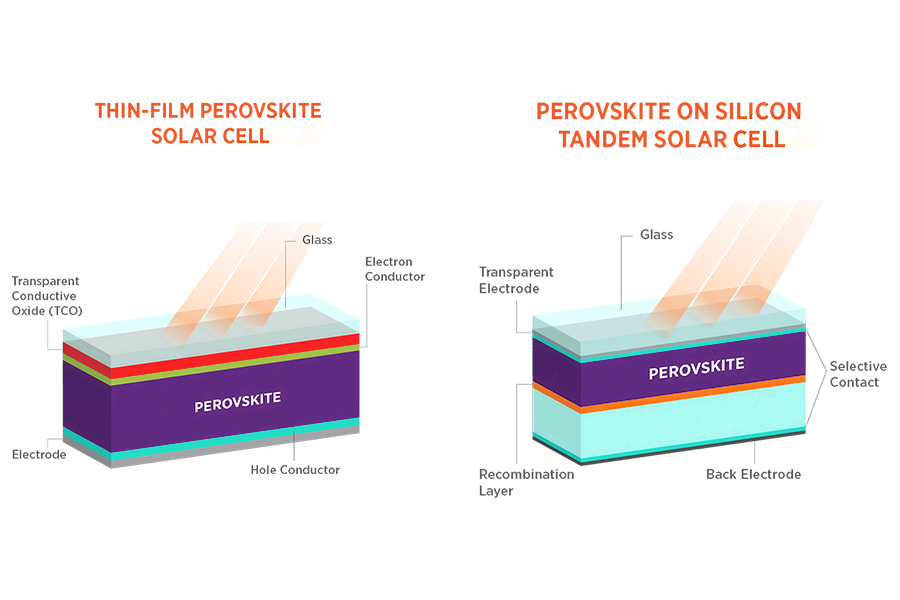
The diagram illustrates two main structural approaches in perovskite solar technology:
On the left, a fully perovskite-based thin-film cell structure, primarily used for laboratory efficiency research;
On the right, a perovskite–silicon tandem structure, which more closely reflects the direction currently explored by industry.
Under laboratory conditions, perovskite cells tend to achieve high headline efficiencies mainly due to several technical factors:
Strong light absorption: Perovskite materials can absorb most incident light within very thin device layers, enabling rapid efficiency gains in experimental settings.
High tunability of device structure and materials: During the research phase, perovskite cell architectures and parameter combinations are highly flexible, allowing fast iteration and optimisation.
Compatibility with silicon tandem concepts: Perovskite is often combined with silicon in tandem configurations to surpass the efficiency limits of single-material devices under laboratory conditions.
It is important to note that these advantages largely apply to laboratory or tightly controlled test environments. They do not reflect the complex operating conditions that real-world photovoltaic systems must withstand over long-term deployment.
Why Are Perovskite Technologies Rarely Seen in Real-World PV Systems?
Despite their impressive efficiency performance under laboratory conditions, perovskite technologies still face multiple practical barriers when it comes to deployment in real-world photovoltaic systems.
Image source: Wikimedia Commons
At this stage, perovskite technology remains difficult to scale for commercial deployment, mainly due to several system-level constraints:
Long-term operational stability has not yet been validated at an engineering level: Real-world PV systems are typically designed for stable operation over 20–25 years. Under complex conditions such as high temperatures, heat and humidity, UV exposure, and day–night cycling, perovskite materials still show clear degradation risks. Most available data is based on short-term or controlled testing and is insufficient to meet long-term engineering requirements.
Device consistency and large-scale reproducibility remain unproven: While high efficiencies can be achieved in laboratory settings, there is still limited evidence that these performance levels can be reliably reproduced in large-area modules and mass production. This directly affects quality control and long-term operational risk assessment.
Certification, insurance, and financing frameworks are not yet aligned: The mainstream PV market has established mature standards and risk evaluation systems around silicon-based modules. Perovskite technology, by contrast, lacks widely accepted long-term validation, making it difficult to secure financial backing and insurance coverage.
System-level reliability and full life-cycle performance remain uncertain: Commercial PV projects are assessed not only on initial efficiency but also on degradation trajectories, maintenance costs, and output stability over more than two decades. Until these indicators are sufficiently validated, perovskite is better suited to research or demonstration stages rather than routine commercial deployment.
As of 2026, What Should Companies Focus on Instead?
In practical projects, mature silicon-based PV technologies remain the more viable option today, while perovskite is better viewed as a medium- to long-term research direction rather than a near-term solution.
From a project perspective, the viability of any photovoltaic technology depends on its ability to deliver stable, predictable, and bankable energy output over long operating periods. At present, perovskite technology remains largely confined to research and demonstration stages and has not yet completed the engineering validation required for routine commercial deployment.
For companies, a more prudent approach is to prioritise silicon-based technologies with established supply chains and proven operating track records, while continuing to monitor developments in perovskite PV.
So far, there is no clear policy or subsidy framework that supports the scalable commercial rollout of perovskite modules. In the absence of long-term operating data, a widely accepted understanding of degradation behaviour, and a mature risk assessment framework, it is difficult to base cost assumptions or LCOE calculations on stable, repeatable engineering models.
As of 2026, there is no strong evidence to suggest that perovskite will replace mature silicon-based photovoltaic technologies in the short term. A more realistic assessment is that technology selection for commercial PV systems will continue to prioritise long-term reliability and controlled risk as the core decision criteria.
Maysun Solar is a PV modules manufacturer and supplier serving the European market, with solutions based on mature silicon technologies such as IBC technology, TOPCon technology, and HJT technology. These engineering-validated routes help projects manage operational risk early on while meeting practical engineering and compliance requirements.
Reference
National Renewable Energy Laboratory. (2025). Best Research-Cell Efficiency Chart. U.S. Department of Energy. https://www.nrel.gov/pv/cell-efficiency.html
Fraunhofer Institute for Solar Energy Systems ISE. (2024). Photovoltaics Report. https://www.ise.fraunhofer.de/en/publications/studies/photovoltaics-report.html
Helmholtz-Zentrum Berlin. (2023). Perovskite–silicon tandem solar cell research. https://www.helmholtz-berlin.de
Recommend reading

How Important Is the Temperature Coefficient When Choosing a Solar Panel?
How important is temperature coefficient when choosing a solar panel? This article answers that question directly and explains which projects should include it in early screening and which do not need to treat it as a top priority.

When does HJT bifacial gain pay off on European rooftops, and when is IBC the better option?
When do HJT bifacial solar panels generate stronger returns on European rooftop projects, and when should IBC solar panels take priority?

Which homes are suitable for garden solar?
Which homes are suitable for garden solar? Assess space, shading, orientation and electricity-use goals to quickly judge whether garden solar is a suitable option.

Are Differences Between Solar Panels More Noticeable in High-Temperature Conditions?
High temperatures reduce solar panel efficiency, but the gap in summer power generation is not determined by temperature alone. This article compares the high-temperature performance of HJT, TOPCon and IBC, and explains how businesses should choose.

Why Have N-Type TOPCon Solar Panels Become the Market Mainstream?
N-type TOPCon solar panels have become one of the mainstream photovoltaic technologies thanks to their strong balance of efficiency, cost and mass-production maturity. This article briefly explains their structural features, practical advantages and typical application scenarios.

April News from the European Solar Industry
The European solar market is showing clear signs of recovery: system value is being reaffirmed, German auction prices are stabilising, Italy’s rules are becoming clearer, and revenue certainty in France is improving.


Good read. The efficiency numbers are impressive, but in real projects that’s never the whole story.
From what I’ve seen, the missing piece is still long-term behaviour under real operating conditions. Without solid data on degradation, stability and bankability, it’s hard to justify perovskite outside of R&D or pilot projects.
For now, sticking with mature silicon tech while keeping an eye on perovskite developments feels like the sensible path.