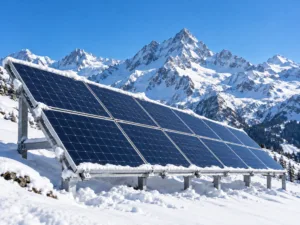
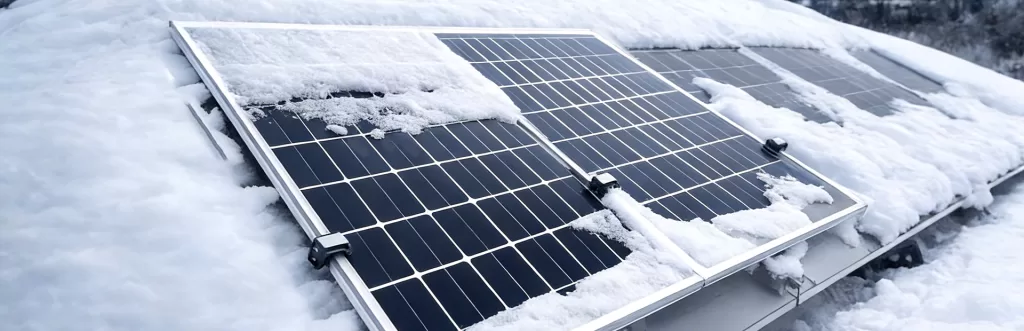
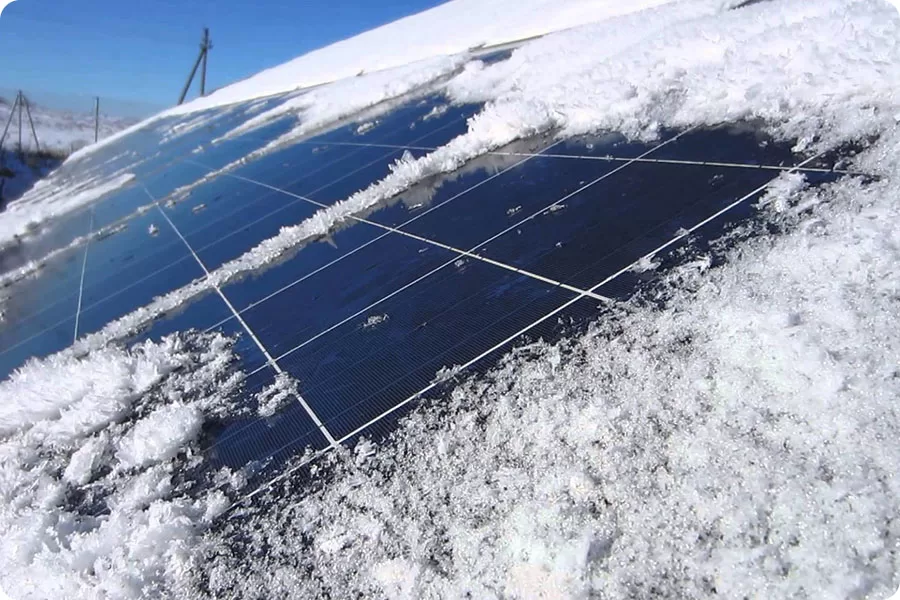
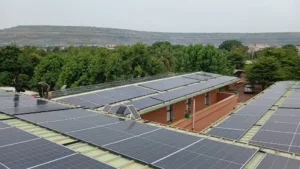
In recent years, many regions across Europe have experienced more frequent heavy snowfall and prolonged low temperatures during winter, making the operation of photovoltaic systems under complex winter conditions increasingly common. Unlike high-irradiance summer conditions, winter-related risks are often not immediately apparent. However, snow accumulation, low temperatures, and repeated freeze–thaw cycles can continuously alter the load conditions acting on solar panels during operation.
Against the backdrop of the widespread adoption of high-power modules and the ongoing increase in module dimensions, these effects are more likely to amplify the differences between various structural designs and installation approaches, ultimately influencing long-term system reliability.
Table of Contents
What challenges do PV systems face under extreme winter conditions?
Under extreme winter conditions, the challenges faced by photovoltaic systems are not driven by a single factor, but by the combined operational stress resulting from multiple environmental influences acting simultaneously.
In practical operation, winter-related challenges mainly concentrate in the following areas:
1.1 Continuous snow load pressure
The impact of snow is not limited to irradiance shading; more importantly, it lies in the sustained weight load it imposes. Unlike wind loads or short-term impacts, snow loads typically remain on the surface of solar panels for extended periods, keeping modules and supporting structures under continuous stress.
This type of long-term pressure is particularly sensitive to module size, load transfer paths, and the rationality of fixing methods.
1.2 Load differences caused by uneven snow distribution
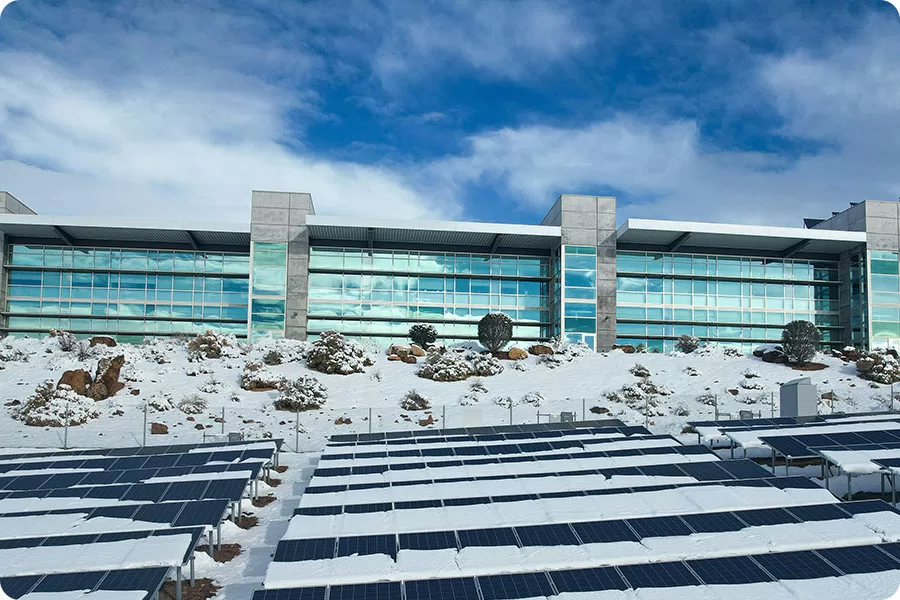
In real-world scenarios, snow rarely covers the entire module surface uniformly. Roof pitch, wind direction, surrounding obstructions, and module layout all contribute to variations in snow thickness.
Such uneven loading is more likely to cause local deformation or stress concentration, and is often difficult to identify through visual inspection alone.
1.3 Repeated effects of melting and refreezing
Winter conditions are not characterised by consistently low temperatures. The recurring cycle of snow melting during the day and refreezing at night continuously alters the load conditions acting on the module surface.
This cyclic effect can amplify initially minor structural differences, causing the system to endure repeated and fluctuating stresses over time.
1.4 Impact of low temperatures on materials and connection points
At low temperatures, the mechanical properties and deformation behaviour of different materials change. Modules, frames, and connection points continuously adjust due to thermal expansion and contraction.
When low temperatures are combined with snow loads, these effects are more likely to influence overall system stability.
1.5 Delayed manifestation of risk
It is worth noting that these effects rarely result in immediate, visible failures after a single extreme weather event.
More often, they accumulate gradually through repeated winter conditions and eventually manifest as system-level reliability issues during long-term operation.
How does module structural design affect snow-load reliability?
2.1 Load transfer paths of snow loads within the module structure
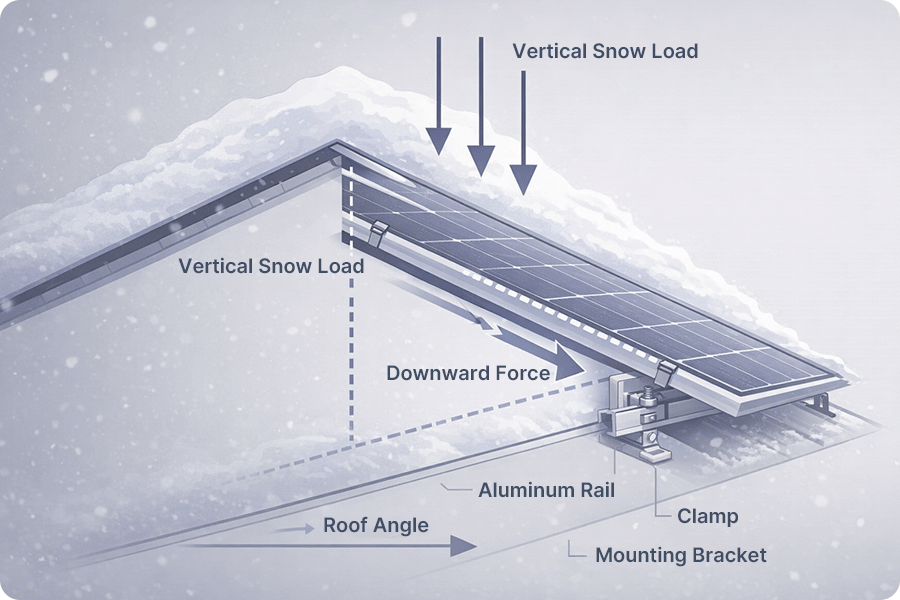
Under winter conditions, the load generated by snow does not remain solely on the surface of the module. Instead, it is transmitted progressively downward along predefined structural paths. This transfer process determines whether snow loads are evenly distributed or amplified at specific locations.
In general, the load transfer path of snow includes:
The module glass surface bearing the initial vertical pressure
The load being transferred through the encapsulation layers to the frame
The frame further transferring the load to the fixing points and supporting structure
If the structural design provides a continuous load transfer path with clear force distribution, snow loads are more likely to be dispersed across multiple structural elements. Conversely, if structural weak points or interruptions in the load path exist, loads are more likely to concentrate locally, increasing the risk of deformation or long-term fatigue.
2.2 Influence of frame design and stiffness distribution on deformation resistance
Under prolonged snow loads, whether a module undergoes irreversible deformation essentially depends on the overall bending stiffness provided by the frame system and how this stiffness is distributed across the module.
Beyond its role in encapsulation and protection, the frame’s cross-sectional geometry, orientation, and interaction with the glass layers directly determine how effectively structural stiffness is mobilised under snow loads.
When a module is subjected to snow pressure:
Structures with uniformly distributed stiffness are better able to share loads across the entire module
Areas with abrupt stiffness changes or insufficient local bending resistance are more likely to become initiation points for deformation
Such structural differences can more easily lead to local deformation during loading and affect the stability of internal module structures and connection points.
2.3 Fixing point layout determines how loads are shared
Under snow loads, the uniformly distributed load acting on a module is not absorbed evenly by the module as a whole. Instead, it is converted into a series of discrete support reactions through the fixing points. As a result, the number, position, and spacing of fixing points directly determine how snow loads are shared within the structure.
From an engineering estimation perspective, the total vertical load acting on a module under snow conditions can be approximated as:
Snow load ≈ snow load intensity × module area (F ≈ q × A)
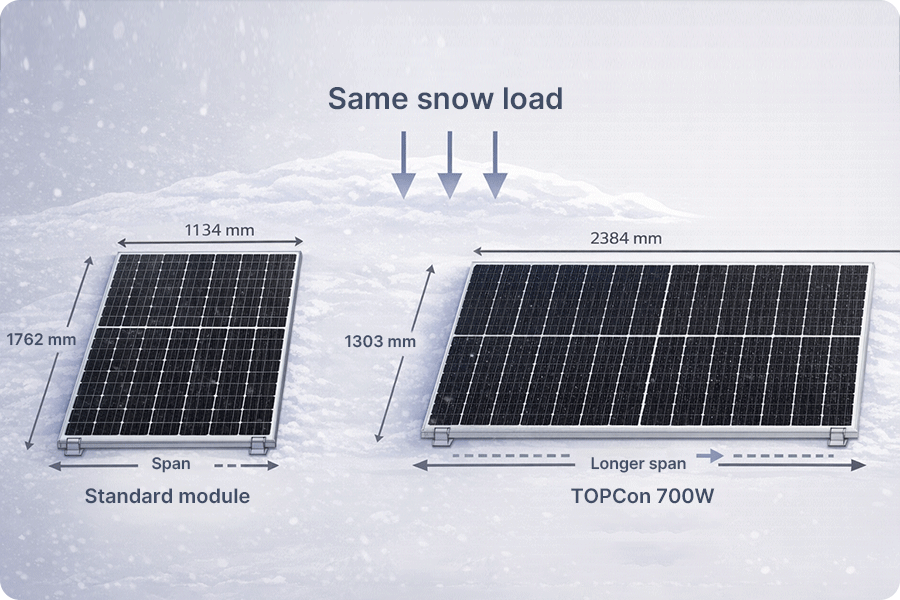
In real operation, differences caused by fixing point layouts are often further amplified during structural loading. As the spacing between fixing points increases, the effective span of the module also increases, making bending moment peaks more likely to concentrate in the central area of the module.
When snow distribution becomes uneven, these structural characteristics further amplify load differences between fixing points, causing local areas to enter high-stress conditions first. If structural design does not adequately account for winter loads, even under the same snow load intensity, the module’s sensitivity to uneven snow loading can increase significantly.
Why are large-format modules more likely to expose issues in winter?
After understanding how module structure and fixing methods influence snow-load performance, changes in module size often determine whether these structural differences are truly amplified.
As module power ratings have expanded into the 410–800 W range, both module dimensions and single-module weight have increased significantly. This shift has become a structural variable that can no longer be ignored in PV system design. Under extreme winter conditions, it does not create new problems, but rather reveals existing structural sensitivities earlier and more clearly.
Taking today’s mainstream TOPCon bifacial double-glass modules as an example, higher-power variants typically correspond to larger geometrical dimensions and greater unit weight. In practical projects, such modules often approach or exceed 2 m in length, with widths of around 1.3 m. Compared with earlier 410–450 W modules, their single-module weight is typically 25–35% higher. When these modules are simultaneously subjected to snow loads, self-weight, and support reactions during winter operation, the load scale faced by the frame, fixing points, and supporting structure is fundamentally different from that of smaller-format modules.
To better illustrate when large formats begin to amplify issues, current mainstream modules can be grouped into three engineering scale ranges based on geometric size and unit weight:
Approx. 1.7 m class, 20–25 kg range (e.g. 410–450 W):
Corresponding to traditional medium-sized modules, with shorter load paths and relatively high tolerance to installation deviations and structural non-uniformity. Winter risks are more likely to manifest on the energy yield side.Approx. 2.2 m class, 30–36 kg range (e.g. 550–650 W):
As module length and weight increase, the effective span between fixing points is enlarged. Mid-span deflection and local load differences begin to emerge, and system sensitivity to structural matching and installation accuracy increases noticeably.Above approx. 2.35 m, approaching 40 kg (e.g. 700 W and above):
At this scale, loads must be transferred over longer structural paths. Once uneven snow accumulation or local snow build-up occurs, load amplification is more likely in central areas and near fixing points, causing winter-related structural sensitivity to appear earlier.
Therefore, large-format modules tend to “expose issues” more readily in winter not because of higher power ratings, but because the simultaneous increase in size and weight significantly reduces the system’s tolerance to structural mismatch, installation deviations, and uneven loading. When systems continue to rely on structural assumptions developed for small- and medium-format modules, these differences are more easily amplified during winter operation.
3.1 When large-format modules become mainstream, how should engineering assumptions be adjusted?
Once module size and weight enter a new range, engineering assumptions originally developed for small and medium-sized modules can no longer fully describe their load behaviour. If existing design logic is maintained, winter conditions are more likely to reveal structural sensitivity prematurely, rather than representing true “overloading”.
From an engineering perspective, large-format modules do not introduce entirely new types of risk. Instead, they place higher demands on several previously implicit design assumptions, primarily in three areas: effective span length, the combined baseline of self-weight and snow loads, and the system’s tolerance to installation deviations.
When these assumptions are not adjusted accordingly, winter environments tend to amplify structural differences first, causing stability issues to emerge earlier during system operation.
How can winter operating risks in PV systems be reduced?
Under extreme winter conditions, the reliability of a photovoltaic system does not depend on any single parameter, but rather on the overall alignment between module selection, structural design, and installation decisions. Compared with post-failure remediation, identifying and evaluating key variables at an early project stage is generally more effective and more cost-efficient.
4.1 Treat module size explicitly as a structural parameter during selection
When module power ratings extend into the 410–800 W range, module dimensions are no longer merely considerations for transport or installation. Instead, they should be regarded as key design parameters that directly influence structural loading.
In winter environments, particular attention should be paid to:
The relationship between module length, width, and fixing point spacing
The combined effect of module self-weight and snow loads on frames and supporting structures
Whether specific structural adaptation guidance or application experience exists for large-format modules
System designs should avoid simply applying fixing concepts originally developed for smaller modules.
4.2 Prioritise reducing span sensitivity in structural and fixing design
Under snow load conditions, structural risks tend to emerge first in areas with larger effective spans. At the system design stage, structural sensitivity can be reduced by:
Optimising the number and positioning of fixing points to avoid excessive effective spans
Ensuring that the stiffness of the supporting structure matches the module size class
Avoiding overly rigid structural layouts in areas prone to uneven snow accumulation
The objective is not to maximise safety margins, but to enable loads to be distributed and transferred more evenly.
4.3 Control installation tolerances during construction
For large-format modules, even minor installation deviations are more likely to be amplified under winter conditions. Compared with relying on adjustments during operation, control at the installation stage is particularly critical:
Ensuring that fixing point positions, levelness, and symmetry meet design requirements
Avoiding the introduction of additional local stresses due to installation errors
Assessing potential snow accumulation and sliding paths in advance on complex roofs or edge areas
Installation quality itself is an integral part of winter system reliability.
4.4 Shift the focus from “compliance” to “long-term stability”
In extreme winter environments, meeting design standards represents only the baseline, not the endpoint. For systems using high-power, large-format modules, more meaningful evaluation criteria include:
Whether the structure retains sufficient stability margins over multiple winter cycles
Whether there are potential paths for long-term stress concentration or fatigue accumulation
Whether the system can maintain controlled structural responses under non-uniform loading conditions
This shift in thinking—from short-term load capacity to long-term operational stability—is often critical to reducing winter-related risks.
Winter operating risks are not triggered by a single factor, but by the combined interaction of structure, size, and environmental conditions. By identifying and addressing these variables during module selection, structural design, and installation, the reliability of photovoltaic systems under extreme winter conditions can be significantly improved and effectively controlled.
Maysun Solar provides solar panels for the European market across multiple technologies, including IBC technology, TOPCon technology, and HJT technology, covering different size classes and application scenarios. Module selection focuses on structural compatibility, installation conditions, and long-term operational performance, supporting a balanced approach to power output, structural requirements, and system reliability.
Recommend reading

How Important Is the Temperature Coefficient When Choosing a Solar Panel?
How important is temperature coefficient when choosing a solar panel? This article answers that question directly and explains which projects should include it in early screening and which do not need to treat it as a top priority.

When does HJT bifacial gain pay off on European rooftops, and when is IBC the better option?
When do HJT bifacial solar panels generate stronger returns on European rooftop projects, and when should IBC solar panels take priority?

Which homes are suitable for garden solar?
Which homes are suitable for garden solar? Assess space, shading, orientation and electricity-use goals to quickly judge whether garden solar is a suitable option.

Are Differences Between Solar Panels More Noticeable in High-Temperature Conditions?
High temperatures reduce solar panel efficiency, but the gap in summer power generation is not determined by temperature alone. This article compares the high-temperature performance of HJT, TOPCon and IBC, and explains how businesses should choose.

Why Have N-Type TOPCon Solar Panels Become the Market Mainstream?
N-type TOPCon solar panels have become one of the mainstream photovoltaic technologies thanks to their strong balance of efficiency, cost and mass-production maturity. This article briefly explains their structural features, practical advantages and typical application scenarios.

April News from the European Solar Industry
The European solar market is showing clear signs of recovery: system value is being reaffirmed, German auction prices are stabilising, Italy’s rules are becoming clearer, and revenue certainty in France is improving.


Good read. The part about large modules having much less tolerance for uneven snow load and small installation errors matches what we see on site in winter. Issues usually don’t show up after one snowfall, but after several freeze–thaw cycles. This explains that very clearly without overcomplicating it.