
Table of Contents
Common Standard Sizes of Solar Panels: Typical Specifications for 430W, 550W and 600W
In recent years, the mainstream power classes in the European rooftop PV market have stabilised around 430W, 550W and 600W.
While different technologies (such as TOPCon, IBC and HJT) vary in detailed parameters, the dimensions and weight of these core power classes have become relatively standardised.
This level of standardisation improves layout efficiency and reduces uncertainty during system design when selecting between different module models.
Standard Dimensions of Mainstream Power Classes
| Power Class | Typical Dimensions | Weight | Common Applications | Wafer Size / Structural Features |
|---|---|---|---|---|
| 420–460W | 1,720–1,780 × 1,130–1,140 mm | 20–24 kg | Residential, small rooftops | 182 mm, mid-size module, suitable for residential layouts |
| 540–560W | 2,250–2,300 × 1,130–1,140 mm | 26–32 kg | Commercial and industrial rooftops | 182–210 mm, medium-large format, commonly used in C&I projects |
| 580–610W | 2,300–2,400 × 1,130–1,140 mm | 30–33 kg | Large factories, warehouses, ground-mounted systems | 210 mm, large-format module, suited for spacious sites |
Note: These ranges are based on standardised products from major European brands. Thickness and glass configurations may vary slightly by model, but this has minimal impact on size assessment.
- 430W (420–460W): Still the mainstream choice for European residential rooftops. Typical modules measure 1.72–1.78 m in length and weigh 20–24 kg. Their flexibility makes them effective in layouts involving skylights, chimneys or other obstructions.
- 550W (540–560W): Common in commercial and industrial (C&I) projects. With dimensions of around 2.25–2.30 m × 1.13–1.14 m and a weight of 26–32 kg, they help reduce the number of panels required per installed kilowatt.
- 600W (580–610W): Widely used on large factory and warehouse roofs. The higher output per panel increases installation efficiency, but the larger format requires clearer structural verification regarding roof load capacity and mounting system span—making them more suitable for spacious, structurally defined rooftops.
How Much Roof Area Is Required for 1 kWp? (Examples for 5/10/15 kW)
In European rooftop PV projects, the roof area required for 1 kWp is rarely calculated with absolute precision. Instead, installers rely on commonly accepted industry ranges based on module dimensions, spacing requirements and usable roof area.
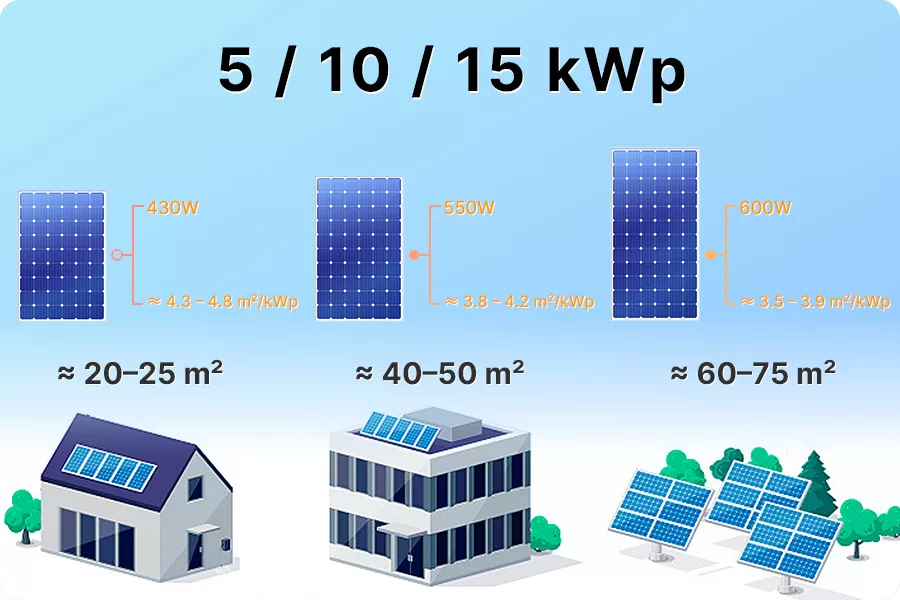
For different power classes, the typical area demand (m²/kWp) is as follows:
-
430W modules: approx. 4.3–4.8 m²/kWp
-
550W modules: approx. 3.8–4.2 m²/kWp
-
600W modules: approx. 3.5–3.9 m²/kWp
Using these reference values, the approximate roof area required for different system sizes is:
-
5 kW system: approx. 20–25 m²
-
10 kW system: approx. 40–50 m²
-
15 kW system: approx. 60–75 m²
Residential rooftops typically fall near the upper end of each range, while factory and commercial roofs tend to sit nearer the lower end. If the roof includes skylights, chimneys, vents or parapet walls, it is safer to use the upper range — or slightly above — when estimating required area.
In practice, the net usable area is often lower than the total roof area. Space must be reserved for edges, walkways and obstruction avoidance, which is why roof area calculations are generally presented as ranges rather than fixed values.
Module Weight: Differences Between 430W and 550W Panels
In rooftop PV projects, module weight is not the only factor influencing system design, but it has a direct impact on roof load assessment, mounting selection and installation efficiency.
Typical weights for mainstream power classes are:
-
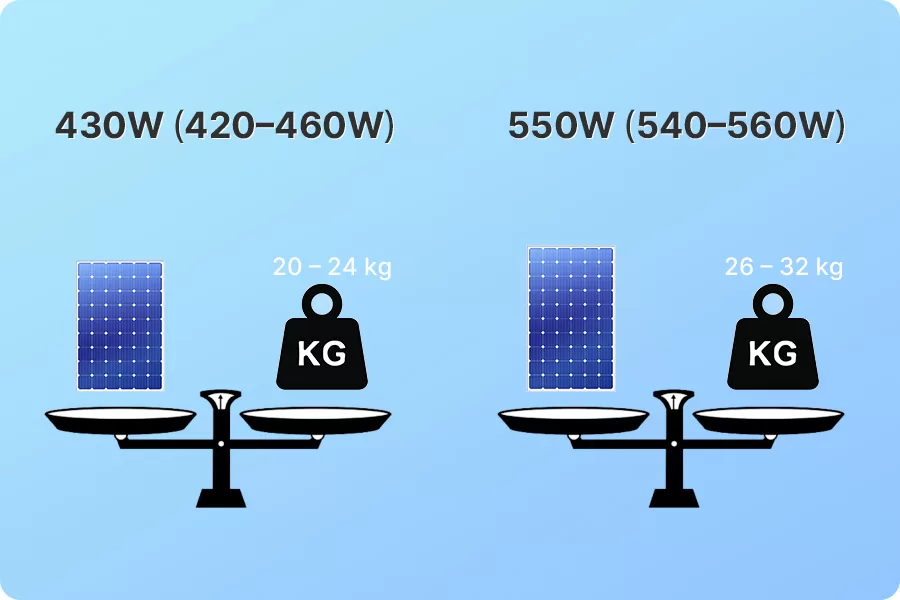
430W (420–460W): 20–24 kg
-
550W (540–560W): 26–32 kg
Because 430W modules are lighter, they work better on tiled roofs, steeper roofs or buildings with limited load-bearing capacity. In contrast, 550W modules are larger and typically 3–8 kg heavier, but for spacious C&I rooftops this difference can usually be compensated for through stronger mounting systems and clear structural load verification.
In engineering practice, considerations extend beyond the weight of the module itself and include:
-
Static load of modules + mounting system
-
Wind and snow load requirements
-
Additional weight introduced by mounting methods (clamps, ballast, rails)
Residential and lightweight roofs are more sensitive to weight constraints, whereas commercial and industrial roofs — where structural capacity is clearly defined — offer far greater flexibility. For older concrete roofs, timber structures or buildings that have undergone historical renovation, verifying the roof’s load limit (kN/m²) is recommended before finalising module selection to avoid redesign due to weight restrictions.
Large-format modules offer clear advantages on structurally robust, expansive rooftops. However, where layout is constrained or load margins are limited, mid-size modules remain the preferable option. Future market trends are likely to see module selection become increasingly roof-specific, rather than one single size replacing all others.
Conclusion: Trends in Module Size and Power Classes
In recent years, the evolution of solar panels has shifted from simply pursuing higher power output to focusing on suitability for different roof structures.
-
Large-format modules will continue to expand their use on commercial and industrial rooftops where structure and available area are clearly defined.
-
Mid-size, lightweight modules will remain in long-term demand for residential and lightweight roofs.
In the European market, future system design will be determined by roof conditions, load capacity and layout efficiency. Selecting module dimensions that match the roof structure will remain essential for ensuring long-term system performance and reliability.
As a module supplier with extensive experience in the European rooftop market, Maysun Solar has gathered substantial real-world data on module size compatibility across different roof types. Our 420W–725W modules range meets the requirements of various rooftops, offering well-established matching strategies that balance load limits, layout efficiency and long-term degradation performance.
Recommend reading

Europe’s Grid Cap Era: Why High-Efficiency Solar Panels Matter More in 2026
Introduction In 2026, the economics of distributed solar in Europe are changing. Grid congestion, export limits, negative electricity prices and zero-export requirements mean that a solar project can no longer be judged only by how much electricity it generates. The more important question

How Do Solar Panel Delivery Delays Affect Installer Costs?
Solar panel delivery delays can affect installation schedules, project acceptance and payment collection.

The Forgotten “Invisible Assets”: Why Repowering Is the Strategic Key for European Solar in 2026
As grid congestion delays new solar projects across Europe, existing PV assets are becoming a strategic source of growth. This article explains why PV repowering can help EPCs and C&I asset owners unlock hidden value from already-connected solar plants, improve LCOE, and extend long-term asset performance with high-efficiency TOPCon, IBC and HJT modules.

Solar Panel Procurement in Europe: Why Stable Supply Matters More Than a One-Off Low Price
When European installers, distributors and corporate buyers choose solar panels, a one-off low price should not be the only factor. Stable supply, model continuity, technical documents and replenishment capacity often matter more for long-term cooperation and project delivery.

How Important Is the Temperature Coefficient When Choosing a Solar Panel?
How important is temperature coefficient when choosing a solar panel? This article answers that question directly and explains which projects should include it in early screening and which do not need to treat it as a top priority.

When does HJT bifacial gain pay off on European rooftops, and when is IBC the better option?
When do HJT bifacial solar panels generate stronger returns on European rooftop projects, and when should IBC solar panels take priority?


This article explains the differences in panel sizes very clearly. Many people only look at wattage, but dimensions really matter when roof space is limited.
The comparison between residential and commercial panel formats is especially useful when planning a real installation.
A clear and practical overview of how module dimensions and power classes affect real rooftop layout decisions.
The distinction between 430W, 550W and 600W modules, especially in terms of roof area usage and load considerations, reflects what often determines feasibility long before electrical design.